How Can You Leverage Voice User Interface in Web Development?

Last Updated on July 13, 2023
Quick Summary:
There was a time when people used to interact with computers using Character User Interface or CUI; wherein people used to type text commands using keyboards to execute a specific task. Technology evolved, and we moved on to Graphical User Interface (GUI). Undoubtedly, we are accustomed to interacting with digital products using graphical components such as buttons, icons, and menus. However, times changed, technologies evolved, and we started preferring convenience over choice. Today, Voice User Interface (VUI) is hitting the market and becoming ubiquitous in human lives. In this blog, we will walk you through the considerate transformation from GUI to VUI.
Table of Contents
Introduction to Voice User Interface (VUI)
Do you remember Jarvis from Iron Man?
It was amazing to watch the way Tony Stark gave voice commands, and how machines reacted to it. Everything felt so simple and seamless. Yes, that seemed then quite impossible; we thought it was a fantasy back then, but now it isn’t. The potential of Jarvis, a voice-based user interface, is so much that the worldwide Voice User Interface industry is expected to skyrocket and touch almost $46 Billion by 2027.
Looking at the speed with which conversational interface or VUI is being adopted, it is pretty sure that scrolling, tapping, and typing will soon be a thing of the past. Navigating digital platforms is transforming from your constant attention to just your voice commands.
If we look at the evolving IT landscape, leveraging VUI in web development will be a worthy investment because that’s the future, and that’s how it will evolve.
Keep reading the blog; it will give you every single piece of information that will help you decide whether to leverage Voice User Interface through web development.
Overview of Voice User Interface
Voice User Interface (VUI) technology revolutionizes human-computer interaction by enabling users to communicate with devices through speech recognition. Leading examples of VUIs include Apple’s Siri, Amazon’s Alexa, Google’s Assistant, and Microsoft’s Cortana. What sets VUI apart is its reliance on voice commands as the primary mode of interaction, departing from the conventional keyboard-mouse-monitor setup or touch screen. By embracing a voice-first approach, users can expedite automated services and seamlessly execute daily tasks, unlocking a faster and more intuitive digital experience. Let’s understand the components of voice UI.
Voice User Interface Components
We have listed down four voice UI components that conveys spoken information by humans to machines, and then, the latter transcribes it to execute the command.
1. Automatic Speech Recognition (ASR)
The technology converts voice commands/audio/spoken language into written texts. This Voice UI component ensures the system understands voice commands, queries, and prompts.
All thanks to machine learning and advanced algorithms that analyze the audio waveform and ensure transcribing them into textual form. All these activities happen through a well-defined process that includes, Preprocessing, Acoustic modeling, Language modeling, Decoding, and Post-processing.
2. Natural Language Understanding (NLU)
Another voice UI component is natural language understanding, which ensures accurate interpretation and understanding of the definite meaning of human language input. The NLU comprehends the user’s language (oral/written) into the machine’s capability of learning and responding to it.
Several NLU techniques and algorithms ensure analyzing the user’s language, including Syntax Analysis, Semantic Understanding, Intent Recognition, Contextual Understanding, and Slot Filling.
3. Text to Speech
As the name suggests, the technology ensures the transcription of textual language to speech. The technology makes digital platforms generate synthesized speech output through which users will be able to understand in an audible format. This voice UI component is quite crucial in voice-based communication channels.
Let’s understand how text-to-speech works:
- Text processing
- Linguistic analysis
- Prosody modeling
- Speech synthesis
- Voice selection
- Output delivery
4. Dialog Management
This Voice User Interface component is accountable for handling the flow between the user and the system. The component ensures precise management of prompts, responses, and the conversational context, which helps create interactive communication.
Below are the significant aspects of Dialog Management:
- Context tracking
- Prompting & user input
- Intent recognition
- System response generation
- Multi-turn conversation
- Error handling and recovery
Now that you know the components of voice UI, let’s understand how this new-age technology works.
How Does Voice User Interface Work?
The UI uses voice recognition technology, enabling voice-based interactions between users and digital systems. This involves users interacting with digital platforms (devices, virtual assistants, and mobile/web-based apps) through voice-based commands or spoken language. Apart from physical or manual involvement, this technology only requires your commands, which is a step ahead in making the tech user-friendly and intuitive.
Let’s understand how the Voice User Interface works:
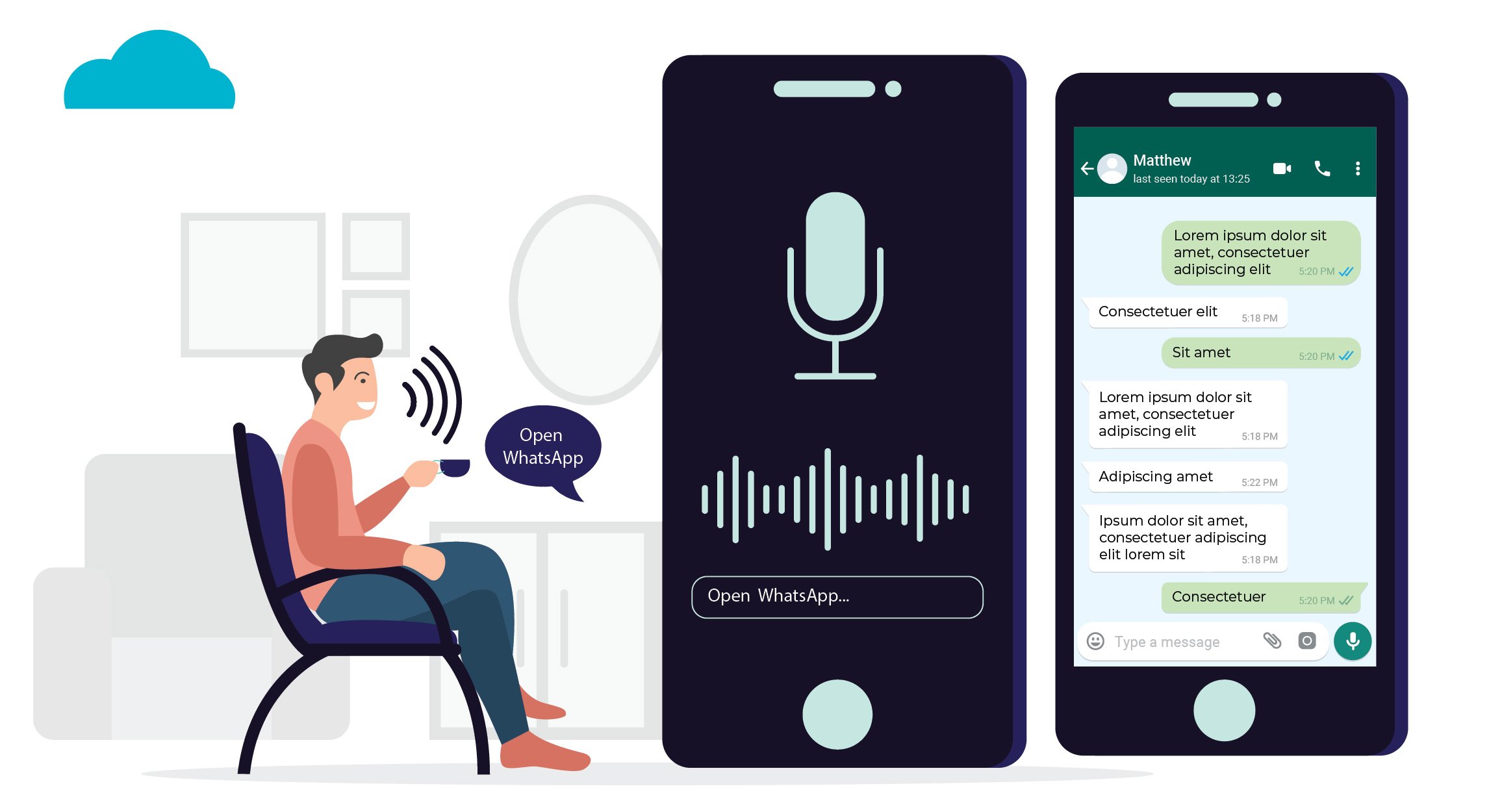
Hope that you have got an idea about the working of the Voice User Interface. With that, let’s look at some current Voice User Interface use cases (VUI).
Voice User Interface (VUI) Use Cases
The Voice-based interface technology isn’t new to the world, and it has already been in use over the years. Thus, there would be voice UI use cases, which you should know to get an idea about what to build next for your project.
Voice Search & Virtual Assistants
Voice search is one of the use cases in today’s world. It enables users to search for anything over the internet through voice commands. You might be using Siri, Alexa, or Google Assistant, which operates on your voice commands and delivers personalized experiences like playing your favorite Netflix series or turning on AC.
Do you know over 150 million smart speakers were installed worldwide in 2022?
In addition to that, by the end of 2023, 8 billion voice assistants are expected to be in use all over the globe.
Smart-Home Integrations
Another great VUI use case is smart-home integrations that also contribute to the revolution of smart homes and interactions. You can control your light, AC, thermostat, security, and all possible connected devices via voice command through the intelligent home. It enables hands-free and eyes-free convenience for home automation, ensuring ease and swiftness in daily tasks.
The fact is, 77% of smart speaker owners control smart devices in their homes using voice commands.
Automotive Voice Control
Controlling the car through voice commands is one of the greatest inventions and use cases of all time. Since drivers are already occupied with several tasks, interacting with various functions and features of a vehicle using voice commands is a great relief. With Automotive Voice Control, drivers can control audio systems, make phone calls, navigate directions, adjust climate settings, and perform other tasks without taking their hands off the steering wheel or eyes off the road.
Example: BMW has developed a virtual assistant called “BMW Intelligent Personal Assistant”, that allows drivers to interact with different vehicle features using voice commands, thereby enabling hands-free control over the car functions.
Voice Commerce & Payments
E-commerce is one of the first and leading industries to embrace Voice User Interfaces. Some call it Voice Shopping or Voice-Activated Commerce, wherein a customer can make purchases and complete transactions using voice commands through voice-enabled devices or virtual assistants. Users can use voice commands to browse products, add items to their shopping cart, review product details, and place orders.
For example, Amazon’s voice-activated assistant, Alexa, enables Voice Commerce and Payments through its integration with Amazon’s e-commerce platform.
Customer Support & Virtual Agents
These days, many companies prefer chatbots powered by artificial intelligence (AI) to provide customer support and assistance. These virtual assistants are designed to mimic human-like conversations for interacting with consumers to address their queries. Most of the time, natural language processing and machine learning algorithms are used to develop virtual agents, so they can understand customer queries and respond with relevant and accurate information. These days, many companies prefer chatbot integration to enhance customer experience.
For example, KLM Royal Dutch Airlines uses a chatbot named BlueBot. It interacts with customers through various messaging platforms like Facebook Messenger and WhatsApp.
Voice Interface in Public Spaces
Even public spaces like airports, hotels, and other retail environments have started leveraging Voice User Interfaces for receiving assistance & information. In this case, users are at leverage for asking nearby places, accessing customized recommendations, and ensuring receiving on-time updates.
Now that you know the VUI use cases, let’s understand the impact of Voice UI on web development.
Want to make your application voice-enabled?
Hire web developers to implement Voice User Interface into your web development projects and unlock the potential of voice technology for your business.
How Voice UI Impacts Web Development?
The Voice User Interface impacts web development, enhancing user experience to convenience and boosting efficiency to build an intuitive application.
Let’s first know how this hands-free and eyes-free voice command technology improves user experience.
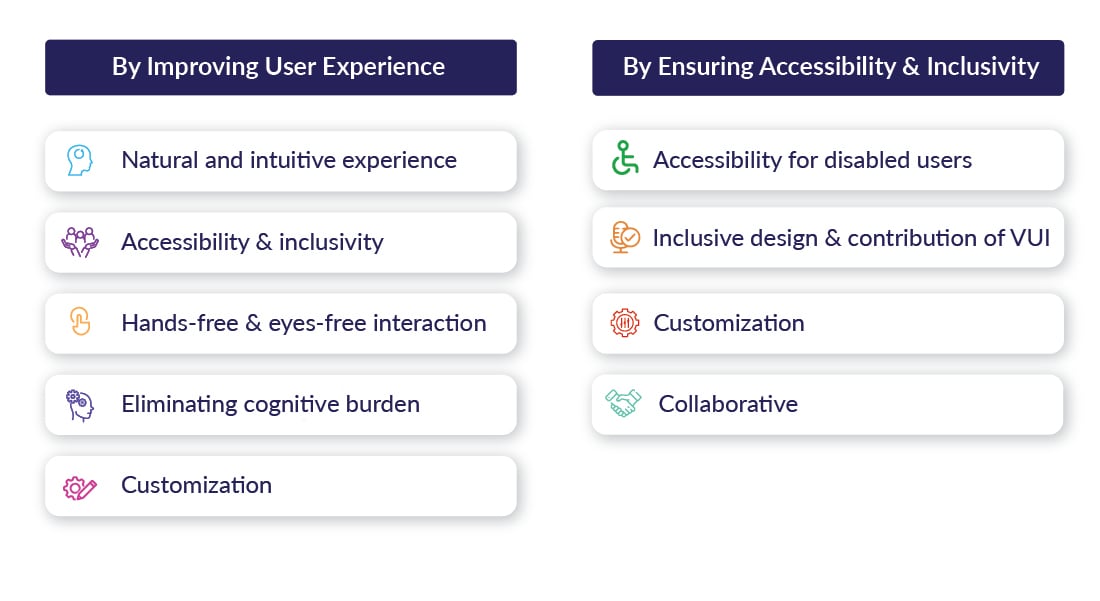
By Improving User Experience
The prime objective of voice UI is to enhance user experience, and when combined with web development, the results are outstanding. Below are the five ways to improve user experience.
🟠 Natural and Intuitive Experience
Voice interaction is one of the natural ways of interacting. Since speaking is the natural form, voice UI leverages this to make the interaction with digital platforms seamless. You just have to speak, and technology gets familiar with the patterns. This user interface form eliminates the challenges of graphical user interfaces and other complex methods.
🟠 Accessibility & Inclusivity
Unlike graphical user interface (GUI), using voice commands overcomes the challenges that disallow disabled users to interact with the systems. The voice-based interaction mode is excellent for disabled users since they can leverage the technology and make their lives easier; many disabled audiences can leverage this voice UI technology. Navigation through web content is also possible seamlessly for physically disabled users.
🟠 Hands-Free & Eyes-Free Interaction
As said, no physical touch or attention is required with the voice-based user interface. Voice UI in web development has turned out to be receiving popularity because of its convenience. Unlike a graphical user interface requiring physical intervention, this one is great even for the most complex tasks. VUI is one of the swiftest methods for interaction with digital platforms.
🟠 Eliminating Cognitive Burden
Voice User Interfaces in web development are far better than graphical interfaces. In this UI, users must speak and not navigate through the tabs. This saves a lot of time that might have been wasted physically navigating. It automates and streamlines users’ journeys and enhances experiences.
🟠 Customization
Using VUI, you can expect customized web experiences using voice commands and user choices. It can even deliver personalized content, responses, and suggestions from the VUI. Personalization ensures user experience enhancement using customized interactions. This way, users will feel more comfortable and engaged.
Now that you know how the technology improves user experience, let us know how accessible and inclusive is the Voice User Interface.
By Ensuring Accessibility & Inclusivity
This is section wherein we will discuss about a visually or physically disabled users will be able to interact with digital platforms. Understand how your voice-enabled web app will uplift disabled users’ experience.
1. Accessibility for Disabled Users
Even if your target audience is disabled by any way from the following possibilities, they still can access Voice User Interface to interact with digital platforms, smart homes, or electronic devices.
🟠 Motor Disabilities
What was once inaccessible for users suffering from motor disabilities or dexterity is now a thing of the past. The advancement of technology has made space for users suffering from paralysis, tremors, and arthritis, allowing them to utilize digital platforms for the best of their use. The technology has made the interaction more accessible and swifter; a voice command and tasks are independently executed.
🟠 Visual Impairments
Not only users with motor disabilities, but this technology is even an excellent boon for visually impaired users. Because of seamless interaction with digital platforms through voice commands, now even blind people can make their way into this world.
🟠 Cognitive Disabilities
Another benefit voice UI brings to the table is the betterment of cognitively disabled users. Such a group of users can access online platforms swiftly using voice commands. This way, the tasks for cognitively disabled users, become easier. The clear and precise voice prompts ensure that it helps the particular group of users understands & interact with the systems.
🟠 Language Barriers
What’s impressive about the Voice User Interface is its multilingual feasibility.
Systems interpret and present the information to the user in their language. Therefore, you don’t need to learn a particular language; just command it in your native language, and the system will interpret it.
2. Inclusive Design & Contribution of VUI
Designing of the Voice User Interface is also equally essential for your web application since a confusing design will be complicated to navigate.
🟠 Inclusiveness of Design
The voice UI’s major focus is on design principles; since it has to be such that every group of individuals can leverage the technology. Developers ensure building and delivering the voice-mode interactive platform is super intuitive so that it can convey information in a precise & understandable to all the users. It does not matter whether you are using .NET, GO, Java, PHP or any other language for creating web applications; you can build Voice User Interface even if you are using React JS, WooCommerce, or Node JS for web development.
🟠 Easy Learning Curve
There is always a high chance of abandoning complex services, programs, or even technology if the learning curve is steeper. Unlike traditional technologies, the Voice User Interface in web development is quite easy to learn and adapt.
🟠 Customization
VUI even offers a personalization feature through which users can improve the experience. The system understands user preferences and offers results that can delight users.
🟠 Collaborative
VUI integrates with assistive technologies like screen readers and input devices. This way, it enhances user experience and ensures users hooks to your digital platform.
So, this was all about how voice UI in web development improves functionality. Now let’s discuss whether you should consider Voice User Interface in web development.
Is it a Feasible Option to Invest in Voice UI?
Investing in the Voice User Interface in web development is feasible because it primarily offers several benefits and a competitive edge over others. After all, you can leverage a massive group audience’s support through this web application.
Voice UI in Web Development Benefits
As you know that Voice UI is a worthy investment, you must know what benefits you can reap by investing in this new-age technology.
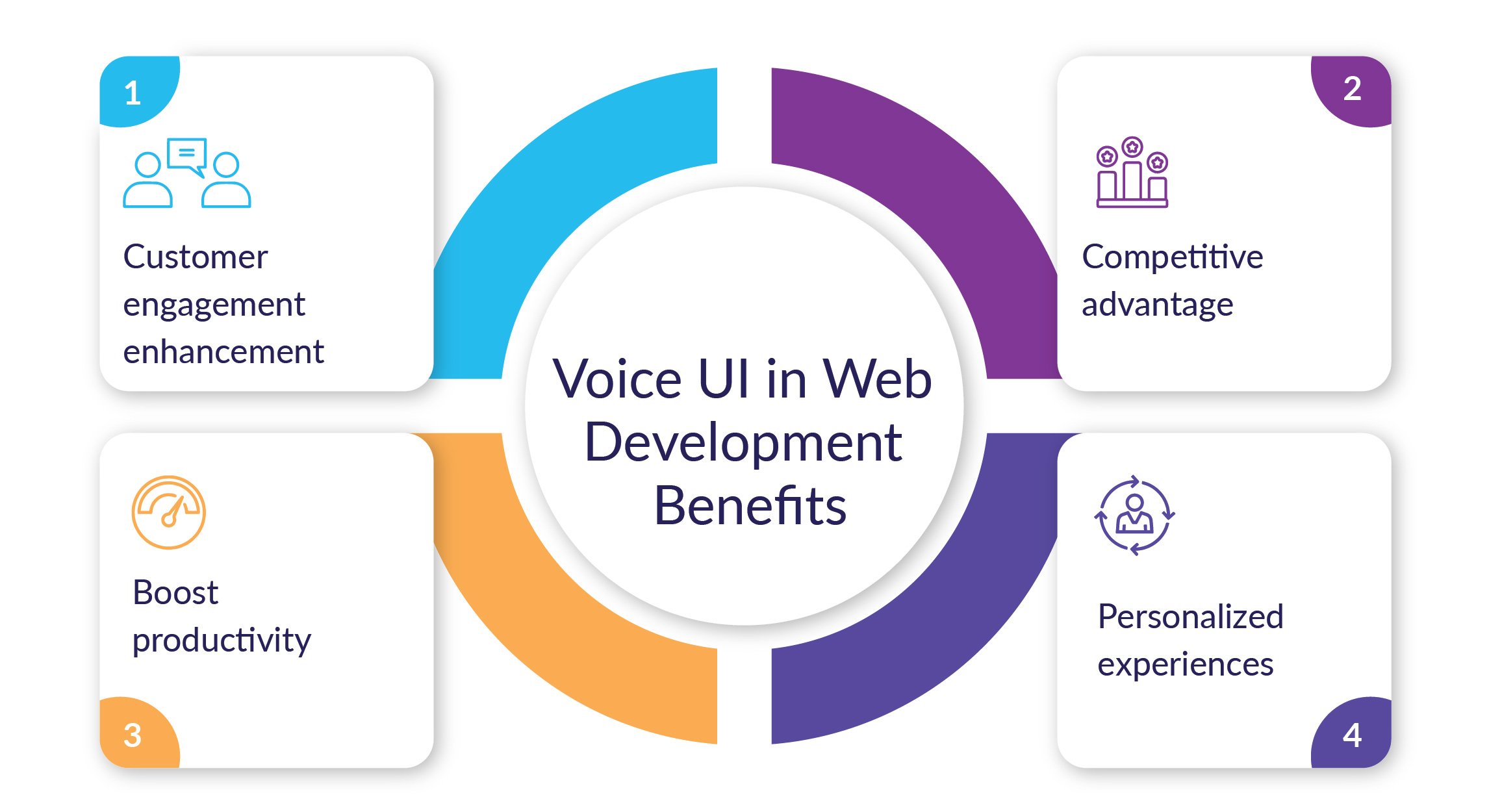
🟠 Customer Engagement Enhancement
An engaging and interactive user experience will always increase the number of users, and that’s what the Voice User Interface is all about. Delivering top-class experience is the prime focus of voice UI to boost customer participation and shoot up engagement rates.
🟠 Competitive Advantage
Since the market is flooded with competition, it’s the best time to introduce something unique that makes your brand stand out. The Voice User Interface in web development is one of the technology trends that help you stay ahead of the competition.
🟠 Boost Productivity
Unlike manual input technology, a voice-based interface increases efficiency and productivity because of less manual work. Having such seamless and feasible technology ensures the quick execution of tasks.
🟠 Personalized Experiences
You can expect a personalized experience with the Voice User Interface, as the tech understands the user preferences and delivers results accordingly. It makes connections with digital platform users better and stronger.
Now that you know the benefits of Voice User Interface (UI), let’s check the technical considerations.
Voice User Interface Technical Considerations
These are some technical considerations related to Voice User Interface, which needs to be kept in mind before jumping into the development.
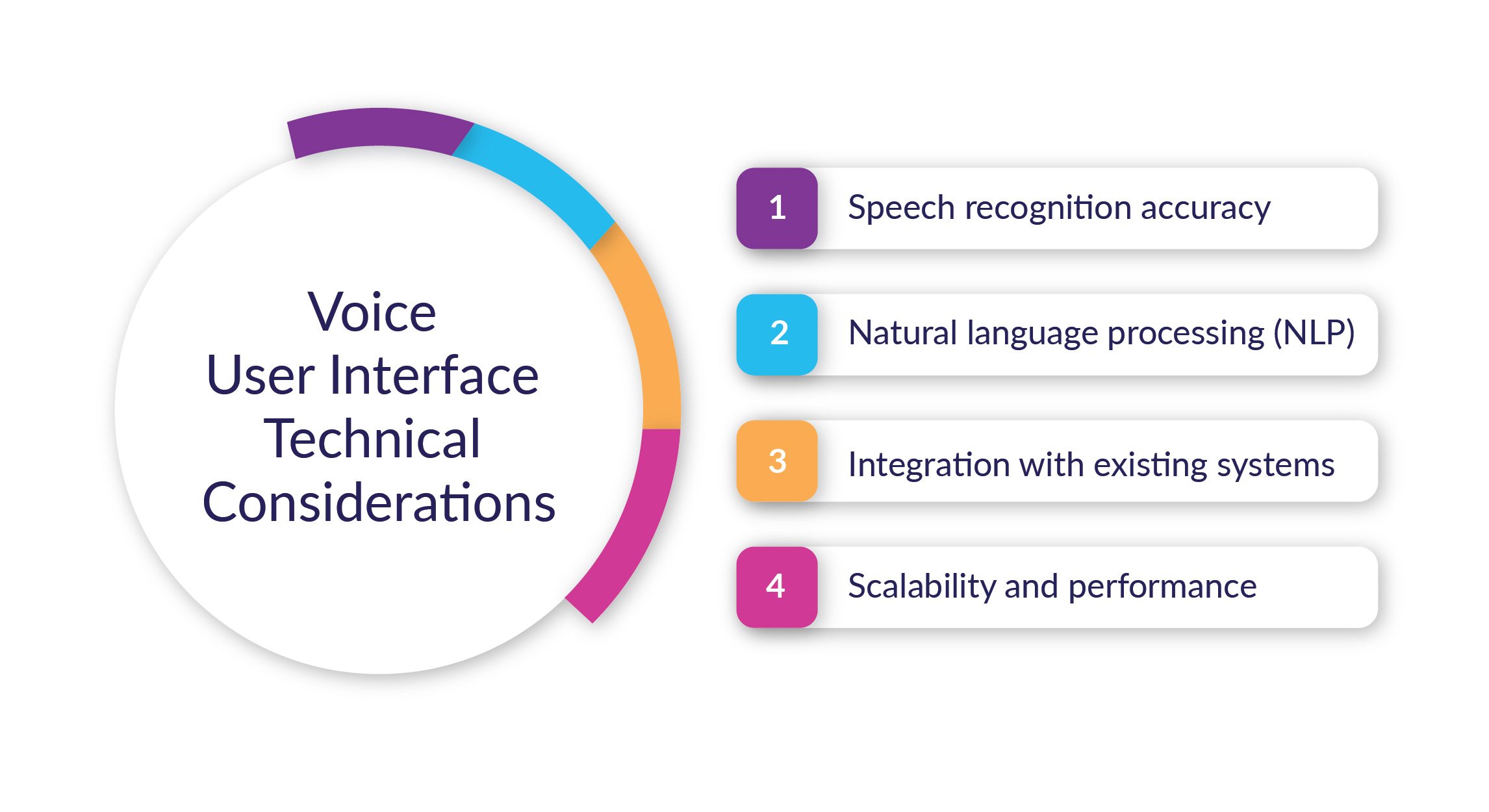
🟠 Speech Recognition Accuracy
For making a successful voice-based user interface, you need an accurate speech recognition system to catch up with the voice commands and deliver the expected results.
🟠 Natural Language Processing (NLP)
You must ensure that a robust NLP technique is implemented in your system to understand your user’s commands accurately and processes them. The interpretation and responsiveness should be accurate.
🟠 Integration With Existing Systems
If you have an existing system, you must ensure that your system is compatible with the integration of VUI. Ensure the existing system is compatible with the VUI and then seamlessly integrate each other.
🟠 Scalability and Performance
Lastly, the performance should not be compromised even during multiple requests for voice commands. Also, you must ensure that your voice-based UI is scalable whenever required.
Besides what challenges Voice UI can overcome and what technical considerations you should expect, you must also consider user research and design focus.
Voice UI User Research & Design Focus
These are a few best practices to follow for increasing your user base and ensuring what you plan to build executes similarly.
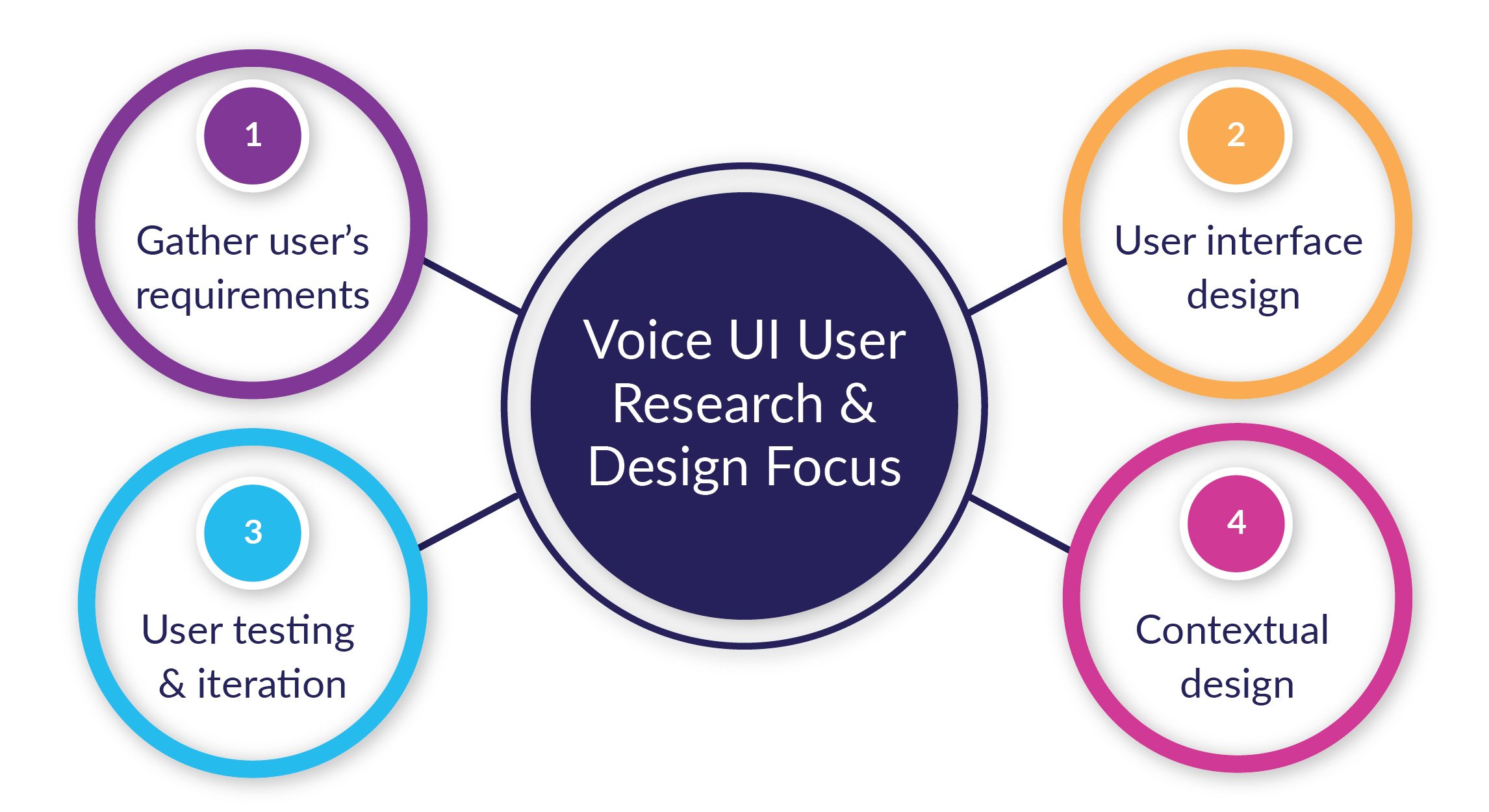
🟠 Gather User’s Requirements
Make sure to gather what users are seeking so that you can build accordingly. You will even stand by their expectations, resulting in higher conversion rates. Try overcoming their challenges like a web development company can solve the Voice UI development challenge for you.
🟠 User Testing & Iteration
Do not forget to test the voice command-based UI since it helps gather feedback. Also, act immediately on user feedback to make them feel special and ensure a continuous enhancement of your product. Ensure you iterate according to the user’s feedback and deliver quickly.
🟠 User Interface Design
When developing a user interface for voice-based web development, consider voice prompts, system responses, and the conversation flow. You must build a UI that makes navigating and interacting easier for users.
🟠 Contextual Design
Lastly, you must understand how your user will interact with the voice-based interface. Several factors constitute environmental noise, distractions, and use cases for better user experience.
So you must ensure this before developing a Voice User Interface in web development. Doing so will allow you to build a voice UI web app compatible with the current trend. But what about the future of voice UI? Is it worth investing in considering the future aspects? Let’s find out.
The Future of Voice User Interface in Web Development
According to a recent report, the worldwide Voice User Interface industry is expected to reach $45.9 billion by 2027. In addition to that, the global Voice User Interface market size is expected to reach $45.94 billion by 2027, rising at a market growth of 23.4% CAGR during the forecast period.
Voice user interface being a prominent and transformative change holds an immense potential in the future of web development. With evolving technology and changing user expectations, VUI is supposed to play a pivotal role in reshaping the way we interact with digital platforms. The speed with which speech recognition, natural language processing, and machine learning is evolving and adopted, VUI is becoming increasingly sophisticated and capable to understand our voice commands.
The future of Voice User Interface in web development is promising and focused on delivering more seamless user experience thereby allowing users to access information, navigate websites, and perform tasks using voice commands. Remember, the transformation from GUI to VUI is motivated due to our desire for convenience, accessibility, and hands-free interaction. Yet the future of VUI in web development is bright, and its potential to revolutionize the way we interact with digital platforms is boundless.
Conclusion
If you want to secure the future of your web applications and digital properties, investing now in building a Voice User Interface is worth the investment. And, to ensure a bespoke journey towards VUI integration and development, you need to partner with a software development a company like Bacancy that offers versatile web development services to realize and transform your ideas into reality. So, what are you waiting for? Get in touch with us now.
Frequently Asked Questions (FAQs)
Voice User Interface (VUI) is a speech recognition technology that allows you to interact with digital platforms, electronic devices, and automobiles in quite a modern way than before. Your voice enables commands and executes tasks that you want. For example, asking Siri to turn on your TV and run your favorite show.
Here are some challenges of Voice User Interface:
- Speech recognition inaccuracies
- Multilingual accent interpretation problem
- Complexity in adapting user preferences
Siri, Alexa, and Google Assistant are well-known Voice User Interface examples you must know about and then decide.
Voice UI brings several advantages to the table, which are as follows:
- Boosts user experience
- Hands-free operation
- Wider user base opportunity
- Efficient execution of tasks
Related Blogs



Expand Your Digital Horizons With Us
Start a new project or take an existing one to the next level. Get in touch to start small, scale-up, and go Agile.
Your Success Is Guaranteed !
We accelerate the release of digital product and guaranteed their success
We Use Slack, Jira & GitHub for Accurate Deployment and Effective Communication.