Bacancy Bacancy
  • Our Engagement Models

    We offer flexible engagement models tailored to your project scope and timeline.

    Software Development Outsourcing
    Staff Augmentation
    Dedicated Teams
    Engagement Models

    High-Quality, Affordable IT Outsourcing

    Explore All Services

    AI & ML

    • AI Strategy & Roadmap
    • AI Development
    • Generative AI
    • AI Agent Development
    • Machine Learning
    • Computer Vision
    • LLM Development
    • RAG Development

    Data

    • Data Engineering
    • Data Analytics & BI
    • Data Science
    • Data Warehouse
    • Data Lake
    • Data Governance

    Cloud

    • Cloud Consulting
    • Cloud Migration
    • AWS Services
    • Azure Services
    • GCP Services
    • Kubernetes
    • DevOps

    Product Engineering

    • Full Stack Development
    • Custom Software Development
    • SaaS Development
    • App Modernization
    • Mobile App Development
    • Web Development
    • UI/UX Design

    Platforms

    • Salesforce
    • SAP
    • ServiceNow
    • Microsoft Dynamics
    • Snowflake
    • Databricks
  • Why Bacancy

    14+ years building domain-specific products for regulated and high-growth industries worldwide.

    Global delivery, every time zone

    Global delivery, every time zone

    1050+ vetted engineers

    1050+ vetted engineers

    Onboard in 48 hours

    Onboard in 48 hours

    Explore Our Case Studies

    Industries

    • Healthcare
    • Finance
    • eCommerce
    • Logistics
    • Fintech
    • Real Estate
    • Education
    • Insurance
    How Bacancy Built a Custom Epic EHR Solution to Automate Clinical Workflows

    How Bacancy Built a Custom Epic EHR Solution to Automate Clinical Workflows

    Read case study
  • About.

    1050+ world-class tech experts. One standard: customer satisfaction.

    About Company

    About Company

    • About Us
    • Leadership Team
    • Customer Reviews
    • Infrastructure
    • Our Locations
    • Partnership

    Resources

    • Press Room
    • Blog
    • Insights
    ISO/IEC 27001:2022 Certified

    ISO/IEC 27001:2022 Certified

    Built for enterprise security and compliance.

    Get Quote
  • Technologies
  • Customer Stories
  • Contact Us
Find a Developer
book a 30 min call
  • AI Strategy & Roadmap
  • AI Development
  • Generative AI
  • AI Agent Development
  • Machine Learning
  • Computer Vision
  • LLM Development
  • RAG Development
  • Data Engineering
  • Data Analytics & BI
  • Data Science
  • Data Warehouse
  • Data Lake
  • Data Governance
  • Cloud Consulting
  • Cloud Migration
  • AWS Services
  • Azure Services
  • GCP Services
  • Kubernetes
  • DevOps
  • Full Stack Development
  • Custom Software Development
  • SaaS Development
  • App Modernization
  • Mobile App Development
  • Web Development
  • UI/UX Design
  • Salesforce
  • SAP
  • ServiceNow
  • Microsoft Dynamics
  • Snowflake
  • Databricks
  • Healthcare
  • Finance
  • eCommerce
  • Logistics
  • Fintech
  • Real Estate
  • Education
  • Insurance
  • About Us
  • Leadership Team
  • Customer Reviews
  • Infrastructure
  • Our Locations
  • Partnership
  • Press Room
  • Blog
  • Insights

Technologies

Customer Stories

Contact Us

Find a Developer
book a 30 min call
Started with SwiftUI

Getting Started with SwiftUI: A Comprehensive Guideline to Build A Form UI for iPhone Apps

Mitul Gajjar
Mitul Gajjar Director of Engineering
Last Updated on June 4, 2024 | Written By: Mitul Gajjar

What is SwiftUI?

SwiftUI is a general-purpose, multi-paradigm, compiled programming language developed and managed by Apple to build and design applications for both iOS, macOS, and tvOs.

It is a revolutionary way to build interactive UIs across all Apple platforms, and with the use of SwiftUI, you can define how your app’s UI should perform with declarative language so you can get rid of confusing UIKit code. SwiftUI provides auto support for Dynamic Type, Dark Mode, localization, and accessibility.

SwiftUI to Build Declarative User Interfaces

Why Declarative UIs are Important?

Declarative UI is one type of UI Designing that allows us to design a view in a declarative manner means we can describe what we want to show on our UI View & what kind of actions we want to trigger on user interaction.

We can define states of apps at once using declarative UI. In case if there is any text entered by the user, then we need to show that clear button & when the user has removed text from the text field, then that clear button should hide. So, using declarative UI, we can tell Swift UI to handle such states based on the user’s interaction. We don’t need to handle these states by hardcode like the old imperative way using some If/Else conditions.

What Was the Old Way to Design UI?

Before SwiftUI, there was UIKit; It is also a user interface framework that has many UI elements like UIButton, UILabel, UIimageVIew etc. that we can use it to design a view by drag & drop.

If we are using UIKit, then we need to use XIBs or storyboards to design the interface. In that, we need to drag & drop UI elements inside it & need to give outlets to its particular class. We can also design interface programmatically by creating UI elements’ Objects in their specific category. Suppose, If you want to give a corner radius to the button, then you need to write code for that. It is like giving the command to do so.

Suppose If I have to design a signup form with UIKit, then below are some things that you will be required to take care of:

  • Add UIScrollView or Vertical UIStackView to the view.
  • Add multiple Text Fields, UIlables, UIImageView, UIButton, etc.
  • Give constraints to all the elements on the View.
  • Give Outlets to these elements.

If you want to do some modifications to these elements like giving background or text color, then that will require some code or actions.

Watch out the WWDC19 video introducing SwiftUI with great examples and differences between UIKit and SwiftUI:
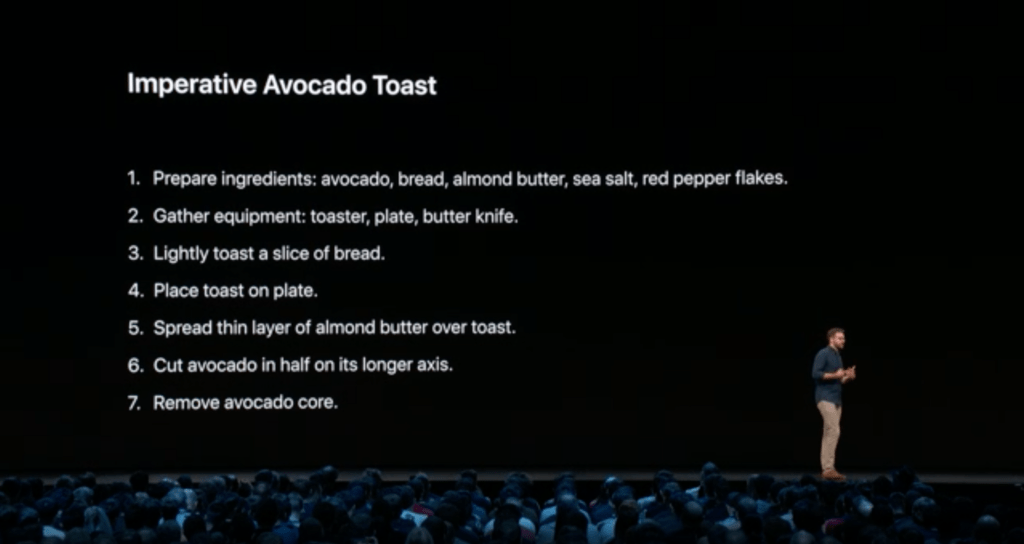
avocado test

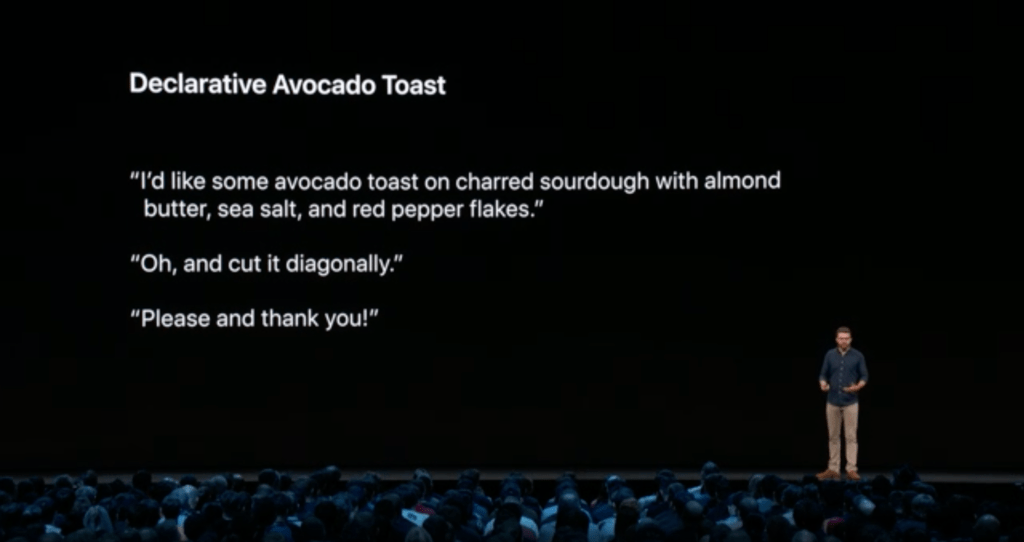
In contrast to this, using SwiftUI, you just need to declare all this interface to swift code, No need to use XIB or Storyboard & it will make sure that this will execute in the way you want.

Here’s what that looks like:

  • Hey SwiftUI, I want to group 3 or 4 Text Fields and a button & image view in a vertical stack on the screen.

SwiftUI will build interface as we want & Put all the elements in List & in a vertical stack.
<img decoding=” width=”1024″ height=”542″ class=”alignnone size-full wp-image-11330″ />

What are the Benefits of SwiftUI?

SwiftUI provides different types of controls, layout structured, view to build the user interface. It is also providing various kinds of gestures, user input controls & provides an excellent mechanism to execute the flow of the app.

You can use SwiftUI elements with UIKit, AppKit & WatchKit to modify the platform-specific features.

SwiftUI has given solutions to the many problems that we are facing with UIKit or swift:

  • If we change in the UI, it will not recompile code again & again. It will increase development speed.
  • Any Source control related issues like while committing user interface code, we are facing version control issue in XML Files, It will not happen with SwiftUI.

SwiftUI: Getting Started

SwiftUI gives us an excellent mechanism to design forms or setting screen; It is a unique way to develop an app which has types UI in which we need to take user inputs.

Let me explain with a demo form sign up using SwiftUI:
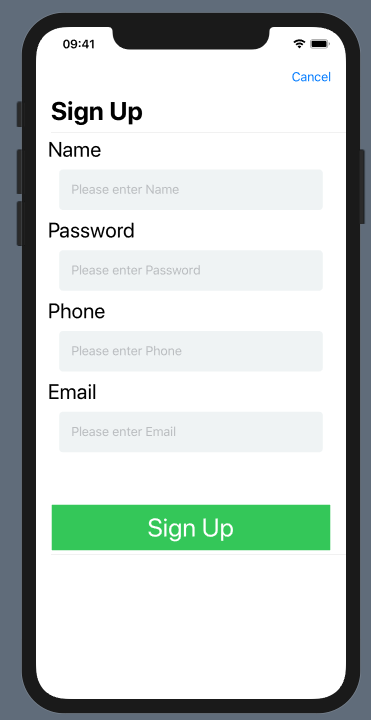
SwiftUI: Getting Started

First of all, We need to create a new project with the following details:
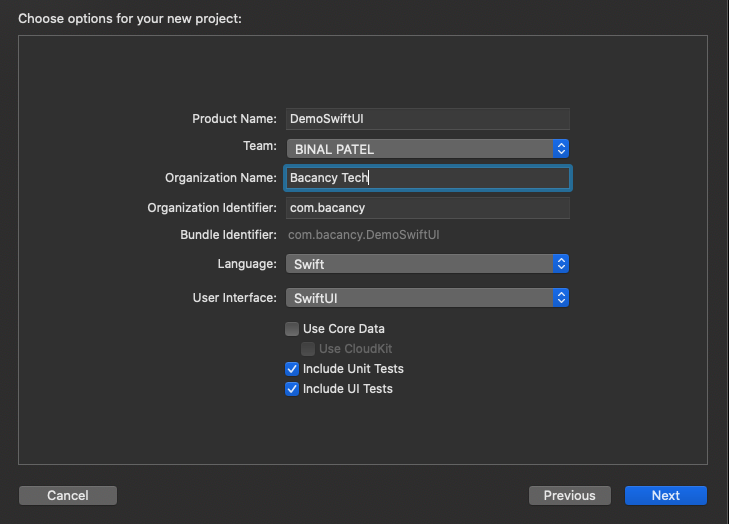
 create a new project

At first, The design canvas will look something like this; you can see the live preview of code on the right side in the simulator:
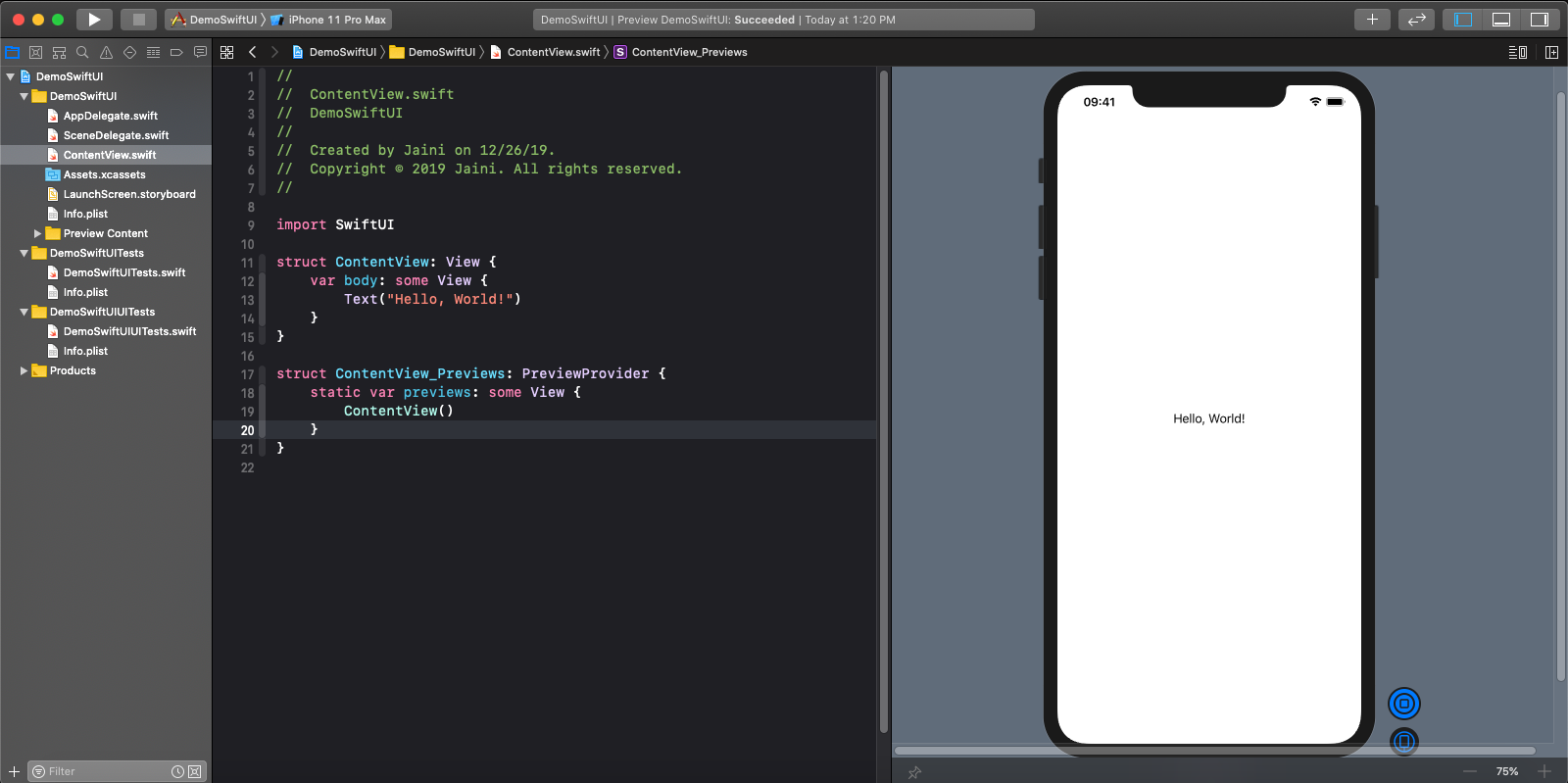
design canvas

You can Play/Pause live preview using the button, that is beside the simulator on the right side:
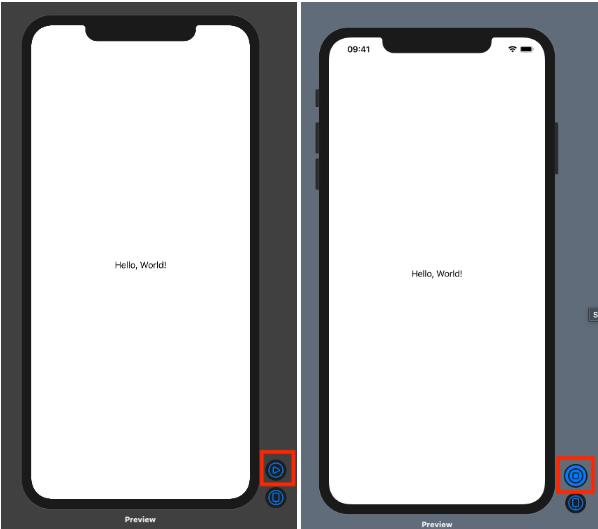
Play/Pause live

Design Some Basic elements:

We will begin the design part with some basic UI controls like label & text fields. If we want to create a label, then I can use “Text” Component & write code like this:
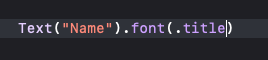
Design Some Basic

Inside Text bracket, I can write the text of label & using “font” I can define fonts of Label.

If we want to create a TextField, then I can use “TextField” Component & write code like this:
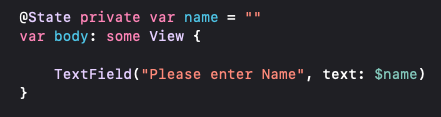
TextField Component

To Place the label above the text field, we need to use “VStack” to put them in a vertical manner:
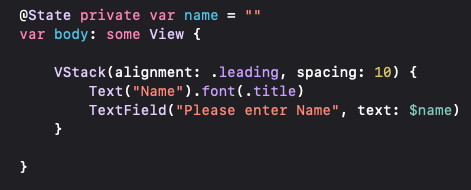
VStack

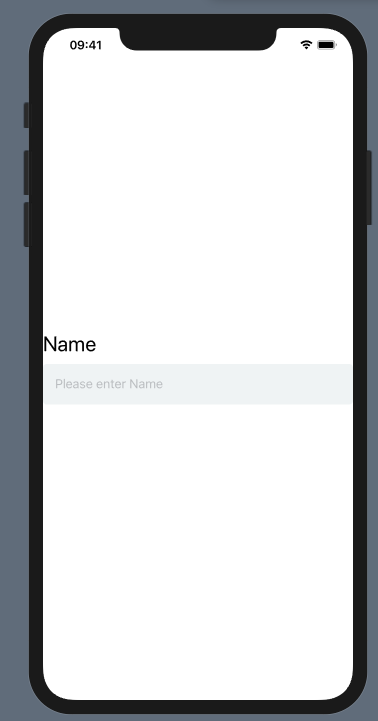
So, the final output will be as follows:
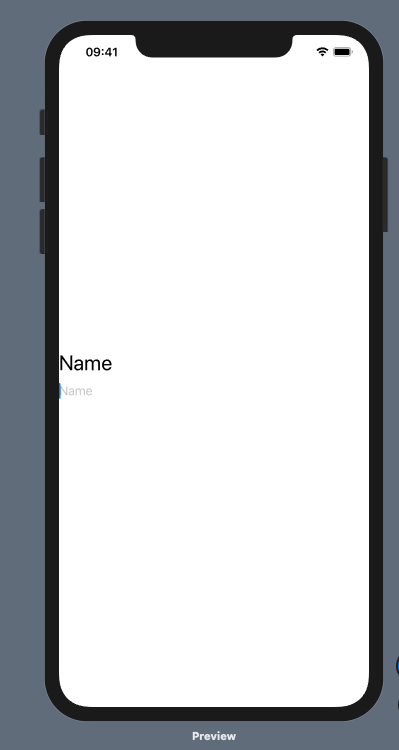
vertical manner

As you can see, there is no padding on the left or right side of the TextField, So we need to make some modifications for it using padding property.
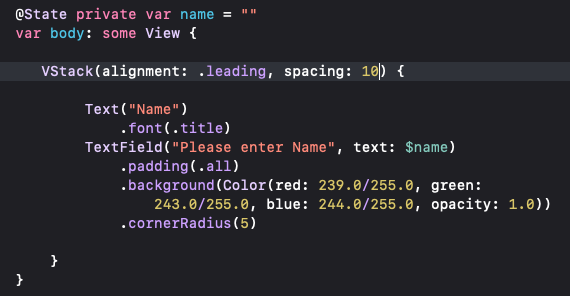
padding property

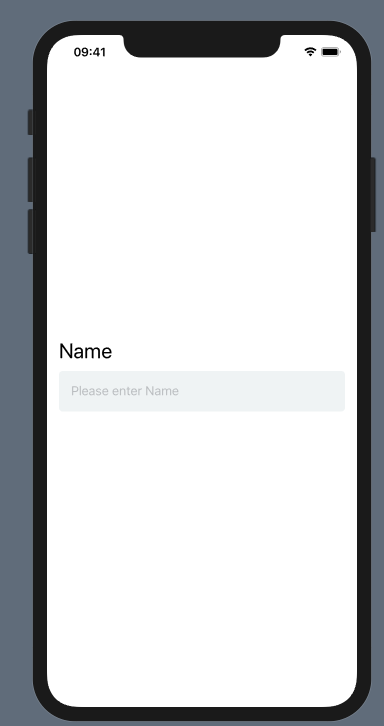
Now, the output will be as follows:

output of TextField

To add the padding around label & textfield both, you will be required to add padding for VStack:
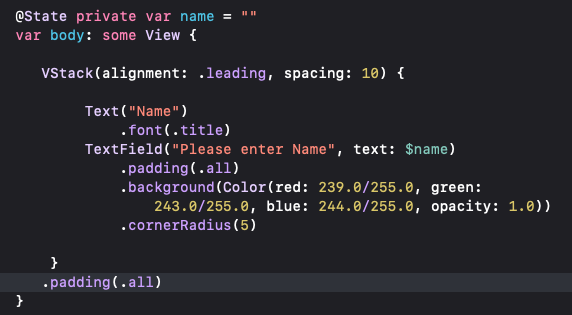
VStack

Now, the output will be as follows:

output

As you can see, all text field shares the same layout, so instead of rewriting code again & again, you can create a separate view to reuse it.

Here, I am creating a struct named TextFieldsLayout & move VStack code inside it.

For reuse purpose, we need to add two variables: label name & placeHolder so that the final code will be:
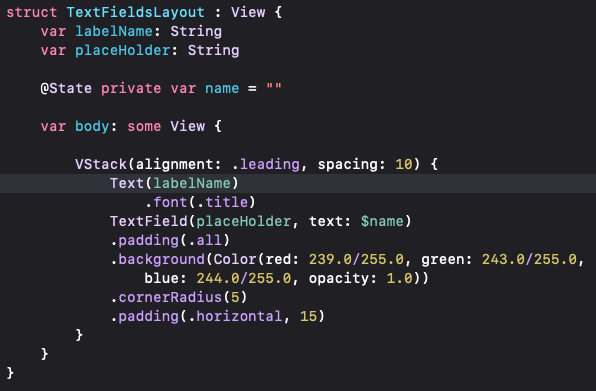
TextFieldsLayout

Now, I am going to add this TextFieldsLayout in ContentView with a specified label name & placeholder.

As we can’t show all the information in a single view, We need to embed this VStack in the List component. So, It will become a scrollable view.
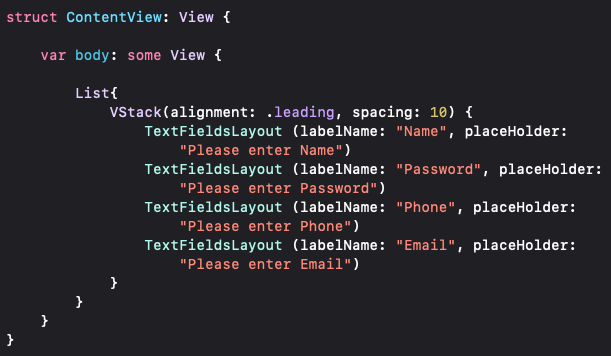
ContentView

So, The final output will be as follows:
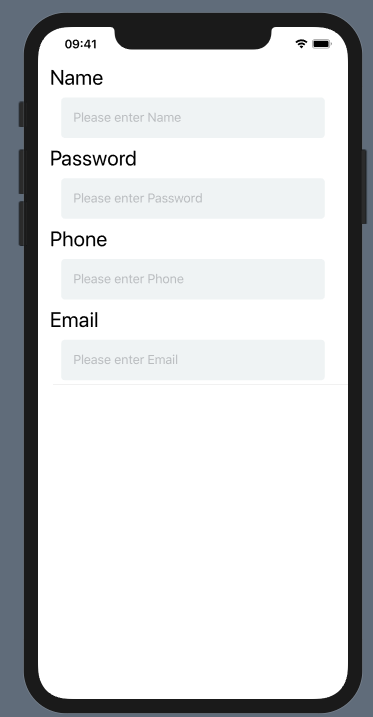
output will be

Now, I want to create a Sign-Up button. We can create it by using the button component. The code inside the action parameter will trigger when the user clicks on it.
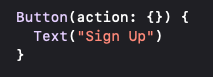
button component.

To better organize the code, we will create a struct named SignUpButton.
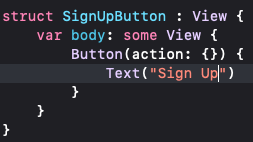
SignUpButton

Now, I am going to do some modification for a button-like setting its font & changing its background color.
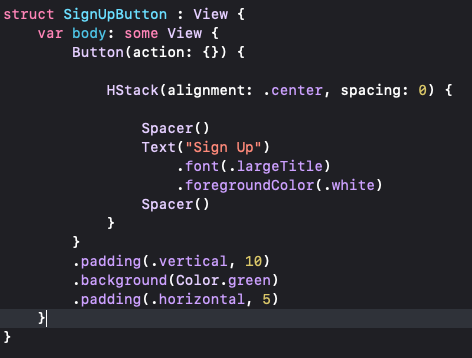
 button-like setting

Let me add SignUpButton struct inside the VStack after the last Textfield in the ContentView.
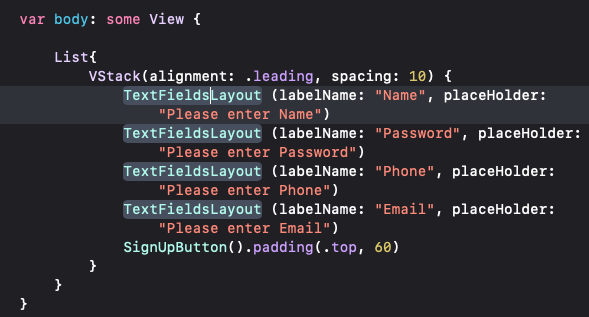
ContentView

So, The final output will be as follows:
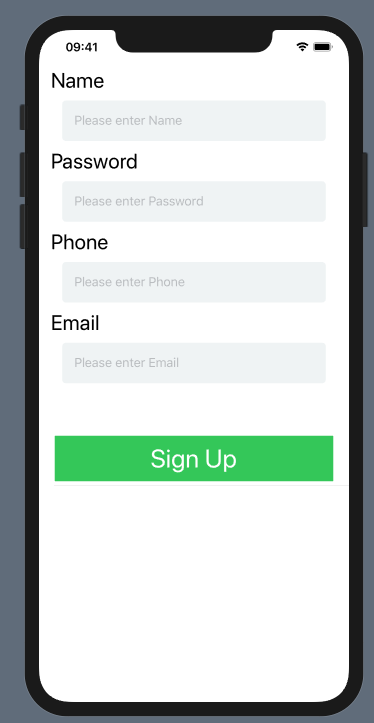
Signout

Here we will be required to add a title to the top of the screen, So now we will embed this ContentView’s code inside the NavigationView component.
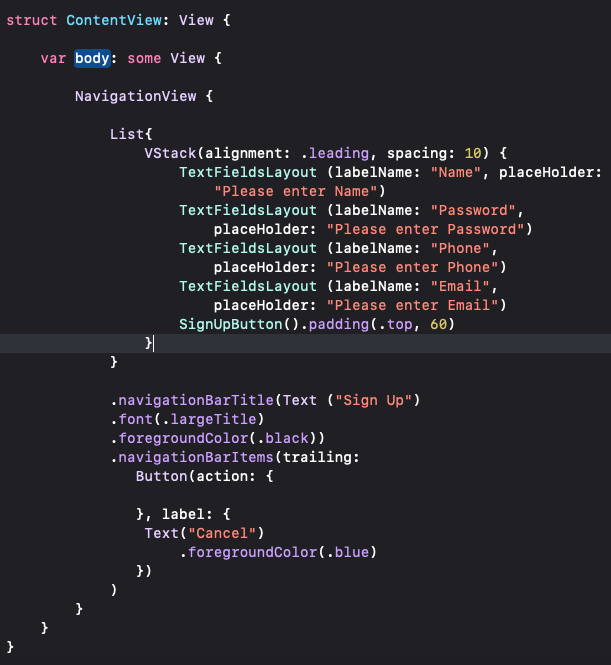
NavigationView

Here, I have added navigationBarTitle to add the Title of the screen & navigation bar items to add bar items. Here, I have added the Cancel button as a bar item on the top right corner of the screen using a trailing parameter.

So, the final Preview of the app will be as follows:
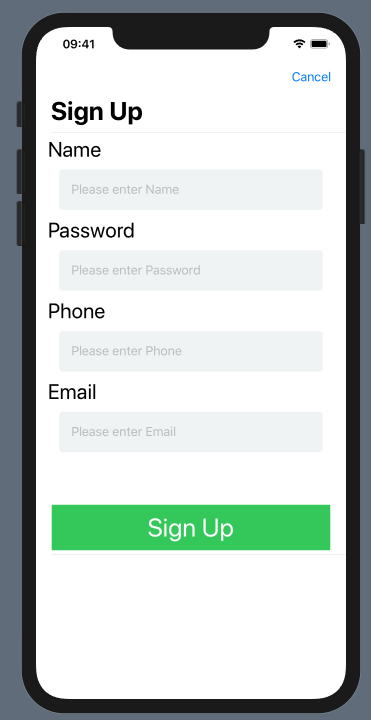
navigationBarTitle


Expand Your Digital Horizons With Us.

Start a new project or take an existing one to the next level. Get in touch to start small, scale-up, and go Agile.

Your Success Is Guaranteed !

Related Articles

Dipal Bhavsar

July 17, 2025

Application Development

Application Modernization Strategy: A Complete Roadmap for Legacy Transformation

By : Dipal Bhavsar

Application modernization strategies help businesses update legacy systems to meet demanding performance, scalability, and integration needs. They include approaches such...

Read More
Dipal Bhavsar

April 10, 2025

Application Development

AI in Mobile App Development: How It Works, Benefits & What’s Next

By : Dipal Bhavsar

This comprehensive guide explores the ins and outs of AI in mobile app development. From chatbots and automation to smart...

Read More
Hardik Patel

December 19, 2024

Application Development

Web App Development Cost: Detailed Factors & Estimates by Bacancy Expert

By : Hardik N Patel

Web app development cost vary for each project due to features, complexity, functionalities, and scope changes. In this blog, we...

Read More

Offices and Development Centers

Bacancy Ahmedabad Ahmedabad

15-16, Times Corporate Park, Thaltej, Ahmedabad, 380059

Bacancy Gandhinagar Gandhinagar

422-A, 4th Floor, Pragya Tower Road 11, Block 15, Zone 1, SEZ-PA Gandhinagar, 382355

Bacancy Hyderabad Hyderabad

Awfis, Level 1, N Heights, Plot No 38, Phase 2, Hitech City Hyderabad, 500081

Bacancy Mumbai Mumbai

18th Floor, Cyberone, opp. CIDCO Exhibition Centre, Sector 30, Vashi, Navi Mumbai, 400703

Bacancy Pune Pune

2nd FloorMarisoft-1, Marigold IT Park, Pune - 411014

Bacancy Bengaluru Bengaluru

Raheja Towers, 26/27, Mahatma Gandhi Rd, East Wing, Craig Park Layout, Ashok Nagar, Bengaluru, 560001

Global Presence

Bacancy New Jersey New Jersey

33 South Wood Ave, Suite 600, Iselin NJ 08830

Bacancy California California

535 Mission St 14th floor, San Francisco, CA 94105

Bacancy Massachusetts Massachusetts

501 Boylston St, Boston, MA 02116

Bacancy Florida Florida

4995 NW, 72nd Avenue, Suite 307, Miami, FL, 33166

Bacancy London London

90 York Wy, London N1 9AG, United Kingdom

Bacancy Ontario Ontario

71 Dawes Road, Brampton, On L6X 5N9, Toronto

Bacancy Australia Australia

351A Hampstead Rd, Northfield SA 5085

Bacancy UAE UAE

One Central 8th and 9th Floor - Trade Centre - Trade Centre 2 - Dubai - United Arab Emirates

Bacancy Sweden Sweden

Junkergatan 4, 126 53 Hagersten

Get in Touch

Great Place to Work

Get in Touch

cal-icon

Looking for expert advice?

Schedule a Expert Call


  • Brochure
  • Quality Assurance
  • Resources
  • Tutorials
  • Customer Reviews
  • Privacy Policy
  • FAQs
  • Press Room
  • Contact Us
  • Sitemap
  • Employee

bacancy google review 4.6
bacancy google review
bacancy clutch review 4.8
bacancy clutch review
bacancy glassdoor review 4.5
bacancy glassdoor review
bacancy goodfirms review 4.8
bacancy goodfirms review
iso
  • Bacancy Behance
  • Bacancy Pinterest

Copyright © 2026 BACANCY SERVICES PRIVATE LIMITED All rights reserved.