Trusted By

Matt tailbot
freyr
Onemedall
zoetis
pharmaplace
Callondoc

Hospital Readmission Challenges We Solve with AI Prediction Systems

Risk models that misfire, clinicians who distrust scores, and EHRs that hold the wrong data are not technology failures; they are design failures. Here is what we resolve before your patient readmission prediction system goes live in any clinical environment.

Generic Models Miss Right Patients

Generic Models Miss Right Patients

Generic systems trained on national datasets misfire for local populations. Bacancy trains condition-specific models on your hospital’s own patient history, reducing false positives and directing care resources to the right cases.

Risk Scores Miss Social Factors

Risk Scores Miss Social Factors

A risk score without context gets dismissed at the point of care. Bacancy implements SHAP-based explainable AI outputs that show clinicians clinical factors that drive prediction, enabling confident decisions.

Systems Use Outdated Patient Data

Systems Use Outdated Patient Data

Static systems degrade as patient populations shift over time. Bacancy builds continuous retraining pipelines that update your model on fresh discharge data, keeping risk scores accurate without any manual intervention from your team.

Risk Scores Lack Clinical Trust

Risk Scores Lack Clinical Trust

A risk score without context gets dismissed at the point of care. Bacancy implements SHAP-based explainable AI outputs that show clinicians exactly which clinical factors drove each prediction, enabling confident, action-ready discharge decisions.

One Model Does Not Work For All

One Model Does Not Work For All

One algorithm cannot predict readmission risk for all conditions. Bacancy builds separate models for heart failure, COPD, sepsis, and post-surgical patients, calibrates them per diagnosis, and deploys them as a unified system.

Data Arrives After It Is Too Late

Data Arrives After It Is Too Late

Risk reports generated from discharge data the following week give care teams nothing actionable. Bacancy builds real-time scoring that fires before a patient leaves the unit, surfacing high-risk cases while intervention is still possible.

What We Build Into Your AI Patient Readmission Prediction System

Every component below is built to specification. Our AI engineers scope each module to your EHR environment, patient population, and compliance requirements, because precise AI patient readmission prediction starts with the right architecture, not a ready-made template.

Real-Time Discharge Risk Intelligence

Real-Time Discharge Risk Intelligence

Our system calculates 30-day readmission risk while the patient is still admitted, surfacing it at the time of discharge so care teams can intervene early and effectively when it truly impacts patient outcomes.

Hospital-Specific Condition-Fit Models

Hospital-Specific Condition-Fit Models

We train models on your hospital’s own data and calibrate per condition, including heart failure, COPD, sepsis, and post-surgical, reducing false positives and improving accuracy.

Explainable AI Designed for Clinical Adoption

Explainable AI Designed for Clinical Adoption

Each risk score includes a SHAP-based explanation covering the clinical and social factors behind predictions, helping clinicians make confident and action-ready discharge decisions every time.

Zero-Disruption EHR Integration

Zero-Disruption EHR Integration

We integrate seamlessly with Epic, Cerner, and other EHRs using FHIR R4 and HL7, embedding actionable scores and clear explanations directly into existing clinical workflows without additional tools.

Risk-Based Care and Discharge Automation

Risk-Based Care and Discharge Automation

High-risk patients trigger automated care coordination, checklists, and follow-ups, while moderate-risk patients follow structured engagement paths to ensure resources match actual patient risk.

Built-In Compliance and Continuous Learning

Built-In Compliance and Continuous Learning

Our system has retraining pipelines, drift detection, and performance monitoring, with HIPAA compliant infrastructure and CMS HRRP reporting, keeping models accurate and clinical outcomes over time.

Social Determinants of Health Integration

Social Determinants of Health Integration

Our engineers incorporate SDOH data, including housing, transportation, and social support, into every risk model, improving prediction accuracy across diverse and underserved patient populations.

Post-Discharge Patient Follow-Up

Post-Discharge Patient Follow-Up

We build automated post-discharge engagement workflows that track patient recovery, flag deterioration signals early, and trigger timely outreach before readmission risk escalates into avoidable events.

AI Patient Readmission Prediction Projects We Have Delivered

From integrating a risk layer inside an existing Epic network to building a full clinical AI platform from scratch, each engagement below reflects real deployments, real integrations, and measurable improvements in 30-day readmission rates.

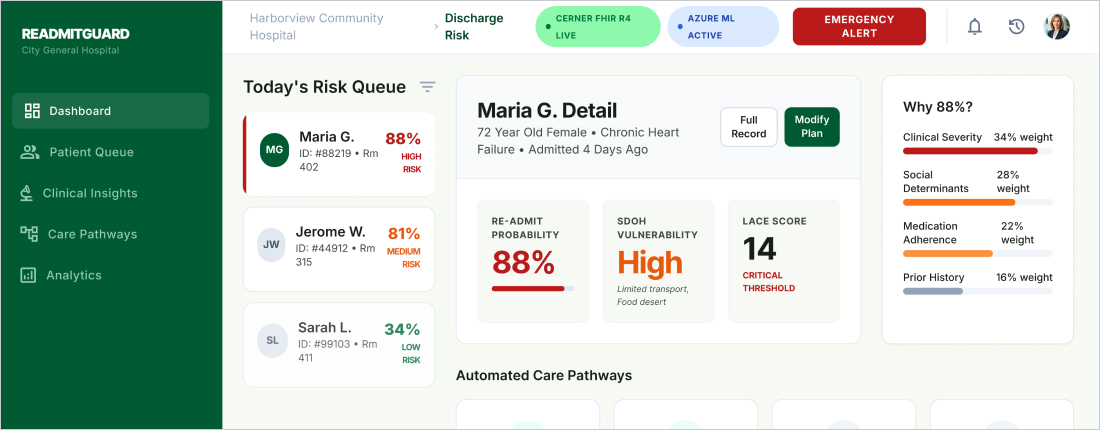
Readmission Prediction Deployed Inside a Community Hospital Cerner EHR

Industry: Community Health | Cerner Environment

Tech Stack: Python (LightGBM), Cerner FHIR R4, Azure ML, SDOH Data Pipeline

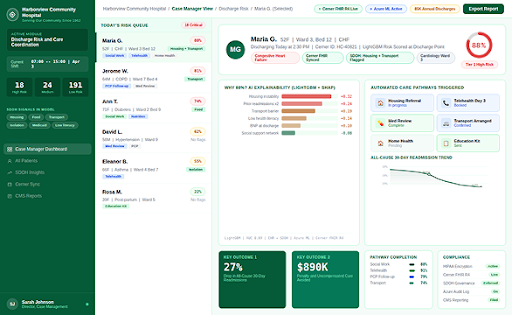
A community hospital with 85,000 annual discharges relied on manual risk assessments during discharge rounds. Case managers reviewed 40+ patients per shift without a structured framework, missing high-risk cases. Bacancy deployed a LightGBM model within Cerner, combining EHR and SDOH data, surfacing discharge-point risk scores with SHAP explanations directly in existing workflows, requiring no external tools for care teams.

27% Drop in All-Cause 30-Day Readmission Rate
$890K in Avoided Penalty and Uncompensated Care Cost

GET QUOTE FOR YOUR PROJECT
Readmission Prediction Deployed Inside a Community Hospital Cerner EHR

AI Readmission Risk Layer Integrated Into a 12-Hospital Epic Network

Industry: Acute Care | Health System

Tech Stack: Python (XGBoost) | Epic FHIR API | AWS SageMaker | Snowflake

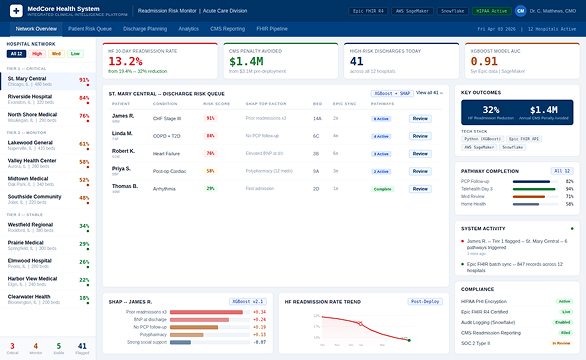
A mid-size health system operating 12 hospitals had a 19.4% 30-day readmission rate, driving $3.1M in CMS penalties. Despite five years of Epic discharge data, no predictive layer existed. Bacancy integrated a gradient-boosted readmission risk model via FHIR, surfacing real-time risk scores with SHAP explanations. Within six months, heart failure and COPD readmissions dropped across all facilities.

32% Reduction in 30-Day Heart Failure Readmissions
$1.4M Annual CMS Penalty Avoided After Deployment

GET QUOTE FOR YOUR PROJECT
AI Readmission Risk Layer Integrated Into a 12-Hospital Epic Network

Full-Stack Readmission AI Platform Built for a Digital Health Company

Industry: Digital Health | Value-Based Care

Tech Stack: React, FastAPI, Python Ensemble Model, PostgreSQL, AWS

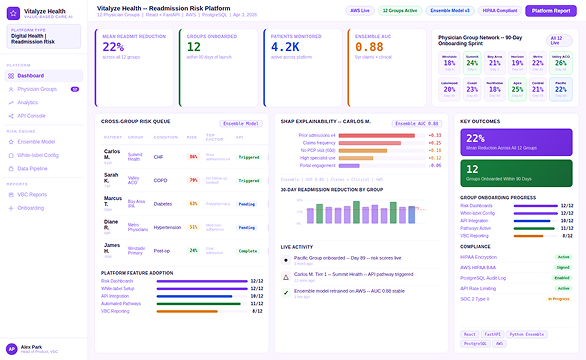
A digital health company building value-based care tools lacked EHR and data infrastructure. They needed a complete readmission risk platform from scratch. Bacancy built the data pipeline, trained an ensemble model on five years of claims and clinical data, and delivered a white-label platform with dashboards, automation, and APIs. Three groups launched initially, with twelve onboarded within 90 days.

22% Mean Reduction in 30-Day Readmission Rate Across Groups
12 Physician Groups Onboarded Within 90 Days of Launch

GET QUOTE FOR YOUR PROJECT
Full-Stack Readmission AI Platform Built for a Digital Health Company

Choose Your Path to Deployment

We meet you where your hospital systems are today. Whether you want AI layered into Epic Systems tomorrow or a fully custom platform built from the ground up, we have a path.

Integrate Into Your Existing System

Already on Epic, Cerner, or another major EHR? We plug our readmission prediction AI directly into your workflows using HL7 FHIR APIs. Clinicians see risk scores in the same screens they already use. No new system to learn.

  • Connects to Epic, Cerner, and Oracle Health
  • Deploys in 6–12 weeks
  • No workflow disruption
  • Fine-tuned for your patient population
  • HIPAA & SOC 2 compliant

Build a Bespoke AI Platform

Need a standalone readmission intelligence platform with custom dashboards, multi-facility rollups, or population health analytics? We design and build the full product, from data pipeline to clinical UI.

  • Full-stack custom development
  • Custom clinical dashboards
  • Multi-site & health system scale
  • Population-level analytics
  • Ongoing model monitoring

Why Choose Bacancy For Patient Readmission Prediction?

Hospital readmission reduction is not a data problem in isolation. Building an effective AI patient readmission prediction system requires clean data, the right model design, EHR-native integration, and clinical workflows that actually get used. Here is how Bacancy delivers on each of those dimensions.

90+

Hospital Deployments

Deployed across hospitals, health systems, and digital health platforms with actionable patient risk insights.

HIPAA

Certified Governance Built In

PHI encryption, role-based access, audit logging, & automated de-identification are built into every system.

FHIR & HL7

Integration Pipelines

Engineers with hands-on Epic, Cerner, Athena, and Allscripts integration experience for seamless deployment.

4x

Faster Model Development

ML-ready feature pipelines cut model training time from several months down to just a few weeks.

Real-Time

Discharge-Point Risk Scores

Risk scores are generated at patient discharge, enabling care teams to intervene before readmission.

90D

Hypercare Post Go-Live

90 days of monitoring, performance optimization, and clinical support included at no extra cost.

What Clinical and Informatics Leaders Are Saying

Laura Stevens

Laura Stevens

Director of Patient Engagement

“Within time frame of six months of integrating the readmission model into our Epic environment, our heart failure 30-day readmission rate dropped by almost a third. The SHAP explanations were the difference. Clinicians actually trusted the scores and acted on them at the bedside.”

John D.

John D.

Director of IT

“Bacancy successfully integrated the model inside our Cerner instance in under six weeks. From the very first week, our care coordinators had a risk-stratified patient list they could actually act on immediately. The SDOH layer was something we had tried to build internally for two years.”

Emily Johnson

Emily Johnson

Healthcare Administrator

“We came to Bacancy with no data infrastructure and a clear clinical problem. They built the full readmission risk pipeline from scratch, including data ingestion, ML model, and clinical dashboard. It launched on schedule and performed above our accuracy benchmark.”

Frequently Asked Questions

Still have questions?Let's talk

Can you integrate AI readmission prediction into our existing Epic or Cerner system?

Yes. The system connects to your EHR via FHIR R4 or HL7, and risk scores surface inside your existing clinical interface.

How long does it take to build and deploy a custom readmission prediction system?

Most hospitals go live in 8–12 weeks from discovery. A full build-from-scratch readmission prediction system takes 16–24 weeks, depending on data infrastructure, feature scope, and the number of condition-specific models required.

What data do you need to get started?

We typically require historical discharge records, diagnosis codes, encounter data, and readmission outcomes. If available, we also use clinical notes and SDOH data. We validate data availability during the discovery phase before development begins.

How accurate are your readmission prediction models?

Accuracy depends on data quality and condition type, but our models consistently outperform traditional scoring methods. Because we train on local patient data and calibrate per condition, hospitals see better precision and more actionable risk stratification.

Does the model include social determinants of health data?

Every system Bacancy delivers includes an SDOH ingestion layer that pulls housing, transportation, income, and social support data from structured and unstructured sources, normalized alongside clinical variables at prediction time. SDOH coverage is built into the model by default, not bolted on after deployment.

How does Bacancy ensure the model stays accurate over time after deployment?

Bacancy sets up systems that keep your model updated over time. It automatically re-trains with new data and monitors performance, alerting your team if accuracy drops. You also get 90 days of post-launch support at no extra cost, and we plan retraining schedules early so everything runs smoothly without constant manual effort from your team.

Is the output HIPAA compliant and ready for CMS HRRP reporting?

Yes, everything is built to meet HIPAA standards. Patient data is encrypted, access is controlled, and all activity is logged for security. The system also automatically generates CMS HRRP reports for each cycle, and keeps proper documentation ready, so your team is always prepared for audits without any additional operational burden.

What level of involvement is required from our clinical team?

Your clinical team is involved during discovery and validation to align workflows and review outputs. After deployment, the system runs within existing processes, requiring minimal ongoing effort from staff.