Last Updated on August 26, 2025
Last Updated on August 26, 2025
Quick Summary
Node.js is revolutionizing healthcare app development with its real-time capabilities, high scalability, and event-driven architecture. It is ideal for building fast, secure, and compatible solutions like telehealth platforms, EHR systems, and IoT-based patient monitoring. In this blog, we will cover everything you should know about Node.js for healthcare.
Table of Contents
With the rise of real-time care and remote health services, healthcare providers need fast, scalable backend systems. According to MarketResearchView, the smart healthcare market will reach $385.28 billion by 2030, growing at a 12.51% CAGR from 2025.
Node.js has become a top choice in health tech for its ability to handle concurrent data, reduce latency, and streamline APIs. From video consultations to syncing EHRs and powering wearable tech, it delivers speed, uptime, and reliability, which are core needs in healthcare.
This blog explores why Node.js for healthcare is powering next-gen medical apps. But first, let’s look at the importance of backend systems in healthcare.
Every robust healthcare application is backed by a strong backend that supports security, speed, and seamless delivery. Here’s what a modern healthcare backend must-have:
Your backend must protect patient data and meet global standards like the Health Insurance Portability and Accountability Act (HIPAA), the General Data Protection Regulation (GDPR), and the Health Information Technology for Economic and Clinical Health Act (HITECH). Think encrypted storage, secure access, and audit-ready logs recorded into your system.
Connecting to Electronic Health Record (EHR) or Electronic Medical Record (EMR) systems is mandatory for healthcare apps. With HL7 and FHIR protocols, your app can sync real-time patient records, labs, and prescriptions, which reduces errors and manual work.
In telehealth for healthcare, real-time data processing is critical for use cases like live video consultations and urgent alerts from wearable health monitors. Your backend should support low-latency, reliable data flow for high-priority events, especially when immediate clinical decisions depend on it.
Your backend must process data instantly from video consults to wearable health monitors. It also includes low latency, high throughput, and real-time reliability.
Healthcare apps must run 24/7. A resilient backend offers automatic failover, strong security layers, and flexible scaling to handle spikes, so care is never interrupted.
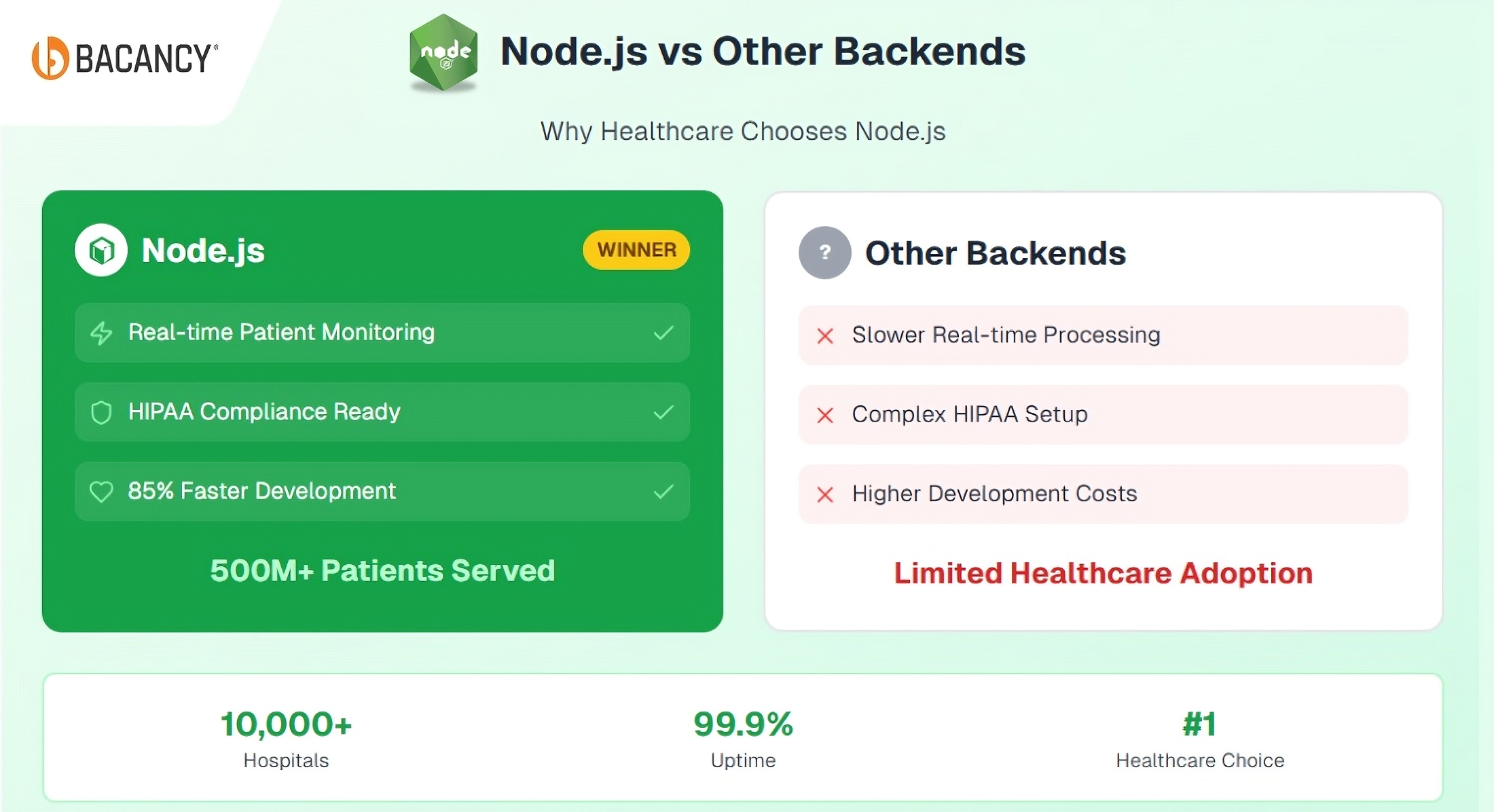
Node.js brings speed, flexibility, and scalability to healthcare software development. Its event-driven architecture and developer-friendly ecosystem make it a strong choice for building modern, real-time healthcare solutions. Here’s why it stands out:
Node.js uses a non-blocking, event-driven model that handles multiple requests simultaneously. This makes it ideal for high-performance healthcare apps that need to process large volumes of data quickly and efficiently.
Real-time interactions are critical in healthcare, including video consultations, live chat, and status updates. Node.js supports WebSocket-based communication that enables seamless and responsive telehealth features.
Node.js comes with access to NPM packages, one of the world’s largest package ecosystems. This speeds up development with reusable modules for authentication, encryption, analytics, and more, cutting time to market.
Scalable and maintainable systems are easier to build with Node.js. Its modular structure supports microservices architecture out of the box and allows your healthcare app to grow with demand while remaining easy to update and secure.
Yes, Node.js can be highly secure for healthcare applications if built with the right security practices. Healthcare systems handle sensitive patient data, so securing your Node.js backend with industry-standard protections is essential.
Follow these key practices to secure your Node.js for healthcare apps:
Use Transport Layer Security/ Secure Socket Layer (TLS/SSL) for secure data transmission and encrypt all stored health records to protect against unauthorized access.
Implement token-based authentication methods, such as OAuth2 and JSON Web Tokens (JWT), to verify users securely and maintain session integrity.
To reduce the risk of internal breaches, ensure users can only access data and actions relevant to their roles, like doctors, admins, patients, and medical administration.
Audit logs track user actions and system events. They support HIPAA or HITECH compliance and help detect suspicious behavior.
Prevent injection attacks and abuse by validating input, escaping output, and limiting the number of API requests per user or Internet Protocol (IP).
Hire Nodejs developer to ensure your healthcare application remains secure while following necessary compliance and guidelines.
Now that we have ensured its security standards, let’s explore where Node.js truly shines in real-world healthcare use cases.
Node.js is a powerful fit for healthcare applications that demand speed, scalability, and real-time functionality. Here are some ideal use cases where Node.js in healthcare delivers maximum value:
Node.js enables real-time communication using WebSockets, which makes it perfect for virtual consultations, live chat with care teams, and instant notifications.
With support for continuous data streams, Node.js can efficiently handle input from remote devices, such as tracking vitals, sending alerts, and updating dashboards in real time.
Node.js works seamlessly with APIs and data from fitness trackers and medical wearables, helping aggregate and process large volumes of sensor data quickly.
Build responsive, interactive interfaces for patients to book appointments, view medical histories, and communicate with providers, backed by a fast, scalable Node.js backend.
When a US-based telehealth startup reached out to us, they had a clear mission: Make virtual healthcare feel as seamless as walking into a clinic.
But their existing platform was slowing them down. Built on a traditional PHP backend, their system struggled with real-time communication, froze under traffic spikes, and couldn’t keep up with growing patient demand. Video calls lagged, appointments crashed, and doctors and patients were frustrated.
They needed a fast, secure, and built-to-scale solution. That’s when we decided to choose Node.js for healthcare applications.
➜ What We Did Differently
Rather than patching up their old system, we helped them rebuild the core, clean and modern from the inside out. Using Node.js, we designed a backend that’s fast, event-driven, and ready for anything.
➜ Here’s how we executed their vision:
All built using a modular, microservices-based architecture, so Node.js for healthcare apps could scale features without downtime or disruption.
➜ The Impact We Delivered
Get in touch with expert-led healthcare mobile app development services provider who can build you secure, HIPAA-compliant, and scalable solutions tailored to your needs.
As the healthcare industry evolves, digital platforms must adapt to meet new demands, like AI-driven diagnostics, IoT-based monitoring, and global user accessibility.
Node.js is uniquely positioned to support these innovations, offering the flexibility and performance that modern Node.js for healthcare solutions need.
Node.js makes it simple to integrate AI and machine learning models into healthcare apps using a microservices architecture. Whether it is predictive analytics for patient outcomes or natural language processing for medical queries, Node.js can manage these models through APIs.
It ensures real-time insights while keeping the core backend lightweight and efficient.
With the rise of wearable devices and remote monitoring tools, healthcare apps need to process data at the edge. Node.js is lightweight and fast, ideal for edge computing scenarios, where latency matters.
It supports local data collection and syncs efficiently with cloud systems, enabling real-time patient updates and proactive care delivery.
Many healthcare organizations are turning to serverless computing to handle spikes in traffic and reduce operational overhead. Node.js serverless works seamlessly with platforms like AWS Lambda and Azure Functions, which allows your developers to deploy secure, event-driven code without managing infrastructure.
It ensures cost efficiency, scalability, and faster time to market, especially for startups and global health platforms.
With Node.js in healthcare, you can embrace innovation without breaking the bank.
If you’re building a healthcare solution that demands real-time performance, secure data handling, and scalable infrastructure, Node.js is not just a good fit; it’s a future-ready choice.
Its non-blocking architecture, microservices compatibility, and seamless integration with modern technologies like AI, IoT, and serverless computing make it ideal for telehealth platforms, patient portals, EHR systems, and beyond.
Choosing the right technology is only half the equation, partnering with the right Node js development company can make all the difference. At Bacancy, we specialize in Node.js development for healthcare, delivering HIPAA-compliant, performance-driven solutions that scale with your users and your vision.
Node.js offers real-time capabilities, high scalability, and efficient performance, making it ideal for healthcare apps like telehealth platforms, EHR systems, and IoT-enabled monitoring tools. It also supports HIPAA-compliant development practices through encryption, secure APIs, and role-based access control.
Yes. Node.js is HIPAA-compliant and supports the security best practices needed for compliance. Developers can implement token-based authentication (OAuth2, JWT), end-to-end encryption, and role-based access control to secure patient data and ensure regulatory alignment.
Yes, Node.js supports horizontal scaling using microservices and containerized infrastructure like Docker and Kubernetes. Healthtech companies use it to support thousands of concurrent users without compromising performance or uptime.
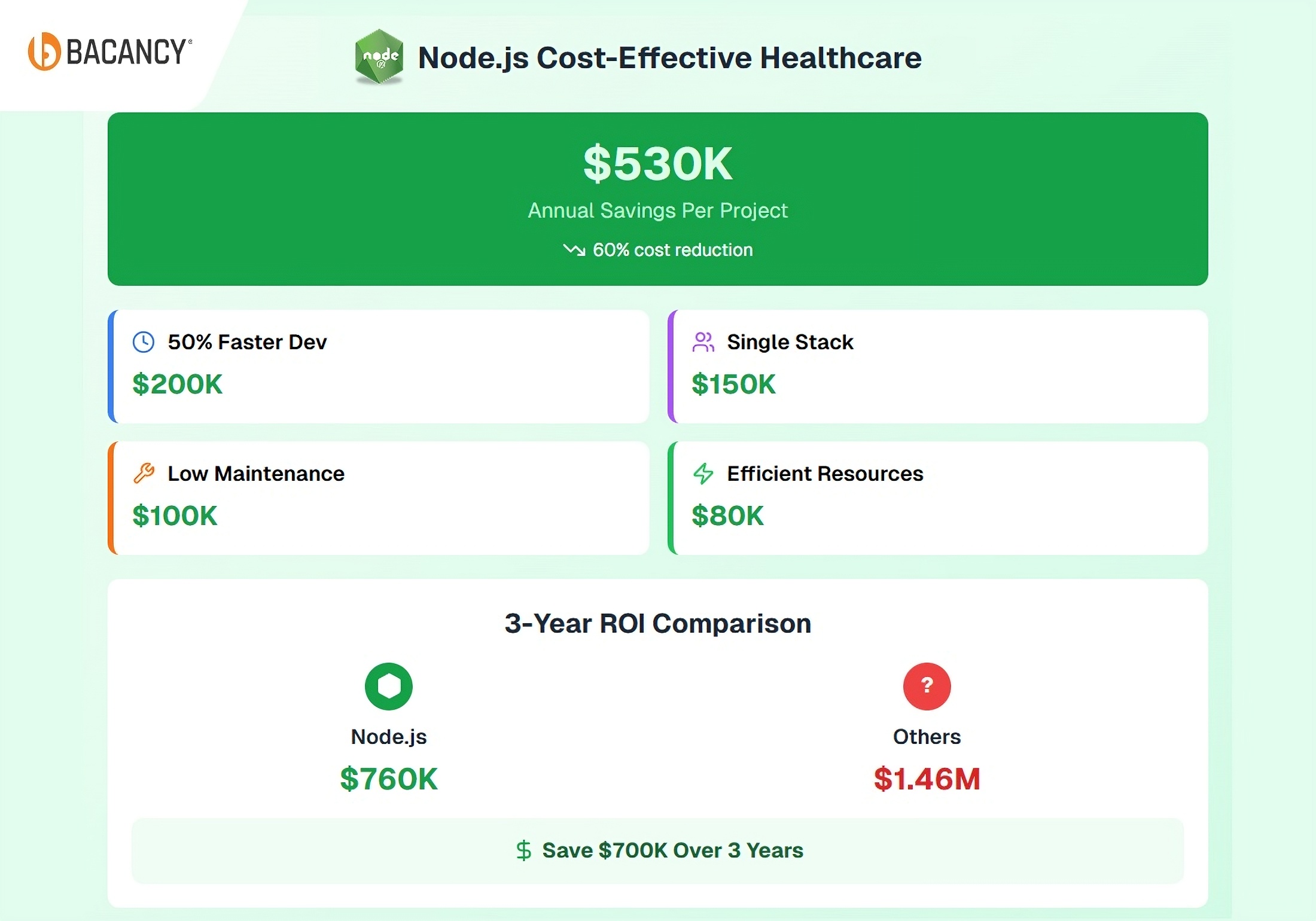
Definitely, Node.js enables faster development cycles, code reusability, and a unified JavaScript tech stack, reducing overall development and maintenance costs. Its compatibility with serverless architecture also helps control cloud costs.
It’s essential to work with a team that understands both Node.js and healthcare compliance requirements. A specialized Node.js development company like Bacancy brings experience in building HIPAA-compliant apps, real-time systems, and scalable architectures tailored to healthcare needs.
Building a Node.js healthcare app typically takes 3 to 6 months, depending on the app’s complexity, integrations, and compliance needs. Timelines may extend for features like EHR sync, HIPAA compliance, and real-time capabilities.

Tech Geek at Bacancy
Story-driven writer blending research, passion, and full-stack web clarity.
MORE POSTS BY THE AUTHOR
Your Success Is Guaranteed !
We accelerate the release of digital product and guaranteed their success
We Use Slack, Jira & GitHub for Accurate Deployment and Effective Communication.