Quick Summary
Building a streaming platform with Node.js requires the right architecture. This blog covers everything from Node js streaming architecture and 5 decisions that determine your build cost and timeline to build, hidden expenses that most teams discover too late. It also includes our real-world case study of how Bacancy built a streaming platform with Node. js in 4-6 months.
Table of Contents
Introduction
Modern users have zero patience. They hit play and expect it to work – no buffers, no delays, no second chances.
Those expectations have built a video streaming platform to $811.37 billion in 2025 and are expected to reach by $3,394.56 billion by 2034, as per a report by Fortune Business Insight. The opportunity is high, so is the pressure.
For a CTO, the hard questions arrive before the first line of code. Is Node.js the right backbone for this platform? Where does build end and buy begin? What will be the infrastructure cost at 10,000 users vs 10 million users? Get those answers wrong early, and no amount of optimization fixes it later.
This blog answers those questions. We will walk you through our experience of building a streaming platform with Node.js, what mistakes we encountered, the decisions we made, and how our solutions and approach can help you make the right call for your platform.
Is Node.js the Right Backend Decision for a Streaming Platform?
Node.js is a suitable choice for your video streaming platform because it can handle the high-concurrency and real-time demands better than any other traditional backends.
Where Node.js Gets It Right at Streaming Scale
Node.js can process thousands of concurrent connections on a single thread through its event-driven, non-blocking I/O model. Instead of a new thread per viewer request, the approach is to cause traditional servers to buckle under traffic spikes and handle each request asynchronously.
When a request waits on a database response or CDN interaction, the first event loop moves to the next one. No idle thread or memory overhead per session.
For a streaming platform, that matters at the application layer: concurrent viewer session management, WebSocket connection coordination for real-time features, CDN cache interaction, and API request execution from thousands of simultaneous clients.
Where Does Node.js Create Technical Debt in a Streaming Stack?
Node.js is single-threaded. CPU-bound work blocks the event loop. Video transcoding, adaptive bitrate package creation, and media file conversion are all CPU-bound operations. Your team can route FFmpeg processes directly through the Node.js application layer without proper isolation, and degrade performance across every concurrent operation.
It results in increased latency, dropped WebSocket connections, and API timeouts, all under the same load the event loop handled before media execution entered the picture.
When Should You Reconsider Node.js Before Commitment?
1. Video codec development or proprietary encoding is a core product differentiator rather than a pipeline component. If the media pipeline itself is what your platform sells, the CPU demands of that work may justify Go or Rust as the primary backend, with Node.js in a support role.
2. Sub-second latency is a hard requirement from the beginning. The WebRTC and WHIP/WHEP protocol stack that latency demands shift the architecture materially. Node.js remains viable at the application layer, but it’s no longer the primary decision.
3. Your team has deep expertise in another backend with strong async I/O support. Stack familiarity beats stack ideology.
Want to handle thousands of concurrent video sessions without API slowdowns?
Connect with us to hire Node.js developers today and design a backend that supports real-time streaming at scale.
Node.js Streaming Platform Architecture: What You Are Building
Most CTOs approve a streaming platform scope without a clear component map.
What your team owns: Application layer, auth and entitlement logic, session management, API orchestration, WebSocket coordination, CDN interaction logic, user data, and subscription management.
Also, your full-stack development approach across frontend and backend determines how much of this layer your team can own without specialist hires.
What you procure: The media pipeline, transcoding, adaptive bitrate package creation, CDN edge delivery, and DRM license management. These are either managed services or dedicated infrastructure. Not Node.js territory.
Based on our experience with Node.js coordinated systems and owned the application layer, such as CDN interaction logic that optimized content delivery by user location and device type. Also, teams that plan to add live later as a feature often commit to a second build without realizing it. And budget it as a separate system from day one or descope it explicitly.
5 Architectural Decisions That Determine Your Node.js Streaming Platform Cost and Time
Every item in this section is something you either decide explicitly or discover at the worst possible moment. Deferral is always the more expensive option.
1. How Do You Design for Concurrent Streaming Load Without Overbuilding Your Node.js Layer?
The question isn’t whether Node.js can handle your concurrent load.’At every application layer it can. But the question is what the architecture looks like when it does and whether you have separated concerns well enough that a load spike on one service doesn’t degrade another.
These 3 failure patterns appear in production, and you need to carefully review it:
1. Auth token validations are in the same services as CDN interaction logic, so a viewer surge creates auth latency for everyone.
2. WebSocket connections for live chat share process resources with API request execution, so a live event causes API degradation across the platform.
3. A monolithic Node.js application with no service boundaries means any CPU-bound operations that jump into the event loop take the entire app layer down with it
You can draw service boundaries before the work starts. Identify which operations are I/O-bound (Node.js handles these natively) and which are CPU-bound; these need best practices or external services. The CDN interaction services, the WebSocket gateway, and the auth services benefit most from isolation at mid-market scale.
2. What Latency Target Is Achievable, and What Stack Changes Does It Require?
Latency targets are not a performance preference. Each tier demands different infrastructure, different CDN configuration, and a different cost structure. A CTO who sets a latency requirement without the corresponding stack conversation will find scope changes in sprint three.
Three tiers, each with real infrastructure consequences:
- Standard HLS- 6-30 seconds: It has the lowest infrastructure cost. Works with most managed media services. Correct for VOD, on-demand content, and live events where real-time interaction isn’t the primary feature.
- Low-latency HLS- 2-5 seconds: Requires CMAF chunk-based delivery, specific CDN configuration, and a server optimized for partial segment requests. Infrastructure cost increases materially. Node.js at the application layer supports this, but CDN and origin complexity go up.
- WebRTC- under 1 second: A fundamentally different architecture. Requires TURN/STUN server infrastructure, WHIP for ingest, and significantly higher compute costs.
Node.js real-time applications use cases, such as live auctions, sports betting integration, and interactive broadcast, have the infrastructure costs at scale run 3 to 5 times higher than a standard HLS stack.
3. How Do You Handle DRM, Geo-Blocking, and Content Protection Without a Rebuild?
Content protection is the decision most frequently deferred until a content licensor demands it. That’s when it gets expensive.
A complete multi-DRM setup covers 3 systems: Widevine (Android, Chrome, Chromecast), FairPlay (all Apple devices), and PlayReady (Windows, Xbox, Edge). You can’t reach a cross-platform audience with fewer than all three.
Node.js manages token issuance, the signed JWT that authorises playback before the DRM license server grants the decryption key. It doesn’t run the license server. That’s the job of services, such as BuyDRM, Irdeto, or AWS Secure Packager and Encoder Key Exchange (SPEKE).
Geo-restriction through your CDN provider is the standard implementation for geographic content controls. The edge case is worth planning for VPN circumvention. If your content agreements require enforcement against VPN traffic, that’s a separate detection layer with its own cost.
Forensic watermarking, the technology that embeds invisible viewer-specific identifiers in video segments, applies when your content library value justifies protection against redistribution.
Managed watermarking services charge around $0.001 to $0.005 per stream hour. At 50,000 monthly active users with 10 stream hours each, that’s $500-$2,500 per month in watermarking cost alone.
4. What Does Skipping Live Streaming at Launch Cost You in Engineering Time?
Live streaming retrofit is the most expensive planning assumption in this domain. Here’s why:
Live and VOD infrastructure share almost nothing beneath the application layer. VOD transcodes content in advance, stores it, and serves it on demand. Live demands a real-time ingest server, a just-in-time packager that creates HLS or DASH segments as the stream arrives, a low-latency CDN configuration, and a real-time signal layer for viewer interaction.
Teams that build VOD-first and then retrofit live typically spend 40-60% of the original build budget on the live layer. The rework isn’t in the Node.js application code. It’s in the media infrastructure, the CDN configuration, and the real-time signal architecture that a VOD-only platform doesn’t need.
The budget-correct decision: Scope live streaming as a separate system cost from the start, even if you plan to build it in phase two. If live isn’t on your first-year roadmap, descope it explicitly so it doesn’t appear as a small addition in your phase two estimate. It won’t be.
Standard application monitoring, such as response time, error rate, and throughput, won’t tell you whether your viewers are having a good experience. A streaming platform fails in ways that HTTP metrics don’t capture.
Three QoE (Quality of Experience) metrics that matter at the CTO level:
- Rebuffering ratio: The percentage of total view time spent in a buffered state. The industry benchmark for a premium platform sits below 1%. Above 2%, subscription churn accelerates. This metric exposes CDN edge performance problems that a 200 OK response code completely masks.
- Video start time: Elapsed time between a viewer’s play request and first frame. Under 2 seconds is the standard expectation for on-demand content. High start times typically point to auth token latency, CDN cold starts, or initial manifest load problems.
- Exits before video start (EBVS): Viewers who abandon before the first frame. An EBVS rate above 5% on a specific title almost always points to a specific infrastructure problem, not a content quality issue. It’s the sharpest signal in the QoE stack.
Plan your observability setup before launch. Tools like Mux Data and Datadog’s Media product are purpose-built for streaming QoE. Standard APM tools, such as New Relic, cover your Node.js application layer. You need both, and they serve different diagnostic functions.
Build vs. Buy vs. Hybrid: Your Node.js Streaming Infrastructure Strategy
| Factors
| Full In-House
| Vendor Extension
| Hybrid (Node.js + Managed)
|
|---|
| Timeline to MVP
| 8-10 months
| 2-4 months
| 4-6 months
|
| Engineering team
| 5+ experts
| 1- 2 specialists
| 2- 3 engineers
|
| Infrastructure control
| Full
| Limited | Application layer only
|
| Project at 10k cost
| High (team overhead dominates)
| Medium (licence fees)
| Low to medium
|
| Project at 100k cost
| Most cost-effective
| Expensive
| Moderate |
| DRM flexibility
| Full custom
| Platform-constrained
| Vendor-dependent
|
| Best fit
| Video is the core product
| Fast launch and limited depth
| Most builds
|
If you need support evaluating which model fits your platform type, Bacancy’s IT consulting practice can run a scoped architecture review before you commit.
What Does a Streaming Platform with Node.js Cost in 2026?
Every cost range reflects the current market, and the infrastructure cost and hidden price vary from the project demands.
Engineering Cost by Region, Team Size, and Build Stage
Team composition at each build stage:
- Lean MVP: 2 Node.js engineers, 1 DevOps/infrastructure engineer, 1 frontend engineer.
- Mid-market: Add one media/video engineer with FFmpeg or managed media service expertise and one QA engineer.
- Enterprise OTT: Add a dedicated SRE, a security engineer for DRM and compliance, and a media infrastructure specialist.
Timeline by stage:
- Lean MVP (hybrid model): 4-6 months
- Mid-market platform: 9-14 months
- Enterprise OTT: 18-30 months
Blended team rate by region (full-time equivalent):
- United States: $150-$200 per hour
- Europe: $90-$130 per hour
- India: $35-$55 per hour
At Bacancy’s rate structure, the build cost sat in the $70,000- $90,000 range, consistent with the lower end of the lean MVP tier below.
Infrastructure Cost Breakdown: Transcoding, CDN, Storage, and DRM
Per-unit costs for each infrastructure component, sourced from vendor pricing pages:
- Transcoding (AWS Elemental MediaConvert): $0.0075 per minute of HD output. A 60-minute 1080p VOD title at four quality renditions costs approximately $0.45 to transcode. A 1,000-title library: $450 in one-time transcoding cost.
- Storage (Amazon S3): $0.023 per GB per month. One hour of 1080p HLS content across four renditions occupies approximately 3-4 GB. A 1,000-hour library at 3.5 GB average: 3,500 GB at $0.023 equals $80.50 per month in storage.
- CDN delivery (Cloudflare Stream): $1 per 1,000 minutes delivered. At 5,000 monthly active users with 120 minutes of average monthly consumption, 600,000 minutes at $0.001 equals $600 per month in delivery cost.
DRM (managed service): approximately $0.001-$0.005 per stream session. At 5,000 MAU with 10 sessions per month each: 50,000 sessions at $0.003 average equals $150 per month.
Working example – 1 hour of 1080p content to 10,000 concurrent viewers: At an average bitrate of 2.5 Gbps across multi-rendition HLS delivery, 10,000 viewers consume approximately 25,000 GB of data per event hour.
At a blended CDN rate of $0.04 per GB, that’s approximately $1,000 in delivery cost for one live event hour. Storage and transcoding are fixed or semi-fixed costs. CDN egress is variable and scales directly with concurrent viewership.
The Hidden Costs That Won't Appear in Your Initial Streaming Platform Budget
Every item below is absent from most initial streaming platform budgets. Each one will show up in your actual year.
What Does Content Moderation Actually Cost on a Live Streaming Platform?
Two cost tracks that scale independently of each other.
- Automated moderation: AWS Rekognition Video charges approximately $0.10 per minute of video content analysed. At 10,000 hours of monthly live content, that’s $60,000 per month in automated moderation alone. This makes per-minute price models prohibitive for high-volume live platforms.
- Human review: User-generated and live content demands human moderation for edge cases that automated tools miss. A full-time content moderator costs $40,000-$80,000 per year in the US market.
What Does 24/7 On-Call Coverage Add to Your Engineering Overhead?
It is the headcount cost that disappears from build estimates and reappears in one year’s operational budget.
- Minimum viable on-call for a live streaming platform: One senior engineer who is available 24/7 with a documented escalation path to your infrastructure vendors. A 3-person on-call rotation at senior engineer rates is the minimum to avoid burnout, costs $300,000 to $450,000 annually in the USA market salaries before the benefits.
- Live events add a separate layer: War-room protocol, pre-event load tests, and a dedicated incident response lead. Budget $5,000-$15,000 per major live event in dedicated operational labour, separate from your standard on-call function.
Four compliance layers appear consistently across most streaming platforms:
1. GDPR: Mandatory for any EU viewer. Annual legal review and data protection documentation: $15,000-$30,000 per year, depending on legal counsel rates and platform complexity.
2. COPPA: Required if any content targets users under 13. Age verification infrastructure and initial legal compliance review: $20,000-$50,000 in setup costs with ongoing legal retainer.
3. DMCA: Requires a documented takedown response process and designated agent registration with the US Copyright Office. Implementation cost is low. Operational cost scales with content volume and the amount of user-generated content on the platform.
4. VOD content licensing: The most variable line item in the entire budget, and the one most frequently underestimated. A licence for a single premium title can range from $5,000 to $500,000, depending on the rights holder, distribution territory, and exclusivity terms.
What Does Subscription Billing and Payment Operations Add Monthly?
Payment processor fees are a fixed cost that scales with revenue and not with infrastructure.
For instance, Stripe charges $0.30 per transaction. At 10,000 subscribers on a $12 per month plan, that’s approximately $3,780 per month in processing fees. This cost never appears in an infrastructure budget or consistent finance teams when the platform reaches subscription scale.
Subscription management tooling, like Recurly, Chargebee, or Stripe Billing, adds $500-$2,000 per month, depending on subscriber volume. Dunning logic for failed payment recovery is a separate workflow that most platforms either build custom or purchase as a tooling add-on.
Without active recovery tooling, churn from failed payments runs 5-10% of subscription volume per month. At 10,000 subscribers, that’s 500-1,000 preventable subscription losses per month.
The Right Node.js Streaming Stack for Your Platform Type
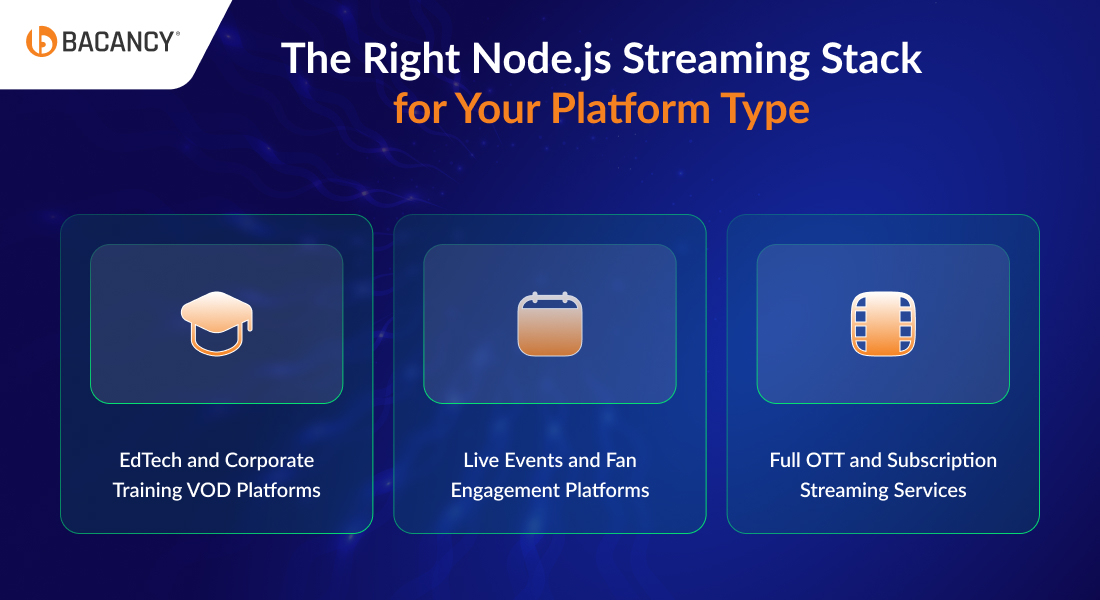
Before you select a stack, answer one question: What am I actually building? The answer changes team composition, infrastructure model, and total cost.
It contains a lower concurrency ceiling, a deep content library, offline content access, LMS integration (SCORM, xAPI), and progress tracking as core features.
The managed VOD model is almost always the correct infrastructure choice here. Content management and playback reliability matter more than pipeline control.
Recommended stack: Node.js API layer with NestJS for structured service architecture, Mux or Cloudflare Stream for media delivery, React frontend with Node.js, PostgreSQL for user data and progress records.
Key decisions specific to this platform type:
- Closed caption and subtitle management (FCC compliance requires captions on US-distributed video content
- Content access control tied to course completion logic
- LMS API integration
None of these are media pipeline problems. All of them are Node.js application layer problems, which is exactly why this platform type maps cleanly to the hybrid model.
Cost: $80,000-$150,000 build cost, $3,000-$8,000 per month infrastructure at 5,000 monthly active users.
It includes high concurrency in short windows around scheduled events, a real-time interaction layer (live chat, reactions, polls, co-watch), and a short content lifecycle after each event.
This is the platform type where Node.js and WebSockets are the strongest architectural fit. A real-time interaction layer at scale, the WebSocket gateway that fans a single broadcast signal out to thousands of simultaneous viewer connections, is exactly what the event-driven model handles well.
The specific infrastructure challenge for this platform type is the concurrency profile. Unlike a VOD platform with steady-state traffic, a live event platform sees near-zero load between events and peak load at predictable times.
CDN pre-warm before events, auto-scaling on origin infrastructure, and multi-region redundancy for the WebSocket gateway are the three investments that separate reliable live event platforms from those that fail at the moment they matter most.
Cost profile: $250,000-$500,000 build cost, with per-event infrastructure costs ($5,000-$20,000 per major live event at 50,000+ concurrent viewers) layered on top of base monthly infrastructure.
Full OTT and Subscription Streaming Services
It is a multi-device delivery across iOS, Android, Smart TV, and web; full multi-DRM; a personalisation and recommendation engine; and subscriber lifecycle management across acquisition, retention, and churn recovery.
This is the platform type with the broadest scope and the most complex content protection requirements. It’s also where managed media services eventually stop being cost-effective. The inflection point, roughly 100,000-200,000 monthly active users, depending on average consumption hours, is where per-minute managed transcoding and delivery cost exceeds the amortised cost of an in-house media pipeline.
Key architecture decisions specific to this type:
- Recommendation engine data infrastructure
- Smart TV and connected device SDK maintenance
- Subscriber data infrastructure for churn prediction modelling.
The Node.js application layer serves as the central coordination point for all of these, but each represents meaningful scope beyond the streaming pipeline itself.
Cost: $1,000,000-$5,000,000+ build cost, $80,000–$300,000 per month at 500,000 monthly active users.
How Bacancy Built a Streaming Platform with Node.js?
One of our clients, Whale Streaming, had a growing audience and a backend that was not ready for it. Buffering complaints were up, live events were unstable, and the team knew the architecture was the problem.
What We Found –
Before we wrote a single line of code, we audited the existing setup. Three problems stood out immediately:
- Auth token validation and CDN interaction logic sat inside the same service, so every viewer surge created auth delays for the entire platform
- WebSocket connections for live chat shared process resources with API execution, causing API degradation every time a live event went out
- A monolithic Node.js application with no service boundaries meant any CPU-bound operation could take the entire app layer down
These were not performance problems. They were structural ones.
What We Built –
We rebuilt the backend on an event-driven, non-blocking Node.js architecture and restructured the platform around isolated Node js microservices. The changes that had the most direct impact:
- Separated auth, CDN interaction, and the WebSocket gateway into independent services so load spikes stayed contained
- Built live chat, synchronized viewing, and real-time commenting using Node.js and WebSockets, which turned a passive viewing experience into a community-driven one
- Node.js-managed logic that optimized content based on user location and device type, bringing down latency across geographies
The Stack and Timeline
The Stack and Timeline
| Layer | Technology
|
|---|
| Backend | Node js
|
| Frontend | React |
| Infrastructure | AWS |
| Edge and Security | Cloudflare |
| Video Playback | Dash |
What Came Out of It –
- Consistent playback performance during traffic spikes
- Live streaming that held up under real event conditions
- Adaptive content recommendations based on viewing history
- Offline download support and full multi-device compatibility
That is the same pattern we see across most streaming platforms at the growth stage. The build is rarely the hard part. The decisions made before are.
Conclusion
A successful streaming platform with Node.js has speed and scalability with real-time performance to meet modern user expectations. Whether it is a live streaming app or on-demand content, Node.js handles large numbers of users smoothly while delivering fast and reliable experiences across devices.
For a CTO, the challenge is not just choosing the right technology but building a platform that can grow with increasing users, content, and performance demands. Partnering with our experienced Node.js development company can help you build a secure and steady streaming platform with Node.js that performs reliably as your business expands.
We can assist you in choosing the right streaming architecture, optimizing video delivery, integrating third-party services, and ensuring consistent performance even during peak traffic. With our expertise, you can launch faster, reduce operational challenges, and deliver the seamless streaming experience users expect.
Frequently Asked Questions (FAQs)
A basic streaming MVP takes around 8 to 16 weeks. A full production-grade platform takes 4 to 8 months. The timeline depends on features, such as live streaming, video on demand, user roles, payment systems, and scalability requirements.
NestJS is the best choice for large-scale video streaming APIs due to its modular structure and scalability. Express.js works well for simple and flexible setups. Fastify provides high performance for heavy traffic. NestJS remains the most suitable option for enterprise-level streaming platforms.
Yes, a CDN is mandatory for any video platform built with Node.js. Node.js handles logic, authentication, and session control, but CDN delivers video content to users. Without a CDN, the origin server becomes overloaded, and the playback quality drops under high traffic.
Node.js is preferred because it manages high concurrency with lower resource usage and faster real-time response. It fits well with event-driven workloads like user sessions, live interactions, and API coordination. Java and Go are stronger for CPU-heavy tasks, but Node.js fits application-layer control in video systems.
Yes, Node.js can support 1 million concurrent users when it works with CDN, load balancers, and a microservices architecture. Node.js manages API calls and real-time connections efficiently, while media delivery shifts to CDN and edge servers