Last Updated on February 27, 2026
Last Updated on February 27, 2026
Quick Summary:
Golang remains the top choice for developing cloud-native, AI-driven, and microservice applications for both startups and established businesses. This blog highlights the technical features of Go, why use Golang, common use cases, limitations, and popular companies using Golang. We will also compare Golang with other programming languages to determine how it is different from other technologies.
Table of Contents
Choosing the right programming language can be a challenging start to any app development journey. You might have asked yourself, “Which language is the most popular? Which one guarantees smooth deployment and reliability?”
If you’ve landed on Golang but are unsure if it fits your project, you’re not alone. This blog aims to clear up your doubts with solid insights, showing you why Go is trusted by tech giants like Google, Netflix, and Uber for building high-performance, user-friendly backend systems.
According to the 2025 Stack Overflow Developer Survey, 16.4% of professional developers actively use Golang, a clear testament to its widespread industry adoption and developer satisfaction. Supported by Google and a vibrant, expanding community, Golang continues to evolve as a future-ready language that can empower your projects to scale efficiently and perform reliably.
This blog will guide you through these facts and more by answering your common questions, like why use Golang, when to use Go, and when not to use it, helping you make an informed decision for your next big development project.
Golang is a statically typed programming language with built-in features, such as garbage collection, concurrency, and a simple syntax, that make it easy to learn and use. Given below are a few advantages that justify why Golang is designed to be fast, efficient, and well-suited for building networked and distributed systems:
Golang’s simple and clean syntax makes learning and reading easy, contributing to simpler Golang web development. It is easier to understand and maintain than other languages, even for inexperienced or new developers, thus enabling you to get resources within the budget. Additionally, it features a standard library that provides numerous built-in functions and tools, facilitating the writing of efficient and scalable code.
Golang was specifically designed with concurrency in mind, making it ideal for applications that require handling multiple tasks simultaneously. The Go language has lightweight goroutines and channels, allowing efficient communication and coordination between program segments, resulting in faster and more efficient performance. Golang’s garbage collector is equally capable of freeing up memory quickly and efficiently.
Golang offers a static typing system that ensures the variables are correctly typed at compile time, reducing the probability of errors. Additionally, it features an inbuilt error-handling mechanism that helps prevent crashes and any unexpected behavior. Furthermore, Golang is highly secure and safe; therefore, it is widely used in applications that require a high level of security, such as healthcare, government, and finance.
Amongst the essential benefits of Golang, automatic garbage collection is one of the most critical Golang benefits that frees the developers from manually managing the memory, thereby reducing the probability of memory leaks or similar other memory-related issues. An effective memory management system enables you to develop scalable applications for your business, allowing for efficient resource allocation and improved performance.
Golang allows for compilation on different operating systems and architectures, making it a versatile and portable language. It also allows your developers to create applications that can run on multiple platforms and devices, reducing the need for multiple versions of a single application and keeping your budgets in check.
Golang has grown extensively in terms of improving and the community supporting it. According to the latest data, it has 1,31,000 stars and 18,400 forks on GitHub.
Other websites, such as Reddit, Stack Overflow, and Golang Bridge, all feature forums that enable users to ask questions and receive help from experienced developers. Additionally, meetups and conferences provide excellent opportunities to network with fellow Golang developers and stay up-to-date on the latest trends and best practices.
Golang, also known as the Go programming language, is an excellent and intuitive choice for businesses with diverse use cases, making it an ideal choice for moving forward. Here are some points mentioning when to use Golang and it’s types of applications where the Golang programming language is the next choice for your web application development:
Golang possesses extensive concurrency features and effective memory management. Golang has given rise to several renowned frameworks, such as Gin and Echo, enabling the development of scalable and performant web applications.
Golang is used to build a variety of network-specific components, including proxies, load balancers, and VPNs. When building low-level programs that need high performance and efficient use of resources, Golang’s built-in network libraries make it easy to create network applications and services.
The performance and efficiency of Golang make it an ideal choice for machine learning and data analysis applications needing a large amount of data processing. Often, Golang is used in conjunction with various other technologies, such as TensorFlow, for building highly effective and scalable machine learning applications.
Golang is effectively used for creating cloud-based applications and distributed systems. The concurrency features and cross-platform compatibility make it ideal for building scalable, fault-tolerant systems. Kubernetes, a renowned container orchestration system, is built using Golang.
Golang for an IoT platform is a great combination that can easily connect millions of IoT devices and create real-time reports by applying various technologies alongside Golang. Combining Golang with IoT improves scalability, concurrency, device usability, and support for feature-rich packages that the Go package management can import.
Blockchain platform development in Golang increases speed and efficiency as it is much more productive than Python and JavaScript. It is easy to find libraries and packages to make technology like the Ethereum Virtual Machine.
Using the Go language for AI-enabled app development is a one-stop solution, as it enhances user experience, facilitates financial planning, and improves customer interaction. These applications use machine learning algorithms and self-correction, enabling them to comprehend human knowledge and inputs. Golang-based AI applications require libraries for natural language processing, extraction, and visualization.
Hire Golang Developer to build high-performance, scalable systems with clean architecture and seamless integrations that drive real business results.
Golang is primarily designed to address the challenges of building high-performance, scalable, and reliable applications. However, after understanding when to use Golang, Let’s understand it’s certain limitations that can pose challenges in specific scenarios. A few of them are given below:
Golang does not have a standard library or GUI toolkit, unlike Java or C#. Therefore, product owners must use third-party libraries to build UIs, which can make their application more complex. So, when aiming for desktop applications with a GUI, you can consider Java or C#, which have their built-in GUI toolkit.
Golang is still a relatively new language and is not viable for maintaining or extending the legacy systems written in other languages. Rewriting an entire system in Golang is a time-consuming and expensive process; thus, it is not worth the effort if the existing system is working effectively. Therefore, it is better to stick with the language used for the legacy systems written or consider a better and more compatible language, such as Java or Python.
While Golang is great for scalability and performance, it might not always be the best fit for large enterprise applications that demand extensive features and deep integrations. Compared to mature languages like Java or Python, Go’s ecosystem is still growing, which means fewer ready-made libraries, frameworks, and tools to support complex enterprise requirements.
Although Golang can handle data processing tasks, it’s not the go-to choice for data analysis or scientific computing. Its library support in this area is still limited, making it less convenient for complex analytical workflows. Data scientists and researchers typically prefer Python or R, which offer rich ecosystems, specialized libraries, and mature frameworks tailored specifically for statistical modeling and advanced data analysis.
All programming languages, including Golang, possess specific characteristics that make one different or efficient than others. Below is a comparison of Golang with a few other programming languages to help you decide why use Go language for your next web application development project.
When comparing Golang with Java, Golang is initially simpler and faster, making it a good choice for small to medium-sized applications. However, Java, on the other hand, is more mature, along with a larger ecosystem, thus making it a more feasible option for developing enterprise-level applications.
When analyzing Golang vs Python, Golang takes the lead, as it is faster than Java and more efficient, making it a better choice for applications that require high performance and scalability. In contrast, Python is easier to learn and offers a broader range of libraries and frameworks, enabling more effective data analysis and scientific computing.
Comparing Golang and C++, the Go language is easier to learn and use, with its simple syntax, efficient memory management, and system. Additionally, it is more secure due to its built-in error handling and garbage collection. C++, on the other hand, is faster and more efficient, making it a better option for low-level systems programming.
The reason to choose Golang over Rust is that Golang offers simplicity and user-friendliness for its developers, delivering a simpler programming experience to the product owners. This uniformity and simplicity-centric approach of Golang enhances team efficiency, making it a developer-favored language.
In contrast, Rust presents excellent control over threads and their behavior within the system; however, its complexity and steep learning curve make it less popular among developers.
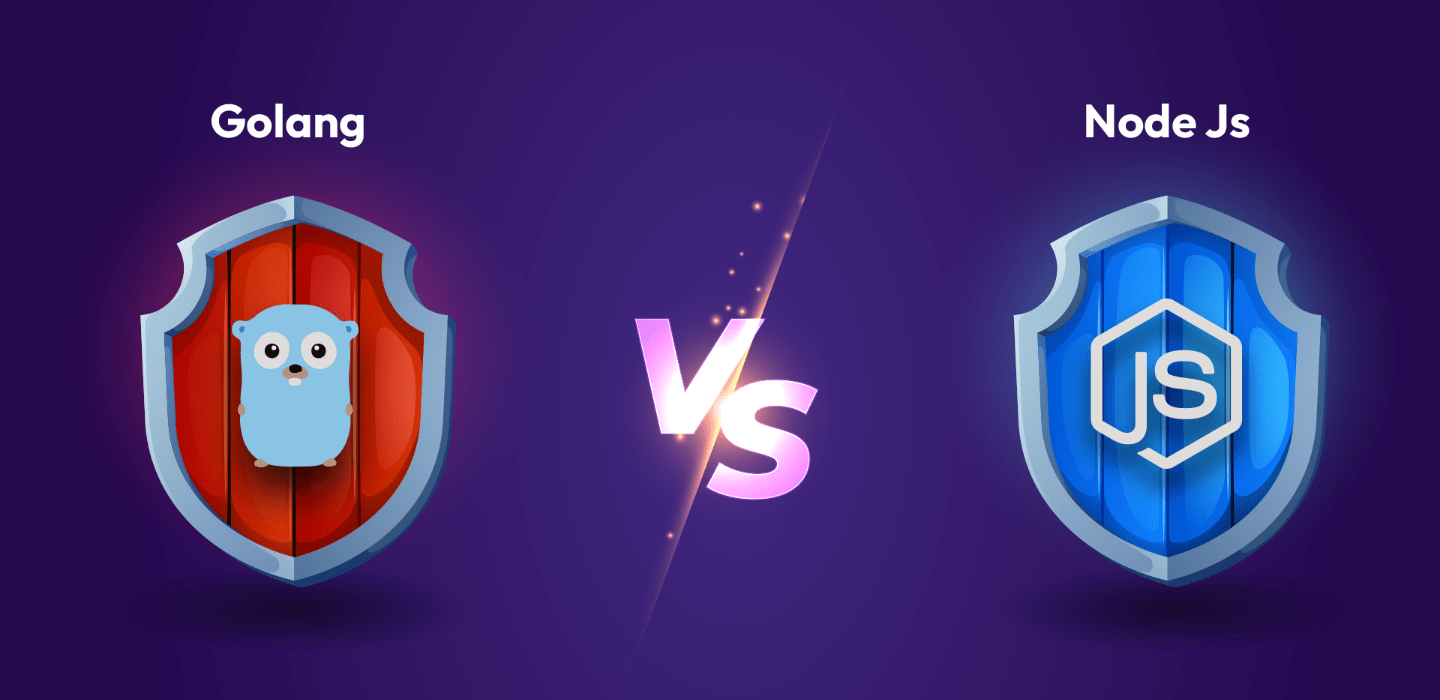
Compared to Node.js, Golang is more lightweight and delivers performance close to C/C++. While both Golang and Node perform similarly in real-world scenarios involving database operations or network communication, Go stands out for its consistency. Node.js can deliver exceptional results in certain use cases but may struggle in others, whereas GoLang maintains steady, predictable performance across diverse application types.
After understanding the necessary aspects of why use Golang and why it is the reliable technology, we will now analyze top companies embracing Go to build their websites and softwares.
Google is the creator of Golang, and it was primarily launched for their internal projects and to ease developers’ work. The Googlers created Google Chrome and Google Earth using Go, and additionally, even YouTube and Google App Engine use the Go programming language natively. Several of Google’s services have been rewritten using Go, and many smaller internal projects at Google also utilize Go.

Uber is the Go programming language’s ideal case study, remarking more than a hundred services written in Go. One recent example of Go services in Uber is the geofence service, which matches the user’s and the driver’s location. Golang is used in writing most of Uber’s high-level GPS services. Most developers at Uber, being well-versed in C++, Java, and Node, can easily switch to and learn Go without much hassle, which increases performance at Uber.
To cope with the rise in resource utilization and latency, Uber utilizes well-executed Go nodes to address these issues. Uber refers to Go as a highly reliable programming language, and they have a positive experience with this modern-day language.
Dailymotion is a video-streaming platform in France and is available worldwide in over 25 languages. The website improved the performance of its application programming interface APIs using the Go programming language. Golang is helpful for end-to-end tests on the site, which otherwise causes heavy loading. However, Go makes it sturdy and fast. Golang’s static type checking, simplicity, and performance have favored the company well.
The famous content publishing platform- Medium uses Golang for its development. GoSocial- one of the Go services manages the Neo4j database. Go also handles other image processing and backend services.

Another live video-streaming service uses the Go programming language for its most loaded systems. Golang resolves all user-chat-related issues and problems during live video streaming, offering unique features such as efficiency, readability, simplicity, and security. One of the most desirable characteristics of Golang that helped Twitch is the garbage collection feature, which dynamically allocates memory.
A cloud-based email transaction service- SendGrid uses Go as its primary programming language. With the help of Go, the company processes several emails every month using asynchronous programming, and it is one of the largest companies to utilize Golang. SendGrid’s developers have mentioned that Go solved all their concurrency-related problems and helps reduce maintenance costs.
Along with Ruby on Rails, SoundCloud engineers use the Go programming language for real-time status analysis. According to these engineers, Go is a what-you-see-is-what-you-get language that makes their work easier and saves time because it’s a one-solution language.
The cloud-computing major Dropbox also uses Golang for its efficiency and scalability. Along with the Go in-built libraries, Dropbox has built its custom libraries. Golang offers several advantages, including improved caching, a standard error interface, and Memcache client libraries, among others.
This blog covers all the reasons why use Golang and why it has become so popular among businesses and enterprises. One of the key factors behind Golang’s rising attention is its high performance, efficiency, and scalability. Whether you are running an eCommerce platform, on-demand service, or next-gen app, Golang has emerged as the go-to choice for delivering a smooth and seamless user experience.
Outsourcing Golang development services to an expert like Bacancy offers significant advantages for businesses looking to optimize resources and accelerate project timelines.
Partnering with our highly skilled Go programmers saves you the time and cost of hiring and training an in-house team. From scalable web applications to complicated backend systems, we offer end-to-end solutions that shorten development cycles, lower operational risks, and give your company a competitive advantage.
Yes, Golang can be used for machine learning, though it’s not as common as Python. Libraries like Gorgonia, GoLearn, and goml support data modeling and computation. However, most developers still prefer Python because of its mature ML ecosystem. Go is better suited for production-grade ML systems where performance and scalability matter.
Since its launch by Google in 2009, Go (Golang) has seen remarkable growth in the developer community. As of 2025, it consistently ranks among the top 10 most loved and in-demand programming languages, according to the Stack Overflow Developer Survey. Its clean syntax, efficient concurrency model, and high performance have made Go a go-to choice for backend systems, cloud-native applications, and DevOps tools.
Many leading tech companies rely on Go for large-scale systems. Some notable names include:
No, Go does not support classical inheritance like Java or C++. Instead, it uses composition over inheritance. This means you can embed one struct within another to reuse code and behavior, promoting a simpler and more maintainable design.
In Go, interfaces are used to define method sets that describe behavior. Any type implementing those methods automatically satisfies the interface, promoting clean, modular, and scalable code. Go’s implicit interface implementation makes it easier to maintain and extend applications without tight coupling.
Some of the in-build supports of Go programming language are:

Tech Geek at Bacancy
Creative content strategist crafting impactful stories around web, mobile, and software.
MORE POSTS BY THE AUTHOR
Your Success Is Guaranteed !
We accelerate the release of digital product and guaranteed their success
We Use Slack, Jira & GitHub for Accurate Deployment and Effective Communication.