Quick Summary
Golang is gaining popularity due to its simplicity, concurrency, and rich ecosystem of libraries for mobile app development. Hence, Go is an ideal option for building scalable and optimized solutions. In this blog, we will discuss the top Golang tools used in mobile app development, their benefits, and why popular companies choose Golang for mobile app development in 2026.
Table of Contents
Introduction
Did you know that in 2024, there were 136 billion app downloads worldwide across user accounts? Mobile apps dominate how people live, connect, and shop, from games to entertainment, social media, communication, and e-commerce.
The data also indicates the growing usage of mobile apps, and in this competitive era, no business can afford to miss out on this opportunity by fulfilling user needs.
However, the major challenge you might have faced is which language to choose that provides speed, concurrency, and cost-efficiency for mobile app development. A wrong choice can slow down your app, cause scalability issues with growing user size, and lead to inconsistent performance.
That’s where Golang comes in. It is trusted by major tech companies like Uber, Netflix, and PayPal due to its speed, concurrency, and cross-platform compatibility.
So, if you are planning to choose Golang for mobile development in 2026, you are at the right place. In this blog, we will help you understand why Go is the best for your next project and how Go provides you with a competitive edge and allows you to expand smoothly.
Evolution of Golang as a Mobile App Development Technology
Google initially launched Golang as an open-source language. It was built for high-performance infrastructure like Docker and Kubernetes, but now it is used to create future-proof mobile apps.
Over the years, the Golang ecosystem has evolved. With Go Mobile, Gobind, and the growing ecosystem of libraries, your team can make Android and iOS integration smooth. Frameworks like Gio help create a smooth UI for mobiles. This futuristic expansion makes Golang more than just an infrastructure language.
Its increasing popularity makes it an ideal language among developers for building robust, secure, and high-performing backends. Go offers a unique combination of high performance, built-in concurrency, and simplicity, which helps your development team build an optimized mobile app.
Today, Golang is used not only for robust backend development but also for cross-platform mobile apps with high-tech security, speed, scalability, and cost efficiency.
Key Benefits of Using Golang for Mobile Development
When it comes to speed, security, and scalability, businesses and tech teams cannot compromise on it. Golang for mobile apps can be beneficial for both developers and businesses in one way or another. Let’s understand the key benefits in this section:
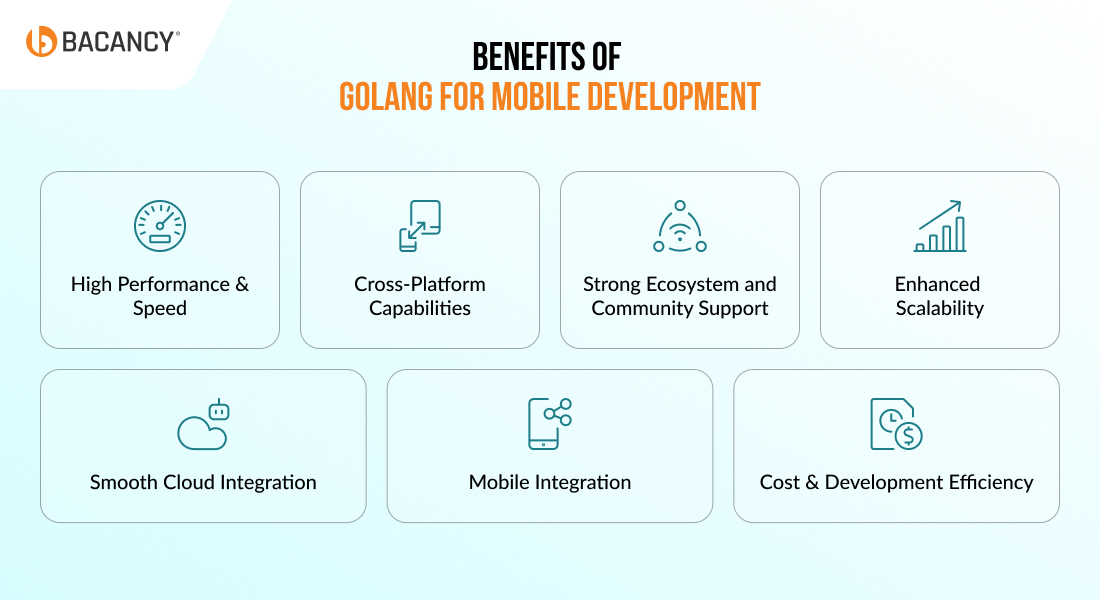
Performance and speed are the core strengths of Go. As a compiled language, your developers can easily run applications directly instead of multiple layers. When developing a mobile application, this will help your team reduce lag, speed up loading time, and ensure a smooth user experience.
For the CTOs, Go’s capabilities help provide market-leading solutions and fulfill user needs.
Developing native mobile apps separately for iOS and Android can be costly and time-consuming. But when your development team combines Golang with Gomobile and Go bindings, they can write the logic once and reuse it across multiple platforms. This helps reduce development time and ensure smooth performance.
The cross-platform capabilities help startups reduce time to market and development costs, while tech leads can simplify their team management, as a less specialized skill set is required when working on Go.
3. Strong Ecosystem and Community Support
Since the beginning, Golang has been evolving. With its open source community, well-documented libraries, and improved mobile development frameworks, your developers can access ready-to-use authentication, networking, and secure UI integration solutions.
For CTOs and tech leads, this ecosystem helps reduce the overhead of developing strategies from scratch, enabling their team to focus on innovation rather than basic-level development.
4. Enhanced Scalability
When a user base grows, mobile applications must handle a larger number of transactions and integrations. Go’s lightweight concurrency model and smooth memory management help scale faster than technologies with heavier runtimes.
The scalability of Golang helps your business reduce the cost of developing mobile apps from scratch to fulfill growing needs. This indicates that you can easily achieve your growing needs without making changes in the solution’s architecture.
5. Smooth Cloud Integration
Golang supports modern cloud infrastructure tools like Kubernetes, Docker, and Terraform. This indicates that mobile apps built on Go can easily be integrated with cloud native services, APIs, and microservices.
This helps your team to build a dynamic mobile app with advanced analytics and cloud-based APIs.
6. Mobile Integration
With Golang, your developers can smoothly integrate mobile apps with existing business software and third-party services. In addition, Go’s API-friendly architecture and support for interoperability using tools like Gomobile and Gobind help your team connect apps with backend services, cloud platforms, and advanced IoT devices.
This helps your business to get a scalable mobile app with a smooth user experience and streamlined operations.
7. Cost & Development Efficiency
Golang helps your developers reuse core logic on Android and iOS, eliminating the need to manage a separate codebase. It’s a strong tooling ecosystem that allows your team to enhance the development, testing, and deployment cycle.
So, your business can have lower development costs, faster time to market, and reduced maintenance overhead, making Golang for mobile development a cost-effective approach.
Want to Create Golang Mobile Applications That Stand Out?
Hire Golang developers from Bacancy to get futuristic and scalable mobile apps that deliver high performance, seamless user experience, and faster time-to-market.
Technical Advantages of Golang in Mobile App Development
Golang is not just a backend language but a mobile-friendly technology that can help your team to simplify complex workflows. With tools like Go Mobile, seamless FFI support, CI/CD compatibility, and rich libraries, your development team can get a technical foundation to build compatible and scalable applications.
Let’s understand the technical advantages of Golang for mobile development that make it an ideal choice for projects.
The Go mobile toolchain makes it possible for your development team to write an app’s core logic once and generate bindings for both Android and iOS. So, instead of duplicating the coding structure across platforms, your team can smoothly maintain a unified codebase.
This will reduce development time and cost and reduce duplication of work for your business, helping you stay updated with current trends.
2. FFI Support
Golang offers smooth interoperability with native languages like Swift, Objective C, Java, and Kotlin. This allows your developers to extend the solution’s functionality and integrate device-specific features while still using Go’s efficiency.
Your mobile application will then combine the speed of Go with a native experience, ensuring smooth user engagement.
3. CI/CD & Container Compatibility
Go was designed with modern DevOps approaches in mind. It helps your developers to smoothly integrate CI/CD pipelines, Docker, and Kubernetes for faster development, smooth testing, and automated deployment.
This ensures your team can deploy the features, fix security issues, and update where required quickly. For your business, this allows you to be agile and makes your app competitive.
4. Rich Libraries
The Go ecosystem comes with powerful libraries and third-party packages for networking, APIs, cryptocurrency, concurrency, and real-time features like messaging or streaming. Your developers need not create from scratch; they can utilize existing tools based on their requirements.
For your business, this allows for faster development, stronger security, and enhanced scalability of enterprise-grade and complex applications.
What are the Use Cases of Golang in Mobile Development?
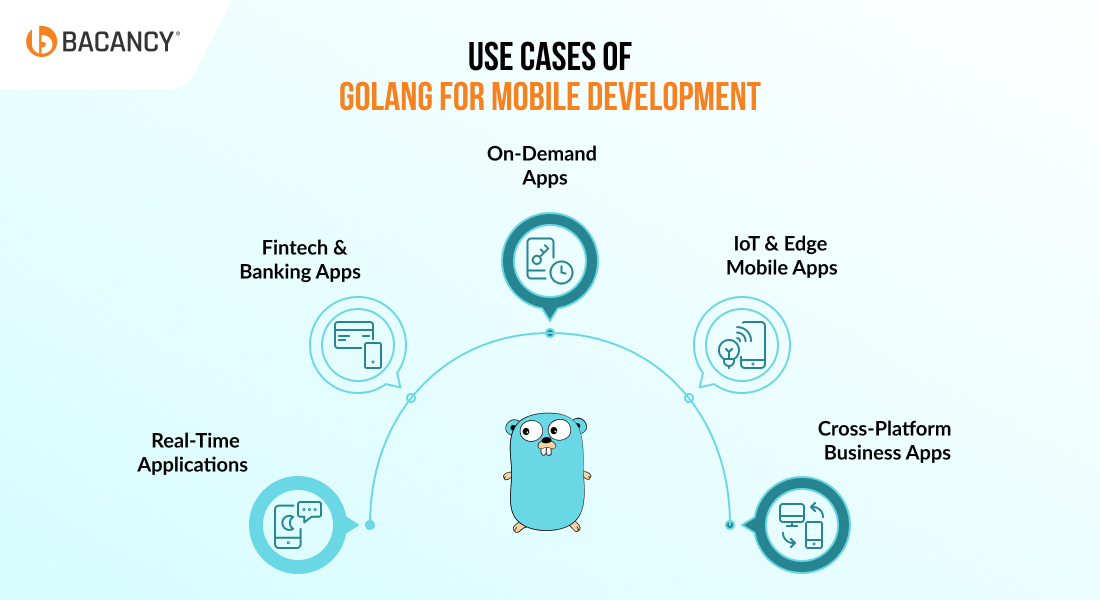
From real-time chat app development to enterprise-grade cross-platform apps, Go provides the speed, concurrency, and scalability for modern mobile apps. Let’s understand some of the practice use cases where golang is helping businesses to stay agile.
1. Real-Time Applications
Most real time apps like instant messaging (WhatsApp), online streaming (Netflix), mobile games require real time collaboration and smooth responsiveness. Golang’s built-in concurrency with goroutines makes it an ideal approach to manage multiple user connections without slowing down.
2. Fintech & Banking Apps
The fintech and banking industry requires fast, secure and accurate transactions. Golang’s optimized performance helps your users in smooth processing of payments, transfers and API requests. This adaptability and simplicity reduce the chances of errors in coding structure which is important when handling sensitive financial data.
Its built-in security libraries help developers establish high-tech safety protocols, making Golang a trusted option for mobile banking apps, wallets, and trading platforms.
3. On-demand Apps
Do you know what’s common in on-demand apps like food delivery, ride-hailing, and logistics apps? It has quick responses, real-time collaboration, updates, and live tracking. However, delays in service delivery can lead to inefficiencies and user dissatisfaction. That’s where your Golang developers help solve the uncertainties by using Go’s concurrency model, which can handle multiple requests simultaneously without any performance bottlenecks.
This will help you to provide a smooth user experience, higher retention, and enhanced scalability without updating the infrastructure.
4. IoT & Edge Mobile Apps
The modern IoT and Edge computing technologies require speed and efficiency. Devices and sensors are required to communicate in real time, often with low resources. However, your team can use Golang’s lightweight runtime and efficient storage utilization to ensure the smooth performance of your IoT and edge applications.
This helps your businesses reduce infrastructure costs, ensure better performance, and smooth the deployment of IoT driven apps, increasing ROI.
Large enterprises struggle with maintaining separate codebases for Android and iOS. Golang solves this challenge by allowing your developers to share core logic and code across platforms. This will allow your team to ensure native-like performance through bindings with Java/Kotlin and Swift.
As a result, your team can reduce time to market and ensure consistency in features and performance. This will also help you reduce development overhead, leading to investment opportunities for growth-driven approaches.
Why Choose Golang Over Other Technologies for Mobile App Development?
Choosing Golang for mobile app development offers distinct advantages, such as high performance, concurrency support, and scalability, making it a strong alternative to traditional technologies.
1. Limited Native UI Support
Golang excels at the smooth implementation of backend logics, but it doesn’t offer extensive native UI components like Flutter and React Native. This indicates that your team is required to integrate platform-specific SDKs (Swift for iOS, Kotlin/Java for Android). Your team can rely on Go to create core logic and use native platform tools to build interfaces. This can create complexities if your app heavily relies on advanced features and UI.
2. Relatively Smaller Ecosystem for Mobile
Go’s ecosystem is rich in backend tools and cloud implementation, but mobile-specific libraries, SDKs, and community support are still in a growing stage. As Flutter and React native, your team won’t find a plug-and-play library for every feature. This indicates your team is required to build custom features or a platform from scratch, which can hamper the project timeline.
3. Learning Curve for Hybrid Teams
If your team is already experienced in Swift, Kotlin, or JavaScript, selecting Golang requires adaptability to its concurrency model, goroutines, and memory management approach. While Go is beginner-friendly compared to Java or C++, hybrid teams can understand it before being active on the project.
Mobile-focused debugging tools and IDE support for Go are not as mature as those for Java or Swift ecosystems. As a result, it sometimes takes time to diagnose and fix issues.
However, if your team is experienced with Go, they can bypass these limitations by smoothly integrating Go’s debugging with CI/CD pipelines and containerized testing. This assists your team in streamlining the development process.
8 Popular Tools for Golang Mobile App Development
There are diverse Golang development frameworks and tools available that can help your team develop smoothly. But here, we will understand the tools of Golang for mobile development that help in ideal selection.
| Tool | Purpose | Why It’s Useful for Mobile Development |
|---|
| Gomobile | Generates native bindings for Android/iOS from Go code | Allows developers to write core logic in Go and reuse it across platforms, reducing duplicate effort |
| Gobind | Auto-creates bindings for Swift, Java, and Kotlin | Simplifies integrating Go modules directly into native mobile apps without manual glue code |
| GoLand (IDE) | Full-featured IDE for Go development | Enhances productivity with debugging, code insights, and faster iteration for mobile app projects |
| Delve (Debugger) | Debugging and runtime inspection | Helps catch performance bottlenecks and runtime issues early, ensuring smoother mobile experiences |
| Go Modules | Dependency and package management | Ensures consistent builds and stable mobile releases by managing third-party dependencies cleanly |
| Fyne | Cross-platform UI toolkit in pure Go | Enables building apps with a unified UI across Android, iOS, desktop, and web without switching frameworks |
| GIO (gioui.org) | High-performance UI and rendering | Supports building responsive, GPU-accelerated mobile apps like fintech dashboards or gaming apps |
| Docker + CI/CD | Containerization and deployment automation | Speeds up mobile build pipelines and ensures reliable, repeatable app deployments |
1. Gomobile
Gomobile is specifically built for Go mobile app development. It offers tools to compile Go code for Android/iOS, create bindings, and smoothly integrate Go logic into mobile app development projects. As a core Go-native tool, it helps your team bridge the gap between Go and native mobile SDKs.
This will help you save costs by letting you maintain a single Go codebase for shared logic instead of duplicating it for Android or iOS. You can get all this with experimental support for graphics (OpenGL ES). Gomobile ultimately helps you speed up the time to market and reduce maintenance overhead.
2. Gobind
Gobind is the tool responsible for Gomobile’s binding capabilities. It helps your team to generate Java and Objective-C bindings for exported Go functions. Although Gobind can be run directly, it is mainly invoked by Gomobile Bind for convenience.
Gobind helps your developers to integrate your Go code with native mobile projects without complex interoperability hurdles.
3. Fyne
Fyne is a cross-platform GUI toolkit that helps developers build native-like apps for desktop, mobile, and web using Golang. Unlike Gomobile, Fyne aims to provide smooth UI development in Go, allowing rich native-like interfaces using Go code.
- Write core business logic in Go.
- Use Gomobile bind to generate mobile bindings.
- Integrate bindings as libraries (.aar for Android, framework for iOS) in platform native projects.
- Use additional x/mobile libraries for assets, events, and graphics.
4. GoLand
GoLand helps your team with intelligent code assistance, debugging tools, version control, and secure testing support. This results in saving time and ensuring higher code quality by avoiding bugs to boost deployment cycles.
5. Delve (Debugger)
Delve is the most popular debugger for Go. It will help your team check the codebase, inspect variables, and debug complex issues even in mobile pipelines. By reducing the debugging time, Delve helps your team improve app stability and performance.
A stable mobile app leads to a smooth user experience, fewer production hurdles, and reduced maintenance costs.
6. Go Modules (Dependency Management)
Go Module is Go’s official dependency management, using go.mod to define module versions and dependencies. It helps your team with automatic version resolution using a minimal version selection approach, performance optimization with proxy caching, and security verification using checksums.
This assists your team to smoothly import, update, and manage third-party packages, while ensuring version consistency and compatibility across environments.
7. GIO (gioui.org)
GIO is the open source GUI toolkit for Golang that your team can use to build user-friendly interfaces for multiple platforms. It helps them in building animations, layouts, and interactive dashboards.
It allows developers to develop apps that are compatible with diverse platforms like macOS, Windows, Linux, iOS, Android, and the web using WebAssembly. This ensures the final output is optimized and aims to enhance user engagement.
8. Docker + CI/CD Pipelines
Your team can perform containerization with Docker and automation via CI/CD (Gitlab CI, GitHub Actions, Jenkins) to smoothly test and deliver a Go-based mobile app. For your business, these automated pipelines help in reducing operational costs and agility to respond quickly to market needs.
Using Docker and CI/CD pipelines, your development team can ensure faster product release, reduced maintenance, and smooth deployment.
Build Future-Ready Mobile Apps Using Golang With Bacancy
Golang has expanded as a reliable technology for developing user-friendly mobile applications. Golang for mobile development offers diverse tools and libraries that allow concurrency, speed, security, and simplified cross-platform integration.
However, it is essential to opt for a company that aligns with your business goal. Being a popular Golang development company, we offer end-to-end Go expertise. At Bacancy, our Go developers utilize the concurrency approach and available library to develop futuristic mobile applications.
We use proven tools like Gomobile, Gobind, and GIO to integrate seamlessly with Swift and Kotlin to provide a native-like experience with smooth performance.
- We don’t just write code, we handle the full project cycle from mobile architecture to deployment on Android and iOS ecosystems.
- We design real time apps for chat, streaming, fintech and other industry specific applications by focusing on smooth user experience.
- Using cross-platform capabilities of Golang, we help businesses achieve faster time to market.
- From enterprise grade security to CI/CD automation with Docker and Kubernetes, we provide scalable and cross platform mobile applications with reduced downtime.
- We are a team of experienced developers with a proven track record of working with diverse industries, ensuring better collaboration, faster delivery, and long-term support.
Frequently Asked Questions (FAQs)
No, Golang will not replace Java or Python, but it will expand the user base with its cloud-based and high-performance capabilities to build secure backend applications.
Yes, if you want to develop cloud, blockchain, backend, or high-performance systems, Golang can be the best choice. Its expanding ecosystem will help developers build complex enterprise applications by simplifying the workflow.
Go is a compiled language that transforms code into machine code. This helps developers run the code faster than the interpreted codebase of Python. In addition, Golang is a concurrent programming language that enhances performance and provides faster time to market.