Quick Summary
Based on Bacancy’s expertise, developing a Golang application in 2026 can range from $25,000 for a basic MVP to $150,000+ for complex, high-concurrency, or compliance-focused solutions. The final Golang app development cost depends on factors such as your chosen architecture, framework, cloud setup, and the expertise of your development team.
We have detailed Golang app development cost by application type, project complexity, and team structure, which give you actionable insights to plan your budget smartly, avoid hidden costs, and build scalable and high-performance apps.
Table of Contents
Introduction
Golang app development cost in 2026 are rising and fluctuating due to evolving architectural choices, AI-assisted development, cloud pricing, and other factors that drive the creation of high-performance applications.
This eventually also raises the critical question for every decision maker:
“Why does the cost change, how do I control it, and how will it really cost for my use case in 2026”?
The cost to develop a Golang project depends on how your budget is allocated across each stage of the development process. From planning and design to deployment and maintenance, each has different costs.
These insights are based on Bacancy’s years of hands-on experience in developing Golang applications across startups, SaaS platforms, and enterprise-grade systems. Understanding how our developers allocated time and resources at each stage can help you make smarter and more informed budgeting decisions for your project.
With the following cost breakdown, you can spot primary decisions, budget spikes, and make informed choices tailored to our project needs. Before we talk about app types or pricing models, let’s understand where Golang development budgets typically go.
Understanding Cost to Develop a Golang App
| Core Areas
| Typical Scope
| Estimate Cost Range
| Timeline
|
|---|
| Backend Development
| Core services, business logic, concurrency design, database interactions
| $30,000 - $90,000
| 8-20 weeks
|
| APIs & Integrations
| Internal APIs, third-party services, auth, payments
| $8,000 - $25,000
| 3-8 weeks
|
| Cloud & DevOps
| Cloud setup, CI/CD, containers, monitoring
| $6,000 - $18,000
| 2-6 weeks
|
| QA & Security
| Functional testing, load testing, security validation
| $5000-$15000
| 3-6 weeks
|
| AI Code Review & Tooling
| Automated code review, performance analysis, and refactoring tools
| $2000 - $6000
| Ongoing
|
| Cloud Usage Spikes
| Auto-scaling, high-traffic compute usage
| $1500 - $10000/year
| Usage based
|
| Compliance & Governance
| SOC 2, HIPAA, GDPR documentation & audits
| $10,000 - $40,000
| 4-12 weeks
|
Key Factors and Variables That Affect Golang App Development Cost in 2026
To develop a Golang application in 2026, you need a strategic investment and certain factors. The following are the core factors and variables that impact your Golang app development cost in 2026. It helps you plan effectively, eliminate hidden costs, and deliver high-performance apps on time.
First, let’s categorize costs into two factors: traditional and innovative. Both have different approaches, aspects, and thus incur different costs.
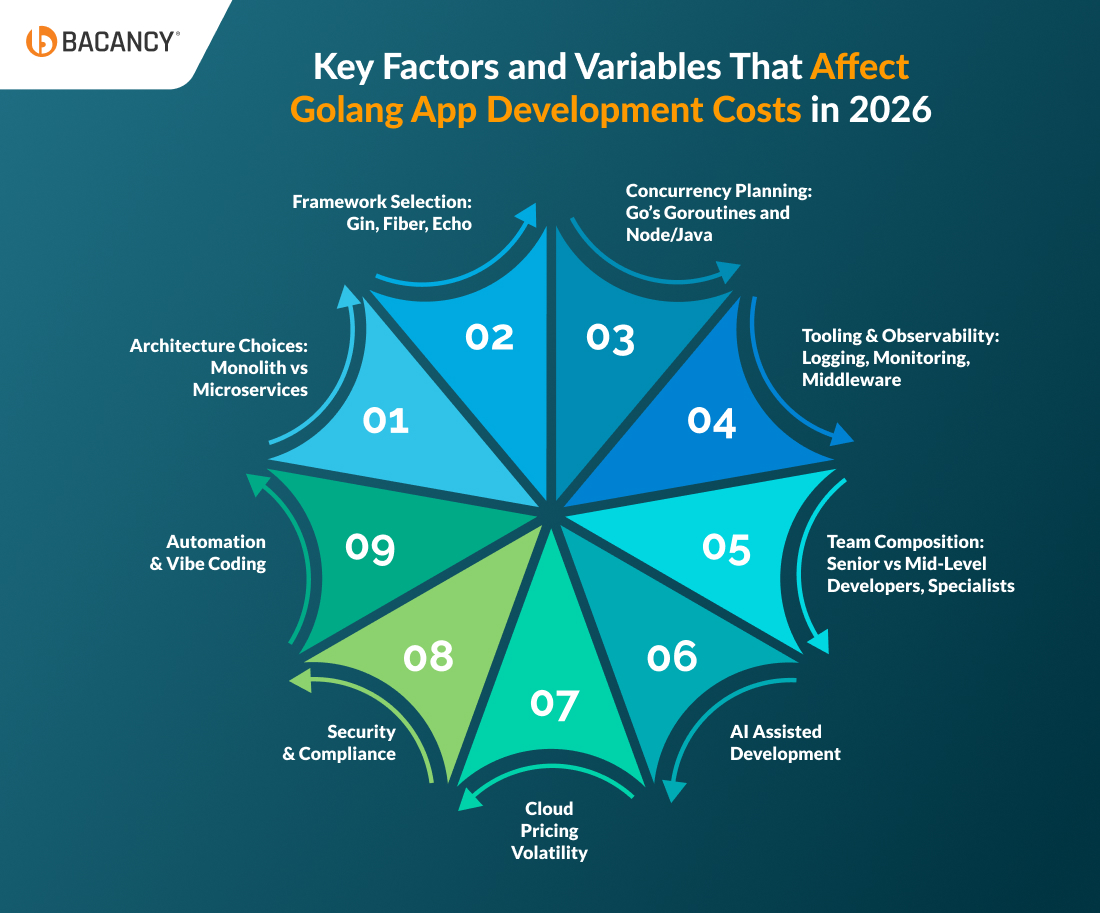
Traditional Golang App Development Cost Factors
These are the basic factors that form the foundation of your Golang development budget. The following elements influence development time, resource allocation, and overall budget. Understanding them helps you plan effectively, eliminate hidden costs, and make informed trade-offs.
1. Architecture Choices: Monolith vs Microservices
Architecture is the backbone of your application and sets the tone for scalability, maintainability, and cost.
Monolith: A single & cohesive application structure. Development is simpler, and testing is straightforward. It costs approximately $25,000 to $50,000.
Monoliths are ideal for MVPs or smaller applications where speed to market matters more than long-term modularity.
Microservices: Modular architecture with independently deployable services. Each module can scale independently, which improves flexibility, reliability, and performance for complex apps.
However, microservices require more development planning, team coordination, and integration testing. So, the cost can range from $60,000 to $150,000.
Choosing the wrong architecture can lead to inflated costs later. For instance, trying to scale a monolith in a high-traffic scenario may require significant refactoring, whereas a microservices architecture setup allows easier scaling, but upfront investment is higher.
2. Framework Selection: Gin, Fiber, Echo
The framework you choose shapes development speed, performance, and long-term maintainability. Frameworks influence development speed, long-term maintenance, and performance.
Gin: High-performance, minimal overhead. Ideal for heavy-traffic apps. Go app development cost: $35,000 – $60,000 for MVPs, scaling to $80,000 – $120,000 for complex enterprise apps.
Fiber: Lightweight and fast, perfect for prototyping. Cost to develop Golang: $25,000-$45,000 for MVPs, rising to $60,000 – $80,000 for complex apps.
Echo: Balanced performance and maintainability. Go app development cost: $30,000 – $70,000, up to $90,000 for enterprise apps with integrations.
3. Concurrency Planning: Go’s Goroutines and Node/Java
One of Golang’s biggest advantages is its built-in concurrency model. Goroutines allow thousands of simultaneous tasks to run efficiently, making apps fast and responsive.
Proper concurrency planning requires careful architecture, stress testing, and skilled developers. Poor planning can lead to server crashes, downtime, or hidden infrastructure costs.
Compared with Node or Java-based: Go is simpler for concurrent workloads, but it still requires expertise to handle edge cases, shared resources, and synchronization.
| Concurrency Approach
| Estimated Additional Cost
|
|---|
| Go’s Goroutines
| $10,000 - $30,000
|
| Node/Java-based concurrency
| $5,000 - $20,000
|
Insider Insight: Investing in proper concurrency planning reduces server Go app development costs, latency, and downtime. By cutting corners, you may save upfront costs, but can end up with expensive failures under high load.
4. Tooling & Observability: Logging, Monitoring, Middleware
Observability is critical for app health and reliability. Golang tools like Prometheus, Grafana, or custom middleware allow real-time tracking of performance, server load, and errors.
Without proper observability, post-launch debugging can be time-consuming and costly.
Estimated Cost: $5,000 – $15,000
Impact on Cost: Investing in observability early prevents lost revenue due to downtime, improves developer efficiency, and provides data-driven insights for scaling your application.
5. Team Composition: Senior vs Mid-Level Developers, Specialists
Mid-level Developers ($40–$70/hr): Handle routine tasks, basic implementation, and testing. Suitable for small features or MVPs.
Senior Developers ($80–$120/hr): Essential for architectural decisions, advanced planning, and performance optimization.
Specialists ($5,000–$20,000 extra): Needed for highly concurrent systems, regulated industries, or complex integrations.
The right team prevents rework, ensures quality, and keeps the project on schedule. Hiring a larger, less experienced team may seem cheaper upfront, but it often increases costs due to Golang error handling, delays, and lower efficiency.
Innovative Golang App Development Cost Factors
Modern trends are reshaping Golang development budgets. These factors can accelerate your development, improve scalability, and future-proof your app, but they also require careful planning and investment. Here’s what you need to know:
1. AI-Assisted Development
AI can automate repetitive coding, generate boilerplate, and even suggest optimized code structures, drastically reducing development time for standard tasks.
Estimated review cost: $5,000 – $15,000
While AI reduces hours spent on routine coding, you cannot skip human oversight. Every AI-generated snippet must be reviewed for:
- Security vulnerabilities
- Performance optimization
- Compatibility with your existing architecture
Proper AI oversight prevents technical debt and hidden errors that could cause costly fixes later. It also allows your team to focus on strategic, complex features rather than repetitive tasks, thereby improving ROI over time.
Pro Tip: Use AI and LLM for scaffolding, testing scripts, and standard functions, but rely on your experienced developers for core business logic and system-critical modules.
2. Cloud Pricing Volatility
Go applications are often high-performance and compute-heavy, which makes cloud costs a significant variable in your budget. Factors like autoscaling, traffic spikes, multi-region deployments, and high I/O workloads can drive unexpected expenses.
| Scale
| Estimated Monthly Cost
|
|---|
| Small App
| $500 - $1,000
|
| Mid-Tier App
| $2,000 - $5,000
|
| Enterprise App
| $5,000 - $10,000+
|
Unplanned cloud costs can blow your budget if you are not monitoring usage or optimizing infrastructure. Decisions around instance types, container orchestration, caching, and autoscaling policies have a direct impact on monthly costs.
Pro Tip:
- Implement cost alerts and usage monitoring early.
- Consider hybrid deployment: reserved instances for predictable workloads, autoscaling for peak demand.
- Optimize database queries, caching, and concurrent models to reduce compute-intensive operations.
3. Security & Compliance
If your Golang app handles sensitive data or operates in regulated industries, security and compliance are non-negotiable. Cutting corners here can lead to fines, audits, or irreparable reputational damage.
Compliance integration (SOC2, HIPAA, ISO): $15,000 – $40,000
Security implementation (encryption, audits, SSO, vulnerability scans): $10,000 – $30,000
Incorporating security and compliance from the start ensures:
- Data is encrypted both at rest and in transit
- Authentication is robust and tamper-proof
- Audits are easier and faster to pass
Investing upfront avoids costly retrofitting and prevents data breaches that can cost hundreds of thousands of dollars in penalties and lost trust.
Pro Tip: Treat compliance as a continuous process, not a one-time checklist. Integrate automated security testing and monitoring to reduce long-term costs.
4. Automation & Vibe Coding
Automation is more than CI/CD pipelines; it’s about removing repetitive tasks, streamlining testing, and increasing developer velocity. Vibe coding combines automation, smart refactoring, and AI assistance to maximize efficiency.
Setup cost: $5,000 – $20,000, depending on complexity
The automation reduces manual errors in repetitive tasks, speeds up deployment cycles. It enables you to release features faster and ensure consistent code quality across your team.
While initial setup requires an investment, automation pays for itself by freeing developers to focus on core functionality and reducing production issues, which translates into lower maintenance costs.
Pro Tip: Start by automating testing, build, and deployment pipelines, then expand to code quality checks and AI-assisted refactoring. This staged approach minimizes upfront cost while maximizing impact.
Phase-Wise Cost to Develop a Golang App Breakdown Table
| Phase
| Cost Range
| Total % of Cost
| Key Activities
|
|---|
| Plan
| $2000 - $10,000
| 5 - 10%
| Requirement gathering, feasible architecture, & data roadmap
|
| Design
| $ 5000 - $15,000
| 10 - 15%
| UI/UX, prototyping, database & API design
|
| Development
| $25,000 - $80,000
| 50 - 60%
| Backend coding, API & integrations, cloud & DevOps setup
|
| Testing & QA
| $ 5,000 - $ 10,000
| 10 - 15%
| Functional, performance, security, & automated testing
|
| Deployment
| $4,000 - $15,000
| 5 - 10%
| CI/CD pipelines, cloud provisioning, containerization (Docker/Kubernetes)
|
| Maintenance and Support
| $5,000 - $20,000/year
| 10- 15%
| Bug fixes, updates, monitoring, scaling & cloud cost management
|
Need a precise cost and timeline estimate tailored to your Golang project or a development phase?
Hire Golang developers from Bacancy to plan, build, and launch a high-performance application with complete transparency and expert support.
3 Common Pricing Models in Golang Development
At Bacancy, we have delivered all sizes of projects, and based on that experience, here are the 3 pricing models and how each model performs in Golang development.
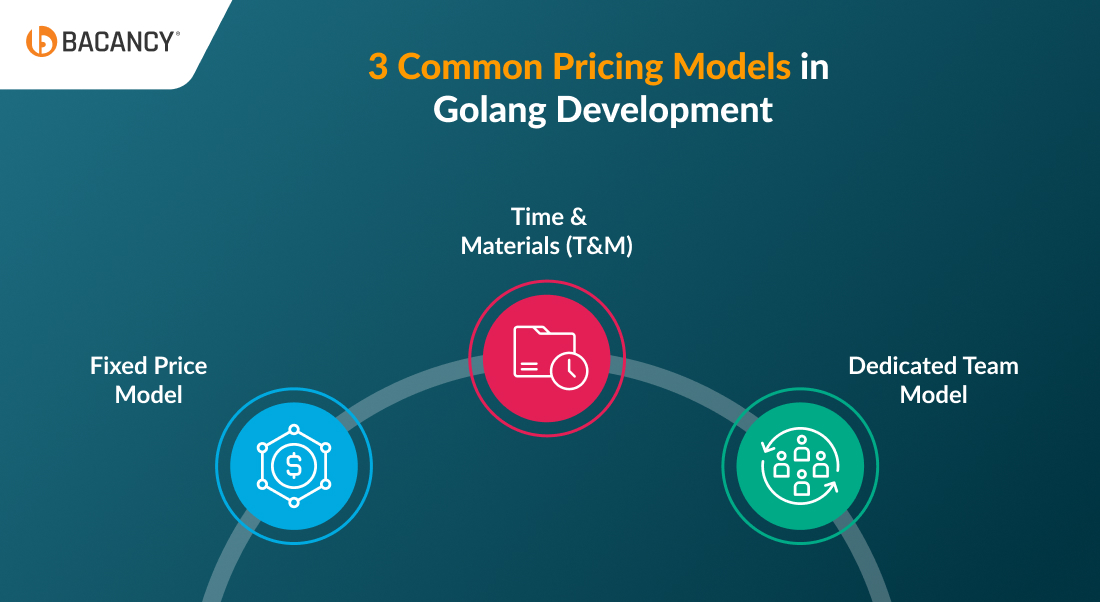
1. Fixed Price Model
It is the best choice when your Golang application scope is clear. The fixed-price model can be accurately predicted if the features, architectures, and integrations are defined early.
How it works in reality:
We usually apply this model for
- MVPs with limited development
- Well-documented backend rewrites in Go
- Clearly defined microservices with fixed traffic assumptions
Typical Cost Range:
$25,000 – $80,000 (depending on complexity and compliance needs)
What most clients underestimate:
In Golang, architectural decisions, such as memory optimization and service boundaries are made early. If these assumptions change mid-way, then your app needs higher throughput or streaming support since the fixed prices are rigid.
From our experience, we mitigate this by:
- Locking architectural constraints early
- Adding a buffer for performance tuning
- Freezing non-critical feature creep
2. Time & Materials (T&M)
This is the most common model we see for serious Golang products, especially platforms expected to scale or evolve rapidly. You pay only for the actual development time spent, and it offers you flexibility to adjust priorities, features, and designs as the business grows.
How it Works in Reality:
You pay only for the actual development time spent and are typically billed monthly.
Typical Cost Range:
$6,000 – $15,000 per developer/month
Why Golang fits T&M extremely well:
- Performance tuning is iterative
- Parallel processing issues surface under real load
- Observability, logging, and optimization evolve over time
With Time & Materials, you are not locked into early assumptions. You can:
- Optimize APIs after traffic grows
- Refactor services for better throughput
- Introduce caching, queues, or async flows when needed
From our experience with T&M, because:
- You retain full control over priorities
- You can pause, pivot, or scale the team
- Cost aligns directly with business value delivered
3. Dedicated Team Model
This model gives you full ownership, velocity, and long-term focus for your Golang application. Your team works exclusively with your product, aligned with your decisions and business priorities.
How it Works in Reality:
You get a fully dedicated Golang team that works as an extension of your in-house engineers.
Typical Cost Range:
$8,000 – $25,000 per month (based on team size and seniority)
Where this model is best:
- High-throughput systems
- SaaS platforms
- Fintech, healthcare, or data-heavy products
- Long-term modernization projects
Hidden Cost Advantage:
With Go, domain knowledge matters. Once developers deeply understand your data flow, high-loading patterns, and scaling bottlenecks, your cost per feature drops over time, not increases.
From the experience of our dedicated Golang teams:
- Reduce rework significantly
- Make smarter performance trade-offs
- Proactively optimize cost-heavy areas like compute and I/O
6 Cost Control Strategies for Golang App Development
It is focused on controlling costs, reducing risks, and maximizing ROI. Here’s what we have learned from helping startups and enterprises build Golang mobile applications that minimize costs, reduce risks, and deliver results.
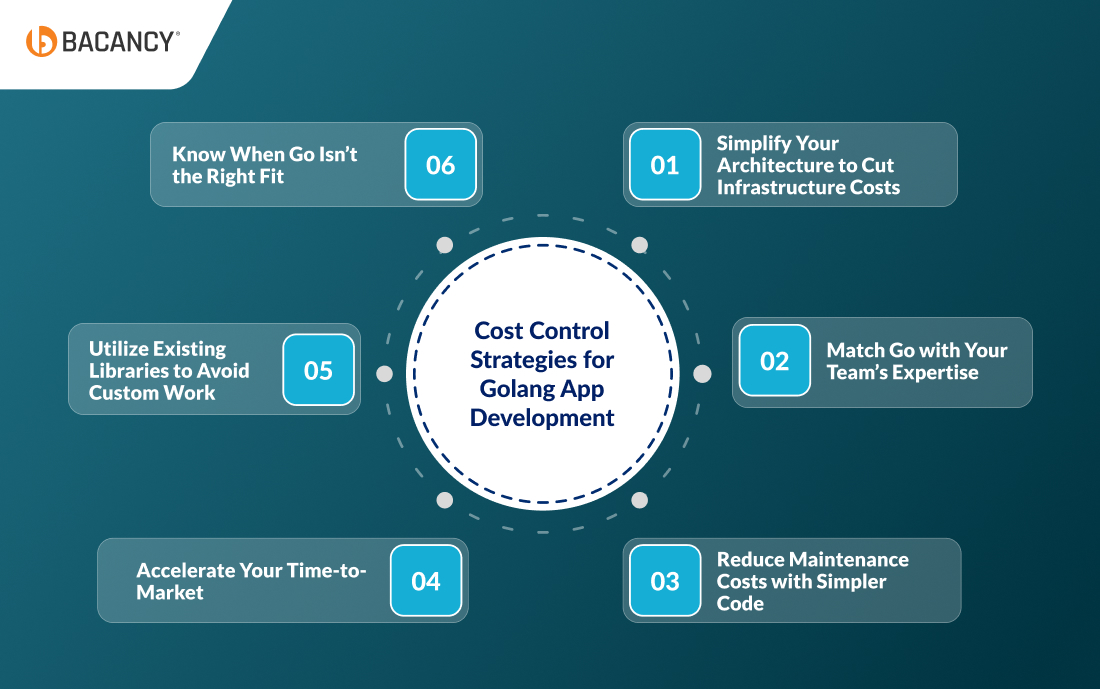
1. Simplify Your Architecture to Cut Infrastructure Costs
We always recommend to keep your architecture as lean and efficient as possible. If your system is overly complex, you will end up paying more in terms of cloud servers, maintenance, and scaling. The Golang applications should run on fewer resources and ensure infrastructure cost stays predictable.
Our Use Case: A SaaS analytics client wanted to re-architect their backend. We have simplified the Go microservices setup and reduced monthly cloud costs by 25%, handled twice the traffic, and made future scaling easier without adding any extra infrastructure spend.
2. Match Go with Your Team’s Expertise
Your team should determine technology that they are familiar with and have expertise in. It will save your time, prevent expensive mistakes, and ensure cleaner code, fewer bugs, and faster delivery. As a result, this approach reduces the need for training or external consultants and keeps your overall project cost lower.
Our Use Case: A logistics company engaged with our developers for a real-time tracking system. We worked closely with their existing team, and the project finished 30% faster than expected, it eventually resulted in extra training costs and reliance on external resources.
3. Reduce Maintenance Costs with Simpler Code
Technical debt drains your budget silently. Our developers write clean and maintainable Go code that decreases bugs and simplifies future updates. You can easily add new features without spending time fixing legacy code, and lowering your long-term maintenance costs.
Our Use Case: A healthcare SaaS platform rebuilt its backend with our Go team. Maintenance workload dropped by 40%, freeing their internal developers to focus on innovation and new features rather than firefighting old code, which improved delivery speed and reduced recurring costs.
4. Accelerate Your Time-to-Market
We know that faster delivery drives faster ROI. With Go, our developers can implement features quickly without sacrificing quality. Shorter timelines reduce labor costs, allow early market entry, and help you capture opportunities before your competition.
Our Use Case: A fintech startup partnered with our team to build a real-time transaction monitoring system. The MVP launched in six weeks instead of ten, allowing them to capture early market share and generate revenue sooner, while keeping development costs well within budget.
5. Utilize Existing Libraries to Avoid Custom Work
We always advise using Go’s mature ecosystem of libraries for logging, authentication, payments, and messaging. Instead of building everything from scratch, our developers integrate these reliable libraries to save development time, reduce errors, and control costs.
Our Use Case: An e-commerce client needed multiple payment gateways and shipping APIs integrated. By using existing Go libraries, our team avoided costly custom development, accelerated delivery, and ensured the backend remained stable and reliable.
6. Know When Go Isn’t the Right Fit
While Go is excellent for backend and API systems, it’s not ideal for frontend-heavy projects. Our developers help you evaluate whether Go is the right choice for your project. Misapplying it can increase your costs and extend timelines, so we guide you to use the right tool for the job.
Our Use Case: A mobile app initially built in Go for frontend-heavy features switched to Nodejs + React after consulting with us. This decision reduced development time by 40%, prevented unnecessary cost overruns, and ensured resources were focused on features that delivered real value.
Go App Development Cost by Application Type
Golang app development cost vary significantly based on what you are developing, how it scales, and how much responsibility the backend carries. Below is the realistic breakdown of Golang development costs in 2026 by application types.
1. MVP / Startup-Stage Applications
The first initial type is MVPs that focus on speed, validation, and cost efficiency. Golang is often chosen here for lightweight APIs, fast response times, and low infrastructure overhead.
What your backend usually includes:
Core APIs, basic authentication, database integration, limited third-party services, and minimal concurrency handling.
Estimated cost range:
$15,000 – $40,000
2. SaaS Backend / Scaling-Stage Applications
Scaling SaaS products relies heavily on Golang for performance, stability, and efficient resource usage as traffic grows.
What your backend usually includes:
Multi-tenant architecture, role-based access, background jobs, caching, API rate limiting, and moderate concurrency.
Estimated cost range:
$40,000 – $120,000+
3. Fintech & Healthcare Applications (Compliance-Heavy)
In regulated industries, Golang is used for secure, high-performance backends, but compliance adds a significant cost layer.
What your backend usually includes:
Advanced authentication, encryption, audit logs, compliance-ready data handling, secure APIs, and strict access controls.
Estimated cost range:
$70,000 – $180,000+
Golang vs Other Backend Technologies (2026 Cost Comparison)
| Cost Factor
| Golang
| Node js
| Java | Python |
|---|
| Developer Rate (USD/hr)
| $50 - $120 | $40 - $100
| $60 - $130
| $40 - $110
|
| Medium App Development Cost
| $40K - $120K
| $35K - $100K
| $50K - $150K
| $30K - $100K
|
| Infrastructure & Scaling Cost
| Low: Goroutines are handled efficiently, and fewer servers are needed
| Moderate: Event-loop scaling may need extra servers
| High: Thread-heavy, costly to scale
| Moderate: GIL limits concurrency, adding servers for heavy load
|
| Maintenance & Long-Term Cost
| Low: Simple codebase, fewer bugs, easy refactoring
| Moderate: Complex logic can increase debugging
| High: Verbose, JVM tuning, and scaling increase cost
| Moderate: Performance tuning adds effort and cost
|
Golang gives you the best combination of performance, scalability, and cost-efficiency, but whatever backend technology your project requires, you can hire backend developer from Bacancy with the expertise to handle your stack, optimize costs, and deliver high-quality solutions.
Expert Insight: Investing Smartly with a Golang App Development Company Like Bacancy
Go app development costs are not a technical decision, but it is a long-term investment decision. In 2026, backend systems are expected to handle real-time traffic, AI workloads, cloud-native deployments, and strict compliance requirements.
Here, the question is not “how much will Golang app development cost”? But rather, “how do you invest in it wisely to maximize ROI”?
As an experienced Golang development company, Bacancy has witnessed that the biggest cost risks rarely come from the coding itself. We created a well-structured Go backend that can reduce infrastructure overhead, enhance response time, and lower long-term maintenance effort.
From our experience, working with various clients, smart Golang investments focus on 5 core areas:
- Right architecture from the beginning. You should avoid over-engineering microservices when a modular monolith can meet early-stage needs.
- Concurrency planning, and you must design goroutines and worker pools strategically to prevent debugging and scaling challenges later.
- Ensure cloud optimization and align Go’s performance strengths with container orchestration and autoscaling strategies to avoid compute spikes.
- Security and compliance early integration with the implementation of SOC2, HIPAA, or ISO considerations into backend development instead of retrofitting them later.
- Scalable team structure that combines senior backend architects with execution-focused developers to balance quality and cost.
Frequently Asked Questions (FAQs)
Project Estimates & Budgeting
A basic MVP usually starts at $15,000 to $25,000 with a focus on core APIs and essential integrations.
Your cost should be around $150,000 due to complex, high-concurrency, and compliance-focused solutions.
Development takes the 50-60 % share, followed by design and testing/QA at roughly 10-15% each.
Modern & Hidden Cost Drivers
While it reduces hours spent on routine coding, it introduces a new review cost of $5,000 to $15,000 to ensure security and performance.
You should estimate between $2,000 and $5,000 per month, depending on traffic spikes and autoscaling needs.
Integrating strict security and compliance documentation typically adds $15,000 to $40,000 to the project.
Strategic Engagement Models
A dedicated remote Golang team or offshore developers with a senior technical lead is usually the most cost-effective model. It balances expertise and affordability while maintaining quality.
Yes. Golang’s simple syntax, strong standard library, static typing, and fast performance make applications easier to maintain, which decreases long-term maintenance and debugging costs.
Timeline & ROI
- MVP backend: 4 – 10 weeks
- mid-size application: 3-6 months
- enterprise system: 6-12+ months
Shorter deadlines increase cost due to larger teams, overtime, and rushed QA. Flexible timelines significantly reduce total spending.
Yes, early automated testing reduces production bugs, emergency fixes, and downtime, which cuts lifecycle costs substantially.
Golang becomes more economical when applications require high concurrency, scalability, real-time processing, or heavy API workloads.
Frequent changes cause rework in architecture, APIs, and testing, significantly increasing cost. Lock core requirements early.