Quick Summary
Discover how MakeMyTrip overcame major infrastructure roadblocks, such as legacy system limitations, traffic spikes, and complex dependencies, by migrating to AWS and achieving a seamless, zero-downtime transition in just six months. Let’s break down the MakeMyTrip AWS migration case study focusing on the challenges, strategy, architecture, and business impact.
Table of Contents
Introduction
Running one of India’s largest travel platforms means operating at lightning speed, with no margin for error. Every second of downtime isn’t just a technical glitch; it could mean thousands of missed bookings, unhappy customers, and lost revenue.
Now, picture having to shift this platform and its entire infrastructure, which includes over 1500 servers and 100 applications, to the cloud, without affecting customers or slowing down the business.
That’s exactly what MakeMyTrip accomplished. In just six months, they successfully migrated to Amazon Web Services (AWS) with zero downtime. The result? Faster performance, improved scalability, and long-term cost savings.
No disruption, no drama, just execution at scale! That’s not just impressive, it’s a benchmark for large-scale cloud migrations.
At Bacancy, we’ve supported many businesses through complex cloud migrations, each with its own set of challenges. Our approach is practical; we collaborate closely with engineering teams, tailor strategies to real-world constraints, and focus on minimizing risk and downtime. Whether it’s legacy systems or high-traffic platforms, we help ensure migrations are not only successful but sustainable.
The MakeMyTrip AWS migration is a successful large-scale transformation executed by To The New. We have studied their case study in detail to uncover how they tackled complex challenges, ensured zero downtime, and delivered a seamless transition to the cloud. This blog shares key insights and practical lessons you can apply to your own cloud journey. Let’s begin!
But to fully understand the scale and impact of this migration, it’s important to first understand the business behind it.
MakeMyTrip at a Glance!
Founded in 2000 and headquartered in Gurugram, India, MakeMyTrip is India’s largest online travel company. It provides a comprehensive suite of travel-related services to individual travelers and businesses across domestic and international markets.
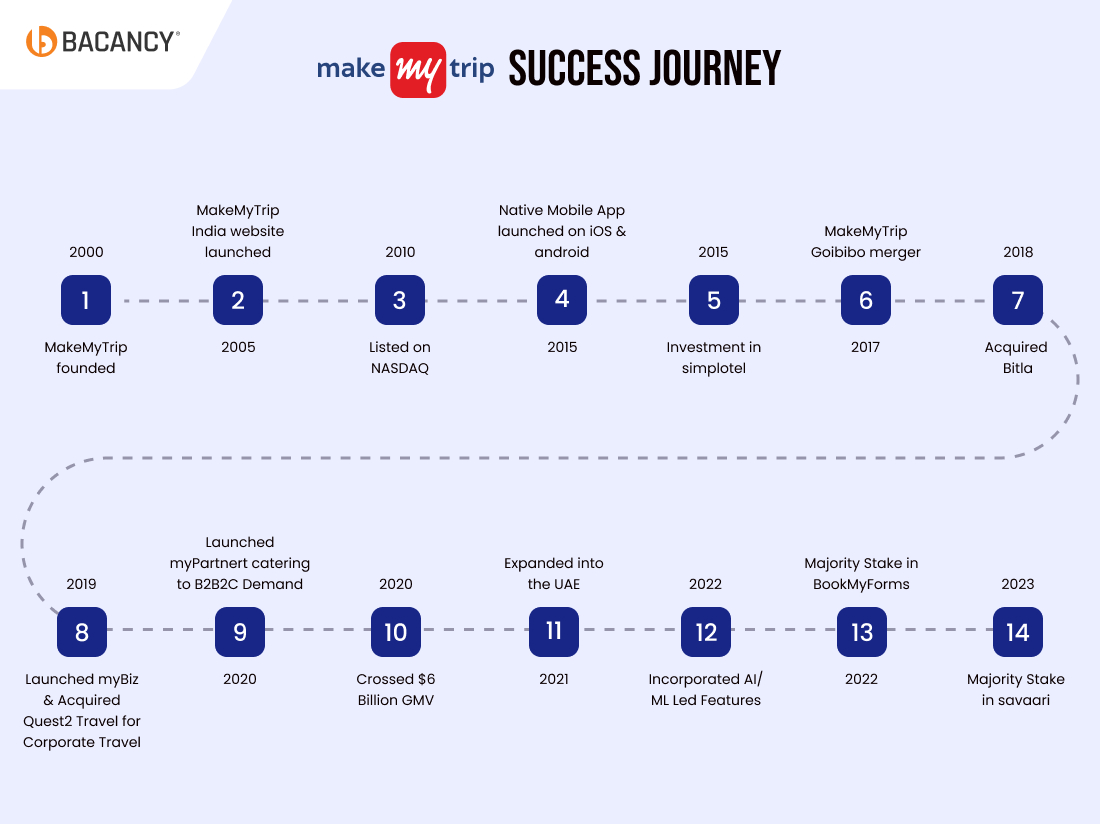
Business model
MakeMyTrip primarily operates under a Business-to-Consumer (B2C) model, directly offering its services to customers through its website and mobile app. Additionally, the company serves the corporate travel market through its MyBiz platform, offering tools for managing employee travel and expenses.
Core Offerings
MakeMyTrip’s platform enables customers to plan, book, and manage their travel needs through a wide range of services:
- Flight Bookings: Domestic and international airline ticket reservations.
- Hotel Reservations: Access to a broad inventory of hotels across categories and destinations.
- Holiday Packages: Pre-designed and customizable vacation packages.
- Rail and Bus Ticketing: Booking options for Indian Railways and intercity bus services.
- Cab Services: Airport transfers, intercity, and local transportation bookings.
- Visa Assistance: Support for travel documentation and visa processing.
Retail & Airport Presence
To complement its digital platform, MakeMyTrip has built a physical network that supports offline travel bookings and customer service:
- 14 company-owned travel stores across 14 major cities in India.
- 30+ franchisee-owned stores operating in around 28 cities.
- Service counters in 4 major Indian airports under the MakeMyTrip brand.
Global Presence
To support its global operations and cater to international customers, MakeMyTrip has established offices in key international locations, including New York, Singapore, Kuala Lumpur, Phuket, Bangkok, and Dubai.
What Challenges Did MakeMyTrip Face With Traditional Infrastructure?
Before moving to the cloud, MakeMyTrip relied on traditional data centers. While effective at first, this setup soon led to scalability, efficiency, and innovation issues. The MMT AWS migration solution addressed these challenges head-on, paving the way for a more agile and resilient infrastructure. Take a look at the major problems they faced:
Slow Provisioning and Upgrades
Anytime the tech team needed to roll out a new feature or support a product launch, they had to request new servers. This involved weeks of manual setup, coordination with vendors, and testing. By the time infrastructure was ready, competitors often beat them to market.
Inability to Handle Traffic Surges
The on-premise infrastructure lacked the flexibility to manage sudden spikes in traffic, especially during peak travel periods or promotional campaigns. This led to system slowdowns and degraded user experiences.
High Operational Overhead
Maintaining physical servers demanded significant time, budget, and manpower. From regular hardware upgrades to ongoing system monitoring, these repetitive tasks pulled resources away from more strategic business initiatives.
Limited Flexibility for Innovation
The infrastructure lacked the agility needed for rapid testing and deployment. This made it difficult for development teams to experiment with new ideas or launch updates efficiently, creating roadblocks to continuous innovation.
Growing Complexity in Application Management
As the platform scaled, managing a large number of applications and services across disparate servers became increasingly complex. This required constant intervention from IT teams and introduced risks related to consistency, downtime, and maintenance.
Why Did MakeMyTrip Think Migrating to AWS Was The Right Choice?
MakeMyTrip selected Amazon Web Services (AWS) as its cloud provider due to its ability to meet both the technical and business needs of a fast-growing, high-traffic digital platform. As the company faced growing demands for scale, flexibility, and reliability, AWS offered a cloud ecosystem that aligned perfectly with their goals.
Here’s why AWS stood out as the ideal choice:
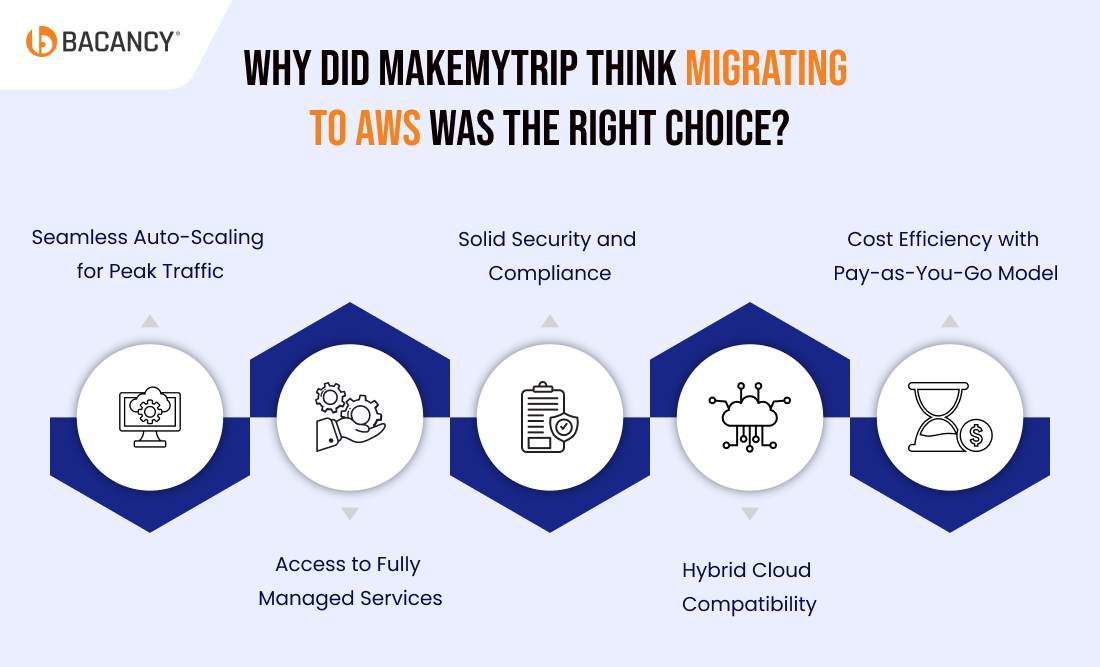
Seamless Auto-Scaling for Peak Traffic
With millions of users booking flights, hotels, and holidays, especially during seasonal spikes, MakeMyTrip needed infrastructure that could automatically scale up or down based on demand. Also, AWS auto-scaling capabilities ensured consistent performance, even during traffic surges.
Access to Fully Managed Services
AWS offers a wide range of fully managed services, such as Amazon RDS (Relational Database Service), ELB (Elastic Load Balancer), AWS Lambda, and S3 (Simple Storage Service). These helped reduce the company’s operational burden, enabling the team to focus more on innovation and less on infrastructure maintenance.
Solid Security and Compliance
Data protection is a top priority in the travel industry. With the on premise to AWS migration, MakeMyTrip gained access to AWS’s robust built-in security features, including encryption, access control, and compliance with global standards. This gave them confidence in safeguarding sensitive customer and payment data.
Hybrid Cloud Compatibility
AWS offered flexible options to integrate on-premises systems with cloud services using tools like AWS Direct Connect and Route 53. This made it easier for MakeMyTrip to adopt a hybrid cloud model during their transition, minimizing disruption and improving connectivity.
Cost Efficiency with Pay-as-You-Go Model
Instead of investing heavily in upfront infrastructure, AWS’s pricing model allowed MakeMyTrip to pay only for what it used. This brought better cost control, reduced cloud waste by avoiding over-provisioned resources, and made scaling more financially sustainable.
Need to migrate without losing a single transaction or user session?
Leverage AWS Migration Services to ensure a seamless, zero-downtime transition from legacy to cloud.
What Technologies Powered the Migration?
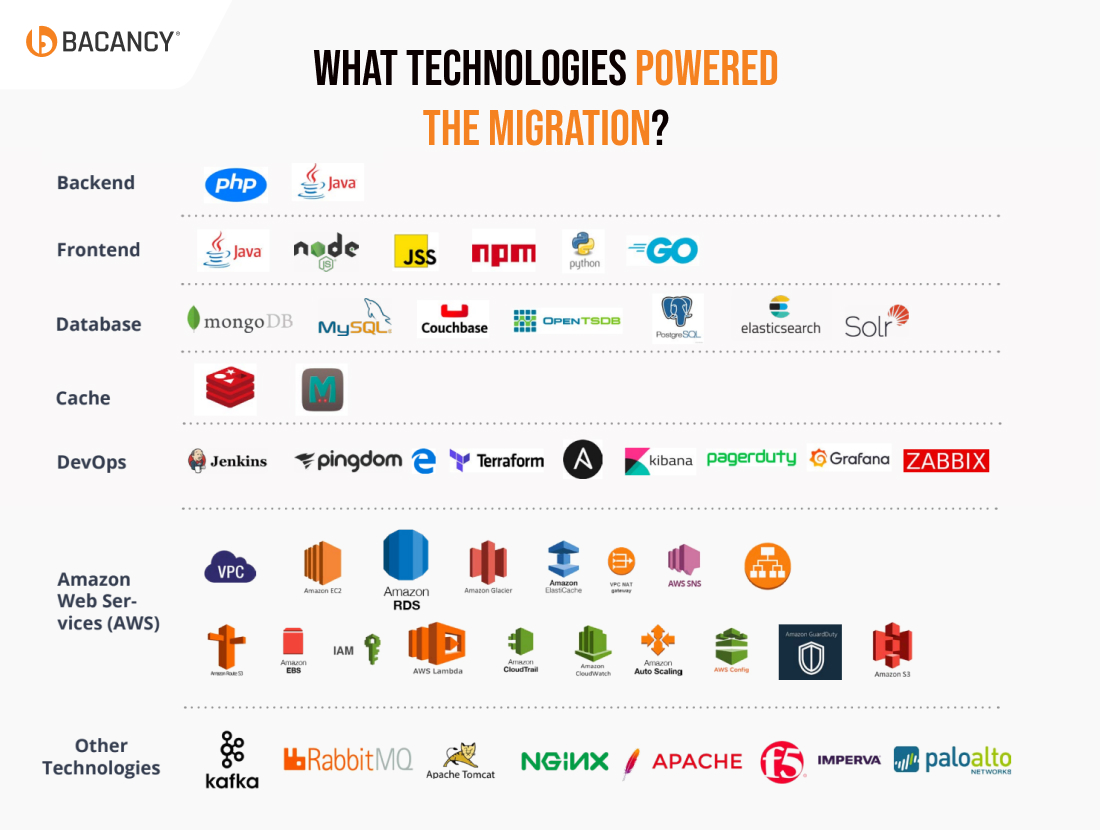
With the support of To The New, MakeMyTrip leveraged a carefully selected tech stack to migrate over 1,500 servers and 100+ applications to AWS, without disrupting business operations.
Behind the Numbers: MakeMyTrip’s Post-Migration Achievements
From faster performance to reduced costs and stronger scalability, every part of the business benefited. Here’s a quick look at the results that made this migration a game-changer.
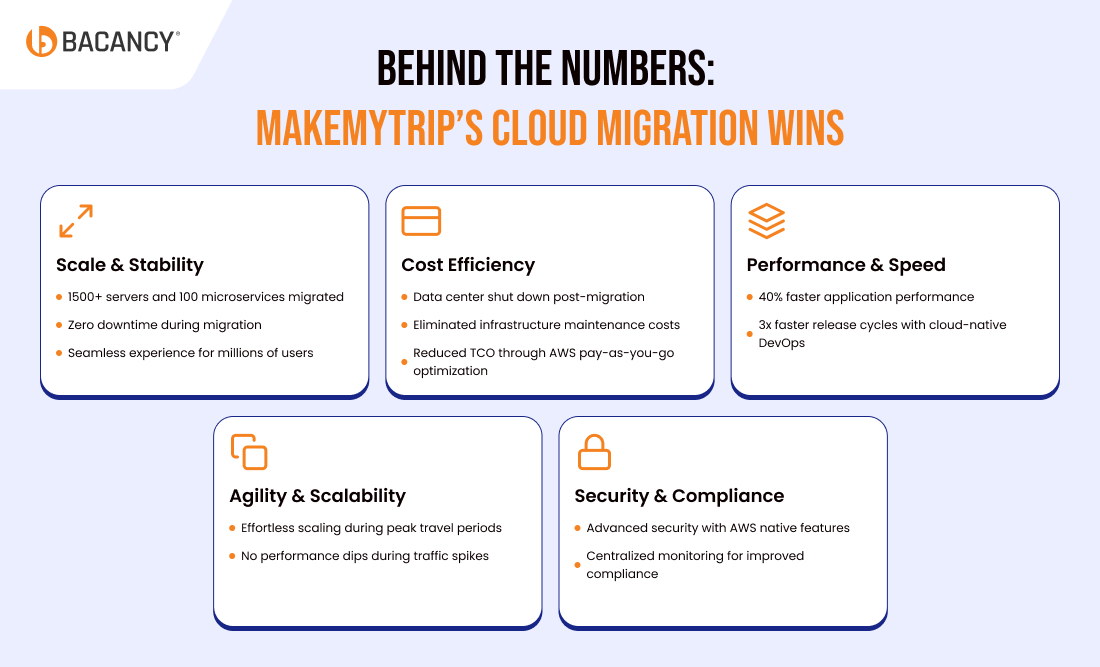
- MakeMyTrip successfully migrated over 1500 servers and 100 microservices with zero downtime, ensuring uninterrupted service for millions of users.
- The legacy data center was fully shut down after migration, which significantly reduced operational complexity and eliminated infrastructure maintenance costs.
- Application performance improved by up to 40%, resulting in faster load times and a smoother user experience.
- Automation and cloud-native DevOps tools accelerated the release cycle, allowing teams to deliver new features up to 3x faster.
- The company reduced its cloud TCO (total cost of ownership) by optimizing cloud usage and minimizing cloud waste through AWS’s pay-as-you-go pricing model.
- MakeMyTrip gained the ability to scale effortlessly during peak travel periods, handling traffic spikes without performance issues.
- Security and compliance were enhanced using AWS’s advanced security features and centralized monitoring systems.
5 AWS Migration Lessons You Can Learn From MakeMyTrip
Here are five practical lessons from MMT’s AWS migration that any business can apply to reduce risk, improve performance, and ensure long-term success.
1. Start with a Hybrid Cloud Setup
MakeMyTrip didn’t switch entirely to the cloud in one go. They connected on-premise systems to AWS, creating a hybrid model that allowed testing and gradual transition. This reduced risk, gave flexibility, and let them migrate at their own pace.
Pro Tip: Our experts suggest this approach to enterprises dealing with legacy environments. It gives teams breathing room to validate performance, build cloud-native skills, and avoid big-bang disruptions that can cause instability.
2. Use Automation to Avoid Delays and Mistakes
Automation was key in reducing deployment errors and manual configurations for MakeMyTrip. They automated infrastructure provisioning, testing, and scaling, which saved time and ensured consistency across environments.
Pro Tip: In similar scenarios, we advise clients to start with infrastructure as code and layer automation incrementally. This helps engineering teams move faster without getting overwhelmed, and ensures a consistent setup across staging, QA, and production.
3. Prioritized Critical Workloads First
MakeMyTrip didn’t treat all workloads equally during the migration. They prioritized mission-critical applications and customer-facing services first, ensuring business continuity and early value delivery. Less critical internal systems followed later, allowing smoother transitions and better resource focus.
Pro Tip: When guiding enterprise migrations, we recommend identifying high-impact workloads and aligning them with business goals. This helps demonstrate early wins, builds stakeholder confidence, and ensures that the most valuable parts of your platform are battle-tested first.
4. Optimize Costs Early in the Process
MakeMyTrip didn’t just aim for performance gains; they optimized for cost from the start. By choosing the right instance types, setting up auto-scaling, and eliminating idle resources, they controlled cloud spending even as usage increased.
Pro Tip: Implement cost monitoring dashboards and tagging strategies before large-scale migrations. This gives teams clarity on which workloads cost the most and how to tune architecture for cost-efficiency from day one.
5. Maintain Visibility at Every Stage
During the MMT migration, they relied on monitoring and logging tools to track performance, detect anomalies, and proactively manage migration. Having visibility at every step helped them make better decisions.
Pro Tip: Visibility is something we advise to never compromise on. They often help clients set up real-time dashboards and alerts before migration begins. Tools like Prometheus, CloudWatch, and Grafana become critical for proactive troubleshooting and performance tuning.
5 Key Insights by Bacancy's CTO on MMT AWS Migration
“Successful cloud migration isn’t about lift-and-shift, it’s about rethink-and-rewire. What stood out in MakeMyTrip’s approach wasn’t just speed, but the discipline to automate, validate, and learn before every move. That’s the difference between a migration and a transformation.”
– Binal Patel, Chief Technology Officer, Bacancy
Here are five key insights I believe every technology leader should carry into their next cloud migration just like we studied in the MakeMyTrip case study.
1. Speed Without Discipline Is a Setup for Failure
“Six months sounds fast. But speed without structure leads to hidden fragility.”
Most teams are pressured to move fast. But without foundational principles, like dependency mapping, phased rollouts, and rollback plans, you’re setting yourself up for delayed pain. MakeMyTrip succeeded because every step was validated before the next move.
What You Can Do:
Map out not just your application dependencies but also your team dependencies. Who owns what? Where’s the tribal knowledge? Migration isn’t just tech, it’s people and processes.
2. Mirror Environments Are the Most Underused Superpower
“Replicating the production environment is the closest you can get to a full-scale rehearsal before executing a cloud migration.”
MakeMyTrip created a live mirror of production on AWS before cutting over. Most companies skip this step because it feels “expensive.” In reality, it’s the cheapest insurance policy against failure. The mirror helped them run real traffic tests and build rollback confidence.
What You Can Do:
Temporarily mirror your production environments using staging infrastructure on AWS. Run synthetic traffic and A/B split. This approach will expose latency spikes, load bottlenecks, and security gaps early, when fixes are cheaper, faster, and less disruptive.
3. Don't Just Migrate; Modernize Along the Way
“Cloud migration offers a rare chance to eliminate technical debt. Don’t carry legacy baggage into a modern environment.”
MakeMyTrip didn’t settle for simply moving systems to the cloud. They used the migration as an opportunity to re-architect their stack into microservices, replace outdated components, and adopt modern DevOps practices. It gave them long-term flexibility and a stronger foundation for innovation.
What You Can Do:
Approach your migration as a gateway to modernization. Use it to refactor legacy code, decouple monoliths, adopt containers, and streamline deployment pipelines. The goal is not just to operate on the cloud but to evolve with it.
4. Smaller Migration Steps Lead to Bigger Long-Term Wins
“We often tell clients: Break your migration into a series of experiments. Then scale what works.”
A phased migration isn’t just about risk reduction. It’s about learning in public. MakeMyTrip treated each wave of migration as a mini-experiment: test performance, evaluate cost, analyze observability. This learning loop is what made their success sustainable.
What You Can Do:
Avoid “big bang” cutovers. Instead, define success metrics for each wave (latency, failover time, rollback duration) and iterate. Share learnings internally to improve confidence across teams.
5. AI Isn’t Just the Future, It’s the Migration Multiplier
“You don’t migrate just to run leaner, you migrate to run smarter.”
MakeMyTrip didn’t stop at infrastructure modernization. Post-migration, they tapped into AWS’s capabilities to power intelligent experiences. Their AI chatbots, Myra and Gia, now handle over 80% of customer queries, personalize responses, and even support voice bookings in Hindi and English. The result? Faster bookings, reduced agent load, and a measurable drop in service costs.
This was only possible because their cloud foundation was built to support real-time data, rapid iteration, and scalable AI services, all of which demand modern infrastructure.
What You Can Do:
- Build your architecture to be AI-ready from day one, with clean APIs, centralized data, and clear service boundaries.
- Leverage AWS tools like Lex (chatbots), SageMaker (ML models), or Bedrock (GenAI) to experiment fast.
- Start with narrow wins, like automating support or itinerary generation, then expand.
Build A Winning AWS Migration Strategy With Bacancy
Moving to the cloud isn’t just about changing servers; it’s about making your business faster, more reliable, and ready for the future. The MakeMyTrip AWS migration is a great example of how the right strategy can enable a smooth move to the cloud without downtime, delays, or disruption.
At Bacancy, we offer cloud migration services designed for real-world business challenges. Whether you’re moving a few applications or your entire infrastructure, we help you with:
- Step-by-step migration planning that fits your unique environment.
- An automation-first approach to reduce human error and speed up delivery.
- Thorough testing to catch issues before they impact production.
- Zero-downtime execution that keeps your business running smoothly.
- Post-migration optimization to improve performance and control costs.
Our team has helped companies of all sizes successfully move to AWS, quickly, safely, and with long-term results in mind.
If you’re planning a cloud move, let’s talk. We’ll help you get it right the first time.
Frequently Asked Questions (FAQs)
Yes. Bacancy specializes in large-scale AWS migrations, offering step-by-step planning, automation-first execution, and zero-downtime strategies tailored to real-world business needs.
Absolutely, a hybrid cloud is ideal for businesses with legacy infrastructure. You can connect your ERP system to AWS using VPNs or Direct Connect, allowing you to migrate modules step by step without disrupting ongoing operations.
Yes, we can help you! Many clients come to us with fragmented cloud adoption. We help assess what’s working, eliminate tech debt, and re-architect your stack into a more efficient, cloud-native foundation.
Definitely, AWS offers tools like Amazon Lex, SageMaker, and Bedrock to power chatbots, recommendation engines, and personalization. We can help you build an AI-ready infrastructure that scales as you grow.
That’s where cloud readiness assessment comes in. Bacancy’s experts analyze your apps for cloud fit, refactoring needs, and dependency mapping, giving you a clear migration plan, not guesswork.