Django with React combines a powerful backend with an interactive frontend to build dynamic, scalable, and efficient web applications. This blog explores how this full-stack duo streamlines development and delivers seamless user experiences.
Table of Contents
Introduction
“Trying to release new features fast but held back by slow apps, inconsistent UI, and scattered development teams?”
A feature-rich application with low speed and a non-intuitive user interface can be a big flop for businesses. No matter how much you invest, you won’t be able to truly empower your business.
You need a reliable backend and a fast, interactive frontend. With so many options, choosing the right one can be tough. As per the Reddit discussion, Django with React is a top choice to build dynamic web software.
Django provides a secure and scalable backend, while React delivers a smooth, dynamic user interface. Together, they speed up development, facilitate teamwork, and ensure your app is ready for the future.
Let’s explore why this full-stack duo is the go-to choice for building apps that scale and perform.
Why Choose Django with React?
Both Django and React are powerful backend and frontend technologies that offer a full-stack API-driven architecture. It allows you to create modern web applications that are fast, scalable, and provide engaging user experiences.
Faster Result with Increased Performance
Django manages database interactions, server-side logic, and authentication through its built-in security features. This keeps backend workflows smooth even under heavy loads. For example, Instagram uses Django to handle millions of uploads and user actions efficiently.
React components update interfaces dynamically without full page reloads. Platforms like Facebook and Airbnb rely on this approach to show instant notifications and search results.
React and Django deliver faster responses, reduce server load, and create seamless user experiences that can 2x app performance.
Meet Modern UI/UX Expectations
React ensures a dynamic frontend experience because of its powerful component-based architecture, which makes it easy to build sleek, interactive, and engaging interfaces. Your users get the benefit of single-page application (SPA) performance, smooth transitions, minimal reloads, and a native app-like feel.
While Django supports the backend experience and ensures that the data powering these modern experiences is secure, consistent, and quickly accessible. As a result, together Django and React provide an appealing user interface and robust backend to create modern apps with effortless features and functions.
Scale App Without Complexity
React with Django is a perfect choice if you want scalability in your application. Django’s architecture promotes clean, maintainable code and encourages the reuse of modules. The backend logic of Django ensures that development is organized and efficient.
React’s component-based structure similarly allows the front end to scale gracefully as the application grows. Together, they enable teams to scale both the backend and front end independently, minimize technical debt, and ensure long-term maintainability.
Connect Backend-Frontend Capabilities
The Django REST Framework (DRF) simplifies the creation of API endpoints that React can effortlessly consume. It enables backend and frontend teams to work in parallel, reduces integration delays, and improves development speed.
The clear separation between the layers enhances maintainability, eliminates bugs, and ensures a more robust and reliable application.
Let’s better understand why React with Django is a suitable solution by comparing it with other full-stack combinations.
Django with React vs Other Full-Stack Combos
Aspects
Django + React
MERN & LAMP
Backend Efficiency
Django ORM and built-in admin speed up development.
Needs extra setup for ORM and admin tools.
Frontend Responsiveness
React SPA gives a fast, app-like UX.
Angular/Vue add complexity, LAMP reloads pages.
Security
Built-in security includes CSRF, XSS, and SQL Injection protection.
Security depends on manual setup and libraries.
Scalability
Backend and frontend scale independently.
Coupled and harder to scale efficiently.
Community Support
Large, reliable, with many packages.
Large but fragmented support.
Developer Productivity
High because of clear separation and reusable modules.
Moderate to High.
Learning Curve
Moderate and easy to onboard.
Often steeper, especially MERN.
Time to Market
Faster with built-ins and DRF + React UI speed.
Slower due to more manual setup.
5 Benefits of Choosing React js with Django for Your Project
React.js and Django complement each other perfectly, making them a smart choice for modern applications. Here are the top 5 advantages of Django and React.
1. Cost Efficiency in Development and Scaling
Utilizing Django with React, you can achieve more tasks with fewer resources. Django provides easy-to-apply backend features, such as security, authentication, and an admin panel. Conversely, React offers reusable UI components that reduce your frontend efforts.
This full-stack combo speeds up your development and decreases large expenditures on the teams. For a CTO or business owner, it indicates you can market faster, reach wider audiences, and save significant amounts on upfront and growth-phase expenses.
2. Future-Proof Tech Stack for Long-Term Growth
Both React and Django are powerful frontend and backend tools with a supportive community and evolving ecosystem. They also signify long-term support, regular security updates, and access to modern tools.
For a CTO, adopting Django with React means building on a stack that will stay relevant, flexible, and adaptable to future business needs. Moreover, both tools integrate with advanced technologies like AI/ML models, cloud-native solutions, real-time data processing, and microservices architectures.
3. Strong Security Software for Enterprise Applications
Django comes with enterprise-grade security features like protection against SQL injection, Cross-Site Scripting (XSS), Cross-Site Request Forgery (CSRF), and clickjacking out of the box. By combining it with React’s controlled rendering, it ensures data and UI are safeguarded against common vulnerabilities.
For CTOs, this means fewer security overheads and compliance readiness, especially in regulated industries like fintech or healthcare.
4. Consistency Across Web & Mobile Platforms
Django’s API-first approach allows businesses to build a single backend that can serve multiple frontends. It means the same Django-powered backend can seamlessly support a React web application and a React Native mobile application without requiring separate backend development efforts.
For CTOs, this creates a unified ecosystem where data, business logic, and security standards remain consistent across platforms. The result is faster time-to-market for both web and mobile apps, lower development and maintenance costs, and a smoother experience.
5. Low Maintenance Overhead
To maintain a web application using Django and React is quite simple because the frontend and backend are decoupled. For instance, if there are any updates or changes in the one layer, it will not affect the rest. This eventually reduces the risk of hampering functionality.
Moreover, the concern of separation makes debugging easier, simpler the latest updates, and lowers long-term maintenance costs. It gives CTOs and tech leaders relief with fewer operational headaches, faster adaptation to changes, and leaner technology budget over time.
This hands-on advantage is something our CTO has also experienced firsthand:
“When we adopted Django with React for a large-scale project, the impact was clear. Our development cycle moved faster, product stability improved, and the overall delivery cost stayed within budget. The decoupled architecture gave us flexibility to scale and adapt quickly without disruption. This Full Stack combo allowed us to focus on innovation instead of constant technical fixes.”
Binal Patel
CTO at Bacancy
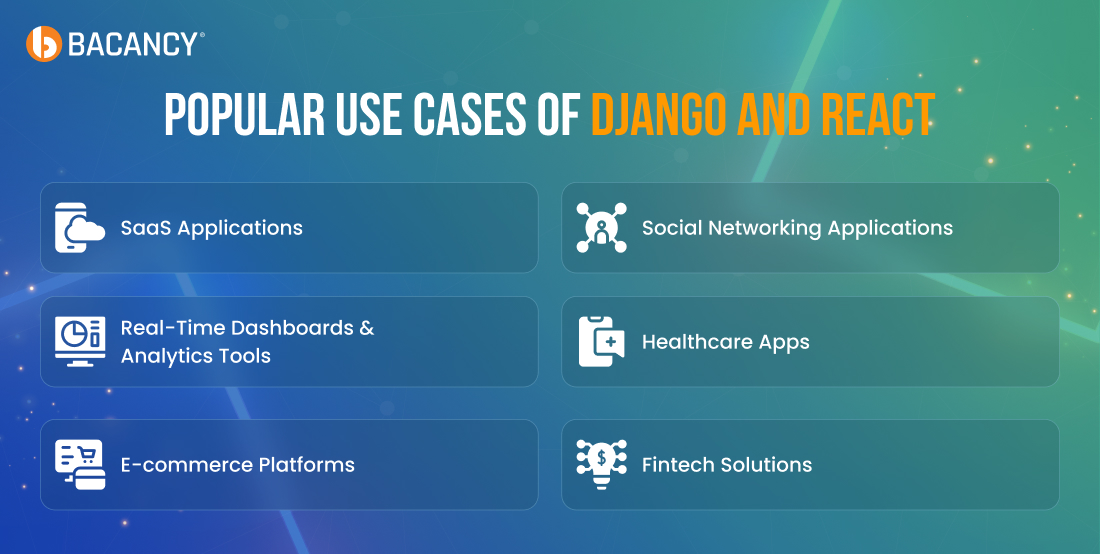
6 Popular Use Cases of Django and React
From startups to enterprises, several companies rely on Django and React to turn complex workflows into high-performing web applications. Below are the most common scenarios where this pairing delivers results.
1. SaaS Applications
SaaS platforms demand frequent feature releases, secure multi-tenant architectures, and high user engagement. Django accelerates backend development with reusable modules, authentication, and API-friendly design patterns. React complements this with interactive dashboards, modular components, and smooth navigation across features.
Real-Life Example: Disqus, a popular blog commenting system, uses Django for backend scalability and React for a smooth, dynamic UI.
2. Real-Time Dashboards & Analytics Tools
Dashboards need low-latency data handling and instant updates. Django’s channels and WebSockets can push real-time data to APIs, while React efficiently re-renders only the affected components (charts, tables, graphs) instead of the entire page.
Real-Life Example: NASA has used Django in some of its projects for handling large-scale data, and React-based dashboards are often integrated for real-time visualization.
3. E-commerce Platforms
E-commerce platforms handle payments, inventory, search, and personalization, all requiring security and scalability. Django ensures PCI-compliant transactions and backend logic for inventory/order workflows. React makes browsing faster with client-side rendering, product carousels, and personalized recommendations.
Real-Life Example: Instacart, a grocery delivery platform, leverages Django on the backend and React on the frontend to deliver a fast shopping experience.
4. Social Networking Applications
Social platforms thrive on real-time interactions, scalability, and engaging UIs. Django efficiently manages authentication, user-generated content, and activity streams. React allows endless possibilities for likes, shares, infinite scrolling, and chat windows without constant page reloads.
Real-Life Example: Pinterest has used Django as part of its backend stack, while React powers many social media-style interfaces for dynamic engagement.
5. Healthcare Apps
Healthcare Mobile apps demand compliance, data security, and intuitive interfaces. Django’s built-in security features like CSRF protection, authentication, audit trails, keep patient data safe, while React builds dashboards for doctors and user-friendly portals for patients.
Real-Life Example: Doctor On Demand (a telemedicine app) uses similar stacks, where Django ensures security and React builds patient-doctor interaction modules.
6. Fintech Solutions
Fintech applications need rock-solid security and real-time transaction updates. Django handles encryption, fraud detection, and financial logic. While, React for fintech builds fast, intuitive interfaces where users track balances, trade stocks, or send payments instantly.
Real-Life Example: Robinhood, the stock trading app, has used React for frontend and Python/Django-based services on the backend to ensure secure and smooth trading experiences.
Maximize Cost Efficiency with Django with React
Hire Full Stack developers experienced in Django with React to craft scalable, budget-friendly applications that enhance efficiency and business growth.
Step-by-Step React with Django Tutorial to Get Started
Integrating Django with React allows you to create a modern, scalable web application. Django handles the backend, database, and API logic, while React powers a dynamic, responsive frontend. Here’s a detailed step-by-step guide to get you started.
Step 1: Set Up Your Django Backend
First, you need to install Python on your machine. Once it is ready, install Django and Django REST Framework (DRF) using pip:
pip install django djangorestframework
Django REST Framework makes it easy to build RESTful APIs that your React frontend can consume. Next, create a new Django project:
django-admin startproject myproject
cd myproject
Inside the project, create a Django app to manage your API endpoints:
python manage.py startapp api
Then, configure your installed apps in settings.py to include the new app and DRF:
INSTALLED_APPS = [
    ...
    'api',
    'rest_framework',
]
Step 2: Create Models and Apply Migrations
Define your database structure using Django models. For example, a simple task model can be created in api/models.py:
from django.db import models

class Task(models.Model):
    title = models.CharField(max_length=100)
    completed = models.BooleanField(default=False)

    def __str__(self):
        return self.title
Apply migrations to create the corresponding database tables:
You can also create a superuser if you want to access Django’s admin panel:
python manage.py createsuperuser
Step 3: Set Up Django REST Framework
Create a serializer in api/serializers.py to convert model instances into JSON format:
from rest_framework import serializers
from .models import Task

class TaskSerializer(serializers.ModelSerializer):
    class Meta:
        model = Task
        fields = '__all__'
Next, create API views in api/views.py:
from rest_framework import viewsets
from .models import Task
from .serializers import TaskSerializer

class TaskViewSet(viewsets.ModelViewSet):
    queryset = Task.objects.all()
    serializer_class = TaskSerializer
Set up URL routing in api/urls.py:
from django.urls import path, include
from rest_framework.routers import DefaultRouter
from .views import TaskViewSet

router = DefaultRouter()
router.register(r'tasks', TaskViewSet)

urlpatterns = [
    path('', include(router.urls)),
]
Include the API URLs in your project’s main urls.py and follow the below code:
path('api/', include('api.urls')),
Run the server to test your API:
python manage.py runserver
Visit http://127.0.0.1:8000/api/tasks/ to see your API in action.
Step 4: Set Up React Frontend
Now, create a new React project using Create React App:
npx create-react-app frontend
cd frontend
npm start
This will start your React development server at http://localhost:3000. Later, install Axios to handle API requests with the following code:
npm install axios
Step 5: Connect React to Django API
Create an API service in frontend/src/api.js to handle HTTP requests:
Step 7: Test Your React js with Django Application
Now, it is time to deploy it. First, start both servers:
Django: python manage.py runserver
React: npm start
Open your React app in the browser and confirm that it successfully fetches and displays data from Django.
Note: If these steps are too complex, you can get in touch with Full Stack consulting experts who can guide you through the process and tailor it to your business.
Common Mistakes to Avoid While Opting for Django with React
While Django and React make a powerful full-stack duo, developers often run into common pitfalls that can compromise performance, security, and scalability. Being aware of these mistakes upfront will help you avoid costly rework and ensure a smoother development process.
Mixing State Management with API Calls Incorrectly
A common pitfall is directly tying API calls to React’s state logic without proper separation. This leads to messy code, harder debugging, and performance bottlenecks. The right approach is to use tools like Redux Toolkit, React Query, or Context API for state, while keeping API call logic in dedicated service files.
Poor API Structuring
When Django’s REST APIs are not structured well, such as inconsistent endpoints, missing versioning, or unclear response formats, the frontend team struggles with integration. This results in duplicated work, unnecessary complexity, and slow development. Following RESTful best practices or adopting GraphQL with Django helps create predictable APIs that React can consume smoothly.
Ignoring Frontend-Backend Security Measures
Many teams overlook key security aspects like CSRF protection, JWT authentication, rate limiting, and HTTPS enforcement when integrating Django and React. Ignoring these makes the app vulnerable to attacks. Django’s built-in security features, when paired with secure token-based authentication and HTTPS on the React side, help mitigate risks.
Not Optimizing Build & Bundling for Production
Running React in development mode or serving large, unoptimized bundles can drastically slow down performance. Similarly, not leveraging Django’s static file handling properly adds to inefficiencies. Best practices include using Webpack or Vite for minification and tree-shaking, splitting bundles, and configuring Django to serve optimized React builds efficiently in production.
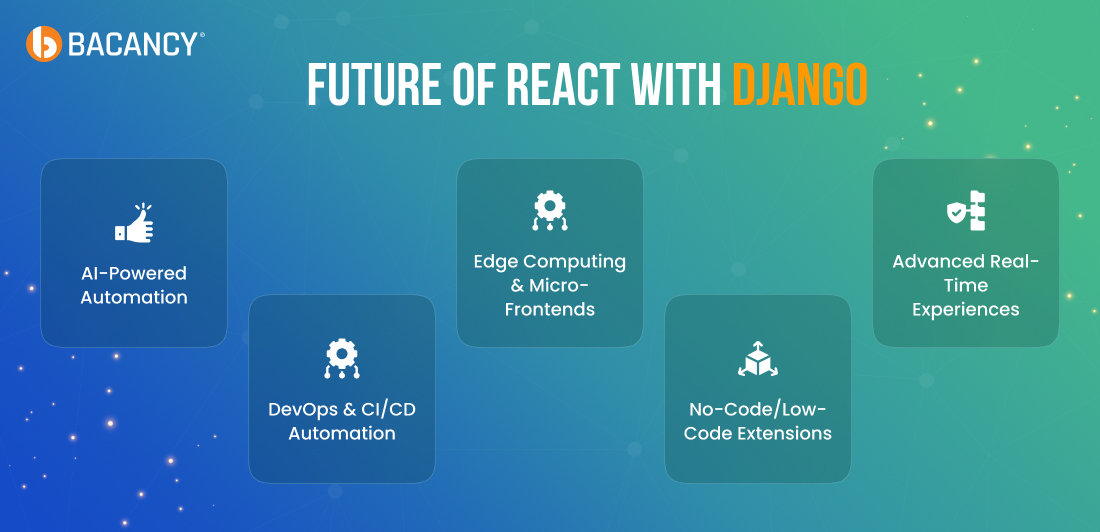
What Future Does React with Django Hold?
As businesses move for quick innovation, combining React and Django opens up future-ready opportunities. Here’s how these technologies will evolve together to help you build scalable, intelligent, and user-focused applications.
Smarter Application Using AI-Powered Automation
React and Django enable your smarter applications with AI. Chatbots, predictive analytics, and personalized user journeys reduce manual work and deliver actionable insights. Django handles backend processes efficiently, while React displays results instantly on web and mobile interfaces, much like how Amazon personalizes shopping feeds with AI-driven recommendations, or how Spotify curates music playlists based on user behavior.
Similarly, Sephora’s AI-powered chatbot helps customers find the right beauty products instantly.
Accelerate Releases with DevOps & CI/CD Automation
The future of React with Django will lean heavily on DevOps practices. Automated CI/CD pipelines ensure faster releases, bug-free deployments, and smoother updates without hampering user experience.
With Django managing backend integrity and React offering modular frontend updates, businesses can roll out features continuously and evolve with market demands.
For instance, PayPal and Stripe push frequent payment updates without downtime, or GitHub ships new features multiple times daily using automated CI/CD pipelines.
Boost Performance Through Edge Computing & Micro-Frontends
As applications scale, performance and modularity become critical. Edge computing reduces latency by processing data closer to users, while micro-frontends allow different teams to manage independent parts of the UI.
React’s component-driven design and Django’s API-first approach make it easy to adopt both trends, just as Netflix uses edge servers for smooth global streaming, Uber relies on edge computing to match riders and drivers in real time, and IKEA uses modular frontends to deliver consistent shopping experiences across regions.
Empower Process with No-Code/Low-Code Extensions
Future-ready applications will blend traditional coding with low-code/no-code tools. Businesses using React with Django can empower non-developers to configure dashboards, content modules, or workflows while engineers focus on core logic. This democratization accelerates digital transformation, enabling faster prototyping and reduced time-to-market.
For instance, healthcare teams can update patient dashboards through drag-and-drop tools, similar to how Airtable empowers non-technical users. Shopify enables store owners to customize storefronts without coding, and Zapier lets businesses automate workflows with minimal technical effort.
Deliver Advanced Real-Time Experiences
From collaborative tools to live-streaming apps, real-time functionality is becoming non-negotiable. WebSockets and Django Channels enable live data streaming on the backend, while React renders updates instantly on the frontend.
Together, they create highly interactive experiences like multiplayer apps, live dashboards, and instant messaging. Slack synchronizes conversations in real time, Figma allows multiple users to design on the same canvas simultaneously, and Twitch powers real-time live streaming with instant viewer interactions.
Why Opt for Bacancy for Django with React Development?
Choosing the right partner is just as important as choosing the right tech stack. With us, you get both. As an experienced Full Stack development company, we know how to balance Django’s reliability on the backend with React’s speed and flexibility on the frontend, so you end up with a product that has a powerful backend and a compelling user interface.
Our Full Stack team understands that all projects are different and require attention to detail. Whether you decide on a SaaS or healthcare app, we will manage development and deployment efficiently and seamlessly.
Bacancy’s agile approach ensures that every feature aligns with your business goals. From design to post-launch support, we make sure that your React js with Django applications is scalable, secure, and innovative to stand out among all.
Let’s take your idea from concept to launch, together.
Frequently Asked Questions (FAQs)
Yes. Django can serve as a powerful backend framework while React handles the frontend. This combination allows developers to build scalable, dynamic, and responsive full-stack web applications. Django manages server-side logic, databases, and APIs, while React creates interactive user interfaces.
To build a Django with React application:
Set up the Django backend with models, views, and REST APIs using Django REST Framework.
Create a React frontend project to handle user interface and state management.
Connect React with Django APIs using Fetch or Axios for data exchange.
Test the application to ensure smooth communication between frontend and backend.
Deploy both frontend and backend, either together or separately, depending on your architecture.
Absolutely. You can gradually integrate React into an existing Django project by replacing or augmenting frontend templates with React components. This incremental approach minimizes disruption and allows developers to modernize the UI without rewriting the backend.
The timeline depends on the project complexity. A small CRUD app can take a few weeks, while enterprise-level applications with multiple modules, authentication, and third-party integrations may take several months.
Django and React communicate via APIs, commonly REST or GraphQL:
Create API endpoints in Django using Django REST Framework or GraphQL.
In React, fetch data using Axios, Fetch API, or GraphQL clients.
Handle responses and update the React state for dynamic rendering.
Ensure authentication, error handling, and performance optimization for smooth interaction.
Dipal Bhavsar
Tech Geek at Bacancy
Story-driven writer blending research, passion, and full-stack web clarity.