Quick Summary:
This blog explains MERN Stack in 2026 for modern full-stack development, especially for API-driven apps, dynamic data systems, and backend-heavy products. It highlights where MERN still delivers strong results and where newer stacks take the lead. It also breaks down the key trade-offs across backend complexity, scalability, and development speed.
Table of Contents
Introduction
Every CTO conversation we have this year opens the same way: “Can we still safely bet on MERN Stack in 2026?”
It is a fair question, not because MERN broke. It is not. But due to this, teams can add products to it every day and scale them to the real users. What changed is the ground underneath it.
Next.js now blurs the line between frontend and backend well enough that a lot of teams skip the MERN question entirely. T3 Stack and Supabase promise less glue code and faster setup.
AI has changed how code gets written; meanwhile, hiring markets shift who writes it. A stack decision in 2026 is not a short-term velocity but is a 3-year commitment with real existing costs.
So the question worth your time is not “Is MERN dead?” The honest version is sharper. Where is MERN still the best choice for full-stack apps in 2026, and where does it quietly turn into a constraint over the next 3 years?
This guide provides a clear decision lens of the MERN stack in 2026 with cost benchmarks, team fit, risk map, and migration paths, so you can pick a stack you will not regret at the 18-month review.
Is MERN Stack Still Relevant in 2026?
Yes, MERN Stack in 2026 is still a strong full-stack choice, but no longer the default one. It remains the right call for AI-integrated SaaS, API-heavy products, and teams that treat talent pool depth as a first-order constraint. For SEO-dependent sites, content platforms, or 30-day MVPs and Next.js full-stack outperform it.
In fact, React is still the most-used web framework among professional developers, according to the Stack Overflow 2025 Developer Survey. Node.js remains the most-deployed JavaScript runtime in production. Express retains over 92 million weekly downloads on npm.
MongoDB Atlas crossed the enterprise adoption threshold years ago and contains new capabilities on a quarterly cadence, including native Vector Search and first-class AI integrations.
Where MERN sits among full-stack options today: one of four credible choices for a new greenfield product. The others are Next.js full-stack (with or without tRPC), T3 Stack (Next.js + tRPC + Prisma + PostgreSQL), and Supabase-backed architectures. Each has its sweet spot. MERN’s sweet spot is narrower than it was in 2020, but the sweet spot has not gone away.
Why Forward-Looking CTOs Still Bet on MERN in 2026?
- Ecosystem maturity vs. framework churn: The 4 components of the MERN stack have each had stable releases for over a decade. React 19. Node.js 22 LTS. Express 5. MongoDB 8. The patterns are settled, and the middleware catalog is exhaustive. Contrast this with Next.js, which has seen 3 routing paradigm shifts in five years (pages, app router, and the current RSC migration). Churn has a cost. CTOs add products to production at the correct price that costs correctly.
- Predictable operations at scale: Express and Node js have predictable production behavior due to known memory profiles. The event loop model is understood across the industry. Observability tools, such as Datadog, New Relic, and OpenTelemetry, all have first-class Node.js support.
- Talent pool depth as a competitive advantage: React + Node.js is the deepest JavaScript talent pool on Earth. The 2025 Stack Overflow survey confirms more open React + Node roles than any other full-stack combination, and offshore markets in India and Eastern Europe have mature MERN talent pipelines with thousands of mid-level engineers available at competitive rates. For teams that need to scale beyond 10 engineers, this depth is a structural advantage Next.js and T3 cannot match.
What a Modern MERN Stack Looks Like in 2026?
The MERN stack shares initials with the 2019 version. Beyond that, the architecture has changed.
The 2026 modern MERN stack toolchain looks like this:
- Language: TypeScript (non-negotiable in professional MERN work)
- Frontend build: Vite
- UI: React 19 + shadcn/ui + Tailwind CSS
- State: React Query (server) + Zustand or Redux Toolkit (client)
- Backend: Express 5, or Fastify for performance-critical APIs
- ORM/ODM: Mongoose for document-native work, Prisma for relational schemas
- Database: MongoDB Atlas with Vector Search, Atlas Search, and time-series collections
- Authentication: Auth.js, Clerk, or custom JWT
- AI integration: LangChain.js or Vercel AI SDK
- Deployment: Edge runtimes (Vercel Edge, Cloudflare Workers) or container platforms (Fly.io, Render, AWS ECS)
- Observability: OpenTelemetry with Datadog, New Relic, or self-hosted Grafana
Working with Document-based Data and Planning AI-driven Features?
Hire full stack developer from us to build MERN solutions that align perfectly with flexible data structures and intelligent workflows.
When Is MERN Stack the Best Full-Stack Choice in 2026?
MERN Stack 2026 is the top full-stack choice because it provides AI-integrated product logic on document-shaped data, API-first architecture with multiple consumer types, and backend beyond basic CRUD.
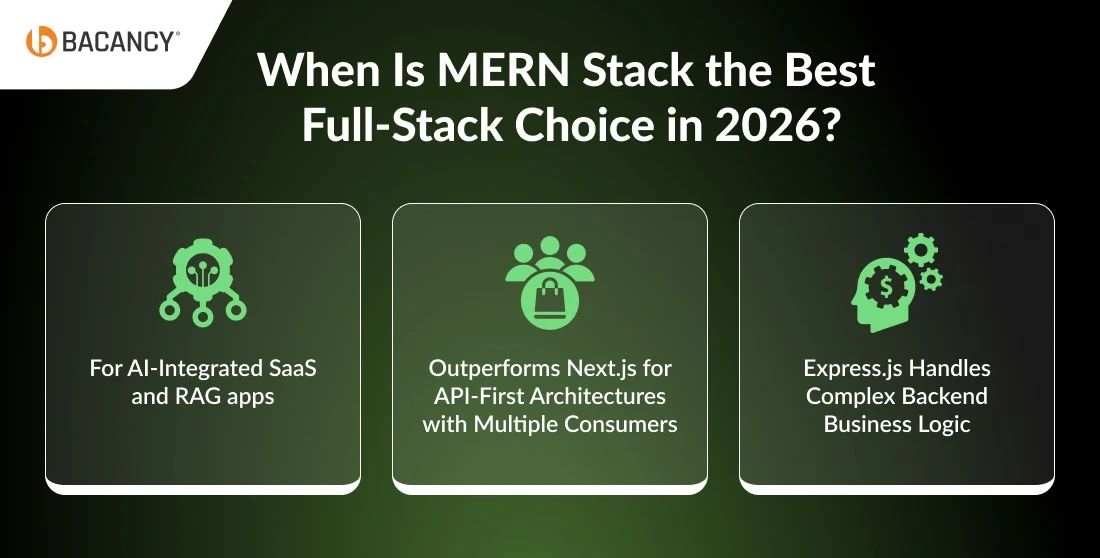
MERN is the Strongest Choice for AI-Integrated SaaS and RAG Applications
MongoDB Atlas Vector Search is a structural advantage that offers AI-integrated SaaS and RAG applications. It stores AI embeddings alongside application data in the same database, under the same query interface, with the same backup and access controls.
A RAG pipeline on MongoDB Atlas does not need a separate vector database vendor.
This matters for 3 reasons:
- The architecture is simpler.
- The vendor count is lower.
- The cost model is predictable.
For an AI-integrated SaaS product where retrieval accuracy depends on real-time data freshness, co-location of embeddings, and source documents eliminates a sync layer that tends to break in production. Express acts as a clean orchestration layer for LangChain.js chains, LLM response streams, and a tool-use platform for autonomous AI agents.
If you plan to build AI agents, RAG systems, or LLM-powered SaaS features as core product functionality rather than bolt-ons, MERN is not merely viable in 2026. It is among the strongest architectures available. Our AI agent development teams can implement this pattern for your project.
Next js full-stack collapses the frontend and backend into a deployable. For instance, a product with a single web client would be a feature. For a product with multiple consumers like web, iOS, Android app, and third-party API partners, internal tools, and webhooks, this becomes a liability for the project.
When your Express API servers are used by 5 different clients, you can scale, version, and deploy them independently of any one of them.
When your Next.js API routes serve 5 different clients, then you can couple your backend deployment cycle to your web app’s frontend. A backward-incompatible UI change blocks a backend deployment. A backend fix drags in frontend rebuilds. The coupling is subtle at first and painful at scale.
MERN keeps the frontend and backend as separate deployables with separate release cycles. For any product that will grow beyond a single web surface, this matters more than the convenience of a unified Next.js codebase. Hire React JS developer and a Node.js developer on separate tracks, and the org structure matches the deployment structure.
React and Node.js Talent Pool Depth Matters More Than Developer Experience
Developer experience (DX) is real, but CTOs overweight it relative to team-growth constraints.
The consequence: at any given moment, the survey shows more open React + Node roles than any other full-stack combination. Bootcamp graduation rates skew MERN-heavy. Offshore markets, particularly India and Eastern Europe, have mature MERN talent pipelines with thousands of mid-level engineers available at competitive rates.
A niche stack gets you better DX. A mainstream stack gets you faster team growth. For a 10-person team, the tradeoff is livable. For a 50-person team, it compounds into a 6 to 12-month delivery gap. Most CTOs we talk to learn this lesson the second time they staff a team, not the first.
Express.js Handles Complex Backend Business Logic Better Than Next.js API Routes
Next.js API routes were not designed for complex business logic. They were designed for thin API endpoints that sit adjacent to pages. For a product with basic form submission, auth, and payments, they are sufficient. For a product with background jobs, webhooks, multi-step transactional flows, custom middleware chains, or domain-driven architecture, they hit a ceiling.
Express is a flexible orchestration layer. It imposes no structure, which is a cost for simple apps and a benefit for complex ones. You can organize Express around controllers and services (traditional MVC), feature modules (vertical slices), event-driven handlers (CQRS-adjacent), or bounded contexts (DDD). Middleware composition is explicit. Tests are straightforward, and team conventions hold up over time.
For complex products (fintech workflows, logistics systems, healthcare platforms, marketplace economies), this flexibility is not negotiable. Next.js API routes can be made to work, but the effort is greater than what Express needs out of the box.
When MERN Stack Is the Wrong Choice in 2026?
MERN would not be an ideal choice for projects whose primary differentiator is organic search traffic, and if your data model is heavily relational with strict consistency requirements. Also, it is not a classic preference if you want a backend-as-a-service pattern or develop an AI MVP in 30 days with a 2-person team.
When Next.js is Better Than MERN for SEO-Dependent and Content-Heavy Websites?
Next.js wins on SEO without argument. Server-side rendering (SSR) and static site generation (SSG) produce fully rendered HTML that search crawlers index without the JavaScript execution step. For content-heavy sites, marketing platforms, e-commerce storefronts, and blogs, this is a structural advantage.
MERN’s default client-side React makes Google’s crawler do more work. Google’s JavaScript render pipeline has improved, but it is still slower, less reliable, and more expensive in crawl budget than pre-rendered HTML. You can add SSR to a MERN app via Next.js or a custom Node.js setup, but at that point, you will rebuild what Next.js provides out of the box.
When Should You Choose T3 Stack Over MERN for Relational Data and Type Safety?
T3 Stack (Next.js + tRPC + Prisma + PostgreSQL) is a suitable option when your data is heavily relational and end-to-end type safety is among your top-three concerns. MongoDB’s document model creates friction for orders-and-line-items data, accounting transactions, inventory ledgers, and any schema with frequent joins across 3+ entities.
PostgreSQL plus Prisma gives you normalized schemas, real foreign keys, ACID transactions without caveats, and strict referential integrity. tRPC gives you type-safe contracts between frontend and backend without REST or GraphQL boilerplate. The combination eliminates entire categories of bugs that a MERN team would catch only at runtime.
If your product is fintech, B2B commerce, accounting, or logistics, T3 Stack is the safer architectural bet. If your product is content, collaboration, or AI-integrated SaaS, MongoDB’s document model is the better fit.
Is Supabase a Better Alternative to MERN for BaaS-Suitable Products?
Yes, for the right product profile. Supabase bundles PostgreSQL, authentication, real-time subscriptions, storage, and edge functions into a backend-as-a-service platform. For products with standard CRUD patterns, row-level security as the main authorization model, and no need for custom background job infrastructure, Supabase collapses 6 months of backend work into 2 weeks.
MERN beats Supabase when you need full ownership of backend logic, custom middleware chains, heavy background jobs, or fine-grained control over database performance. Supabase’s opinionation is a feature for standard products and a constraint for complex ones.
The question to ask: Do you want to own the backend, or consume it as a service? If the answer is consume it. Supabase is the one for time-to-market.
If the answer is own it, MERN wins on long-term control. You can hire MERN stack developer who can architect, scale, and own your backend with the fine-grained flexibility that complex products demand.
MERN vs Next.js Full-Stack: Which is Better for Full-Stack Apps?
| Aspects | MERN Stack | Next js Full-Stack |
|---|
| SEO and organic search | Weak by default and requires bolt-on SSR
| Strong and SSR built-in
|
| Time to MVP
| Slower and more architectural decisions | Faster and opinionated defaults
|
| Backend complexity
| High and Express handles any pattern
| Medium and API routes hit a wall at scale
|
| Multi-client support
| Native and a decoupled backend serve any client
| Not much and offer coupled frontend and backend deploys
|
| AI/RAG Integration
| Strong and MongoDB Atlas Vector Search is native
| Moderate and needs an external vector DB
|
| Talent pool
| High and React + Node is their global talent baseline
| Medium and Next.js experts are their core
|
| Deployment surface
| Two deployables (frontend + backend)
| One deployable (Next.js)
|
| Vendor lock-in risk
| Low with any cloud and host
| Medium with high vercel-optimized
|
| 3-year maintenance burden
| Predictable and mature patterns
| Less predictable and framework paradigm shifts
|
A third option that everyone ignores is the hybrid pattern. Next.js handles the marketing shell and SEO-dependent routes. The MERN backend (Express + MongoDB) handles the authenticated app and API endpoints.
These two full-stack developments can deploy independently. But the pattern captures Next.js’s SEO strengths and MERN’s flexibility without a full-stack compromise either way.
How Much Does It Cost to Build a MERN Stack Application in 2026?
A production-grade MERN application costs between $80,000 to $450,000 to build in 2026, depending on scope, team geography, and AI integration depth.
The cost breakdown is across 3 buckets: developer compensation (60 to 70% of total), infrastructure (10 to 15%), and third-party services (15 to 25%). Here is what each bucket looks like in 2026.
How Much Do MERN Stack Developers Cost in 2026?
Based on report data, 2026 MERN developer compensation looks like this:
- United States: Mid-level $95,000 to $135,000 per year. Senior $145,000 to $210,000. Contract rates $85 to $160 per hour.
- Western Europe: Mid-level €55,000 to €85,000. Senior €90,000 to €130,000. Contract rates are €60 to €110 per hour.
- Eastern Europe: Mid-level €30,000 to €55,000. Senior €60,000 to €90,000. Contract rates are €30 to €60 per hour.
- India (offshore): Mid-level $25,000 to $45,000 per year for outsourced roles. Contract rates $25 to $55 per hour through vendor partnerships.
- Latin America (nearshore to US): Mid-level $45,000 to $75,000. Contract rates $45 to $90 per hour.
AI integration skills add a 15 to 30% premium across all geographies. TypeScript fluency is now table stakes, not a premium. MongoDB Atlas operational experience adds another 10 to 15% for senior roles.
How Long Does It Take to Hire a MERN Developer vs a Next.js Specialist?
- Mid-level MERN developer: 2 to 4 weeks to hire, 2 to 3 weeks to ramp to productivity.
- Senior MERN + AI integration: 4 to 8 weeks to hire, 3 to 4 weeks to ramp.
- Next.js specialist (app router fluent): 6 to 10 weeks to hire, 3 to 6 weeks to ramp. The pool is smaller, and the best engineers cluster at a handful of companies.
- T3 Stack specialist: 8 to 12 weeks to hire. Rare skill set. Often staffed by strong TypeScript + React engineers who pick up the stack on the job.
- Svelte, Qwik, or Solid specialist: 12 to 20 weeks to hire. Scarce. Often requires a remote-first posture to find them at all.
The hire-velocity math favors MERN in every geography. For a team that needs to scale from 3 to 15 engineers in 12 months, this matters more than any DX comparison.
What Is the 3-Year Total Cost of Ownership for a MERN Application vs Next.js Full-Stack?
A total cost of ownership (TCO) comparison for a medium-complexity SaaS product over 3 years.
| Cost Component
| MERN Stack in 2026
| Next js Full Stack |
|---|
| Initial Build (1 year)
| $280,000 - $380,000
| $240,000 - $340,000
|
| Hire and ramp costs (3 years)
| $45,000 - $75,000
| $75,000 - $130,000
|
| Infrastructure (3 years)
| $45,000 - $90,000
| $35,000 - $80,000
|
| Maintenance and refactor work (2-3 years)
| $120,000 - $210,000
| $140,000 - $260,000
|
| 3 - year TCO
| $490,000 - $755,000
| $490,000 -$810,000
|
When Should a CTO Choose MERN Stack in 2026? (Decision Checklist)
This is a checklist you need to follow while choosing MERN stack 2026 for your projects.
Choose MERN Stack in 2026 if:
- Your product is an app-shell (SaaS dashboard, internal tool, marketplace, collaboration platform) where organic search is not the primary acquisition channel.
- You plan to build AI or RAG features on document-shaped data, and MongoDB Atlas
- Vector Search offers a structural advantage.
- You need multiple API consumers (web + iOS + Android + third-party integrations + internal tools).
- Team-growth velocity matters more than developer experience polish.
- Your backend business logic is complex (background jobs, webhooks, multi-step transactional flows, custom middleware chains).
Choose a Different Stack if You:
- Organic search traffic is the primary acquisition channel.
- Your data model is heavily relational with strict ACID and foreign-key requirements.
- Your team is two engineers who must launch an MVP in 90 days.
- You want a backend-as-a-service pattern rather than backend ownership.
- Your product depends on first-party Shopify, Stripe, or commerce platform integrations.
How Bacancy Helps CTOs De-Risk MERN Stack Projects
We are a full stack development company with 14+ years of MERN delivery across AI-integrated SaaS, enterprise dashboards, fintech workflows, healthcare platforms, and API-heavy backend systems.
What we do differently:
- Stack decision consulting – Before we write a line of code, we run your product requirements through the decision framework above and recommend the stack that fits your constraints, not the stack that fits our bench.
- Greenfield MERN delivery – End-to-end product engineering from architecture to deployment. Full 2026 toolchain. Production-grade security, observability, and CI/CD from day one.
- MERN modernization – For teams on 2019-era MERN codebases, we modernize in place (TypeScript, React Query, Vite, Vector Search) without a full rewrite. Most projects recover their investment within 4 months.
- Hybrid architecture work – For products that need a Next.js marketing shell on top of an Express/MongoDB backend, we implement the hybrid pattern with clean boundaries and independent deployments.
- AI integration and RAG pipelines – LangChain.js, Vercel AI SDK, MongoDB Atlas Vector Search, and custom agent workflows on production MERN stacks.
Frequently Asked Questions (FAQs)
No, MERN stack is not dying in 2026. It no longer serves as the default for every project, but it remains a strong choice for API-first systems, complex backend logic, and flexible data models. Frameworks like Next.js reduce setup for simpler apps, but MERN still fits advanced use cases.
MERN is better for AI-integrated applications in 2026 because MongoDB Atlas Vector Search stores embeddings natively alongside application data, which removes the need for a separate vector database. Express also handles LLM response streams and multi-step agent workflows cleanly. Next.js can do the same with external vector DBs (Pinecone, Weaviate), but the architecture is more complex, and the vendor count is higher.
A MERN to Next.js migration takes 3 to 9 months for a medium-complexity application, depending on whether you do a full migration or a hybrid (Next.js frontend in front of the existing Express/MongoDB backend). Most teams should pick the hybrid path because it cuts 70% of the migration cost and preserves the backend investment.
Yes for document-shaped data, AI-integrated products, and apps with flexible schemas. No for heavily relational data, strict ACID requirements, or apps with frequent multi-entity joins. MongoDB Atlas Vector Search added a structural advantage for AI workloads in 2024 that remains MongoDB-unique in 2026. If your data fits the document model, MongoDB is the right pick.
Next.js full-stack beats MERN when organic search is the primary acquisition channel, when the product is content-heavy or marketing-driven, when a single web client is the only consumer, and when the team is two to four engineers with a short delivery horizon. Next.js’s SSR/SSG and unified deployment outweigh MERN’s flexibility in these scenarios.
MERN beats Next.js when you need multiple API consumers (web + mobile + third parties), when backend business logic is complex, when AI/RAG features on document data are core to the product, and when team-growth velocity is a first-order concern. The decoupled frontend and backend deployments, plus the depth of the React + Node talent pool, are MERN’s durable advantages.
Yes, and this is what many production systems actually look like. The common pattern: Next.js handles the marketing site, public pages, and SEO-dependent routes. The MERN backend (Express + MongoDB) handles the authenticated app, complex business logic, and API endpoints for multiple clients.
Most teams should not. The cost of a full migration rarely pays back within 3 years for a medium-complexity application. The better path is modernization in place: add TypeScript end-to-end, swap Create React App for Vite, adopt React Query, and layer in MongoDB Atlas Vector Search for AI features. If SEO is a gap, add a Next.js marketing shell in front of the existing Express backend rather than a full rewrite of everything.