Laravel with Svelte is a modern full-stack combination that delivers fast, scalable, and responsive web applications. This blog explains how Laravel with Svelte enhances web app performance and why it outperforms other popular stacks. CTOs will learn when this stack is the right choice for their products and how to implement it effectively.
Table of Contents
Why Are Companies Rethinking Their Full-Stack Technology Choices?
The companies reconsider their full-stack choices when executions drift way too long before anything official breaks. The majority face their roadmaps slipping, every release feels riskier than the last, and the team spends more time stabilizing features.
This isn’t an isolated frustration; industry reports show that 95% of leaders view application modernization as essential to their organization’s survival.
From our experience guiding full-stack transformations, we have found that the Laravel and Svelte combination directly arrests this drift. Laravel provides the structured, reliable backend needed to keep roadmaps on track, while Svelte’s compile-time frontend ensures lightweight, predictable behavior.
Together, they slash maintenance overhead and restore the execution confidence teams need to scale efficiently.
How Laravel with Svelte Supports Modern Web App Performance?
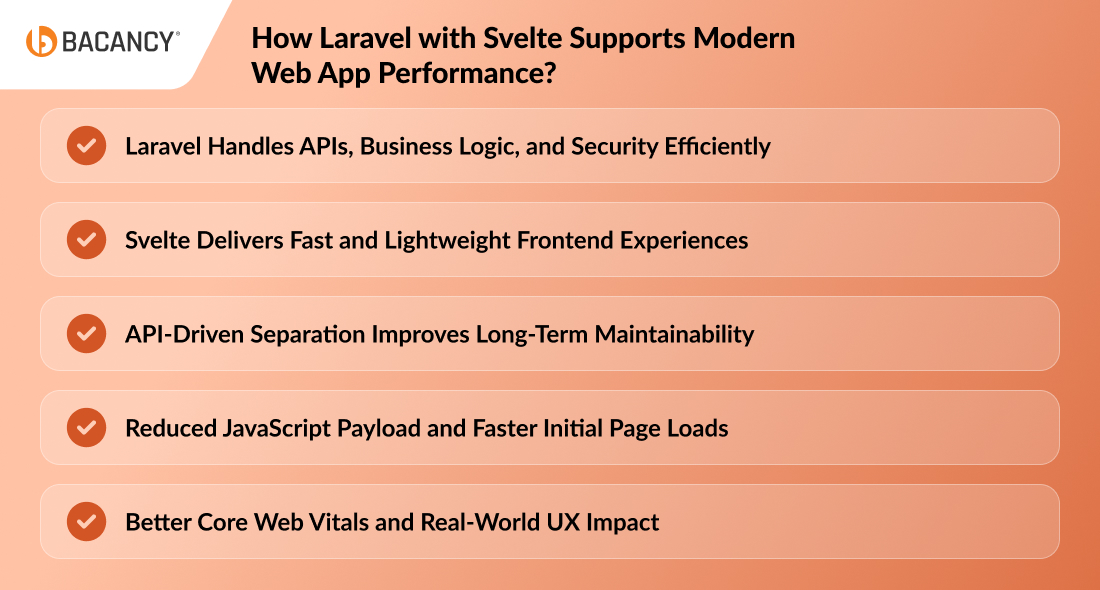
For a CTO, performance means execution cost over time, not initial load speed. Laravel with Svelte prevents this decline by placing complexity on the server and fixing frontend execution cost at build time. Performance remains stable as teams add features, users, and integrations without constant tuning.
This combination focuses on consistency under continuous delivery rather than short-term speed gains.
Laravel Handles APIs, Business Logic, and Security Efficiently
Laravel defines a clear performance boundary. Authorization, data shaping, and workflow rules execute once on the server rather than across multiple UI states. For complex enterprise needs, you can hire Laravel developers who can ensure your API architecture is optimized for high-concurrency environments.
By returning final-state API responses, Laravel removes conditional logic from the frontend. This avoids a common enterprise problem where frontend speed drops as permission models and business rules expand.
Security controls such as throttling, validation, and middleware run within a single request lifecycle. No extra network calls or client enforcement appear.
For CTOs, this leads to uniform performance across roles, features, and user paths.
Svelte Delivers Fast and Lightweight Frontend Experiences
Svelte follows a compile-time model that removes runtime framework cost. Most teams underestimate how runtime state tracking and reconciliation inflate frontend execution over time.
Because Svelte outputs direct JavaScript instructions during build, component execution cost stays fixed even as the application grows. Visual complexity increases, not computational load.
This makes frontend performance measurable, predictable, and enforceable across teams. It also makes it a top choice for brands looking to hire Svelte developers for performance-critical UIs.
Many architectures claim separation but fail under delivery pressure. Laravel with Svelte enforces it structurally.
Backend changes affect data contracts rather than UI logic. Frontend updates affect presentation rather than business flow. This prevents accidental performance regressions during parallel releases.
For CTOs who manage multiple teams, this reduces coordination overhead and stabilizes release cycles.
Reduced JavaScript Payload and Faster Initial Page Loads
Svelte removes unused logic before deployment, but the larger benefit lies in payload stability. JavaScript size grows in proportion to features rather than framework overhead.
Laravel reinforces this by returning narrowly scoped API responses instead of large datasets that require client filtering.
Initial load time remains consistent even as feature density increases, which suits long-lived products.
Better Core Web Vitals and Real-World UX Impact
Core Web Vitals often decline due to frontend overwork rather than server latency. Svelte limits layout recalculation and script execution. Laravel delivers predictable response times.
This reduces variation in Largest Contentful Paint (LCP), First Input Delay (FID), and Cumulative Layout Shift (CLS) across different user journeys, not just in controlled tests.
For CTOs, this ensures performance that holds across real traffic patterns.
Why Compile-Time Frontend Matters for Business Metrics?
Compile-time UI changes the cost model of feature delivery. Each new feature adds minimal runtime overhead, which keeps infrastructure usage and maintenance effort under control.
Combined with Laravel’s backend governance, teams ship faster without sacrificing performance discipline.
For CTOs, the outcome stays clear. Performance becomes an architectural property, not a recurring operational issue.
Accelerate Feature Delivery Without Increasing Costs
Hire full stack developer from us to integrate the Laravel backend with the compile-time frontend, ensuring every feature adds minimal runtime overhead.
How to Integrate Laravel with Svelte for Full-Stack Modern Applications?
Svetle and Laravel work together in multiple ways, depending on how much separation, scalability, and deployment flexibility your product needs. Below are the 3 proven ways to integrate Laravel with Svelte for a full-stack application.
Method 1: Integrating Interia.js With Svelte and Laravel
Inertia.js integration enables Laravel to handle routing and backend logic while Svelte manages the frontend, which delivers a single-page application experience without requiring a separate API.
import { defineConfig } from 'vite';
import laravel from 'laravel-vite-plugin';
import { svelte } from '@sveltejs/vite-plugin-svelte';

export default defineConfig({
  plugins: [
    laravel({
      input: ['resources/js/app.js'],
      refresh: true,
    }),
    svelte(),
  ],
});
Step 4: Initialize Inertia App
resources/js/app.js:
import { createInertiaApp } from '@inertiajs/svelte';

createInertiaApp({
  resolve: name => import(`./Pages/${name}.svelte`),
  setup({ el, App, props }) {
    new App({ target: el, props });
  },
});
Step 5: Render Svelte Components from Laravel
In a Laravel controller, use Intertia to render a Svelte component:
use Inertia\Inertia;

return Inertia::render('Dashboard', [
    'users' => User::all()
]);
CTO Takeaways:
This approach delivers a rapid and maintainable development workflow with minimal architectural complexity.
It is an ideal choice for CTOs who want to create new applications or MVPs where speed and simplicity are top priorities.
Method 2: Decoupled API Integration (Svelte Kit Integration)
This method separates Laravel and Svelte into two independent applications through the Laravel Svelte kit. In this integration, Laravel 12 serves as the backend API and Svelte handles the frontend routing, rendering, and state management.
Step 1: Create Laravel API Backend
laravel new backend
cd backend
composer require laravel/sanctum
php artisan vendor:publish --provider="Laravel\Sanctum\SanctumServiceProvider"
php artisan migrate
Step 2: Configure API Authentication
Enable Sanctum middleware in app/Http/Kernel.php and configure CORS in app/Http/Kernel.phps.php to allow your SvelteKit domain.
Step 3: Create API Routes
Route::middleware('auth:sanctum')->get('/users', function () {
    return User::all();
});
Step 4: Create SvelteKit Frontend
npm create svelte@latest frontend
cd frontend
npm install
npm run dev

]
The last way to integrate Svelte with Laravel is to embed Svelte components into specific Laravel Blade templates to add interactivity without converting the entire app into a single-page app. It allows selective frontend enhancements while keeping the backend and existing pages stable.
Step 1: Install Svelte
npm install svelte @sveltejs/vite-plugin-svelte
Step 2: Configure Vite Entry
Update vite.config.js to compile Svelte components.
Step 3: Create Svelte Component
// resources/js/components/Stats.svelte
export let count;
Step 4: Mount Component Manually
In resources/js/app.js:
import Stats from './components/Stats.svelte';

new Stats({
  target: document.getElementById('svelte-stats'),
  props: {
    count: window.APP_DATA.count
  }
});
The hybrid approach keeps the backend stable and maintainable, which reduces your risk while incrementally improving the user experience.
It allows gradual modernization of legacy Laravel apps, which adds interactivity only where needed without overhauling the entire system.
Why Laravel Svelte Is a Better Full-Stack Choice Than Popular Alternatives?
CTOs evaluate full-stack options by how clearly they define execution boundaries and prevent bottlenecks across teams. The key question becomes: how well does a tech stack manage complexity, enforce consistency, and reduce delivery risks as the product scales?
Laravel and Svelte address this by establishing clear architectural responsibilities. Laravel centralizes data access, security, and business rules, while Svelte keeps frontend execution predictable at build time. This structure prevents issues from cascading across layers and reduces reliance on constant optimization.
Unlike other stacks, Laravel + Svelte allows easy integration of AI-powered features, such as predictive analytics, recommendation engines, or intelligent workflows, without compromising frontend performance or API reliability. Teams can scale, deliver faster, and release features with a lower risk of regressions, without hidden operational overhead.
Laravel Svelte vs Popular Full-Stack Alternatives
Aspects
Laravel + Svelte
Laravel + React
MERN Stacks/ Next.js
Execution Boundaries
Laravel controls backend logic, and Svelte keeps the frontend predictable
Some backend logic moves to the frontend, which adds complexity
Frontend handles most logic, and backend/frontend boundaries are unclear
Complexity Growth
Feature growth does not slow down the frontend
Runtime overhead increases as features grow
Complexity grows rapidly and becomes hard to manage
Operational Efficiency
Low maintenance and predictable performance reduce operational effort
Requires ongoing optimization and careful tuning
High maintenance and frequent manual optimizations are needed
Delivery & Risk
Releases are predictable, and regressions are rare
Occasional regressions occur, and careful testing is needed
Frequent regressions and unstable performance make delivery risky
Scalability & Future-Proofing
The stack scales easily with teams and features and adapts to future requirements
Scaling requires careful management and additional optimization
Scaling is challenging and increases long-term technical debt
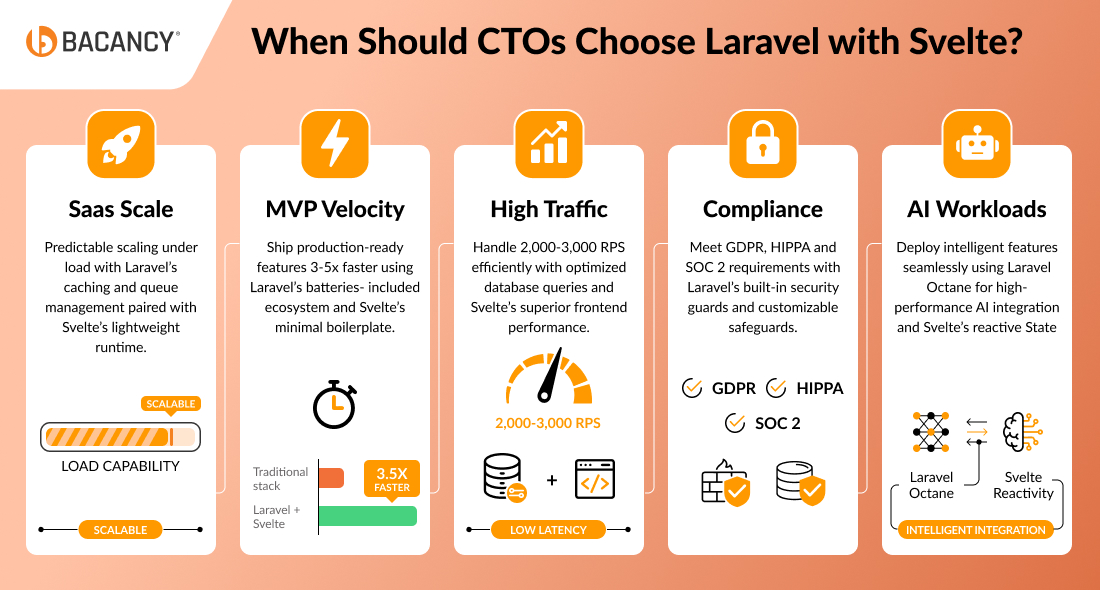
When Should CTOs Choose Laravel with Svelte for Their Products?
Laravel with Svelte offers a unique full-stack combination that balances a robust backend with a lightweight and compiled frontend. CTOs can utilize it to build scalable, high-performance, and maintainable applications while controlling technical debt.
SaaS Platforms Needing Speed and Scalability
CTOs prioritizing performance and scalability will benefit from Laravel and Svelte. Laravel manages complex business logic, secure APIs, and authentication efficiently on the server, while Svelte ensures a lightweight frontend with minimal runtime overhead. This combination allows SaaS platforms to handle increasing users and features without affecting user experience.
Use Case: For a SaaS application serving multiple daily users, we implemented Svelte with Laravel. Page load times stayed under 2 seconds even during peak traffic, and adding new modules did not impact frontend performance. The result was a platform that scales predictably without engineering bottlenecks.
MVPs That Must Validate Fast Without Technical Debt
Speed to market is critical, but architecture quality cannot be sacrificed. Laravel + Svelte allows teams to launch MVPs quickly while maintaining clean separation between backend and frontend. This minimizes shortcuts and prevents technical debt that often slows future development.
Use Case: A fintech startup launched its MVP in 8 weeks using Laravel and Svelte. Post-launch, they added new features and integrated third-party services without refactoring the codebase. The team could iterate rapidly, keeping the product stable and maintainable.
High-Traffic or Performance-Sensitive Applications
Applications with strict latency requirements need predictable and efficient execution. Svelte’s compile-time optimization reduces frontend payloads, while Laravel efficiently handles heavy server-side operations. This ensures fast load times, lower bandwidth consumption, and stable Core Web Vitals, critical for SaaS, fintech, or enterprise applications.
Use Case: We delivered a healthcare data analyst dashboard that processes millions of records daily. Using Laravel with Svelte, the frontend remained responsive with complex visualizations, while backend processing stayed efficient. The outcome was reliable performance under peak load and a consistent user experience.
Applications Requiring Strong Security and Compliance
CTOs managing sensitive data need a stack that enforces security without sacrificing performance. Laravel centralizes authentication, authorization, and middleware, while Svelte ensures the frontend remains fast and efficient. This combination helps meet compliance standards and reduces the risk of security gaps.
Use Case: A healthcare SaaS product was built with Laravel and Svelte to meet HIPAA compliance. Backend security rules were centralized and easy to audit, while the lightweight frontend maintained smooth performance. As a result, it provides secure, reliable application delivery that meets regulatory requirements without slowing users down.
AI-Powered Applications and Intelligent Features
You can build products with AI or machine learning capabilities, and can utilize Laravel with Svelte for efficient integration. Here, Laravel manages complex AI workflows, APIs, and data processing on the server, whereas Svelte ensures the frontend updates in real-time without any performance lag.
Use Case: A logistics platform implemented AI for route optimization and demand prediction. Backend computations ran on Laravel, while Svelte provided real-time visualizations for fleet managers. The system delivered fast, actionable insights, enhanced operational efficiency across large datasets.
Where Laravel with Svelte Does Not Fit Well?
While powerful, Laravel + Svelte is not ideal for every scenario. CTOs should consider these limitations before committing.
Svelte has a smaller ecosystem than React or Vue. Projects heavily dependent on ready-made UI components may see development slowdowns.
Example: For an internal admin dashboard, most components had to be built from scratch. Using Svelte with Laravel extended timelines compared to a React-based solution, which offered a richer prebuilt component library.
2. Teams Already Standardized on Another Ecosystem
Switching stacks can reduce initial productivity. Your team, who are experienced in React, Angular, or Vue, may face a learning curve with Svelte.
Example: A product team with deep React expertise continued using Laravel with React for their frontend and backend development. This decision avoided ramp-up delays and ensured delivery deadlines were met
3. Applications with Complex Frontend-Heavy Logic
Svelte may require more boilerplate for dynamic SPAs, real-time dashboards, or large-scale state management than frameworks with mature ecosystems.
Example: A real-time trading platform used Laravel for backend logic but chose React for the frontend. Svelte would have required complex custom state management, slowing development and adding risk.
4. Very Small Projects or Static Sites
For simple websites, blogs, or small apps, Laravel with Svelte may be overkill. Lightweight frameworks or static site generators can deliver faster results with less maintenance.
Example: A marketing landing page used a static site generator instead of Laravel with Svelte. The team launched in just a few days, avoiding unnecessary complexity while keeping maintenance minimal.
How Bacancy Helps CTOs Succeed with Laravel and Svelte?
Choosing the right technology partner is critical for CTOs looking to build scalable, high-performance applications without compromising maintainability. As a trusted full stack development company, Bacancy specializes in Laravel and Svelte, helping technology leaders accelerate product delivery, reduce technical debt, and maintain predictable performance across the stack.
We focus on creating solutions that balance backend robustness with frontend efficiency. Our approach ensures:
Laravel manages complex business logic and secure APIs, while Svelte keeps the frontend lightweight and fast.
Launch functional products quickly with clean, maintainable code that can evolve without major rewrites.
Reduce frontend payloads, improve load times, and stabilize Core Web Vitals for high-traffic applications.
Handle authentication, authorization, and regulatory requirements without sacrificing speed or user experience.
With Bacancy as your partner, CTOs gain more than just development services; they gain strategic support. From planning to deployment for Laravel with Svelte project, we act as an extension of your team, providing transparent collaboration, agile delivery, and hands-on expertise in full-stack development. The result is faster go-to-market, predictable performance, and a tech foundation that scales with your business.
Frequently Asked Questions (FAQs)
Combining Laravel and Svelte gives you a fast, modern, and scalable full-stack setup. Laravel handles APIs, database, and backend logic, while Svelte delivers reactive, lightweight, and fast-loading frontend interfaces.
Svelte compiles components into efficient JavaScript, resulting in smaller bundle sizes and faster performance than traditional frameworks. For projects focused on speed and low runtime overhead, Svelte often outperforms Vue or React.
Yes. Laravel’s event broadcasting and APIs combined with Svelte’s reactive components make building real-time dashboards, chat apps, or live data platforms straightforward.
Laravel provides RESTful APIs or GraphQL endpoints. Svelte fetches data from these endpoints and updates the UI dynamically, keeping frontend and backend loosely coupled for better maintainability.
Yes, Laravel ensures secure, scalable backend architecture, while Svelte handles complex, interactive frontend interfaces efficiently, which makes it ideal for SaaS, e-commerce, and large-scale web apps.
Yes, Svelte components can be embedded in Laravel Blade templates, or you can separate them completely, letting Svelte run as a standalone frontend consuming Laravel APIs.
Svelte apps often have smaller bundle sizes and less runtime overhead, resulting in faster page loads and smoother UI updates, especially on low-powered devices or slower networks.
SaaS platforms with dynamic user interfaces
E-commerce websites with fast checkout flows
Real-time dashboards and analytics tools
Admin panels and content management systems
Social networking or community platforms
Set up a Laravel backend with APIs, create a Svelte frontend project, connect the two via REST or GraphQL endpoints, and use tools like Vite or Laravel Mix for build integration.
Nikunj Padhiyar
Director of Engineering at Bacancy
Senior Software Engineer building robust, high-performing PHP web applications.