Quick Summary
This blog explains what DevOps compliance means and why it matters for fast-moving development teams. It guides on how to meet security and regulatory standards without slowing down software delivery, highlights the most common DevOps compliance challenges, and offers practical ways to solve them. You’ll also find a list of DevOps tools that help streamline compliance and keep your pipelines audit-ready.
Table of Contents
Introduction
As more businesses adopt DevOps to speed up software delivery, staying compliant with security and regulatory standards becomes a major concern. This fast pace of implementing DevOps can make it easy to overlook essential rules, putting organizations at risk of breaches, fines, and legal issues.
DevOps compliance helps avoid these issues. It directly adds security checks, policy enforcement, and audit readiness into the development process without slowing teams down. From automated scans to real-time evidence tracking, it helps teams release faster while staying within the rules.
Learn how leading teams build compliance into their CI/CD pipelines using smart tools and practical methods. Whether you’re in finance, healthcare, or tech, learn how you can stay compliant and move fast at the same time. Let’s start with the basics first.
What is DevOps Compliance?
DevOps compliance is the practice of embedding regulatory, security, and policy requirements at every stage of the software development lifecycle. It ensures that all code changes, deployments, and infrastructure meet industry and legal requirements through automation, clear governance, and continuous monitoring.
Why is Compliance in DevOps Essential?
Compliance in DevOps is important because code changes, deployments, and releases happen quickly, and adding the right checks early helps catch issues before they turn into bigger problems. Here are the key areas of impact:
1. Faster Code Releases
DevOps helps teams push updates and new features faster. But it’s easier to miss important security or legal steps when things move quickly. Without built-in compliance checks, fast releases can lead to mistakes, risks, or even violations that are hard to fix later.
2. Compliance in an Automated SDLC
DevOps uses automation to handle many parts of software development, like testing code, deploying it, setting up servers, and checking for security issues. As more tasks become automated, building compliance into each step is essential to keep everything consistent.
3. Risk Minimization
Ensuring compliance in DevOps means minimizing security problems, fines, and reputational damage. By aligning with key industry regulations (like HIPAA, GDPR, or SOC 2), teams lower the risk of penalties for non-compliance.
4. Avoiding Expensive Fixes
Addressing compliance issues early in the development process saves time and money. If problems arise after deployment, they can be costly and delay the project. Tackling compliance in DevOps from the start avoids these expensive and last-minute fixes.
5. Continuous Compliance Monitoring
DevOps relies on continuous integration and deployment (CI/CD), so compliance must be constant, too. Real-time monitoring and enforcement of policies ensure that every code change aligns with governance requirements throughout the pipeline, not just at the end.
6. Integrating Compliance From the First Stage
Instead of waiting until the end to check for compliance in DevOps, it should be part of the development from the beginning. This advanced approach prevents complications later on and ensures smoother, faster, and more efficient software delivery.
Compliance in DevOps For Healthcare: A Real-World Example
Healthcare is one of the clearest examples of where DevOps and compliance must work together. Teams dealing with electronic health records, patient data, or clinical workflows cannot separate delivery speed from regulatory requirements. HIPAA compliance demands traceability, access control, encryption, and audit readiness across the pipeline. If you’re building or modernizing software in healthcare industry, you cannot treat compliance as an afterthought. It has to be part of how the pipeline is designed and operated.
We’ve outlined this in more detail in our blog on DevOps in Healthcare, covering how teams can take care of DevOps compliance in healthcare, while staying aligned with regulations.
How to Integrate Compliance into the DevOps Workflow?
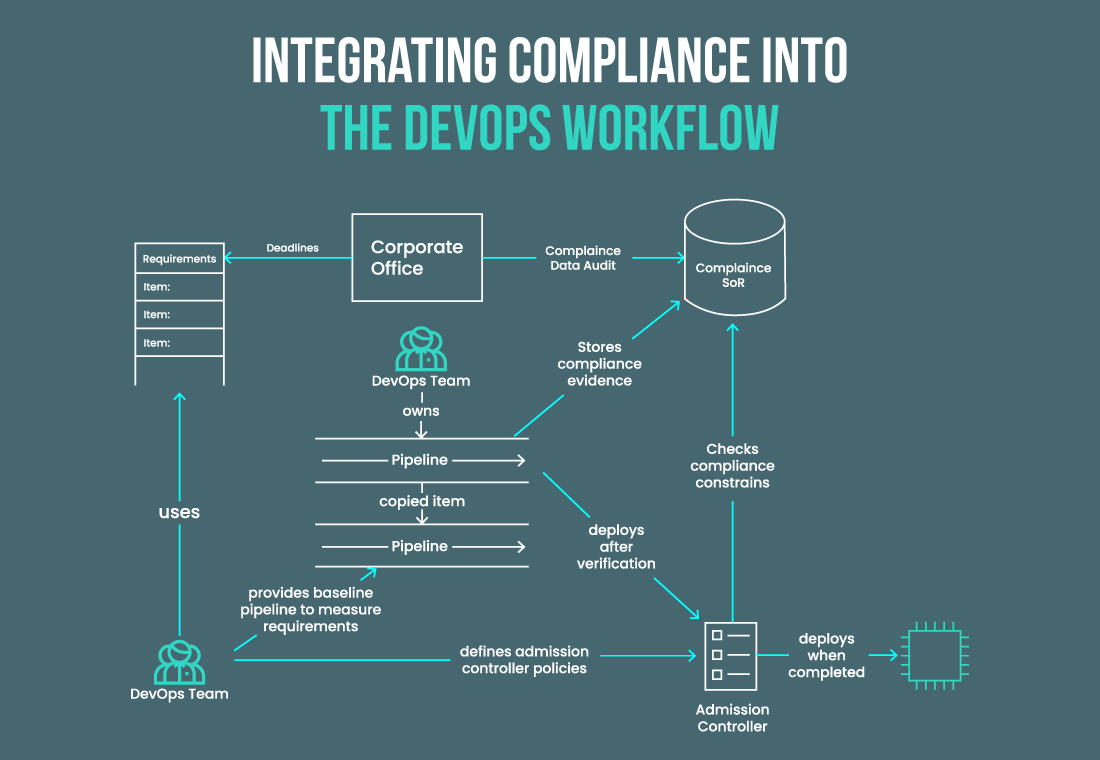
Integrating compliance into DevOps ensures that every step of software delivery meets required rules and standards. This approach helps maintain security and regulatory alignment without slowing down development. Here’s a simple step-by-step breakdown of how it works.
Step 1: Define Compliance Rules
The compliance team starts by writing down the rules and standards that need to be followed. They then share these with DevOps and the development team so everyone is on the same page.
Step 2: Build Baseline Compliance Pipeline
The DevOps team uses those rules and builds a basic pipeline. This pipeline helps them check if the development work is following the rules. Once it’s over, they hand it to the development team.
Step 3: Customize Pipeline
The development team customizes the basic pipeline to fit their project. They are in charge of this version and ensure it follows all the compliance rules.
Step 4: Store Compliance Evidence
As the team works, they collect evidence, such as logs or test results, that they are following the rules. All the evidence is saved in a system called the Compliance System of Record (SoR).
Step 5: Compliance Verification
Before the software goes live, a tool called the Admission Controller checks everything. It uses the saved proof from the SoR to make sure the pipelines meet all the compliance rules.
Step 6: Final Deployment
If everything looks good, the Admission Controller gives the green light. The software is then deployed into production and is fully compliant with all the required rules.
Compliance Challenges in Implementing DevOps
Here are the key compliance challenges you might encounter when implementing DevOps, as well as expert solutions to navigate them. These solutions can help streamline processes while maintaining security and regulatory standards.
1. Documentation Overhead
Challenge:
DevOps compliance requires teams to document every change, configuration, and decision made during development. However, this may feel like a burden to developers who would rather focus on writing code. As a result, documentation is often skipped or incomplete, which puts audits and certifications at risk.
Solution:
Use DevOps tools that automatically collect and store compliance data during development. It removes the need for manual documentation and ensures you are always audit-ready without slowing down developers.
2. Security vs Speed Conflicts
Challenge:
Development teams are under pressure to release features quickly. Pausing to perform security reviews or compliance checks can feel like a delay. In some cases, these checks are skipped to meet deadlines, leading to hidden risks in production.
Solution:
Automate security and DevOps regulatory compliance checks within the CI/CD pipeline. This way, every update is reviewed for compliance in real time without interrupting the pace of development.
3. Infrastructure Complexity
Challenge:
Modern apps run on complex environments like containers, cloud platforms, and microservices. Each part has its own setup and security requirements; managing these apps manually without any help can lead to errors that cause compliance failures.
Solution:
Use Infrastructure as Code(IaC) to define and manage systems. IaC makes setups consistent, repeatable, and easy to audit so your infrastructure always meets security and compliance standards.
4. Access Control Management
Challenge:
As teams grow and change, tracking who has access to what is hard. Giving too much access can lead to data leaks; giving too little slows down work. Either way, it can lead to DevOps compliance issues.
Solution:
Follow the principle of least privilege, give only needed access, and use automated tools to manage permissions. It keeps data secure and ensures that access rules meet compliance requirements.
5. Audit Readiness
Challenge:
Most applications rely on open-source libraries or third-party services. If these external components aren’t secure or compliant, they can become weak spots in your system, even if your code is fine.
Solution:
Automated tools scan third-party components for DevOps security and compliance. These tools can help ensure that everything you use, from libraries to APIs, meets compliance standards and is safe to include in your code.
6. Lack of Visibility for GRC Teams
Challenge:
Governance, Risk, and Compliance (GRC) teams often lack real-time development access. They only see changes after deployment, making it hard to assess risks or catch issues early.
Solution:
Provide dashboards and reports that give GRC teams real-time insights into code changes and compliance status. It bridges the gap and helps them respond to risks earlier.
Struggling with DevOps Compliance?
Hire DevOps developers from us to embed compliance into every stage of your workflow, reducing risks and ensuring security from day one.
DevOps Compliance Best Practices
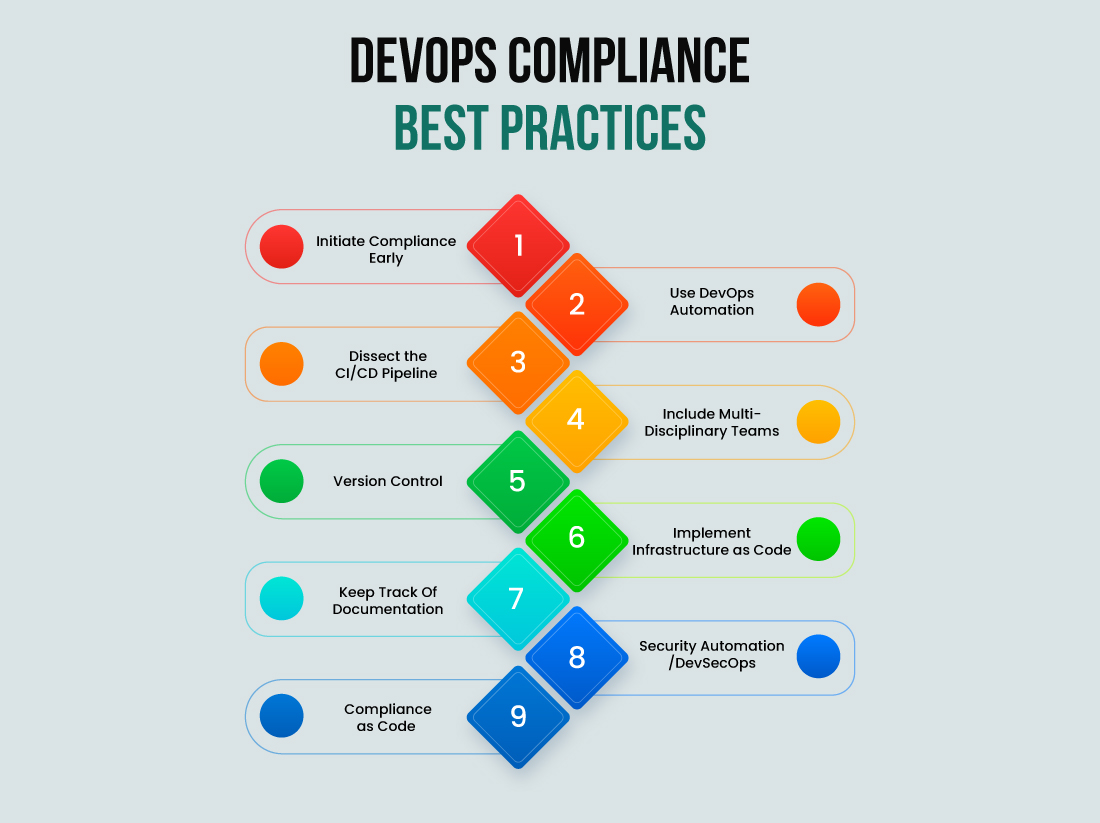
DevOps compliance best practices ensure that security and regulatory standards integrate easily into the development lifecycle. Adopting these practices helps teams maintain compliance while enabling faster, more efficient software delivery.
1. Initiate Compliance Early
Initiate compliance tasks like testing from the beginning to remove roadblocks and help prevent future security and regulatory issues. Early adoption removes roadblocks and enhances the software’s speed, safety, and overall quality.
2. Use DevOps Automation
Use DevOps automation to handle repetitive and time-consuming tasks, such as reviewing pull requests, managing access controls, tracking code coverage, and handling failovers. It ensures you follow rules, boosting speed, accuracy, and productivity.
3. Dissect the CI/CD Pipeline
Instead of waiting until the end, incorporate compliance checks throughout the CI/CD pipeline. This end-to-end approach ensures that each step meets required standards and helps quickly trace and fix issues before they impact delivery.
4. Include Multi-Disciplinary Teams
Compliance now extends beyond legal and security teams. When all team members understand compliance requirements, making frequent updates and maintaining a secure, streamlined process becomes easier.
5. Version Control
Version control manages and tracks code changes, ensuring every modification is documented and auditable. DevOps compliance helps maintain a clear record of updates, ensuring traceability, accountability, and adherence to regulatory standards throughout the development process.
6. Implement Infrastructure as Code
IaC ensures consistent, auditable infrastructure setups. By treating infrastructure as code, teams can replicate environments, track changes, and manage resources using tools like CloudFormation and Terraform to simplify compliance across multiple systems.
7. Keep Track Of Documentation
Documentation is key to DevOps regulatory compliance. Teams must collaborate and share responsibility to avoid bottlenecks. Use version control tools like Git and dashboards to keep clear, trackable records of all changes and updates.
8. Security Automation / DevSecOps
DevSecOps incorporates security into every phase of DevOps. By automating security checks, such as vulnerability scans and access control, issues are found early. It ensures ongoing security without delaying development or needing separate security steps.
Read more about Automated Testing in DevOps.
9. Compliance as Code
Compliance as code turns policies into automated scripts. By coding compliance rules, teams can enforce standards instantly, preventing manual mistakes and ensuring systems stay compliant throughout the DevOps process.
Did you know that, according to a Gartner report cited by PR Newswire, by 2026, 70% of enterprises will have integrated compliance as code into their DevOps toolchains, reducing risk management and improving lead time by at least 15%.
DevOps Compliance Tools To Use
Here are the DevOps compliance tools that can help you automate policies, enforce standards, and maintain regulatory alignment throughout your development pipeline. These tools support secure, consistent, and auditable processes without slowing down innovation.
Terraform enables infrastructure as code, making it easier to automate infrastructure provisioning while ensuring compliance with security and regulatory requirements.
Benefits of Terraform:
- It automates infrastructure deployment and ensures consistency.
- It enforces security policies and DevSecOps compliance through code.
- It reduces human errors in infrastructure configuration.
2. Jenkins
Jenkins is an open-source automation server for continuous integration and delivery (CI/CD). It integrates with tools that perform real-time security and DevOps compliance checks during the development life cycle.
Benefits of Jenkins:
- It automates testing and deployment processes.
- It provides early compliance checks with every code update.
- It reduces manual intervention, speeding up compliance verification.
3. Chef
Chef automates infrastructure configuration so that environments are actually deployed according to the DevOps compliance standards. It helps standardize processes, reducing the risks of non-compliance.
Benefits of Chef:
- It automates system configuration management to meet regulatory standards.
- It also improves consistency across different environments.
- It reduces the chances of misconfigurations leading to security vulnerabilities.
4. Ansible
Ansible is an automation platform used for configuration management and application development. It ensures that system configurations comply with regulatory standards through simple, repeatable processes.
Benefits of Ansible:
- It ensures consistent configurations across environments.
- It reduces compliance risks by automating security patches and updates.
- It helps teams maintain a secure, compliant infrastructure with minimal manual effort.
5. SonarQube
SonarQube is a continuous inspection tool for code quality and security. It scans code for vulnerabilities and DevOps compliance issues, ensuring that the code adheres to security and regulatory requirements.
Benefits of SonarQube:
- It detects vulnerabilities and security issues early in the development cycle.
- It helps developers write compliant, secure code by providing real-time feedback.
- It automates the code review process to ensure continuous compliance.
6. Kyverno
Kyverno is a Kubernetes-native policy engine that allows teams to define, enforce, and audit policies directly within the cluster. It helps maintain DevOps software compliance by preventing misconfigurations and enforcing rules automatically as workloads are deployed.
Benefits of Kyverno:
- It enforces custom policies for Kubernetes resources in real time.
- It supports policy-as-code using native YAML syntax, simplifying adoption.
- It blocks non-compliant deployments before they reach production.
How Bacancy Can Help Your Business With Compliance in DevOps
Here’s how our DevOps managed services help your business stay compliant without compromising speed or agility. Take a look:
- Built-in Compliance in CI/CD: We design pipelines that include security and compliance checks at every stage of the deployment process.
- Shift-Left Compliance Automation: From the first line of code, we integrate tools that scan for licensing issues, insecure dependencies, and misconfigurations before anything goes live in production.
- Implement RBAC and Policy Enforcement: We implement identity-aware access controls using tools like OPA and Kyverno to enforce who can deploy, modify, or audit sensitive components.
- End-to-End Traceability: We centralize logs, DevOps metrics, and actions across your stack, tying every development back to the developer and the approved policy.
- Infrastructure-as-Code Audits: We scan Terraform. Helm, Helm kubernetes with custom rules to flag noncompliant provisioning practices.
- Regulatory Framework Mapping: We align your pipelines with frameworks like ISO 27001, SOC 2, HIPAA, and CIS benchmark, which can translate regulatory language into actionable DevOps controls.
- Industry-Specific Compliance Playbooks: No matter which industry you belong to, we design controls tailored to your threat model, and not just generic best practices.
- Toolchain Hardening & Integration: We don’t just use the tools; we configure them with custom thresholds, exceptions, and CI/CD hooks that align with your risk tolerance.
Conclusion
Incorporating DevOps compliance into your workflow is essential for delivering secure, reliable, and regulatory-compliant software. Automating compliance checks, integrating security early in the process, and maintaining continuous monitoring can avoid delays and reduce risks. Compliance doesn’t have to slow you down if it’s built into your DevOps pipeline from the first step of the process.
If you’re looking to streamline your compliance processes and ensure that your DevOps practices meet all regulatory standards, opt for DevOps consulting services to help you implement the best practices and tools. Here, experts can help you automate compliance, improve security, and maintain smooth and efficient development workflows.
Frequently Asked Questions (FAQs)
DevOps uses automation and teamwork to enforce policies, monitor systems, and quickly adapt to changes, helping maintain regulatory compliance.
DevOps supports compliance with HIPAA, SOC 2, GDPR, PCI-DSS, ISO 27001, and CIS benchmarks by using the right tools and frameworks.
Compliance as Code automates policy enforcement by translating rules into scripts, ensuring real-time, consistent compliance across environments.
Tools like Terraform, Jenkins, Ansible, Chef, SonarQube, and Kyverno help with DevOps compliance by automating infrastructure, code quality, and security policies. These DevOps compliance solutions ensure consistent, secure, and auditable environments across development pipelines.
Organizations should integrate compliance checks directly into the CI/CD pipeline. Automated code scans, infrastructure checks, access controls, and audit logs must run with every build and deployment. This will make sure that every release meets DevOps compliance requirements before it reaches production.
Each industry, whether healthcare, banking, government, or any other industry, follows different regulations. The first step is to identify the applicable DevOps compliance standards and define the required technical controls. These controls should then be applied within development workflows through security checks, data protection measures, and approval policies that align with industry regulations.
DevOps teams need integrations that put security and compliance checks directly into their CI/CD pipelines, often called Compliance-as-Code. These include enforcing infrastructure policies, scanning code and containers, managing secrets, and controlling access. Audit logging and centralized monitoring make every action visible and traceable, directly supporting compliance with standards such as SOC 2, ISO 27001, and HIPAA.
Continuous compliance in DevOps can only come from continous validation, not one-time audits. That means running automated policy and security checks in the pipeline, monitoring systems for issues as they happen, and updating rules as your applications and infrastructure scale.