Quick Summary:
The modern economy is data-centric, and new job roles are emerging that drive the digital revolution in the information age. Data Science vs Data Engineering are two such job roles that are creating buzz in a data-driven world. In this blog, we will evaluate the major differences between a data engineer and data scientist based on their roles, responsibilities, skills, and technology awareness. We will also consider when to hire a data scientist and when to hire a data engineer. Let’s explore a side-by-side comparison of data scientist vs data engineer.
Table of Contents
Introduction
Data is the new oil of the digital economy: an unreleased, valuable asset. We live in a world that generates about 2.5 quintillion of data every day. Companies are in a race to convert raw data into valuable insights. However, who’s best suited for the conversion role, a data scientist or a data engineer? Although both are important roles, they have different responsibilities, skills, and objectives, and you’ve probably heard the two defined in ways that confuse many companies.
As the demand for data professionals continues to grow in 2026, it’s crucial to understand the differences between data scientists and data engineers, especially if you plan to hire. This blog will outline the two roles, their skills, tools, and tips for hiring, so you can assemble the right data team.
What is a Data Scientist?
A data scientist is a professional responsible for analyzing and processing large sets of structured and unstructured data. An expert data scientist possesses excellent skills in computer science, statistics, and mathematical applications. They analyze, model data, design frameworks, and then utilize their skills to interpret the results extracted from the data so that companies or organizations can create actionable plans. As IBM explained, who is a data scientist, the one “partly analysts and partly creative.”
What is a Data Engineer?
A data engineer manages and optimizes data infrastructure for data collection, management, and transformation. A data engineer creates pipelines that convert raw data into forms usable by data scientists and other consumers. They integrate, consolidate, cleanse, and structure data for analytics applications. If you are still wondering who is a data engineer then justifying in layman’s terms the one who aims to make the data accessible and optimize the organization’s big data ecosystem.
Data Scientist vs Data Engineer: A Quick Comparison
Here’s a complete comparison to help you clearly understand the key differences between a data scientist and a data engineer.
| Aspect | Data Scientist
| Data Engineer
|
|---|
| Primary Focus
| Focuses on uncovering patterns, insights, and trends in data to support decision-making and predictions.
| Focuses on designing scalable systems to collect, store, and organize data for analysis and usage.
|
| Responsibilities | Responsible for analyzing complex datasets, developing predictive models, running experiments, and communicating findings to stakeholders.
| Responsible for building and maintaining robust data pipelines, ensuring data quality, and managing database systems.
|
| Core Skills
| Strong in statistics, data modeling, experimentation, machine learning, and storytelling using data.
| Skilled in data architecture, system design, cloud platforms, and handling large-scale distributed data.
|
| Tools & Software
| Uses tools like Jupyter Notebook, TensorFlow, PyTorch, Scikit-learn, Power BI, and Tableau to analyze and visualize data.
| Uses tools like Apache Spark, Hadoop, Apache Airflow, Kafka, Snowflake, and Databricks to move and manage data.
|
| Programming Languages
| Mainly works with Python and R for analysis and modeling, and uses SQL for querying structured data.
| Primarily uses Python, Java, Scala, and SQL to build data systems and handle large-scale processing.
|
| Data Processing
| Works with structured and cleaned datasets, often transformed by data engineers, to derive analytical insights.
| Handles raw and real-time data, performs data ingestion, cleansing, transformation, and ensures efficient storage.
|
| Visualization | Creates charts, dashboards, and visual narratives to present data-driven findings to non-technical audiences.
| Occasionally visualizes data to test pipeline integrity or support engineers and analysts in data verification.
|
| Collaboration | Collaborates closely with business analysts, product managers, and stakeholders to align insights with business goals.
| Works closely with data scientists, DevOps engineers, and architects to ensure data is accessible, reliable, and scalable.
|
Major Difference Between Data Engineer And Data Scientist
Data scientists and data engineers play a crucial role in data utilization and analytics, and their roles guide the different aspects of exploiting this valuable resource.
Suppose you want to invest in data analysis and build a team to implement a data-centric culture. In that case, it is a must for you to understand the differences between Data Scientist vs Data Engineer 2026. Knowing this difference will help you hire data engineers or data scientists per your needs and utilize their skills to meet your objectives.
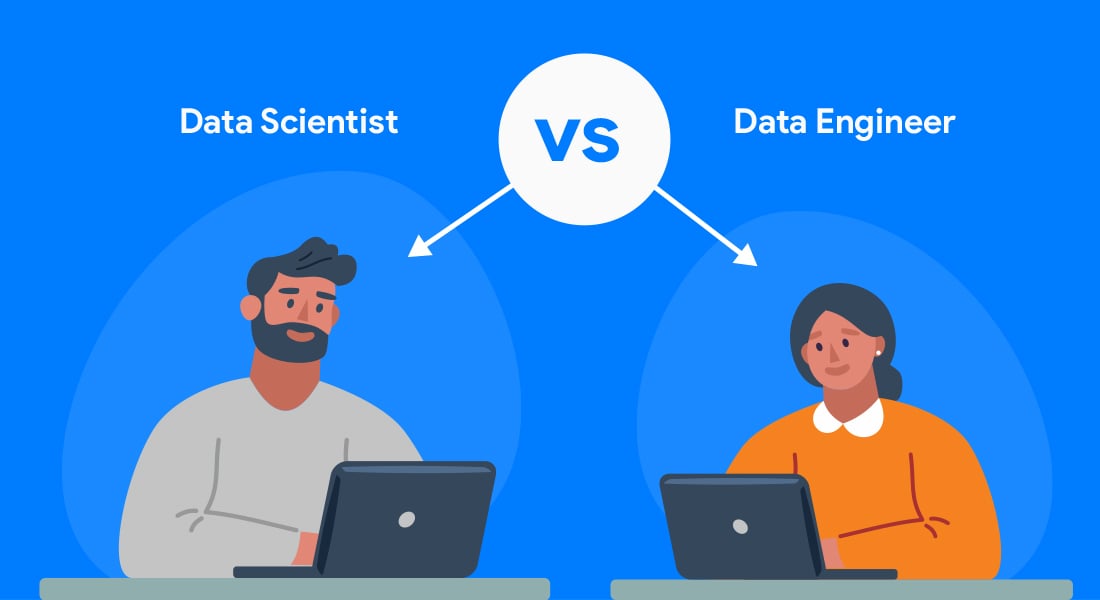
The major difference between data scientist and data engineer is that data engineers focus on building and maintaining the frameworks and structures that can fetch and store data in an organized manner. On the other hand, data scientists focus on analyzing the data to identify trends and extract useful insights to assist organizations in making decisions to increase profitability and productivity.
Data Scientist Duties and Responsibilities
Data scientists are investigative thinkers. Research and discovery are one of their core duties. They research data and discover patterns, trends, and information invisible to the human mind and eyes. This discovered information or data insights help businesses make better decisions, streamline business processes, optimize operations, and increase ROI.
The responsibilities of a data scientist depend on the needs of an organization. However, a summary of several responsibilities they fulfill is mentioned below,
- Gather data by identifying different internal and external sources.
- Process and clean the data to make it ready for modeling and discovery.
- Find the right questions to begin the discovery and analysis process on structured and unstructured data.
- Understand business challenges and collaborate with the team to create data strategies and design solutions.
- Explore additional technologies and tools necessary to explore, analyze, and visualize data insights.
- Leverage data visualization tools (e.g., Tableau, Power BI) to present insights in an understandable format.
- Develop custom analytics solutions using ML algorithms and statistical methods.
- Update the solutions or analytics process based on the feedback received.
Data Engineer Roles and Responsibilities
Data engineers are the backbone of any data-driven system. Their primary focus is creating seamless data pipelines using a combination of big data technologies and tools. As the name suggests, data engineers build, test, and maintain data architecture so data analysts and scientists can use the data in real time to extract value-based insights.
The raw data collected for analysis contains many anomalies and errors, making it worthless for data scientists. To make the data usable, a data engineer creates reliable data pipelines that interconnect data from different sources and transfer it from one format to another.
Here is a summary explaining data engineer responsibilities,
- Collect data from different sources as it is, where it is available.
- Design, develop, build, test, and maintain data architectures and processing workflows.
- Build robust, comprehensive, reliable, and efficient data pipelines.
- Understand business data needs and provide tailored data acquisition solutions.
- Ensure the data architecture they build supports business requirements and integrates with their data science strategy.
- Develop datasets to be used in data modeling, mining, and production.
- Improve the quality, consistency, and reliability of collected data.
- Enhance and streamline the process of collecting and integrating new data.
Skills of a Data Scientist
As discussed earlier, data scientists need to be a pro in mathematics, statistics, and machine learning techniques. Their job role majorly revolves around combing the best of models, architectures, algorithms, and tools to get the job done.
Here is a list of skills a data scientist has,
• Mathematics and Statistics
A data scientist has a computer science background and a strong foundation in maths, stats, and probability. Knowing mathematics and statistics is the primary requirement to become a data scientist. Creating hypotheses, models, and flows to work on different machine learning algorithms constitute the foundational skills of a data scientist.
• Machine Learning
Data science works on a core principle of extracting knowledge or information from the data. Therefore, basic familiarity with machine learning models and algorithms is another skill set every data scientist has.
• Programming Knowledge
A data scientist must be well versed in programming languages like R Python. Besides, they must have coding skills to build databases, software development lifecycles, and analytic solutions meeting business needs. Almost all data scientists have proven skills in using data science tools and technologies.
• Data Visualization
Having a strong hold on data analysis and data visualization is a major skill set for data scientists. An ability to look beyond patterns, trends, and KPIs and a strong understanding of various data analytics and visualization tools help them transform data into insights and present them in a visually appealing format.
• Managing Database
Profound knowledge of databases and managing data is the foremost skill of a data scientist. Managing large databases, cleaning, processing, modeling, structuring, and processing data is their core responsibility. Hence managing large databases with expertise in different data storage domains such as MongoDB, PostgreSQL, MySQL, Open Source NoSQL Database, Databricks, AWS, Casandra, Oracle, etc., is a must.
Is it now time to aim for the bull’s eye?
Hire data scientists from us with the skills you need for your next project.
Skills of a Data Engineer
As discussed earlier, data scientists need to be a pro in mathematics, statistics, and machine learning techniques. Their job role majorly revolves around combining the best of models, architectures, algorithms, and tools to get the job done.
Here is a list of skills a data engineer has,
• Database Systems
A data engineer has excellent knowledge of managing rational databases and standard programming languages like SQL and NoSQL. They are excellent at manipulating database management systems (DBMS) – a software application offering an interface to databases for information storage and retrieval.
• Data Warehousing Solutions
Data engineers possess exceptional knowledge of data warehousing. Hands-on experience in Amazon Web Service and Microsoft Azure is an essential and fundamental skill set for a data engineer. Besides, creating data warehousing solutions and customizing the existing solutions is a necessary skill set for data engineers.
• ETL Tools
ETL stands for Extract, Transfer, and Load. It is an important aspect of data science requiring data engineers to have profound knowledge of data pulling, batch processing, applying rules to specific data, and then loading transformed data into databases for further viewing or processing. A data engineer is well versed with almost all ETL tools used in the process to get the job done.
• Data APIs
A data engineer must be a nerd using the Application Programming Interface (API). Knowledge of APIs is a prerequisite for data integration, processing, or any activities related to a data engineering job. APIs offer a bridge to connect various applications and data sources and transport their data. Data engineers predominantly rely on REST APIs. Also called Representation State or REST APIs provide seamless communication over HTTP, establishing them as a valuable asset for any web-based tool.
• Programming Languages
A data engineer must have exceptional skills in versatile programming languages, especially backend and query languages, considered specialized languages for statistical computing. Python, Ruby, Java, and C# are some of data engineers’ widely used programming languages besides SQL and R.
With a growing number of tools available for data science and data engineering, choosing the best tool can be challenging. However, professionals in both fields rely on a few standout tools that continue to prove their value. Here is the list of tools that data scientists and data engineers consider the best in 2026.
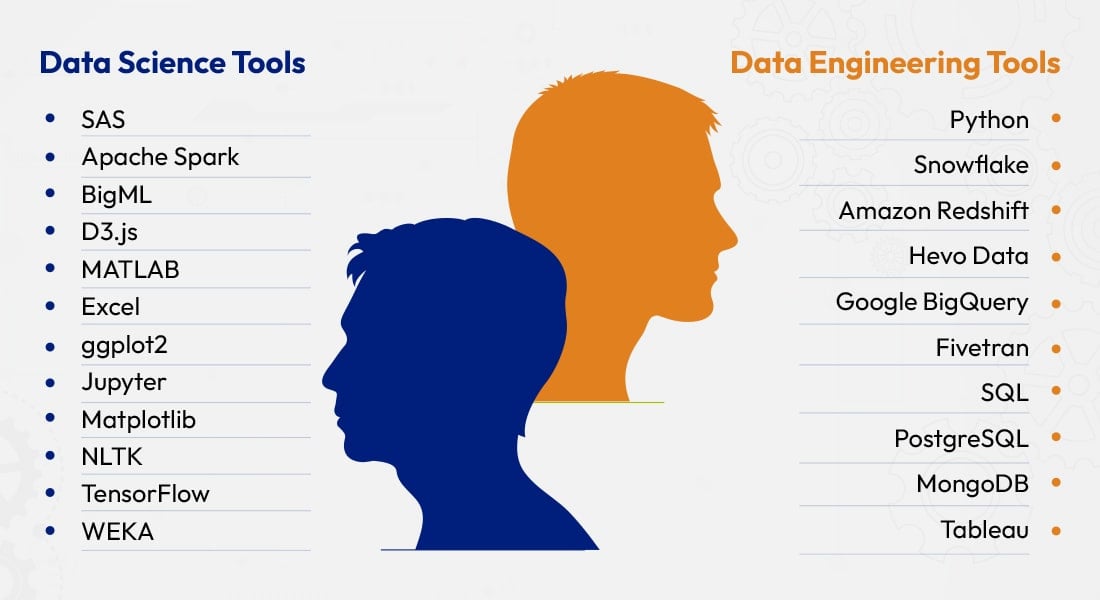
Data Science has become incredibly popular in the 21st century. Companies hire data scientists to understand their customers better and improve their products. A data scientist must have hands-on experience in various tools and programming languages. Let’s look at some of the popular data science tools used in 2026.
1. SAS
2. Apache Spark
3. BigML
4. D3.js
5. MATLAB
6. Excel
7. ggplot2
8. Jupyter
9. Matplotlib
10. NLTK
11. TensorFlow
12. WEKA
To offer excellent Data Engineering Services our Data Engineers build data pipelines and help design data infrastructure. They also work on algorithm development, making data more useful to companies. To build a rich data infrastructure, data engineers require a mix of programming languages, data management tools, and other tools for processing and analyzing data. Here is a list of top tools and technologies used by data engineers in 2026.
1. Python
2. Snowflake
3. Amazon Redshift
4. Hevo Data
5. Google BigQuery
6. Fivetran
7. SQL
8. PostgreSQL
9. MongoDB
10. Tableau
As organizations scale their analytics capabilities, selecting the right data engineering stack becomes even more critical. Before finalizing any tool, it is important to gain in-depth knowledge about its architecture, integration capabilities, scalability, and long-term impact on your data ecosystem. A clear understanding of each data engineering tools helps avoid compatibility issues, performance bottlenecks, and unnecessary costs in the future.
When to Hire a Data Scientist?
- When you need analytical thinkers who aren’t afraid of asking questions, think about hiring a data scientist. These professionals are dedicated to take any efforts necessary to test their hypothesis.
- Prefer hiring a data scientist when you want the data to make sense when you want to forecast the trends by analyzing the things that happened in the past and need to understand the probability of what might happen in the future.
- It’s better to onboard data scientists when you want advanced analytics, write machine learning algorithms, and use AI and deep learning models.
- Data science consulting is ideal when you want to analyze data statistically, find patterns, understand relationships between variables, and present visualizations of insights to decision-makers.
When to Hire a Data Engineer?
- Hiring data engineers is the best choice when you need someone to manipulate, transform, and cleanse the raw data that data scientists can use for analysis and building machine learning models.
- Data engineers are excellent at preparing or working with infrastructure and architecture that stores the organizational data and moves it and the code driving it. They also ensure the data is equally accessible by all stakeholders within the organization.
- Hire data engineer when you want someone to design, build, test, integrate, manage and optimize data from various sources.
How to Hire Skilled Data Scientists and Data Engineers
Hiring data professionals can be tough, whether it’s data scientist or data engineer. While both roles play distinct parts in the data ecosystem, they must work together to help businesses make informed decisions, develop efficient systems, and drive digital transformation.
To select the right data talent, it is important to understand your business objectives and the data issues you want to resolve. Whether you need a data scientist to accomplish advanced analytics and predictive modelling, or a data engineer to build a dependable data pipeline and infrastructure, identifying these needs ahead of time will help you select the right level of data expertise for the right candidate.
Hire According to Your Needs - Freelance or Full-Time
Both data scientists and data engineers can be hired as employees and/or contract workers, depending on the type of work you are planning. For smaller tasks, like exploratory analysis or to set up data pipelines, it is acceptable to hire a freelancer. When planning for larger timelines and ongoing maintenance of systems, hiring full-time professionals will provide some consistency in their understanding and approaches to your specific domain.
Look beyond the resume.
Resumes rarely reveal the full extent of what is needed from data professionals. The easiest way to gauge the skills of a data scientist or data engineer is to ascertain whether they can solve complex problems, communicate technical concepts clearly, and collaborate across teams.
Data scientists should be proficient in converting data to actionable insights, and data engineers should be able to demonstrate strength in designing reliable systems and data pipelines. Outstanding programming skills and the ability to adapt to tools and processes that will invariably evolve are important markers of a successful individual in both roles.
Education and Experience
Most data scientists and data engineers have graduate-level qualifications, but formal qualifications are not the only way to acquire expertise. Many successful data professionals have learnt their skills from online courses, boot camps, certifications, or self-taught. Employers should recognize that both quantitative and qualitative indicators are worthy of consideration, as many times, real-world projects can reveal skills that qualifications do not convey.
Screening Candidates
Recognizing the best talent requires employers to dig deeper for evidence rather than looking solely at a resume. Skills tests, portfolio reviews, and interviews help employers determine candidates’ technical depth and fit into their company culture. Employers should also provide candidates with evidence of their role requirements.
Data scientists should be tested on their ability to think analytically in order to solve problems and how they use statistics to provide solutions. Data engineers should be evaluated on their design and build capability in relation to data architecture and pipeline development.
Skill Assessment
Consider candidates’ domain capabilities, with data scientists being proficient in statistics, machine learning, and interpreting data to provide insights. While data engineers demonstrate proficiency in maintaining databases, ETL, data migration or transfer processes, and system optimization.
Onboarding
Help your new hires be successful by assigning them mentors, integrating them into multiple cross-functional teams, and setting clear expectations. Work with them on smaller projects so they can learn about your systems and then increase their commitment as they get in line with your data strategy.
Conclusion
I hope your purpose of landing on this blogpost to understand the significant difference between Data Scientist vs Data Engineer is served. Understanding the market requirements, the demand for data scientists is growing, and the talent supply is limited. Recruiters and managers are trying to hire faster, better, and smarter. As companies face an expanding array of challenges and opportunities, they will continue to hire more data scientists in the future.
Bacancy is the right partner to hire data scientists or hire data engineers, who are well-experienced, skilled, and ready to onboard. We have vetted data professionals who have been screened and analyzed for their skills and expertise in statistics, mathematics, data mining, analytics, programming, algorithms, machine learning, time series forecasting, predictive modeling, anomaly detection, security, and natural language processing, and much more. In-between data engineer vs data scientist, the ultimate decision is primarily based on your specific business needs, the type of data challenges you face, and the goals you aim to achieve with data-driven solutions.
Frequently Asked Questions (FAQs)
Data scientist vs data engineer plays a crucial part in a data-driven culture. Although data scientists are more recognized and more in demand, data engineers are the pillars supporting data scientists to perform their job better. If data scientists have a more focused approach, data engineers are the ones who organize algorithms prepared by data scientists into a production flow. Besides, data scientists do the job when you want data collected, modeled, and structured by data engineers to make sense.
As David Bianco states, “Data Engineers are the plumbers building a data pipeline, while data scientists are the painters and storytellers, giving meaning to an otherwise static entity.” Both Data Engineer to Data scientist are part of the same team that seeks to transform raw data into actionable business insights.
Data Engineers and Data Scientists have the most important thing in common: their educational background. Both professionals tend to come from Mathematics, Physics, Computer Science, Information Science, or Computer Engineering backgrounds. Both Data Engineers and Data Scientists are skilled programmers who know how to use languages such as Java, Scala, Python, R, C++, JavaScript, and SQL. However, there is a significant difference between data scientist and data engineer as well as their roles and responsibilities.
A data engineer designs and manages the systems that collect, store, and process data, ensuring it’s accurate, organized, and accessible, while a data scientist analyzes that prepared data to uncover patterns, build predictive models, and generate actionable insights. In short, data engineers make the data usable, and data scientists make the data valuable.
Yes, data engineers and data scientists can switch roles. Their overlapping skills—from knowledge of programming languages to working with data pipelines—allow them to make an easy transition into the other profession.
However, since data engineers focus on the architecture and infrastructure that supports the work of data scientists, and data scientists develop and test hypotheses through data, both professions would have to brush up on additional skills before they could leap.
Finding a suitable candidate for a data science position can take hundreds of applications. Companies are beginning to recognize the need to rethink their hiring practices regarding data science. An effective recruitment system can be thought of as like a funnel. The process of hiring a data scientist has been explained above in the blog. However, if you need more information about the same you can contact us at Bacancy.
Data scientists and engineers are here to stay, but their roles may shift over time. Data scientists will still be in demand for the creative aspects of the job. Data engineers manage databases and set up Data Modeling environments, while data scientists use knowledge of quantitative science to build predictive models.