Quick Summary
Data engineering tools play a critical role in building scalable and reliable pipelines in 2026. With growing AI workloads and increasing complexity, choosing the right tools requires more than feature comparison. This guide explores key categories, evaluation criteria, and practical considerations to help you make informed decisions that support long-term growth and operational stability.
Table of Contents
Introduction
Modern data pipelines are no longer just backend infrastructure. They’re the heart of analytics, automation, and AI initiatives. In fact, 90% of AI and machine learning initiatives depend directly on data engineering pipelines. Every prediction made by AI/ML models depends on the quality of the underlying data.
According to one study, 30-40% of data pipelines experience failures every week. The failure of AI/ML models and data visualizations has significant downstream effects that go beyond just technology. It affects trust, timelines, and business outcomes.
That’s why choosing the right Data Engineering Tools in 2026 requires thinking beyond features and focusing on long-term sustainability. It’s about creating systems that can handle complexity without requiring firefighting. In this guide, we’ll explore the landscape of today’s data engineering tools and help you evaluate them in terms of practical requirements.
Core Data Engineering Tools to Consider in 2026
The modern data stack is made up of multiple specialized tools, each solving a specific part of the pipeline. Below, we break down the core tool categories you should evaluate in 2026 and why each one matters in building a scalable data ecosystem.
1. Data Ingestion and Streaming Tools
Every data journey begins with ingestion. Before dashboards update or models make predictions, data has to move from multiple sources into a central system. This could be live user activity, transactions, logs, or scheduled exports from different platforms. If this first step is unstable or poorly designed, the rest of the pipeline constantly struggles to catch up. The tools below address different ingestion needs, whether you require real-time streaming, controlled data routing, or large-scale batch processing.
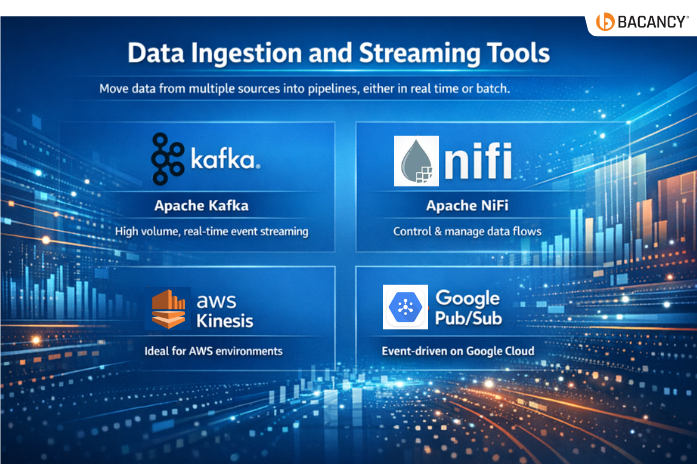
Apache Kafka
Apache Kafka is a distributed event streaming platform designed to handle high volumes of real-time data across multiple systems. It allows applications, databases, and services to continuously publish and subscribe to data streams in a reliable and scalable way. Because of its architecture, Kafka can process millions of events per second while maintaining low latency, making it a strong choice for modern, data-intensive environments.
Why teams use it:
- Handles massive throughput with low latency, even under heavy load
- Supports event-driven architectures where systems react to real-time changes
- Strong ecosystem and community adoption with wide industry support
- Works well in distributed environments across clusters and data centers
Ideal for:
Organizations processing continuous streams such as user activity, IoT signals, financial transactions, or log data.
Apache NiFi
Apache NiFi is a data integration and flow management tool designed to automate and control the movement of data between systems. It provides a visual interface that allows teams to design, monitor, and manage data flows with precision. NiFi focuses heavily on traceability and governance, making it easier to see where data is coming from, where it is going, and how it is being transformed along the way.
Why teams use it:
- Visual interface for designing flows, reducing the need for complex custom code
- Fine-grained control over data movement, routing, and prioritization
- Built-in monitoring and traceability for full data lineage visibility
- Strong support for hybrid and on-premise environments where governance matters
Ideal for:
Teams that require governance, traceability, and controlled data routing.
AWS Kinesis
AWS Kinesis is a fully managed streaming data service designed to collect, process, and analyze real-time data at scale. It enables organizations to continuously ingest data from sources such as applications, devices, and logs without managing complex infrastructure. Because it is built within the AWS ecosystem, it integrates smoothly with other AWS services, making deployment and scaling more straightforward for cloud-native teams.
Why teams use it:
- Fully managed service that reduces the need to maintain streaming infrastructure
- Seamless integration with the AWS ecosystem, including storage and analytics services
- Handles real-time streaming data with low latency processing
- Reduced operational overhead compared to self-managed streaming systems
Ideal for:
AWS centric architectures where speed and integration matter.
Google Pub/Sub
Google Pub/Sub is a fully managed messaging and event ingestion service designed to enable real-time communication between systems. It allows applications to send and receive messages asynchronously, making it easier to build scalable, event driven architectures. As a serverless service, it automatically handles scaling, infrastructure, and reliability, which reduces operational effort for engineering teams.
Why teams use it:
- Serverless and scalable architecture that adjusts automatically to traffic spikes
- Reliable message delivery with built-in redundancy and durability
- Strong integration with Google Cloud services like BigQuery and Dataflow
- Suitable for asynchronous systems where decoupling services improves flexibility
Ideal for:
Organizations building cloud-native applications on Google Cloud that require scalable, low maintenance event streaming and real-time data processing.
Decision Hint:
Choose streaming tools when data freshness is business critical. For simple, low volume batch ingestion, these tools may introduce unnecessary complexity.
2. Data Transformation and Orchestration Tools
Once data is collected from different sources, it rarely comes in a format that teams can directly use for reporting or analytics. It needs to be cleaned, standardized, combined, and structured properly so that it becomes reliable and consistent across systems. At the same time, workflows must be scheduled, monitored, and managed to ensure data moves smoothly from one stage to the next without breaking. The tools listed below help automate these processes, maintain pipeline reliability, and reduce manual effort across teams.
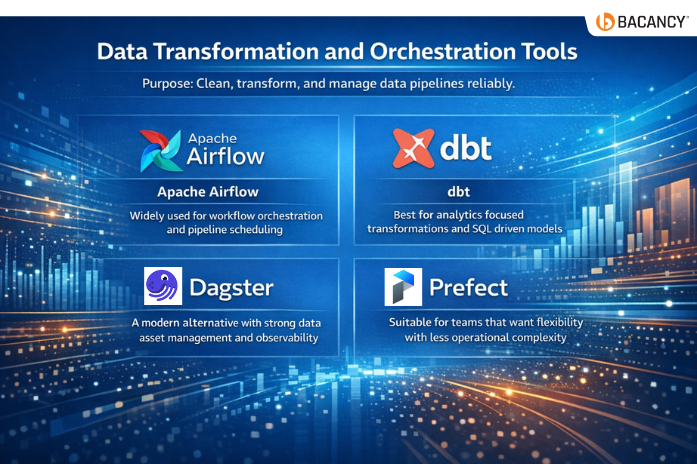
Apache Airflow
Apache Airflow is an open-source workflow orchestration platform designed to programmatically schedule and monitor data pipelines. It allows teams to define workflows as Directed Acyclic Graphs (DAGs), making complex processes easier to visualize, manage, and scale. Airflow is widely adopted in modern data stacks where reliability and structured pipeline management are critical.
Why teams use it:
- Flexible DAG-based workflows that clearly define task dependencies and execution order
- Strong scheduling capabilities for recurring, event-based, or time-driven jobs
- Large community and plugin ecosystem that extends integrations across tools and platforms
- Supports complex dependencies across multiple systems and environments
Ideal for:
Enterprises managing multi-step pipelines across systems and organizations that need visibility and control over orchestration logic need to Hire Apache Airflow developers to design, implement, and optimize scalable workflow orchestration.
dbt
dbt (data build tool) is a transformation framework that enables teams to transform raw data inside their data warehouse using SQL. Instead of moving data between systems, dbt focuses on modeling and organizing data directly where it lives, making it analytics-ready. It is especially popular in modern ELT workflows where transformation happens after data is loaded into the warehouse.
Why teams use it:
- SQL-first approach that allows analysts and engineers to work in a familiar language
- Strong data modeling capabilities for building structured, reusable datasets
- Built-in testing and documentation to improve reliability and transparency
- Popular with analytics teams due to its focus on warehouse-native transformations
Ideal for:
Organizations where analytics engineers and data teams work closely.
Dagster
Dagster is a modern data orchestration platform designed with a strong focus on data assets, observability, and developer experience. Instead of just managing tasks, Dagster treats data itself as a first-class asset, helping teams understand how datasets are produced, updated, and connected across pipelines. This approach makes complex data systems easier to manage and debug.
Why teams use it:
- Asset-based pipeline design that centers workflows around datasets rather than just tasks
- Built-in testing and monitoring features to improve reliability
- Clear separation of logic and configuration for better maintainability
- Improved developer experience with structured project organization
Ideal for:
Organizations that prioritize maintainability and data visibility and teams building modern, observable data platforms.
Prefect
Prefect is a modern workflow orchestration tool built to simplify pipeline management without adding heavy operational overhead. It allows teams to create, schedule, and monitor workflows using Python, while offering both cloud-managed and self-hosted deployment options. Prefect focuses on flexibility and ease of use, making orchestration more accessible for growing teams.
Why teams use it:
- Cloud and self-hosted options that provide deployment flexibility
- Python-friendly design that feels natural for engineering teams
- Reduced infrastructure management compared to traditional schedulers
- Easy deployment with straightforward setup and scaling
Ideal for:
Teams that want flexible orchestration with minimal operational burden
Decision Hint:
dbt fits analytics heavy teams. Airflow and Dagster are better suited for complex, multi system pipelines with strict orchestration needs.
3. Cloud Data Platforms and Warehouses
Cloud data platforms and warehouses form the backbone of modern data architectures. They are where cleaned and transformed data is stored, processed, and made available for reporting, analytics, and machine learning. As data volumes grow and AI workloads become more demanding, these platforms must support scalability, performance, and secure access across teams. The tools listed below represent some of the leading options organizations consider when building or modernizing their cloud data foundation.

Snowflake
Snowflake is a cloud-based data platform built for scalable analytics and secure data collaboration. It enables organizations to store large volumes of structured and semi-structured data while delivering consistent performance for reporting, dashboards, and advanced analytics workloads. Its cloud-native architecture separates storage and compute, allowing teams to scale resources independently based on demand.
Why teams use it:
- Separation of storage and compute, allowing flexible scaling
- Secure data sharing across teams and even external partners
- Automatically scales based on workload demand
- Multi-cloud support across major cloud providers
Ideal for:
Organizations that need flexible scaling, cross-team collaboration, and a cloud-native platform that can support both analytics and growing AI workloads without heavy infrastructure management.
Databricks
Databricks is a unified data platform designed to support data engineering, machine learning, and AI workloads within a single environment. Built on Apache Spark, it enables large-scale data processing while allowing teams to work collaboratively through interactive notebooks. Its lakehouse architecture combines the flexibility of data lakes with the reliability of data warehouses, making it suitable for both analytics and advanced AI use cases.
Why teams use it:
- Unified data and AI environment that reduces tool fragmentation across teams
- Strong Spark-based processing for large-scale distributed workloads
- Collaborative notebooks that allow engineers, analysts, and data scientists to work together
- Lakehouse architecture approach that balances performance, governance, and flexibility
Ideal for:
Organizations that want to bring data engineering, analytics, and machine learning teams onto one platform, especially those building AI-driven applications or working with large-scale distributed data processing.
Google BigQuery
Google BigQuery is a fully managed, serverless data warehouse designed for fast SQL-based analytics at scale. It allows teams to run high-performance queries on large datasets without managing infrastructure. Because it is serverless, resources scale automatically based on workload demand, making it easier to handle fluctuating query volumes while maintaining performance.
Why teams use it:
- Serverless model that removes the need for infrastructure management
- Automatic scaling to handle unpredictable workloads efficiently
- High-performance SQL queries optimized for large analytical datasets
- Deep integration with Google Cloud services for seamless data workflows
Ideal for:
Organizations looking for a low-maintenance, serverless analytics platform, especially those already operating within the Google Cloud ecosystem and prioritizing fast, large-scale SQL analytics.
Amazon Redshift
Amazon Redshift is a fully managed cloud data warehouse designed for scalable analytics within the AWS ecosystem. It enables organizations to run complex SQL queries on large volumes of structured data while integrating seamlessly with other AWS services. With its mature architecture and enterprise-grade capabilities, it supports reporting, business intelligence, and analytical workloads at scale.
Why teams use it:
- Native AWS integration that works smoothly with services like S3, IAM, and AWS analytics tools
- Scalable analytics that can handle growing data volumes and concurrent queries
- Suitable for structured data workloads with strong SQL performance
- Mature enterprise support backed by AWS infrastructure and security standards
Ideal for:
Organizations that are heavily invested in AWS and want a tightly integrated, enterprise-ready data warehouse for large-scale structured analytics.
Decision Hint:
Platform choice should align with cloud strategy, data volume, and AI readiness rather than pricing alone.
4. Data Quality and Observability Tools
When data starts driving dashboards, reports, and AI systems, even small inconsistencies can create serious consequences. Missing records, delayed updates, or unexpected schema changes can quietly break trust in analytics before anyone notices. This is why data quality and observability have become essential layers in modern pipelines. These tools help teams monitor freshness, detect anomalies, track lineage, and ensure that data remains accurate and reliable as it moves across systems. The tools listed below are designed to address these challenges at different levels of the data stack.
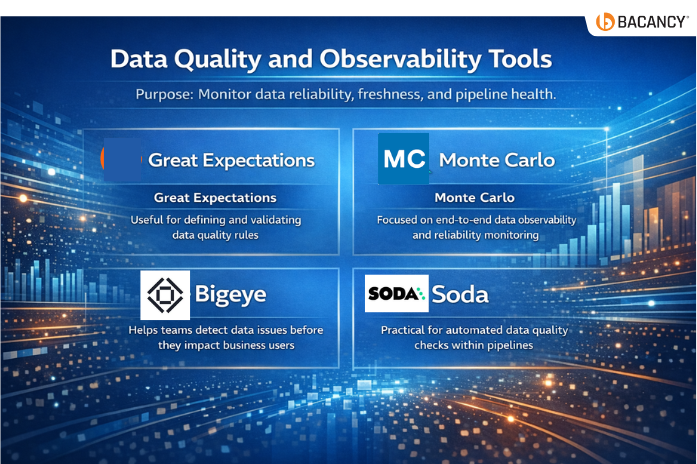
Great Expectations
Great Expectations is an open source data quality framework that helps teams define, test, and document expectations for their data. Instead of manually checking datasets, teams can create validation rules that automatically verify whether data meets defined standards before it moves downstream.
Why teams use it:
- Declarative validation rules that are easy to define and maintain
- Open source flexibility with strong community support
- Smooth integration with existing data pipelines and orchestration tools
- Built-in documentation generation for better transparency and governance
Ideal for:
Teams that want structured, rule-based data validation within their pipelines, especially organizations looking for an open source solution that can scale with evolving data quality requirements.
Monte Carlo
Monte Carlo is a data observability platform designed to monitor the health of modern data stacks from end to end. Instead of only validating predefined rules, it focuses on detecting unexpected changes in data volume, freshness, schema, and usage patterns. This helps teams identify issues early before they affect dashboards or downstream applications.
Why teams use it:
- Automated anomaly detection without heavy manual rule creation
- End-to-end lineage tracking across pipelines and warehouses
- Impact analysis to understand which reports or systems are affected
- Enterprise-grade monitoring built for large, complex data environments
- Continuous monitoring of warehouse tables and datasets
- Proactive alerts when anomalies or unexpected changes occur
- Easy integration with major cloud data warehouses
- Reduced downtime risk by catching issues early
- SQL-based checks that are easy for data teams to write and maintain
- Smooth integration within existing pipelines and orchestration tools
- Flexible deployment options across cloud and hybrid environments
- Scales effectively as data volume and complexity grow
- Pre-built connectors for hundreds of common data sources
- Automatic schema updates that adapt to source changes
- Minimal maintenance with fully managed pipeline operations
- Faster implementation compared to building custom integrations
- Customizable connectors that can be modified or built for unique data sources
- Community-driven ecosystem that continuously expands connector support
- Flexible deployment options, including self-hosted and cloud setups
- Suitable for hybrid environments where data flows across on-prem and cloud systems
- Native cloud integration optimized for leading cloud platforms
- Visual interface that simplifies pipeline design and management
- ELT-focused workflows that leverage warehouse compute power
- Works well with major cloud warehouses like Snowflake, Redshift, and BigQuery
- Strong interactive dashboards with rich visualization capabilities
- User-friendly interface that supports both analysts and business users
- Advanced data exploration features for deeper insights
- Integrates with a wide range of data sources across cloud and on-prem systems
- Seamless integration with Microsoft tools like Excel, Azure, and Teams
- Strong enterprise reporting and governance capabilities
- Cost-effective licensing for large organizations
- Built-in data modeling features for structured analytics
- Centralized data modeling for metric consistency
- Strong governance and controlled data access
- Native integration with cloud data warehouses
- Scalable architecture suited for growing analytics needs
- Associative data engine for flexible data exploration
- Self-service analytics capabilities for business users
- Interactive dashboards with strong filtering and discovery features
- Enterprise scalability with governance controls
- Handles both batch and streaming data within the same framework
- Scales efficiently across distributed clusters
- Mature ecosystem with strong community and library support
- Strong integration with major cloud platforms and storage systems
- Low latency processing for time-sensitive workloads
- Stateful stream management for complex event handling
- Real-time analytics capabilities with continuous computation
- Reliable event processing with strong fault tolerance
- Portable pipeline model that abstracts execution complexity
- Works across multiple execution engines such as Spark and Flink
- Supports complex data processing patterns
- Flexible architecture design for evolving pipeline needs
Ideal for:
Organizations with mature data ecosystems that need proactive monitoring and visibility across multiple tools, teams, and business-critical data assets.
Bigeye
Bigeye is a data observability platform built to monitor data directly within cloud data warehouses. It continuously tracks metrics like freshness, distribution changes, and volume patterns to identify issues before they reach dashboards or business users. The focus is on early detection and fast resolution without adding heavy operational overhead.
Why teams use it:
Ideal for:
Teams that rely heavily on cloud data warehouses and want automated monitoring without building custom validation frameworks from scratch.
Soda
Soda is a data quality and monitoring tool designed to embed automated checks directly into data pipelines. It allows teams to define quality tests using SQL and validate datasets as they move through different stages of processing. The goal is to catch issues early and ensure reliable outputs without slowing down development.
Why teams use it:
Ideal for:
Teams that prefer SQL-driven validation and want lightweight, automated quality checks built directly into their data workflows.
Decision Hint:
These tools become essential once dashboards, reporting, and AI models directly influence business decisions.
5. Data Integration and ELT Platforms
As organizations rely on multiple SaaS platforms, databases, and operational systems, moving data into a centralized warehouse has become a foundational step in analytics. Manually building and maintaining custom connectors is time consuming and difficult to scale. Data integration and ELT platforms simplify this process by automating data extraction, loading it into target systems, and handling schema changes along the way. The tools listed below are designed to streamline data movement, reduce engineering effort, and make pipelines more reliable as data sources continue to grow.
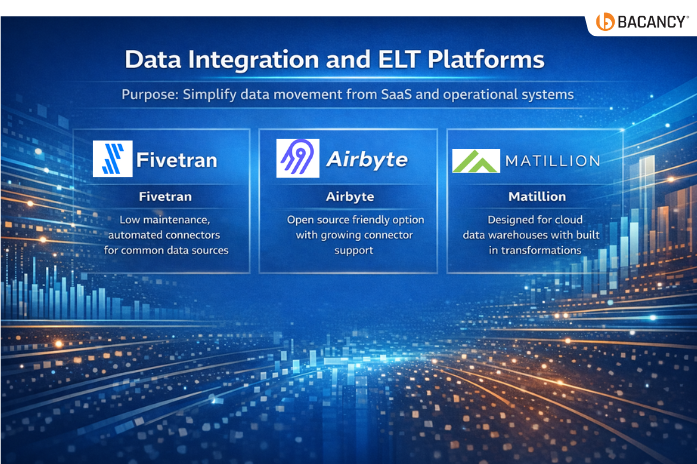
Fivetran
Fivetran is a managed data integration platform that automates the process of extracting data from SaaS applications, databases, and other operational systems into cloud data warehouses. It focuses on reducing manual engineering effort by handling connector maintenance, schema changes, and data syncing automatically.
Why teams use it:
Ideal for:
Teams that want reliable, low-maintenance data integration without dedicating engineering time to building and maintaining custom connectors.
Airbyte
Airbyte is a data integration platform designed to move data from various sources into data warehouses, lakes, and databases. It offers an open source core with a rapidly growing library of connectors, allowing teams to customize and extend integrations based on their specific needs.
Why teams use it:
Ideal for:
Teams that prefer open source flexibility and want greater control over their data integration workflows, especially in complex or hybrid infrastructure environments.
Matillion
Matillion is a cloud-native data integration and ELT platform built specifically for modern cloud data warehouses. It enables teams to extract data from various sources, load it into cloud warehouses, and perform transformations directly within the warehouse environment for better scalability and performance.
Why teams use it:
Ideal for:
Organizations that rely on cloud data warehouses and want a visual, ELT-driven integration tool that maximizes in-warehouse processing performance.
To ensure long-term scalability and performance, hire data engineers from Bacancy who can implement your vision effectively.
6. Data Visualization, Analysis, and BI Tools
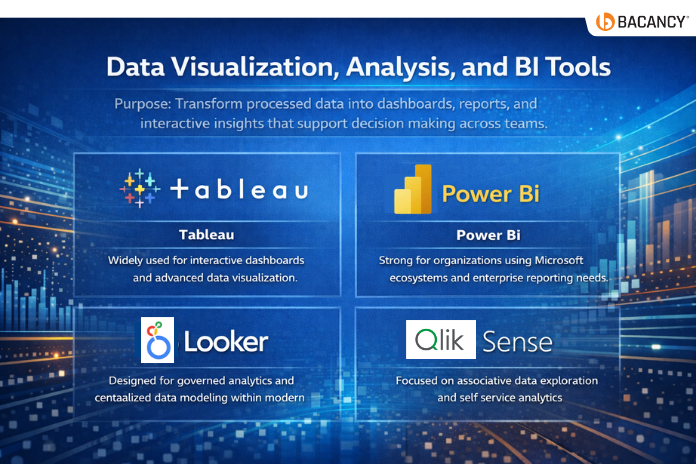
Once data has been collected, transformed, and validated, it still needs to be translated into insights that people can actually use. This is where visualization and BI platforms play a critical role. They turn raw tables and complex queries into dashboards, reports, and interactive views that make trends, patterns, and performance metrics easier to understand. The tools listed below help organizations bridge the gap between data engineering and real-world decision making by making insights accessible, visual, and actionable.
Tableau
Tableau is a leading data visualization and business intelligence platform designed to turn complex datasets into interactive dashboards and visual reports. It enables users to explore data through drag-and-drop interfaces, making advanced analytics more accessible across teams.
Why teams use it:
Ideal for:
Organizations that prioritize visual storytelling and interactive analytics, especially teams that want flexible dashboard creation with strong data exploration capabilities.
Power BI
Power BI is a business intelligence platform from Microsoft that enables organizations to create reports, dashboards, and data models within a tightly integrated ecosystem. It combines data preparation, visualization, and enterprise reporting capabilities in one solution.
Why teams use it:
Ideal for:
Organizations already operating within the Microsoft ecosystem that need scalable, enterprise-ready reporting and centralized BI management.
Looker
Looker is a modern BI platform focused on governed analytics and centralized data modeling. Built for cloud environments, it enables teams to define consistent business metrics using a modeling layer, ensuring that reports and dashboards align across the organization.
Why teams use it:
Ideal for:
Organizations that require governed analytics with consistent business definitions, particularly those operating on modern cloud data stacks.
Qlik Sense
Qlik Sense is a data analytics platform known for its associative data model, which allows users to explore relationships across datasets dynamically. It supports self-service analytics while maintaining enterprise-level scalability and control.
Why teams use it:
Ideal for:
Organizations that want dynamic, self-service data exploration while maintaining structured oversight and enterprise scalability.
Decision hint:
Choose these tools when your priority is making data accessible to business users, leadership teams, and analysts. The right platform depends on your existing cloud ecosystem, governance requirements, and how much self service access you want to enable.
7. Data Engineering Development and Processing Frameworks
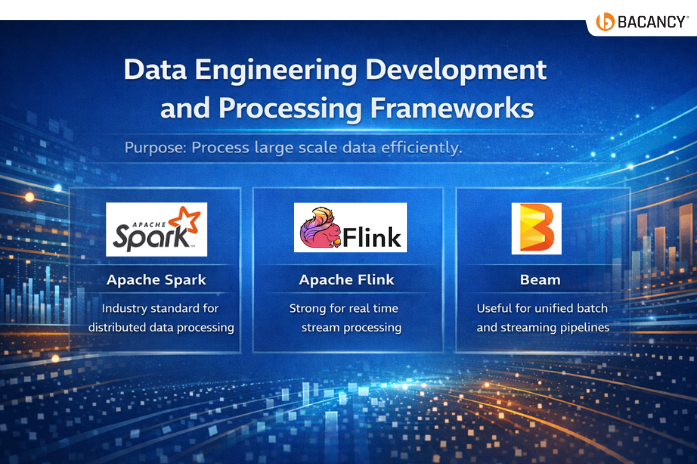
Processing is at the heart of any data engineering workflow. Once data is ingested, it needs to be cleaned, transformed, enriched, and prepared for analytics or machine learning. At large scale, this requires distributed computing frameworks that can handle high volumes, complex transformations, and performance demands without slowing down. The tools listed below are designed to support efficient data processing across batch and real-time environments, helping teams manage scale while maintaining reliability and speed.
Apache Spark
Apache Spark is an industry standard framework for distributed data processing, widely used for handling large-scale batch and streaming workloads. It provides high-performance computation across clusters and supports multiple languages, making it a core component in many modern data platforms.
Why teams use it:
Ideal for:
Organizations processing large volumes of data that need a proven, scalable framework for both batch analytics and real-time workloads can hire Apache Spark Developers to accelerate your data processing capabilities.
Apache Flink
Apache Flink is a stream processing framework designed for real-time data applications that require low latency and high reliability. It is built to process continuous data streams while maintaining consistent state across distributed systems.
Why teams use it:
Ideal for:
Teams building real-time data applications such as fraud detection, event-driven systems, or continuous analytics pipelines.
Apache Beam
Apache Beam is a unified programming model for building both batch and streaming data pipelines. It allows teams to define pipelines once and run them across different execution engines, providing flexibility in deployment.
Why teams use it:
Ideal for:
Organizations that want flexibility in choosing execution engines while maintaining a consistent pipeline development model across environments.
Decision Hint:
These frameworks require skilled engineering teams and should be selected with long term maintenance and scalability in mind.
What to Look for in Data Engineering Tools in 2026
In addition to the product name and features lists, successful tool selection requires the right evaluation mindset. In 2026, the market offers many excellent tools that promise scalability, automation, and AI-readiness. However, the key difference comes in the tools that are right for your architecture and your long-term goals.
Before making any decision on a platform, take a step back and consider what you are really trying to solve for. Are you trying to solve for future growth in your data? Real-time analytics? AI initiatives? Or are you trying to solve for reducing the overall complexity of operations? The answer is not what the market says; rather, it is what you need.
Here are the key considerations that should be considered when thinking about tools and platforms:
Scalability and Cost Control
Can the tool handle future growth in data volume and users without unpredictable cost spikes? Scalability should not only mean technical performance but also financial sustainability. A solution that works today but becomes expensive at scale can create long-term challenges.
Cloud and Platform Compatibility
Is the tool compatible with your current cloud infrastructure and data architecture? The more integrated the tool is with your current data warehouse, storage, and orchestration layers, the less complexity there will be and the easier it will be to maintain the tool. Incompatible tools can result in hidden operational complexities.
Ease of Collaboration
Data engineers, data analysts, and data scientists will increasingly need to collaborate with one another in the data workflow. Consider whether the tool will facilitate collaboration between teams in terms of version control, documentation, and visibility. In many cases, the lack of collaboration tools can hinder the workflow more than the tool’s capabilities or limitations.
Maintenance and Operational Overhead
Every tool adds some level of complexity. The question is whether the tool will simplify or complicate your infrastructure. Consider setup time, monitoring requirements, upgrades, and long-term management effort before making a decision.
Alignment with Analytics and AI Goals
Will the tool support machine learning, automation, and other AI requirements in the future? Although machine learning and AI may not be on the horizon for many businesses in the next quarter, the tool’s ability to support these requirements in the future is essential in terms of architecture and infrastructure.
Ultimately, tool decisions should simplify your data ecosystem, not fragment it further. Choosing wisely means balancing flexibility, performance, cost, and long-term sustainability based on what truly benefits your organization.
Final Takeaway
There is no single best Data Engineering Tool in 2026. The right choice depends on:
– Your current business stage
– Team structure and ownership clarity
– Data volume and performance needs
– Long term analytics and AI strategy
Modern data pipelines require a clear architecture; when tools have been chosen with a long term view and operational understanding, they will support future growth instead of creating new technical debt. Bacancy’s data engineering services can assist you in designing, implementing and optimizing dependable data systems will assist you in the long run achieve your analytics and AI business goals should you wish to upgrade your stack or build scalable pipelines from scratch.