Quick Summary
This Airbnb AWS case study explores how Airbnb’s migration to Amazon Web Services solved early infrastructure challenges and supported rapid growth. It highlights Airbnb’s phased migration strategy and how AWS’s scalable, secure services improved the application’s performance.
The migration reduced downtime, resolved scalability issues, and improved cost efficiency. Overall, this case study is a perfect example of how adopting the cloud can transform a startup’s ability to scale and innovate, ensuring sustained growth and global reach.
Table of Contents
Introduction
Imagine launching your innovative app, and users rush to your platform. It’s a dream come true except for one thing: Your initial IT infrastructure, which was designed for a smaller team at the time, is now struggling to handle the unexpected traffic after making it big.
This is a common scenario for most startups. Initially, every startup is focused on launching the product. Unaware of how big their product can become, teams don’t think about developing a scalable infrastructure. Instead, they begin with a basic setup, which starts to crack once the growth becomes unmanageable.
Airbnb’s Early Growth Challenges
Airbnb faced a situation similar to that of many startups. The initial idea of renting air mattresses in a San Francisco apartment quickly grew beyond what the creators had expected. The platform attracted thousands of users in a short time, surprising the founders and putting unexpected pressure on their systems.
As usage surged, the challenges became clear. Their IT infrastructure struggled to handle the increasing number of hosts and guests. Servers crashed, the website experienced downtime, and customer service teams were overwhelmed.
To address these issues, Airbnb migrated its infrastructure to AWS. By taking a strategic approach, the company successfully scaled its systems, overcame early challenges, and ensured its infrastructure could meet the demands of a rapidly growing user base.
About Airbnb
In 2008, Brian Chesky, Joe Gebbia, and Nathan Blecharczyk launched Airbnb, changing the travel and hospitality sector by letting people rent out their homes or spare rooms to travelers.
What began as a way to earn money by renting out air mattresses during a San Francisco conference quickly evolved into a sensation. The concept was straightforward yet impactful: offer an alternative to hotels with personalized accommodations that range from cozy city apartments to secluded cabins in picturesque settings.
This idea resonated with budget travelers. Tapped into the increasing desire for genuine travel experiences.
Why Did Airbnb Migrate to AWS?
Here are the top reasons why Airbnb chose to migrate to AWS, highlighting the key factors that drove the decision and shaped their cloud strategy.
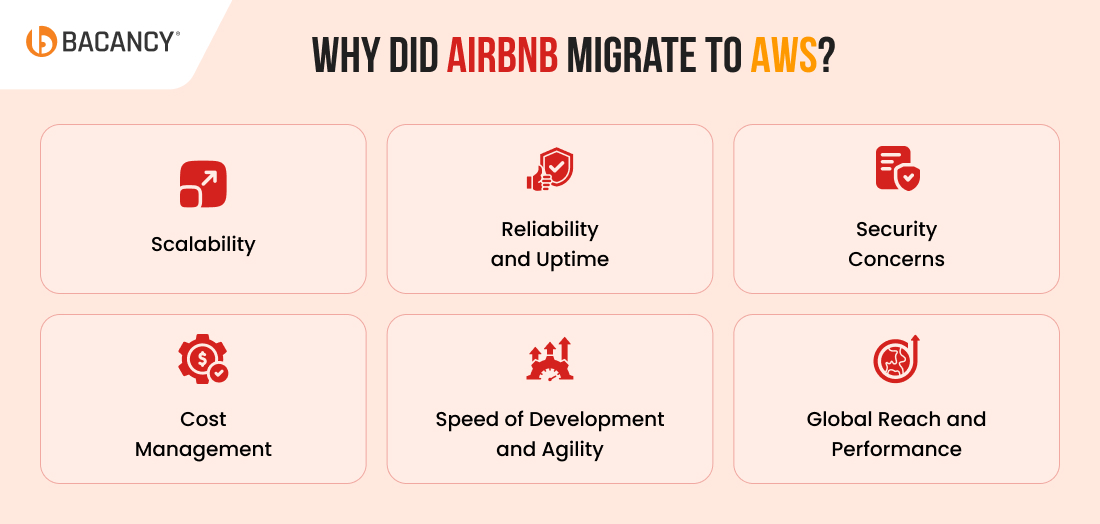
1. Scalability
Airbnb faced challenges with its infrastructure as it struggled to cope with increased user activity and data. The servers frequently hit their capacity, causing delays in loading and sometimes disrupting the service.
Amazon Web Services (AWS) provides options, like Amazon EC2 and auto-scaling, which adjust capacity automatically depending on the need. Airbnb wanted to leverage this service to handle traffic levels and efficiently provide users with an experience.
2. Reliability and Uptime
A growing user base frequently caused server crashes, leading to regular downtime. In addition, the existing infrastructure lacked the robustness needed to deliver consistent service.
In contrast, AWS offers a reliable infrastructure featuring services, like Amazon RDS and Amazon S3, that prioritize durability and availability. With a strategic approach to Airbnb’s AWS migration, they believed these Amazon services would help reduce downtime and enhance their platform’s reliability.
3. Security Concerns
Airbnb’s team was concerned about data safety and compliance with stringent data protection rules. Their current IT infrastructure was not scalable enough to handle these issues.
Moving to AWS offers a range of security measures and resources such as data encryption, Identity and Access Management (IAM), compliance certifications, and more. Using these features, Airbnb was confident it could enhance its data protection capabilities.
4. Cost Management
While Airbnb enjoyed unexpected growth, it started to realize the increasing expenses it had to incur to manage its in-house IT infrastructure. The cost of maintaining servers, storage, and resources spiked drastically, giving Airbnb one more reason to migrate to AWS.
The Pay-as-you-go model was another added benefit. Airbnb was positive that it would control costs if it had to pay only for the resources it utilized. This would help Airbnb manage costs more efficiently while scaling its infrastructure to align with its growth.
5. Speed of Development and Agility
Airbnb experienced limitations regarding the rapid development and deployment of new features. They needed a more hostile and agile environment to iterate quickly and bridge the gap between user demands and product updates.
With the versatile development tools offered by AWS, such as AWS CodeDeploy and AWS CodePipeline, Airbnb wanted to facilitate rapid deployment and development. This would help Airbnb to innovate faster and respond to market demands quickly.
When Airbnb grew into a global platform, the founders realized their initial IT infrastructure could not support users worldwide. Providing fast, secure, and reliable access to a growing international audience became a significant challenge.
Using AWS’s global network of data centers, Airbnb was able to deploy applications closer to users worldwide. This reduced latency and improved performance, ensuring a smoother experience for customers.
Optimizing infrastructure for global reach allowed Airbnb to scale efficiently and maintain high-quality service regardless of its users’ location.
What Were the Results of the Airbnb AWS Migration?
Airbnb needed a way to expand its server capacity as its business boomed quickly. Traditional methods needed to be faster and more convenient. They found the answer in Amazon Web Services (AWS). This cloud platform allowed them to add more server power whenever needed without extra staff or long-term commitments.
Speed was crucial during the migration. Airbnb could only afford to keep its users locked out of the marketplace for a short time. Thankfully, the move to AWS was incredibly smooth. They could migrate their entire database to Amazon RDS with only 15 minutes of downtime, which minimized disruption and kept users happy.
Airbnb estimates that AWS saved them money on staff costs and provided the flexibility they needed for future growth. They were impressed by AWS’s responsiveness to customer needs. If a needed feature wasn’t available, it could be soon. Ultimately, AWS’s ease of use and affordability led to a clear decision to switch to the cloud, which is a clear winner for Airbnb.
Here’s what their CTO says about the Airbnb migration to AWS.

Key AWS Services Driving Airbnb’s Growth
Airbnb’s migration to AWS laid the foundation for a cloud architecture that could scale reliably with its global growth. Have a look inside the key AWS services and components that power Airbnb’s platform and ensure seamless performance at scale.
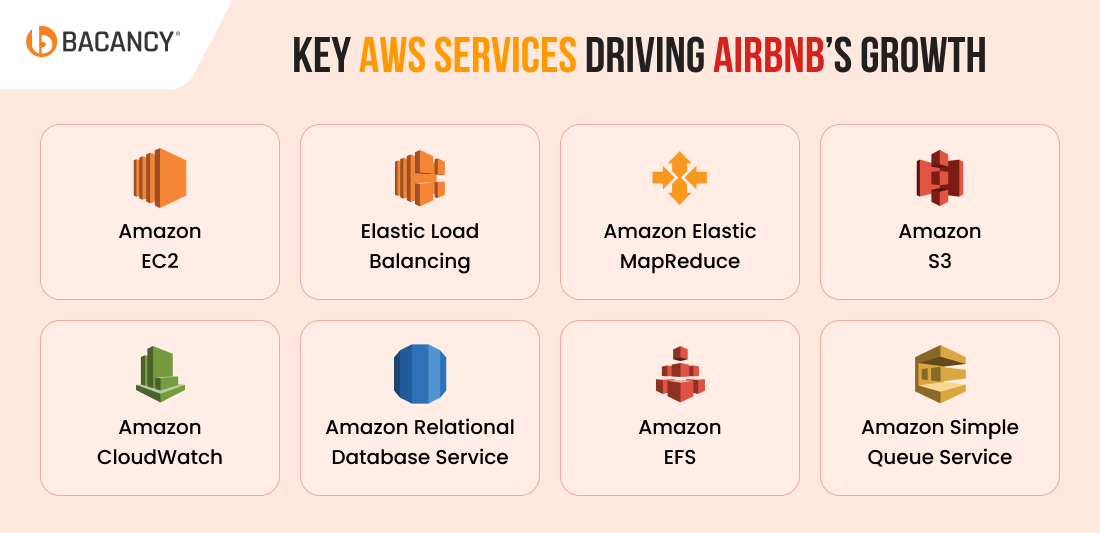
1. Amazon EC2 - Elastic Servers on Demand
Imagine having a fleet of virtual servers you can easily adjust. That’s what Airbnb gets with Amazon EC2. They use 200 EC2 instances for their applications, data caching (memcache), and search functions.
It allows them to scale up or down their server capacity based on real-time demand. Need to handle a surge in bookings during a holiday or weekend? That is no problem; they can easily add more servers. Is user activity slowing down during weekdays? They can scale down seamlessly to optimize costs.
Read our practical guide to creating EC2 Instances from scratch.
2. Elastic Load Balancing - Automatic Traffic Distribution
Have you encountered a website that loads slowly due to traffic? Airbnb keeps its users from facing this frustration by using Elastic Load Balancing. This service automatically distributes incoming traffic across its pool of EC2 instances.
Think of it like a traffic cop ensuring a smooth flow for all users, regardless of how many visit the platform. After Airbnb’s AWS migration, there has not been a single instance of slow website loading.
3. Amazon Elastic MapReduce - Big Data Processing Power
Airbnb gathers approximately 50 Gigabytes of data daily! It must organize and analyze this data to understand user behaviors, enhance listings, and improve recommendations.
To efficiently handle this responsibility, Airbnb depends on Amazon Elastic MapReduce (EMR), a service that provides a budget solution for processing datasets and uncovering insights from the information.
4. Amazon Simple Storage Service (Amazon S3) - Secure Storage for Everything
When storing information such as user backups, photos (10 terabytes!), and static files, Airbnb turns to Amazon Simple Storage Service (S3).
This service provides scalable storage solutions for all their needs. It functions like a vault where all their digital assets are stored securely and can be accessed from anywhere.
Read our detailed guide on Amazon S3 Pricing.
5. Amazon CloudWatch - Keeping an Eye on Everything
To ensure operations across its AWS environment with components in play, Airbnb utilizes Amazon CloudWatch as its monitoring hub.
This tool allows them to effectively oversee the performance of EC2 instances, databases, and other AWS services. By using Amazon CloudWatch as its control center, Airbnb can swiftly identify any issues that may arise and maintain the operation of its platform.
6. Amazon Relational Database Service - Database Made Easy
Managing databases can be quite challenging. Airbnb simplified this task by switching its database to Amazon Relational Database Service (RDS).
RDS handles time-consuming duties such as backups and scaling, allowing Airbnb’s IT team to concentrate on strategic projects. Moreover, they introduced a Multi-Availability Zone setup for dependability, ensuring the security of their data during unforeseen circumstances.
Planning a Move to the Cloud? Don’t Overlook Your Database.
Explore our database migration services for expert guidance and support to migrate your database to the cloud.
7. Amazon EFS - Scaling the CI/CD pipeline
Airbnb’s code storage system (GitHub Enterprise) struggled to handle increasing daily code changes and updates (over 100,000!).
They switched to a service called Amazon EFS. This acts like a central storage space accessible by all their code repositories. Think of it as a shared folder everyone can access and update simultaneously. This solved the traffic jam and ensured all their code was always in sync.
8. Amazon Simple Queue Service (SQS) - Smoother Updates
Another challenge was keeping their code repositories synchronized across different locations. Here, Amazon Simple Queue Service (SQS) came in handy.
Imagine a line where code updates are added individually, and the system processes them efficiently without losing any information. This allowed their engineers to focus on building new features without worrying about updates getting stuck or data loss.
Along with scaling performance, Airbnb also leveraged AWS-native tools like Cost Explorer, Intelligent-Tiering, and Savings Plans to keep its cloud infrastructure cost-efficient as the platform grew.
Growth Achieved After Airbnb’s AWS Migration
Since migrating to AWS, Airbnb has scaled its platform to serve a global user base efficiently and reliably. The latest figures from 2024-25 illustrate this scale:
- Global presence: Over 8 million active listings across over 240 countries and regions. (Source)
- Hosts: More than 5 million hosts in 2025. (Source)
- Users: Approximately 275 million users worldwide as of 2024–25. (Source)
- Guest volume: Around 491 million bookings in 2024, with over 719 million nights booked. (Source)
- Benefit for Hosts: Since the launch, hosts have earned over $250 billion through Airbnb. (Source)
- Stay metrics: Average stay length is 4.3 nights in 2024, with the average rate around ~$163/night in North America. (Source)
- Market share and valuation: Airbnb holds over 20% of the vacation rental market, which is valued at approximately $113 billion. (Source)
- Recent financial performance: In 2024, total revenue reached ~$11.1 billion, with net profit around ~$2.6 billion. (Source)
These achievements underline how a strong cloud foundation, enabled by AWS, helped Airbnb manage its rapid growth.
Inspired by Airbnb’s AWS Migration Journey?
Airbnb’s move to AWS shows how cloud migration enables businesses to scale efficiently, reduce operational overhead, and stay ready for growth. If you are considering a similar path, having the right strategy and execution in place is essential.
You can leverage AWS migration services backed by certified experts who guide you through every stage, from infrastructure assessment to seamless transition and post-migration optimization. With the right support, you can achieve performance, reliability, and cost efficiency while laying the foundation for long-term innovation.
Frequently Asked Questions (FAQs)
Airbnb needed better scalability, reliability, and security to handle its rapid user growth and evolving business needs.
Airbnb adopted a phased approach, starting with less critical services and gradually moving to core functionalities. They conducted a proof of concept, optimized applications, and rigorously tested each component before a complete migration.
Airbnb used AWS tools like AWS Snowball and Direct Connect for data transfer, AWS CloudWatch for monitoring, and services like Amazon EC2, RDS, and S3 to enhance performance, scalability, and security.
Rigorous testing and validation ensured that migrated components functioned correctly and met performance and security standards, reducing post-migration issues.