Summary:
This guide breaks down the real difference between a full-stack consultant vs full-stack developer, an honest comparison of costs, responsibilities, and ownership involved with each role. It also explains when businesses should hire each expert, the cost model behind each role, and the common mistakes companies make related to roles. Whether you are scoping a new product, looking to scale an existing one, or stuck somewhere in the middle, through this blog, you will be able to decide your project’s needs for development, strategic consulting, or both in 2026.
Table of Contents
Introduction
The discussion around full-stack consultant vs full-stack developer is no longer limited to hiring decisions. In 2026, the selection between them directly affects project risk, their decisions, and impacts project delivery speed, scalability, and long-term development cost. Both roles work across frontend and backend databases, APIs, and cloud infrastructure, solving fundamentally different problems. While full-stack developers primarily focus on implementation, coding, feature delivery, and application performance, full-stack consultants focus on architectural decisions and their planning.
The PMI report mentions that 47% of unsuccessful projects fail because of poor requirements in management. As they rely on different roles that don’t meet the project’s needs leads to budget overruns, delivery delays, poor scalability, and technical debt.
Based on McKinsey’s analysis, large IT projects, on average, run 45% over budget and 7% over time, while delivering 56% less value than predicted. Software projects run the highest risk of cost and schedule overruns. In most cases, these failures begin long before development starts, with poor architectural decisions, unclear scope, and the wrong technical role. Choosing between a full-stack developer and full-stack consultant at the right time is one of the most underrated cost-control decisions a business can make.
Why Are Full-Stack Consultants and Full-Stack Developers Not the Same Role?
At a surface level, full-stack developers and full-stack consultants may appear similar, as they both know development workflows and work with technologies like React, Node.js, Python, PostgreSQL, AWS, and Kubernetes. But despite their shared technical knowledge, these two roles solve entirely different business problems, and their core difference lies in their responsibility.
A full-stack developer owns complete execution phases across the full-stack development of the project. Their work role falls under developing, testing, optimizing, and maintaining software applications based on work-defined requirements. They perform throughout the development lifecycle, implement features, integrate APIs, fix bugs, improve performance, and ship production-ready code. Their success is measured through delivery metrics such as sprint planning, code quality, uptime, scalability, and release efficiency.
However, a full-stack consultant operates at a more strategic and decision-making level. Their work is to plan technically, focusing on software architecture, and what would be the right direction that fits market needs. Their decision involves infrastructural strategy, scalability forecasting, technology evaluation, risk assessment, and process optimization. Rather than relying on implementation alone, they help organizations to make high-impact technical yet operational decisions before development becomes expensive to change.
The simple questions that make a difference are:
- A developer asks: “How do we build this?”
- A consultant asks: “Should we build this? What is the best way to build it, and how will it scale over time?”
Full-stack developers usually own components or features within a system, and full-stack consultants evaluate the system as a whole, including infrastructure, workflows, team structure, scalability limitations, and business impact.
What Do Full Stack Consultants Bring That a Developer Doesn't?
A full-stack developer shows up while executing and shipping the software, but a full-stack consultant focuses on strategic decision-making on which developer to act, leading the project’s success. The value of a full-stack consultant is often noticed before development and continues through scaling, optimization, and long-term technical planning. Here are the areas where consultants typically add the most value:
Technology Decision-Making
Having the wrong stack by your side can create years of tech constraints, limitations, and unwanted infrastructure spend. A full-stack consultant evaluates frameworks, databases, and cloud providers against business goals, traffic forecasts, team capacity, maintenance cost, and licensing exposure. They will mention why PostgreSQL fits one workload and DynamoDB another, and why your microservices ambition needs a monolith for the first 18 months.
System Thinking Beyond Features
Full-stack developers generally proceed feature by feature, following the sprint. But full-stack consultants evaluate how every tech decision can affect the entire project cycle. They figure out whether the current infrastructure survives at 10x scale, whether the database architecture handles future data growth, or whether the deployment workflow is sustainable for a growing engineering team. That long-range thinking helps businesses avoid costly rebuilds after months.
Cost Optimization at Scale
Costing is one of the biggest differences in the full-stack consultant vs full-stack developer discussion. Developers are mostly focused on building stable, functional software, but full-stack consultants look in-depth into whether the development is financially sustainable when it scales or not. They evaluate inefficiencies at the system level, reviewing AWS, identify oversized instances, reduce unnecessary compute consumption, optimize CI/CD pipelines, and eliminate expensive infrastructure patterns before they become long-term financial issues.
Cross-Functional Communication
Software projects rarely fail because of developers. Their failure happens when the business goal is not defined, or the technical requirements are not met, and delivery expectations get misaligned. The role of a full-stack consultant acts as a bridge between technical and non-tech teams. They help them translate product requirements into engineering decisions while ensuring that stakeholders understand operational impact.
Independent Technical Evaluation
Internal engineering teams stay naturally aligned with the system and workflows they build effortlessly. With time, it can create blind spots around technical debt, inefficiency with process, or architectural limitations. With the help of a full-stack consultant, an external or unbiased assessment is conducted to analyze code maintainability, infrastructure performance, deployment cycle, vendor dependencies, security risks, testing standards, and team productivity.
Faster Strategic Problem Solving
When the software issues reach the architectural level, solving the problem needs more than just expertise in coding. Problems such as database failures, authentication systems, third-party API bottlenecks, infrastructure instability, CI/CD failures, and distributed system latency need more strategic redesign rather than temporary fixes. A full stack developer might resolve them immediately, but a consultant evaluates them on a broader pattern, analysing the root cause.
Full-Stack Consultant vs Full-Stack Developer: What Are the Core Differences?
Identification of the difference between a full-stack consultant and a full-stack developer becomes much easier with the responsibilities, engagement models, and business impact when compared side by side. This comparison outlines how both roles differ, their different delivery responsibilities, engagement structure, project timelines, and cost expectations in 2026.
| Dimension | Full Stack Consultant | Full Stack Developer |
|---|
| Primary Function
| Defines architecture, evaluates systems, and guides technical strategy
| Builds, tests, ships, and maintains software applications
|
| Core Focus
| Scalability, planning, optimization, and risk reduction
| Feature delivery and implementation
|
| Primary Question: They Solve
| “Should we build this, and how should it scale?”
| “How do we build this?”
|
| Typical Engagement Length
| Short-to-mid-term engagement based on project scope
| Long-term engagement lasting months or years
|
| Where They Operate in the SDLC
| Discovery, planning, architecture, audits, and scaling reviews
| Development, deployment, maintenance, and iteration
|
| Key Deliverables
| Technical roadmaps, architecture plans, audits, migration strategies, risk assessments
| Production-ready code, APIs, releases, bug fixes, performance improvements
|
| Success Metrics
| Scalability readiness, infrastructure efficiency, and reduced technical risk
| Development velocity, uptime, code quality, and sprint completion
|
| Technical Expertise Style
| Broad architectural expertise across multiple systems and platforms
| Deep expertise within a selected technology stack
|
| Team Structure
| Works across leadership, engineering, operations, and product teams
| Embedded inside the engineering team
|
| Cost – Hourly Rate (2026)
| Custom advisory pricing depending on complexity, industry, and engagement depth
| Offshore mid-level developers typically start around $22–$25/hour, depending on expertise and region.
|
| Cost – Typical Engagement
| Fixed-scope consulting, retainer advisory, or time-and-material pricing models
| Approx. $3,200/month for a dedicated full-time developer (160 hours/month)
|
| Engagement Models
| Technical audits, architecture consulting, roadmap planning, and strategic advisory
| Dedicated monthly hiring, hourly contracts, or fixed-price development
|
| Time to Onboard
| Usually 1–2 weeks for discovery, assessment, and project scoping
| Often, within a few days after technical screening
|
| Best Suited For
| Product strategy, modernization, migration planning, scalability reviews, and technical due diligence
| Product development, feature expansion, maintenance, and long-term execution
|
Build Scalable Web Applications With Experts!
Hire Full stack developers from Bacancy with flexible hiring models, faster onboarding, and expertise across modern frontend, backend, cloud, and DevOps technologies.
When Should You Hire a Full Stack Developer?
You are making the right choice by hiring a full-stack developer if your technical direction is already defined and the primary challenge is execution. In most cases, developers create the most value when the requirements, architecture, and workflows are clear. Also, read about the myth of the full-stack developer for a better understanding.
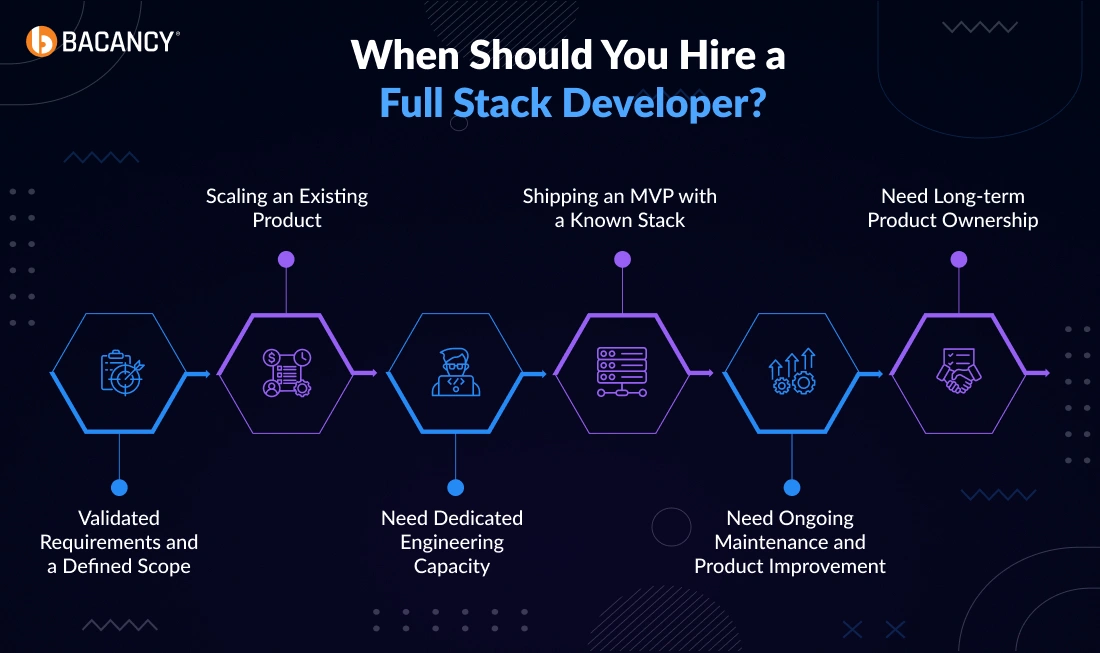
You Have Validated Requirements and a Defined Scope
When the requirements of the product are validated, wireframes, workflows, and API requirements are already defined. It ensures that architecture stays established and developers can focus entirely on implementation. At this stage, the goal is no longer about figuring the flow out; it is about building it whole efficiently, securely, and at production quality.
You're Scaling an Existing Product
Businesses that have active products, mature workflows, and an established engineering process, full-stack developers help increase the overall delivery capabilities. It includes building new features, expanding integrations, improving app performance, reducing bugs, and supporting sprint execution.
You Need Dedicated Engineering Capacity
Businesses often end up hiring full-stack developers when they need to extend their internal team or want immediate effect over development output through staff augmentation or dedicated development teams. This works best with development workflows that already exist, team responsibilities, engineering process, and tech stack. In these cases, developers can integrate their expertise directly into existing workflows without requiring major architectural involvement.
You're Shipping an MVP with a Known Stack
The majority of companies already know which technology they need to employ before development begins. When the stack decision gets finalized and the product scope stays defined, a full-stack developer becomes the fastest path to MVP execution.
You Need Ongoing Maintenance and Product Improvement
Not every project needs strategic market consulting; there are many organizations that just need continuous engineering support for an existing product, including performance optimization, bug fixing, refactoring, security code, accessibility improvements, and API maintenance. These are implementation-focused tasks where developers provide the highest value.
You Need Long-term Product Ownership
Those software products that evolve over months or years usually benefit from a dedicated development team rather than short-term consulting engagements. Developers here provide continuity across projects based on feature releases, technical maintenance, infrastructure support, product interaction, and knowledge retention.
Pro Tip: The simplest yet easy way to decide between full-stack developers or full-stack consultants is to identify the project’s major limitation. If the major decisions have already been made, then the performance lag might lie in execution. But if the project still lacks clarity around architecture, scalability, and tech direction, hiring developers can slow down the development process instead of powering it.
When Should You Engage a Full Stack Consultant?
The engagement of a full-stack consultant is useful when the cost of making wrong technical decisions is higher than the cost of strategic guidance. Unlike front-end developers, consultants are usually brought in to reduce uncertainty, evaluate risk, and create technical direction before implementation proceeds.
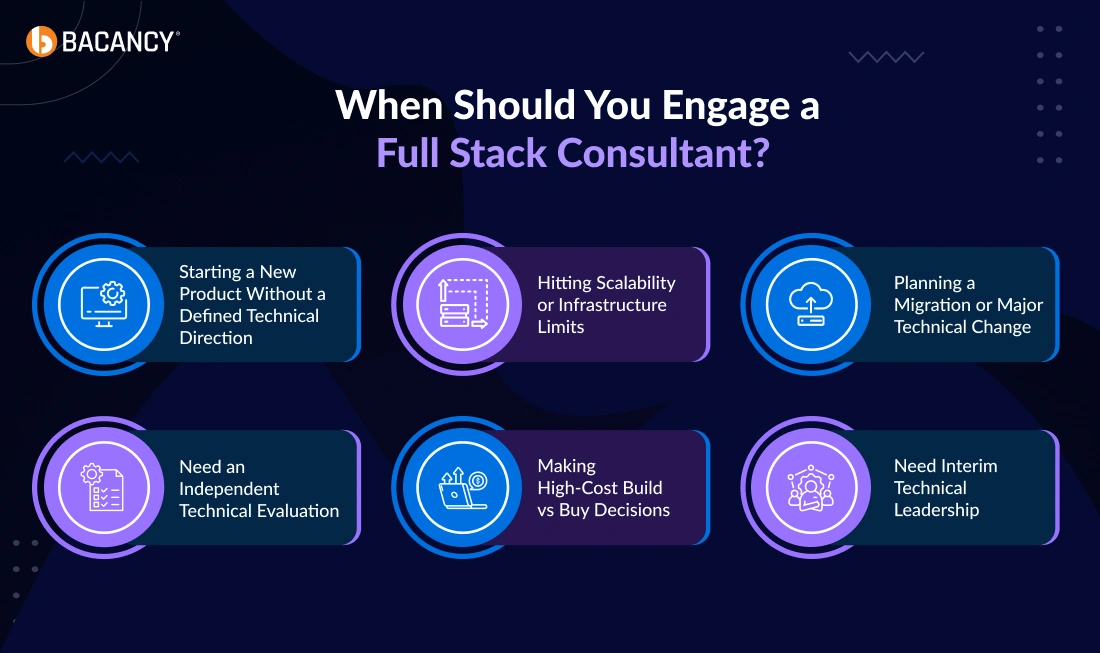
You’re Starting a New Product Without a Defined Technical Direction
Early architecture decisions shape the overall scalability, maintenance cost, and operational stability of a product. By choosing the wrong stack, database structure, or deployment model, an infrastructure pattern can lead to years of technical failure and debt. A full-stack consultant helps a project evaluate its technology selection, scalability planning, infrastructure architecture, security considerations, development workflows, and build vs buy decisions.
You’re Hitting Scalability or Infrastructure Limits
As the product grows, technical bottlenecks appear at the system level rather than on the feature level. The common signals include increasing cloud costs, slower deployment, database performance issues, APIs, reliability problems, and scaling failures across services. All these problems usually require architectural analysis rather than simply adding more developers.
You’re Planning a Migration or Major Technical Change
The large technical transitions include more significant operational risk, such as migrating from monolith to microservices, moving infrastructure to the cloud, replacing legacy systems, rebuilding core platforms, changing frontend frameworks, and modernizing DevOps workflows. Full-stack consultants help evaluate the project’s feasibility, market strategy, cost impact, downtime, and long-term sustainability before the organization commits resources.
You Need an Independent Technical Evaluation
When businesses need unbiased technical assessment during acquisitions, technical due diligence, vendor evaluation, infrastructure audits, performance reviews, and security assessments. An external consultant can identify hidden technical risks, operational failures, or inefficient workflows that the internal team might overlook.
You’re Making High-Cost Build vs Buy Decisions
One of the most valuable consulting functions a business needs is deciding whether custom development is actually required or not. Consultants assess SaaS alternatives, third-party integrations, internal platform requirements, and vendor lock-in risks. It prevents companies from spending months building a platform that could be solved faster and more cost-efficiently.
You Need Interim Technical Leadership
Startups and scaling companies sometimes lack senior engineering leadership, and that affects rapid growth and hiring transitions. A full-stack consultant can temporarily support technical roadmap, hiring process, architecture reviews, engineering management, and delivery oversight. This is especially common before hiring a permanent CTO or VP of Engineering.
Can One Person Be Both a Full Stack Developer and Consultant?
Technically, yes, this sounds more real, but in practice, it is far more difficult than most companies assume. A full stack developer or full stack consultant operates across very different working models. Developers need to focus on a single codebase, testing, building, and delivering software efficiently, whereas consultants work across systems, teams, workflows, and business decisions. Their role steps back from implementation and requires evaluation over architecture, scalability, delivery risks, and long-term technical decision-making.
Balancing both responsibilities simultaneously on the same project rarely works. The challenge is not about tech capability; it is about context switching. A developer may spend weeks focusing on feature delivery, sprint execution, and product issues. And a consultant needs broader visibility across infrastructure, business goals, engineering workflows, vendor decisions, and future scaling requirements. The management of both roles at the same time requires strategic thinking in the background because immediate development priorities naturally take over.
However, there have been experienced professionals who pull both functions effectively. Senior engineers with extensive experience across architecture, scaling, DevOps, infrastructure, and product delivery may act as consultants during planning phases and can contribute technically during implementation.
It’s highly recommended for startups and mid-sized companies to partner with a full-stack development company that offers comprehensive services, creating the best balance of working with in-depth analysis. It also reduces the communication gap, improves continuity, and prevents disconnects that often happen when strategy and implementation are handled by different vendors.
What Mistakes Do Companies Make When Choosing Between the Two?
Most companies’ projects fail because they hire the right people at the wrong stage of the project, not because they just hire the wrong people. The difference between a full stack consultant and a full-stack developer becomes highly important when the organization misaligns its challenges and its strategic planning or tech execution fails. Here are some of the most common mistakes that companies make to avoid them in the future.
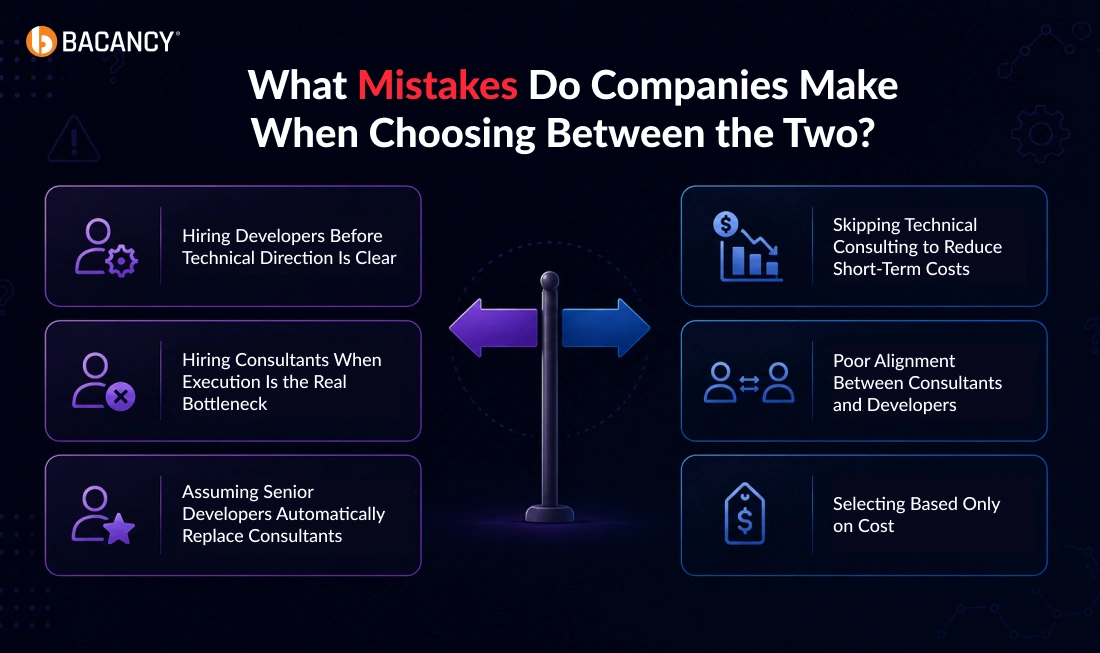
Hiring Developers Before Technical Direction Is Clear
This can be the most expensive mistake companies can make during development. They hire developers to execute requirements, architecture, and product goals. If those directions are not followed, development teams often begin building systems that later require major redesigns.
Hiring Consultants When Execution Is the Real Bottleneck
Some businesses continue investing in audits, technical recommendations, architectural reviews, and consulting workshops long after the core strategy gets completely clear. At that point, the project no longer requires additional analysis and requires implementation capacity ahead.
Assuming Senior Developers Automatically Replace Consultants
Senior developers may provide valuable technical advice, but the in-depth implementation experience does not automatically translate into strategic consulting expertise. A full-stack consultant has additional responsibilities to look after infrastructure planning, scalability, vendor budgeting, risk management, and cross-functional communication.
Skipping Technical Consulting to Reduce Short-Term Costs
Sometimes businesses avoid consulting because architecture reviews, audits, and tech planning may feel less tangible than shipping product features. However, poor technical decisions often become more expensive due to rewriting code, downtime, performance failures, security gaps, migration costs, and delayed product launches.
Poor Alignment Between Consultants and Developers
Another major concern arises when consultants create technical plans, but the development team is never properly involved in the process. It creates disconnects such as developers ignoring architectural recommendations, delivery teams lacking technical expertise, unrealistic implementation, misaligned expectations, and delays during execution.
Selecting Based Only on Cost
Many companies compare full stack consultants and full stack developers’ costs rather than their impact on the project. A developer may cost less upfront, but hiring a developer before resolving major architectural uncertainty can lead to expensive downstream problems. Similarly, extending consulting engagements without execution support can delay product deliveries unnecessarily.
Conclusion
The decision between a full-stack consultant vs full-stack developer is not related to hiring; it is about selecting the right expertise at the right stage of a project. A full-stack consultant can help a business reduce its technical uncertainty, avoid costly architectural mistakes, and create scalable, long-term strategic planning. Whereas a full-stack developer executes those plans into reliable, production-ready software through execution, interaction, and continuous improvements.
Most successful projects require both, but at different stages of the development cycle. Consultants provide clarity before major technical decisions, while developers accelerate delivery once the direction is established. When businesses seem confused about such responsibilities, projects often suffer due to delayed timelines, rising infrastructure costs, technical debts, and expensive rework.
The most effective approach is not choosing between a full-stack consultant or a full-stack developer; it is better to reach out to a dedicated full stack development company that can look strategically after both roles, reducing risk, improving delivery efficiency, and building software that scales sustainably.
Frequently Asked Questions (FAQs)
If you need to hire a full-stack developer for your ongoing workflow or to carry forward the project, look for 4-6 years of experience shipping similar products, their fluency with CI/CD and code review workflows, and a portfolio of real deployments. For a full-stack consultant, the bar is quite different. You need 10+ years across multiple stacks, at least two or three architecture migrations under your belt, and exposure to industry’s compliance and scaling patterns.
Software architects generally work full-time, embedded employees focused on one product’s long-term technical design. Solution architects who typically work at a vendor or systems integrator level on customer projects, often tied to a specific platform like AWS, Salesforce, or SAP. But full-stack consultants can also work externally, project-bound, and across multiple stacks and clients. They bring broader cross-industry views that internal architects rarely have.
Yes, they can both integrate to make projects more streamlined and efficient. A developer slots into your standups, sprint planning, and code review workflows, operating as an extension of the in-house team for the duration of the engagement. A full-stack consultant works beside leadership and senior engineers rather than inside daily sprints, but includes knowledge transfer sessions.
In a short engagement of 4-6 weeks, full-stack consulting generally includes a technical audit report, an architecture diagram, a technology stack recommendation, an infrastructure cost analysis, scalability, and risk assessment. The long retainers add ongoing technical reviews, hiring support, vendor evaluation, and execution oversight at key milestones.
There are three metrics that work for almost any project engagement to measure its ROI: cost avoided, decision quality, and team velocity. You can also track this with your project. Try making a reasonable benchmark that pays for itself within two quarters, and conduct the most well-scoped audits because the cost of a single avoided rewrite can exceed the entire consulting fee.