Quick Summary
Native vs cross platform app development is the most talked-about comparison of two approaches used to build mobile applications. Native app development highlights platform-specific development, while cross-platform is about using a single codebase to run applications on multiple platforms. This blog explains the differences, benefits, and use cases of cross platform vs native app development to help you choose the right approach for your product’s stage, budget, and long-term scalability goals.
Table of Contents
Introduction
You have started mobile app development, your team is ready, timelines are set, and execution is about to begin. Then comes the critical question: native or cross-platform?
It sounds like a technical decision. It isn’t. It is a product strategy decision with a long financial tail, and the wrong answer at this stage can cost you 18 months and a complete rewrite.
With the mobile app market projected to reach $626.39 billion by 2030, the competition and expectations are also rising fast. At the same time, the gap between cross-platform and native development is shrinking, which makes the decision even more complex.
This guide cuts through the noise. You will get a comprehensive comparison of native vs cross platform app development across performance, cost, scalability, and industry fit with the data and real-world cases to back every recommendation.
| Factor
| Native | Cross Platform
|
|---|
| Performance
| Highest and direct OS access
| 95-98% of native for most business apps
|
| Cost | $55K–$500K per platform
| $40K–$300K total build cost
|
| Development Speed
| Slower, but two separate codebases
| Single codebase and 30% faster than native
|
| AI Integration
| Full CoreML, ML Kit access
| Plugin-based; some latency for on-device AI
|
| Scalability
| High and full OS control
| High for most apps; hardware-intensive apps may hit limits
|
| UX Quality
| Platform-native feel by default | Consistent across platforms; implementation-dependent
|
| Maintenance | Two teams, two update cycles
| One team, one update cycle
|
An Overview of Native vs Cross Platform App Development
Before jumping to the detailed comparison, let’s get a clear picture of the Native and Cross apps development to understand how these two differ from each other.
What Is Native App Development?
Native app development is the process of building mobile applications for a specific operating system, either iOS or Android, using that platform’s dedicated programming languages and tools.
For iOS, that’s Swift and legacy Objective-C built inside Xcode. Whereas, in Android, that’s Kotlin or older Java inside Android Studio. Each application connects directly to its operating system without any intermediary layer.
When your app directs the camera, the biometric sensor, or the GPS, it connects to the native hardware.
As a result, it maximizes performance, platform-consistent UI, and restricted access to every new Android and iOS API the moment Google or Apple releases. Developing native applications means both platforms can be maintained through two codebases, 2 development teams, and separate QA processes.
Cross-platform app development enables you to write a single codebase that compiles and runs on both Android and iOS, and in several cases, web and desktop too. It has the write once and deploy everywhere concept using frameworks like Flutter, React Native, or Ionic.
Each framework serves differently as per the project needs; like React Native utilizes to build a mobile-first environment, Ionic is used to adopt web applications for mobile deployment, and Flutter for UI consistency across various platforms with an extensive Flutter widget library and render engine.
Cross-platform development works well for the majority of mobile applications, such as ecommerce, SaaS, and on-demand platforms. Where in apps that require deep hardware integration, custom Bluetooth protocols, on-device AI inference, real-time AR, and performance benchmarks that leave no room for abstraction overhead.
Pros and Cons of Native vs Cross Platform App Development
No approach wins in every dimension. Here’s an honest breakdown without the spin.
Advantages of Native App Development
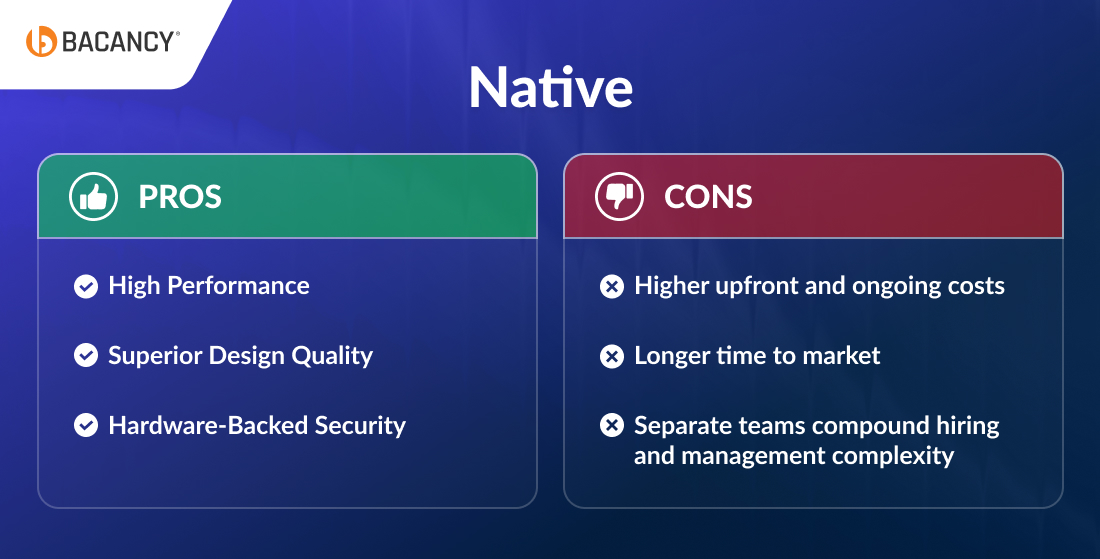
High Performance
The app development provides you with performance due to its direct OS access. The native environment understands the operating system language. Hence, there is no extra layer or runtime. For applications that require real-time responsiveness, like AR filters, on-device ML inference, and complex animations, native consistently outperforms cross-platform by measurable margins.
Superior Design Quality
iOS apps built with SwiftUI follow Apple’s Human Interface Guidelines by default. The Android applications designed with Jetpack Compose follow Google’s Material Design 3. Their platform-specific gestures, navigation patterns, and interaction models all behave exactly like users would on the devices.
Hardware-Backed Security
Native app development offers direct access to platform-managed encryption and secure enclave APIs (Touch ID and Face ID on iOS). It also provides Android Keystore and OS-level sandboxing. The app development is highly beneficial for industries like fintech and healthcare, applications where security is audited at the architecture level. Native provides a more defensible foundation.
Disadvantages of Native App Development
Higher upfront and ongoing costs
Using Native for iOS and Android means two codebases, development teams, QA cycles, and deployment pipelines. With different platforms, you need separate development efforts, which increases time and resource requirements, making the overall development and maintenance process more expensive and complex to manage.
Longer time to market
The native team cannot share code between multiple platforms. However, every feature needs to be added twice. Every bug needs to be fixed twice. But for startups, validating an idea or executing takes time to market.
Separate teams compound hiring and management complexity
You need to pay for two different teams, developers, and hire managers to define the pipeline. More than that, the process will be longer since there will be a requirement for two code review processes and skill sets. In a talent market, where senior iOS and Android engineers remain competitive hires, and apparently, this overhead compounds quickly.
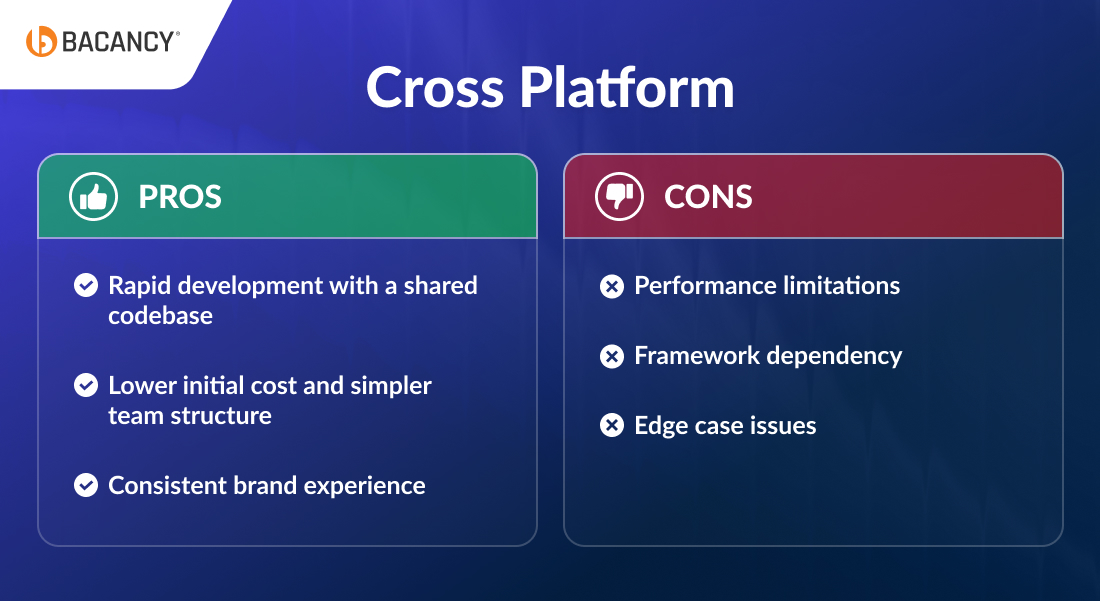
Rapid development with a shared codebase
A single team can work for both Android and iOS simultaneously. Hot reload in Flutter and React Native architecture can let you change the preview instantly without rebuilding it completely. You can also add features to go live faster and eliminate repetitive cycles. As per the survey, cross-platform development reduces build time by up to 40% compared to maintaining separate native teams.
Lower initial cost and simpler team structure.
In cross-platform app development, you need one team that will use one codebase, one sprint plan, and QA cycles. Moreover, a cross-platform MVP usually costs $20,000 to $50,000 and launches in 2-4 months. It is a great choice for startups and businesses that want to validate ideas quickly without heavy upfront investment.
Consistent brand experience
Flutter widget-based rendering produces pixel-identical UI across Android and iOS. It ensures that your app looks and behaves the same regardless of the platforms. The cross-platform approach helps to maintain a strong brand identity, decrease design discrepancies, and minimize the efforts required to manage separate user experience implementations for different operating systems.
Need a consistent UI across Android and iOS without extra effort?
Hire Flutter developers to build a single-codebase app that preserves your brand identity and eliminates design inconsistencies.
Performance limitations
For 95% of business applications, the cross-platform performance gap is imperceptible to end users. However, for the remaining 5%, high-end mobile gaming, real-time AR/VR, on-device ML with a latency requirement, native still has a measurable edge. It helps you to decide which category your app falls into before you begin the development.
Framework dependency
Your product’s roadmap is partially tied to Flutter’s or React Native’s roadmap. Framework deprecations, architecture changes (React Native’s shift to the New Architecture with Fabric and TurboModules), and community size all affect your long-term maintenance cost in ways a native codebase doesn’t face.
Edge case issues
The “write once, run everywhere” promise holds for 70-85% of a typical codebase. The remaining 15-30% involves platform-specific navigation patterns, keyboard behavior, push notification flows, and App Store compliance requirements. That code still has to be written, just in smaller, targeted patches rather than full parallel development.
Cross Platform vs Native: A Detailed Comparison
When it comes to Native vs cross-platform performance, native apps are the highest in terms of performance due to their direct interaction with the operating system.
Native apps are compiled into platform-specific machine code, which allows faster startup times, smoother animations, and more efficient CPU and memory usage. It makes them ideal for performance-intensive applications, such as gaming, AR/VR, and real-time processing systems.
On the other hand, modern cross-platform frameworks have significantly reduced the performance gap. For instance, Flutter uses the Impeller rendering engine to deliver smooth 60- 120 FPS experiences across devices, while React Native’s Fabric architecture can minimize JavaScript bridge latency.
In short, cross-platform apps achieve near-native performance for most business applications, though native still leads in highly complex and resource-intensive scenarios.
Verdict: Native apps win in performance, especially for applications that demand high responsiveness, complex animations, or intensive background processing.
2. User Experience Consistency
Native apps automatically adopt each platform’s current design language. An iOS app built with SwiftUI follows Apple’s Human Interface Guidelines by default. It enables you to add typography, spacing, animation curves, and gesture behaviors that match what iOS users expect from every other app on their devices.
Meanwhile, cross-platform apps, especially Flutter, have a different approach with their own UI layer and interface that looks and behaves identically on every device. That’s an advantage for businesses that showcase visual consistency, like fintech dashboards, enterprise tools, and brand-critical customer apps.
Verdict: In cross platform vs native, choose Native when platform-specific experience and familiarity are critical, and cross platform when consistent branding and uniform UI across devices.
3. Scalability
Native app development scales with the operating system. Every new API Apple or Google launches, whether it is a new biometric standard, updated payment framework, or new sensor capability, is available to your team from the beginning.
Cross platform app development scales through framework maturity and plugin ecosystem growth. For most product categories, it works without any hurdles. The ecosystem for payments like Stripe, Braintree, authentications (Firebase Auth, analytics), and push notifications is stable and well-maintained across Flutter and React Native.
Verdict: Both scale well, but native offers greater flexibility for advanced, platform-specific growth while cross-platform scale efficiently for most standard applications.
4. Development Speed
Cross platform app development provides a significant speed to build the overall process with a single codebase for both iOS and Android. It decreases the efforts across the team and helps you shorten the time to market and provide faster user experiences. Frameworks like Flutter and React Native further enhance their speed with features such as hot reload and fast refresh.
In contrast, native development requires separate codebases for each platform, which leads to duplicated engineering effort, independent QA cycles, and more complex coordination between teams. While this approach offers strong control and optimization, it naturally increases the overall development timeline compared to cross-platform solutions.
Verdict: Cross-platform is 30-40% faster than native app development.
Need to launch faster without doubling your development effort?
Hire mobile app developers from Bacancy to develop cross-platform apps that reduce timelines by 40% using a single codebase.
5. Cost
A cross-platform app MVP cost can range between $20,000 to $50,000. Native app development costs around $10,000 to $80,000.
The initial build cost in cross-platform app development is low because of its single codebase, and it eliminates the need for more teams and development efforts. It is highly suitable for startups and early-stage products and takes around 2-4 months to execute.
In contrast, native app development requires separate teams for each platform, which increases development effort, timelines, and overall investment. It doubles the time and resources, along with the chance of hidden costs. It is ideal for apps that want a specific feature or a large enterprise.
Verdict: Cross-platform is more cost- effective for the initial development, while native can be more financially efficient in the long run and scalable applications.
6. Maintenance Effort
Native development requires a separate codebase, which means every feature must be built, tested, and maintained twice. It increases the coordination effort between teams and increases the risk of feature drift, where one platform may receive updates later.
In contrast, cross-platform app development simplifies maintenance by using a single codebase for all devices. It lets you update, fix bugs, and enhance in one implementation and reduces operational efforts, streamlines QA cycles, and maintains feature parity across platforms.
Verdict: Cross-platform is easier and more efficient to maintain, while native offers more controlled but higher-effort maintenance across separate codebases.
7. Integration with Device Features
Native app provider has direct and first-party access to all hardware APIs exposed by the operating system, including camera pipelines, Bluetooth, GPS, and accelerometers. There is no intermediary layer, no plugin dependency, and no delay in adopting new platform capabilities, which makes native the most reliable choice for larger integration.
On the opposite side, cross-platform frameworks handle the most standard device features through well-maintained plugins. It includes camera access, location services, push notifications, and payment integrations. For the majority of the applications, it has a stable ecosystem.
Verdict: Native offers full and immediate device-level access, but cross-platform manages most standard integrations, excluding advanced or custom hardware use cases.
8. AI and Advanced Feature Readiness
Native applications have direct access to platform-level AI frameworks, such as Core ML on iOS and ML Kit on Android, which enables hardware-accelerated, low-latency inference. It allows you to have real-time potential, such as image classifications, fraud detection, speech recognition, and predictive analytics, through minimal overhead and maximum optimization.
The cross-platform development integrates AI through cloud APIs, such as OpenAI, Google Gemini, and more, which work equally well across native and cross-platform applications since both rely on standard network requests. This approach is suitable for advanced AI use cases and performance-critical scenarios.
Verdict: In native vs cross platform, native is better for high-performance on-device AI, while cross platform is sufficient and efficient for most cloud-based and standard AI use cases.
When to Use Native vs Cross Platform - An Industry-Specific Verdict
- Fintech applications can benefit from native development by involving their real-time fraud detection, biometric authentication at the hardware level, or strict regulatory security requirements. While cross-platform frameworks are useful for most standard fintech products, like portfolios, dashboards, and payment interfaces.
- Healthcare apps require a mixed approach, but here, native is preferred for clinical-grade systems with deep OS-level data handling. Cross-platform is ideal for patient-facing features, such as appointment booking, telehealth, and medication reminders.
- E-commerce applications are ideal for cross-platform development because they demand a fast release cycle, consistent branding, and synchronized feature delivery across multiple devices. Native becomes relevant only when an e-commerce platform requires deep device integration, such as AR-based try-on features, custom camera pipelines, or high-frequency real-time inventory processing at scale.
- SaaS apps are most used for cross-platform frameworks as they primarily involve dashboards, internal tools, and workflow systems where a single codebase is needed. Here, native plays a role where there is a requirement for platform-specific capabilities.
- Gaming applications are better suited for native development because high-performance, 3D rendering, real-time processing, and consistent frame rate require direct access to the GPU and OS-level optimization that cross-platform frameworks cannot fully match.
- On-demand apps start with cross-platform development due to faster time-to-market and cost-efficiency. But at this scale, you may require native optimization for real-time tracking, mapping, and notification systems; however, it depends on the complex and performance needs.
Cross-Platform vs Native App Development: Hidden Cost Breakdown
When CTOs compare native vs cross platform, the development cost, hours, team size, and tooling are one part of the picture. Another hidden cost impact comes after the first release. Below is a breakdown of where those costs actually emerge.
Cross platforms often face issues in real-time chat, image, or video; hence, it needs extra time and cost to fix the lag or rewrite parts in the native code. It can also add an extra touch after the launch, which can increase effort by 15-20%.
A feature may work well on Android but fail on iOS due to system differences like gestures or permissions. For which a developer needs to fix the same issue twice, which eventually increases QA cycles and slows down releases.
3. Dependency and Plugin Issues
Several cross-platform apps depend on third-party plugins for payments, camera, or maps. These plugins may break after OS updates, and due to that, your teams must wait for updates or build custom native solutions, adding delay and extra cost.
4. Scaling Complexity
As the app grows from a small MVP to a large product, shared code becomes harder to manage. It often splits logic or adds native modules, which increases complexity and long-term maintenance costs.
5. UX Adaptation Costs
iOS and Android users expect different design patterns and interactions. A single UI approach does not always meet both expectations. You need to spend extra time to adjust the UI for each platform, which reduces the benefit of one codebase.
The Future of Mobile Development: Will Cross Platform Replace Native?
Absolutely not. The cross platform would never replace native app development because it is dominated by industries, such as ecommerce, SaaS, and on-demand applications. Native holds its ground wherever direct OS access is non-negotiable, such as on-device AI, real-time AR, high-end gaming, and compliance-driven security architectures.
Conclusion
Native vs cross platform is often treated as a technology debate, but the real debate is who you should prioritize for outcomes like speed, user experience, and scalability. The cross-platform helps you validate faster and reduce early development costs.
Native assists you to deliver faster performance and deeper system integrations when your users’ expectations are high. Both can succeed or fail; it depends on how well they align with your product stage.
To avoid any confusion, you can get in touch with a mobile app development company to help you to start with the right architecture and avoid expensive rework later. Our experts ensure you get solutions that match your product stage and long-term scalability requirements.
Frequently Asked Questions (FAQs)
Yes, you can start with cross platform mobile app development and later migrate to native app development when performance or scale becomes crucial. However, it requires proper planning because a partial or full codebase migration can boost development efforts.
Yes, cross platform app development works well for enterprise applications. It lets you add features, such as a dashboard, internal tools, and workflow systems. For complex enterprise mobile apps with real-time processing or heavy integrations, native or hybrid mobile app development is often preferred.
Native app development uses direct OS level security features like encryption APIs, biometric authentication, and secure data storage. This makes native mobile apps more reliable for fintech, healthcare, and enterprise mobile app development.
Yes, cross platform mobile apps can face issues due to OS differences, screen variations, or third-party plugin limitations. These issues are usually resolved with additional testing and platform-specific fixes.
Cross platform mobile apps can become costly when scaling requires native modules, performance optimization, or dependency fixes. Over time, a single codebase may evolve into a hybrid structure that needs specialized development support.
Yes, native app development reduces technical debt because it avoids abstraction layers and dependency on external frameworks. This leads to cleaner architecture and easier long-term mobile app maintenance.
Startups usually do not regret cross platform app development. Challenges appear when the mobile app grows without proper architecture planning, rather than due to the framework itself.
Yes, both native app development and cross platform app development can support millions of efficiency and long-term scalability management.users if the mobile app architecture is designed properly. The difference lies in performance