Quick Summary
FlutterFlow AI is a low-code platform enhanced with AI that speeds up app development by automating code generation and offering smart design suggestions. In this blog, we’ll explore why FlutterFlow AI is gaining popularity, its key features and benefits, practical use cases, potential risks, future trends, and how Bacancy can help you maximize it effectively.
Table of Contents
Introduction
What if I told you that you could create an application in half the time without losing scalability, security, or ownership? That’s the edge FlutterFlow AI offers.
As a CTO or founder, you care less about buzzwords and more about answers. Will it scale as my product grows? Is it secure for sensitive data? Does it reduce long-term costs or only shift them? Do I own the code and IP, or am I locked in? Does it make my team faster or more dependent?
These are the questions that matter most for the future of software. Low-code adoption shows that companies value both speed and quality, with the market projected at $35.22 billion by 2030. FlutterFlow AI fits this shift by providing you speed with control, security, and scalability that never slips away.
Understand Why Everyone is Talking About FlutterFlow AI
FlutterFlow AI is the artificial intelligence assistant in FlutterFlow. It is an advanced application development platform that merges Google’s Flutter framework with AI. Moreover, it helps your team design, develop, and launch applications by automating manual repetitive tasks, suggesting code, and simplifying workflows.
What makes it special is how differently and smarter it operates than traditional drag-and-drop tools. In FlutterFlow AI, you can type instructions in layman’s language, and get results 5x times faster. Apart from speeds up delivery time, it reduces errors, and ensures apps are secure and scalable.
Here’s the quick comparison table to help you understand how FlutterFlow differs from traditional development.
| Aspects | FlutterFlow AI | Traditional Development |
|---|
| Speed | Reduces delivery time by up to 50% | Slower due to manual coding |
| Security | AI-assisted checks and best practices | Relies fully on developer expertise |
| Scalability | Scales from MVP to enterprise with ease | Scales but needs more resources |
| Cost Efficiency | Lowers long-term costs through automation | Higher costs due to manual effort |
| Code Ownership | Exports Flutter code with no vendor lock-in | Full control but more development time |
Not just limited to that, FlutterFlow is gaining attention among experts because of its functionality to enhance existing pages, create mobile applications without writing a single code, and its autocomplete features.
The FlutterFlow AI integration allows you to connect seamlessly with third-party AI services like OpenAI and Gemini. It assists AI app development with FlutterFlow, accessible to both technical and non-technical users.
For startups, it means you can launch products quickly. You can handle complex projects for larger teams without wasting time on routine coding. That’s the reason FlutterFlow AI has become the talk of the town, it makes app development faster, smarter, and more powerful than ever.
Let’s dive into the core features of AI-powered development in FlutterFlow and how these features can make your app smarter and efficient.
6 Key Features of FlutterFlow AI That Stand Out
FlutterFlow AI comes with a set of smart features that are designed for rapid creation, reduce manual effort, and make development accessible for both technical and non-technical users. Let’s look at the key features that set it apart.
1. AI Page Generation
With the AI page generation feature, you can create an app screen completely within some minutes. As a result, rather than spending weeks on the login pages, dashboards, and forms, your team can generate them instantly using this Flutterflow feature.
In addition, this feature helps startups test ideas rapidly and enables entrepreneurs to move ahead quickly, whether from concept to prototype. It also helps you create pages without compromising quality.
2. AI Code Assistant
As the name suggests, it will be like your assistant who helps you to automate your workflow. Several projects get stuck due to repetitive manual tasks, data handling, form validation, and basic logic. But with an AI code assistant, you can decrease technical debt, minimize bugs, and keep the codebase clean.
Another cherry on top is that it lets developers focus on adding features, which can efficiently add value to the product. This also helps ensure a streamlined workflow and saves a large amount of costs.
FlutterFlow AI offers reusable components and widgets, such as buttons, forms, and navigation. These ensure consistency in design and enhance project workflow. Moreover, AI components and widgets ensure a uniform user interface, decrease manual efforts, and improve the overall experience.
Hence, it stands out because businesses can easily utilize pre-built customized widgets to match their functionality needs. It decreases the errors and makes collaboration smoother. In other words, it becomes a reliable way to deliver a polished app without stretching resources.
4. AI Firestore Schema
A database set up takes quite time to plan and restructure. FlutterFlow AI can generate Firestore schemas in minutes within a clean and ready-to-use structure. For instance, an e-commerce application can automate collections for users, owners, and sellers.
It lets you accelerate development and enables your team to start working on core functionality that matters to your projects. Moreover, with this AI Firestore schema, you can offer accuracy and consistency, which also results in fewer errors and a faster launch.
5. Smart Suggestions
The great feature of FlutterFlow AI is that it offers context-based recommendations during the development process. With their suggestions, you can cover best practices for performance, data structure, and logic.
Nevertheless, it acts like an experienced consultant that guides teams at every step to ensure fewer mistakes and higher-quality applications. For instance, it may highlight an inefficient query, recommend optimized flow, and better component usage.
This is especially useful for new developers, as it shortens the learning curve and provides expert-level support built into the platform.
6. Integration Help
Integrating APIs and backends often slows projects and requires advanced technical knowledge. FlutterFlow AI simplifies this by guiding teams through setup and auto-configuring certain connections. It makes the addition of services like payments, notifications, or authentication faster and less error-prone.
This feature speeds up MVP launches for startups by allowing quick integration with essential third-party services. For enterprises, it ensures smooth scale-up when connected to complex backends or cloud platforms. With FlutterFlow AI, your teams can save time, reduce risks, and maintain focus on value instead of manual integration fixes.
Scaling Your App But Stuck On Technical Integrations?
Hire FlutterFlow developer who ensure smooth connections and reliable performance.
5 Benefits of FlutterFlow AI Integration for Faster, Smarter App Development
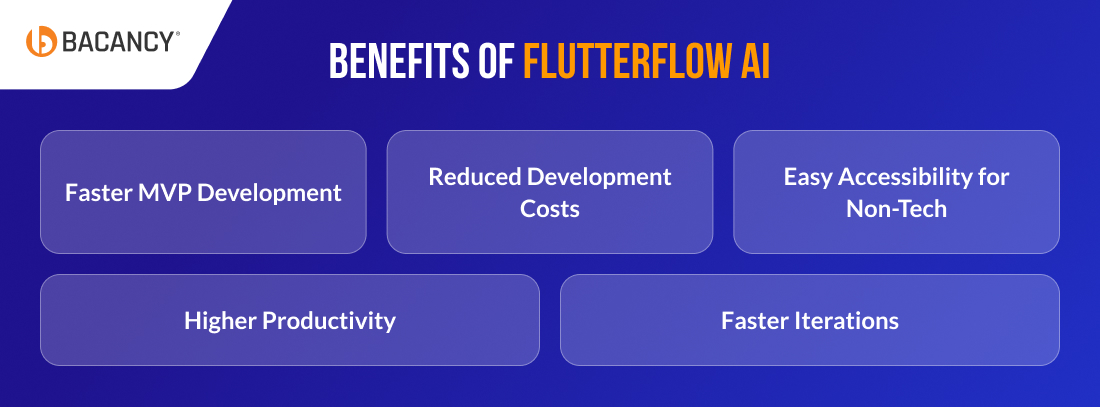
By integrating FlutterFlow AI, you gain efficiency, faster time-to-market, and reduced risk. Let’s look at 5 advantages of FlutterFlow AI that make it a strategic choice.
Faster MVP Development
One of the biggest benefits of FlutterFlow AI is speed. Instead of spending weeks building basic app screens like login pages, forms, or dashboards, teams can generate them in minutes. This allows businesses to turn ideas into working prototypes quickly and test them with real users.
For instance, a health-tech startup can launch a simple appointment booking app within days to validate the concept before investing in a full-scale platform.
Reduced Development Costs
App development can be expensive, especially when a project requires large teams and months of effort. FlutterFlow AI helps cut costs by handling repetitive coding tasks automatically. Smaller teams can build more with fewer resources, which reduces the need for additional developers in the early stages.
For instance, an e-commerce startup can save thousands by using AI to generate product catalog pages and checkout flows, instead of hiring extra engineers.
Accessibility for Non-Technical Founders
For non-technical founders, bringing an app idea to life is often a challenge. FlutterFlow AI removes this barrier by making app creation possible without deep coding knowledge. Entrepreneurs can focus on their customers, business strategy, and growth while still creating functional applications.
For instance, a restaurant owner who wants a delivery app, FlutterFlow AI to create one without writing complex code or hiring a full technical team.
Higher Productivity for Tech Leaders
CTOs and tech leads often see teams get stuck with routine coding work that adds little long-term value. With FlutterFlow AI, those tasks are automated, giving developers time to work on more important aspects such as scalability, architecture, and innovation.
For instance, a fintech company’s developers can skip repetitive form validations and instead concentrate on building secure payment systems that matter to the business.
Faster Iterations for Product Managers
Product managers need to test ideas, gather feedback, and update products quickly. FlutterFlow AI makes this easier by turning user stories into working features in less time. It reduces the gap between planning and execution, which means updates can be rolled out faster.
For instance, an edtech product manager can instantly add new quiz formats or course modules, keeping the platform fresh and aligned with student needs.
How do the Use Cases of FlutterFlow and AI Shape Modern Apps?
FlutterFlow AI delivers value in many real-world scenarios. It empowers founders, agencies, enterprises, and communities to build apps faster, smarter, and with fewer barriers.
1. Building Investor-Ready Demos
Startups often need polished demos to impress investors before committing heavy budgets. FlutterFlow AI allows founders to generate sleek, functional app demos in days. These demos can showcase user flows, dashboards, and data handling, giving investors confidence in both the product vision and the team’s execution ability.
2. Enterprise Innovation Labs
Enterprises run innovation labs or pilot projects to test new digital ideas without disrupting core systems. FlutterFlow AI fits perfectly here by enabling teams to spin up prototypes quickly, connect them with existing backends, and run experiments. This way, enterprises can validate ideas with minimal risk and roll out successful pilots into full-scale platforms.
Universities, coding bootcamps, and corporate training programs can leverage FlutterFlow AI to teach app development concepts without needing months of programming instruction. Students and professionals can build working apps faster, which makes learning more practical and engaging.
4. Agencies Delivering Multi-Client Solutions
Agencies often have to manage multiple client demands simultaneously. FlutterFlow AI speeds up the delivery of reusable components, consistent designs, and quick integrations. It allows agencies to take on more projects simultaneously while meeting strict client deadlines and maintaining quality. Businesses looking to replicate this advantage can opt for FlutterFlow app development services to deliver the same efficiency.
5. Nonprofits and Community Projects
Nonprofits or small community initiatives often lack technical resources. With FlutterFlow AI, they can launch apps for fundraising, volunteer coordination, or awareness campaigns without high costs or long timelines. This makes digital solutions accessible to organizations that otherwise could not afford them.
Potential Pitfalls and Challenges of FlutterFlow AI
While FlutterFlow and AI integration bring speed and efficiency, they also come with certain risks and limitations that businesses must consider before full adoption. Below are some key challenges to know:
Over-Reliance on AI
AI can handle a large part of the heavy lifting in app creation, but depending too much on it can become a weakness. The output is not always perfect and may skip important details around performance, scalability, or security. Human developers still need to review, refine, and validate the results to make sure the application is production-ready.
Vendor Dependency
Choosing FlutterFlow means aligning with its ecosystem. If pricing, feature availability, or the product roadmap changes, your team might feel locked in with limited alternatives. As a result, businesses should weigh the long-term commitment carefully and build a strategy that allows for flexibility if the platform evolves in unexpected ways.
Handling Complex Features
For common use cases, FlutterFlow AI works very well. However, when projects require advanced workflows, custom business logic, or highly tailored integrations, the platform may fall short. In such cases, developers must rely on traditional coding to extend the application.
Limited Debugging and Troubleshooting
While FlutterFlow AI accelerates development, identifying and fixing issues can be more challenging compared to traditional coding. AI-generated code may produce unexpected behavior, and debugging complex interactions or integrations might require deeper technical knowledge.
Is There a Future for FlutterFlow and AI-driven Development?
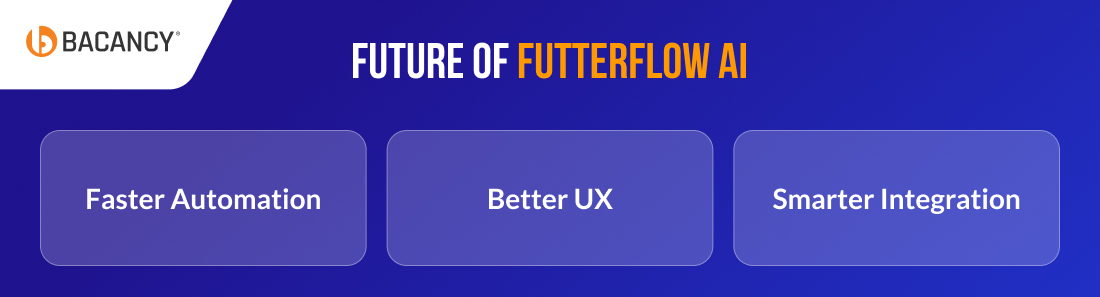
Yes, FlutterFlow AI continues to improve, and the future looks bright as AI-driven development grows. Here are some ways it is expected to advance:
1. Automation That Saves Time
FlutterFlow AI will handle more parts of coding, testing, and deployment. Hence, your team can have more time to focus on creative ideas and building features that set your product apart.
2. Predictive UX for Better Engagement
AI will help FlutterFlow understand what users need and suggest layouts, flows, and designs that feel natural. It helps you create apps that meet expectations and keep users coming back.
3. Smarter Integrations That Add Value
FlutterFlow AI will connect more easily with APIs, cloud tools, and AI services. You can add features, such as chatbots, recommendations, or voice assistants, without long development cycles or high costs.
How Bacancy Can Help You Utilize FlutterFlow AI?
The increasing demand for FlutterFlow AI proves that app development is no longer required to be slow or resource-heavy. It has opened endless possibilities for creating faster and smarter applications. However, expert guidance is quite crucial to transform capabilities into real business outcomes.
As a trusted FlutterFlow web app development company, Bacancy helps you go beyond basic features and build future-ready products. With our team by your side, you can turn any ideas into powerful apps that deliver value since day one.
Our expertise with FlutterFlow AI ensures that you get more than just rapid prototyping. We help you:
- Set up AI-powered workflows that cut down repetitive tasks.
- Use AI page generation and smart suggestions to launch MVPs faster.
- Integrate third-party AI services like OpenAI or Gemini into your apps.
- Design scalable solutions that grow from startup to enterprise level.
Whether you are a startup testing a new idea or an enterprise modernizing products, Bacancy provides the technical depth and experience to help you maximize the full potential of FlutterFlow AI.
Frequently Asked Questions (FAQs)
FlutterFlow AI is a low-code development platform powered by artificial intelligence. It helps you design, build, and deploy mobile and web apps faster while reducing the manual effort of coding and testing.
Startups can launch MVPs quickly with fewer resources, while enterprises can scale projects faster, cut development costs, and stay flexible with feature upgrades.
No. FlutterFlow AI accelerates repetitive and time-consuming tasks, but human developers are still essential for strategy, architecture, complex logic, and quality control.
Yes, FlutterFlow AI generates clean code, but it still needs oversight. Developers can review, customize, and optimize the code to match business requirements and performance standards.
You can build cross-platform mobile and web apps for industries like healthcare, fintech, e-commerce, education, and more. It works well for MVPs, prototypes, and production-level solutions.
The main risks include vendor dependency, limited flexibility for very complex features, and over-reliance on AI outputs. With proper developer involvement, these risks can be managed.
Yes, FlutterFlow AI supports APIs, third-party tools, and AI-powered services, such as chatbots, payment gateways, and cloud platforms.
Yes, because the platform continues to evolve with more automation, smarter integrations, and AI-driven optimization. Early adoption can give your business a head start.