Quick Summary
This blog covers everything you need to know about picking the right SaaS for eCommerce platform in 2026. Learn why it’s becoming popular, which platforms to consider, the key features to look for, and how to scale smartly with the right tech partner.
Table of Contents
Introduction
Launching an online store once meant months of development, heavy infrastructure costs, and endless IT troubleshooting. In 2026, smart brands are choosing a SaaS for eCommerce platform to launch fast, scale on demand, and reduce costs.
As the eCommerce market heads toward $16.5 billion by 2030, businesses need to launch quickly, scale painlessly, and keep costs in check. SaaS delivers on all three fronts.
In this blog, we will explore why SaaS is a strategic choice and a great move for building a modern, future-ready eCommerce business. Let’s get started.
Why SaaS eCommerce Is the Smart Choice in 2026?
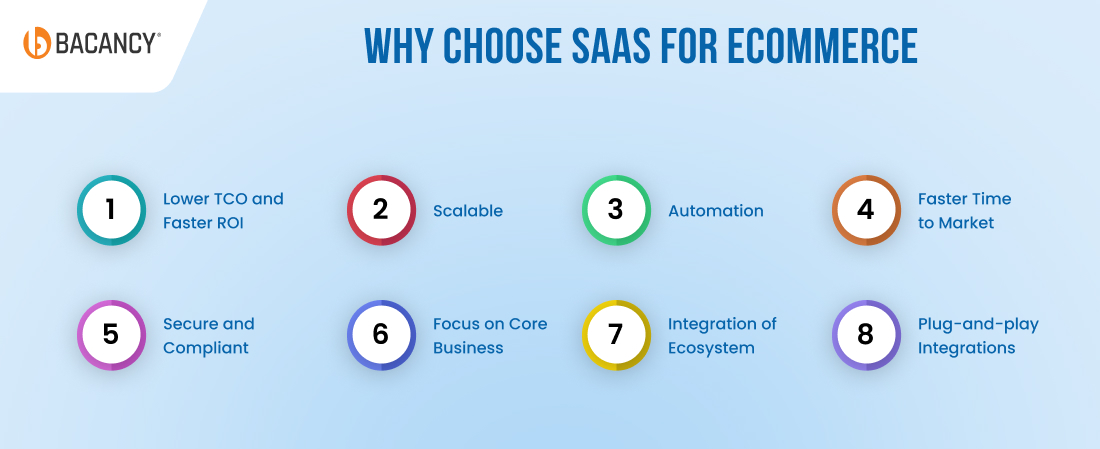
For eCommerce founders, CTOs, and platform evaluators, SaaS eCommerce platforms offer real business value, lower costs, effortless scaling, and built-in innovation. Here’s why it has become a go-to choice for future growth:
1. Lower TCO (Total Cost of Ownership) and Faster ROI
A SaaS for eCommerce platformremoves the need for costly infrastructure, ongoing maintenance, and large IT teams. As a result, businesses must pay a monthly or annual subscription that covers hosting, support, and upgrades.
This cloud-based setup significantly reduces upfront investment and improves overall cloud TCO, helping companies achieve a faster return on investment.
2. Built to Scale Without Breaking
SaaS platforms support growth from day one. Whether a business processes 100 or 100,000 transactions, the system adjusts to meet demand. It avoids downtime during traffic peaks and eliminates the need for manual scaling or expensive hardware changes.
3. Automate Innovation
SaaS providers handle all feature releases, performance boosts, and security fixes. Teams always use the latest version without needing to schedule upgrades. This ensures access to modern tools and trends in eCommerce, without extra effort from internal staff.
4. Faster Time to Market
SaaS platforms come with pre-built features, templates, and integrations, allowing businesses to launch their online stores quickly. This rapid deployment is ideal for brands looking to test, pivot, or scale without spending months on development.
5. Stronger Security and Compliance
With built-in SSL (Secure Sockets Layer), PCI DSS compliance (Payment Card Industry Data Security Standard), and regular security updates, SaaS eCommerce providers take care of data protection and regulatory needs. This gives businesses the ability to handle sensitive customer information securely.
6. Better Focus on Core Business
Since the provider manages the platform, internal teams can focus on growth, product, and customer experience. They no longer need to worry about infrastructure, patches, or performance issues.
7. Plug-and-play Integrations
Most SaaS eCommerce solutions come with plug-and-play integrations, whether it is CRM, ERP, marketing automation, or shipping. This helps businesses build a robust, unified commerce stack without custom development.
SaaS vs Open Source vs Custom Build
Now that you know why SaaS is a value-driven choice, it is crucial to compare it to other options like open-source and custom-built platforms. Here’s a quick comparison to guide your decision:
| Aspects | SaaS
| Open-Source | Custom Build |
| Initial Cost | Low (subscription-based) | Medium (setup + customization) | High (development from scratch) |
| Time to Launch | Quick | Medium | Slow
|
| Ownership & Control
| Vendor-managed | Full control
| Full control |
| Security | Built-in & regularly updated | Depends on implementation | Fully your responsibility |
| Scalability | Built-in, auto-scalable
| Requires optimization
| Needs planning and development effort |
| Innovation & Features | Frequent updates, latest features | Depends on the community or developers
| Fully custom, slower feature rollout |
| Best for | Fast growth, lower cost, ease | Flexible, tech-savvy teams | Unique needs, full control |
11 Best SaaS eCommerce Platforms to Choose in 2026
With so many options available, it’s important to evaluate platforms based on features, ease of use, and overall SaaS development costs. Here are some of the top SaaS eCommerce platforms getting popular in 2025.
1. Shopify
Shopify is one of the most popular SaaS platforms, offering ease of use, scalability, and thousands of themes and plugins. It supports everything from single-product stores to global D2C brands.
- Cost: Starts at $20/month
- Time to Launch: 1-2 weeks
- Ideal For: Entrepreneurs, small-to-midsize businesses, D2C startups
- Real-World Examples: Nestle, Allbirds, Gymshark
2. Salesforce Commerce Cloud
Salesforce Commerce Cloud is an enterprise-grade platform with native AI, multi-site support, and deep CRM integration. It’s highly customizable and suited for complex, large-scale operations.
- Cost: Custom pricing (generally high)
- Time to Launch: 2-4 months
- Ideal For: Global brands and enterprise retailers with complex needs
- Real-World Examples: L’Oreal, Puma, Jimmy Choo
3. Dokan Cloud
Built for multivendor marketplaces, Dokan Cloud enables vendors to manage their own stores while you control the platform. It’s based on WooCommerce but offered as SaaS for easier scaling.
- Cost: Starts at $15/month
- Time to Launch: 1-3 weeks
- Ideal For: Niche B2C/B2B marketplaces, multi-seller platforms
- Real-World Examples: BidCurios, Forstep Style, Hawk and Peddle
4. BigCommerce
BigCommerce provides enterprise-level performance and B2B features like custom pricing, quote management, and headless capabilities. It integrates well with ERPs and POS systems.
- Cost: Starts at $29/month
- Time to Launch: 2-4 weeks
- Ideal For: Mid-to-large businesses, B2B commerce, headless setups
- Real-World Examples: Sony, Toyota, Ben & Jerry’s
5. Wix eCommerce
Known for its intuitive drag-and-drop builder, Wix makes it easy for non-tech users to set up an online store with aesthetic templates and essential eCommerce tools.
- Cost: Starts at $17/month
- Time to Launch: 2-5 days
- Ideal For: Small businesses, freelancers, and creative sellers
- Real-World Examples: Animal Music, Izzy Wheels, Ruby Love
6. Adobe Commerce (Magento SaaS)
Adobe Commerce combines the power of Magento with cloud convenience, offering deep flexibility and advanced commerce capabilities. It is suitable for highly customized and large catalogs.
- Cost: Starts around $3,000/month
- Time to Launch: 2-6 months
- Ideal For: Enterprises, complex product logic, deep custom development
- Real-World Examples: HP, Asus, IKEA
7. Volusion
A straightforward platform offering essential inventory and sales tools. Volusion includes SEO features, payment integration, and basic analytics, which are good for mid-level sellers.
- Cost: Starts at $35/month
- Time to Launch: 1-2 weeks
- Ideal For: Small to mid-sized stores looking for simplicity and speed
- Real-World Examples: Fitness Finders, All Dog Boots, BathroomPlace
8. Shift4Shop
Shift4Shop, formerly known as 3dcart, is a no-cost eCommerce platform for US citizens who use Shift4 as their payment processor(includes transactional fee). It is a full-featured platform with SEO tools, product options, and no additional transaction fees.
- Cost: Free with Shift4 payments (US only)
- Time to Launch: 1-2 weeks
- Ideal For: Budget-conscious businesses
- Real-World Examples: Morgan Sports, Beverly Hills Orchids, Pearls of Joy
9. Squarespace Commerce
It offers stunning templates and intuitive interfaces for creators and small business owners. While Squarespace backend logic is not as robust, it’s great for branding and portfolios.
- Cost: Starts at $16/month (includes 14-day free trial)
- Time to Launch: 2-5 days
- Ideal For: Designers, photographers, and boutique brands
- Real-World Examples: Lyft, HBO Documentary Films, Brew Tea Co
10. BigCartel
Tailored for independent artists and makers, BigCartel offers a minimal and affordable platform for selling a small range of products without technical overhead.
- Cost: Free up to 5 products; Paid plans from $15/month
- Time to Launch: Under 1 week
- Ideal For: Indie artists, hobbyists, creators selling limited inventory
- Real-World Examples: Hype Machine, Regan Smith Clarke Clothing, The Feebles
11. Square Online
Perfect for retail stores already using Square POS, this platform enables seamless online expansion with inventory syncing and basic store functions.
- Cost: Free (with transaction fees); Paid plans available
- Time to Launch: 1-2 days
- Ideal For: Brick-and-mortar stores adding an online storefront
- Real-World Examples: Donut Bar, Sheek Studio, Just Table Tennis
Inspired by the Best? Be the Next.
Hire SaaS developers to create your own standout eCommerce platform.
7 Must-Have Features Your SaaS for eCommerce Platform Should Offer
Selecting the right SaaS for eCommerce platform involves more than just comparing pricing plans or themes. For eCommerce founders, CTOs, and platform evaluators, it’s about ensuring the platform is built to support long-term growth, innovation, and customer experience.
1. Headless Architecture with API-First Flexibility
Choose platforms that decouple frontend and backend layers to allow greater customization. This lets developers build high-performing storefronts using modern frameworks like React or Vue. It supports faster changes and improves UX across web, mobile, and emerging channels.
2. Omnichannel Selling and Centralized Management
Ensure the platform supports integrations with marketplaces, POS systems, social commerce, and mobile apps. A centralized backend makes it easier to manage products, inventory, and orders across channels, reducing errors and improving customer satisfaction.
3. SEO-Ready Framework and Fast Page Loads
Look for platforms offering editable meta tags, schema markup, and clean URL structures. Combine that with CDN support and image optimization to ensure faster load times, improved search rankings, and better Core Web Vitals scores.
4. Built-In Analytics and Customer Segmentation
Choose platforms that offer real-time reporting, audience insights, and built-in dashboards. Features like funnel analysis, cohort tracking, and behavioral segmentation allow smarter targeting and help optimize sales and retention campaigns.
5. Global Commerce with Multi-Store Features
Pick a platform that allows multi-storefront management from a single backend. Look for support for multiple currencies, localized languages, regional tax rules, and content variations, which are ideal for cross-border and multi-brand strategies.
Look for platforms that offer REST or GraphQL APIs, SDKs, webhooks, and CLI tools. These enable faster and safer development of custom features or integrations. Sandbox environments allow developers to prototype and test without affecting the live store, making deployment more secure and reliable.
7. Built-In Compliance and Enterprise-Grade Security
Choose platforms that offer SSL, firewalls, role-based access, and compliance with PCI-DSS and General Data Protection Regulation (GDPR). Combine this with uptime Service Level Agreements (SLAs) and Distributed Denial of Service (DDoS) protection to ensure business continuity and protect sensitive customer data.
Emerging SaaS for eCommerce Platform Trends You Should Not Miss
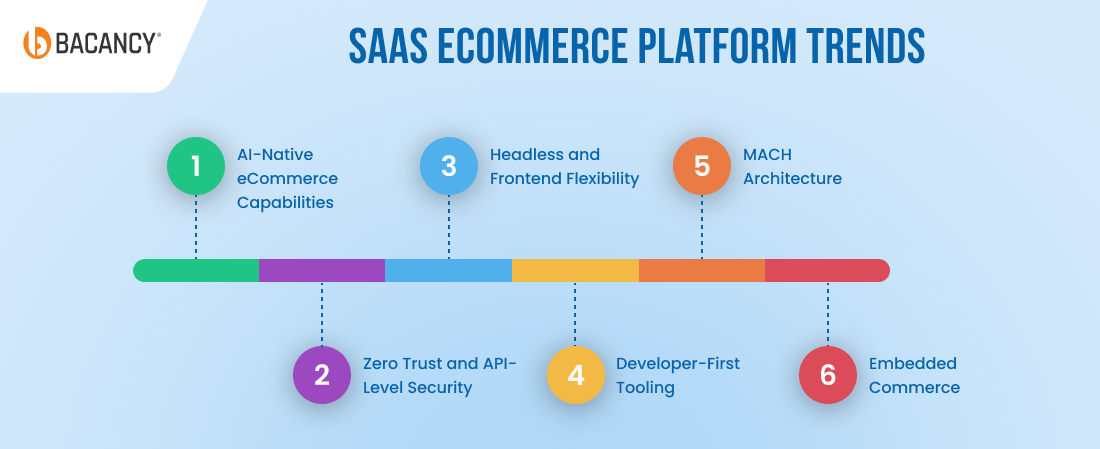
To keep your eCommerce business ready for the future, it’s important to know how the SaaS market is evolving. These SaaS for eCommerce platform trends help you move faster, cut costs, and deliver a better customer experience.
1. AI-Native eCommerce Capabilities
Modern SaaS platforms integrate AI at the core, empowering personalized shopping, smart search, product recommendations, and predictive inventory. These AI-native features help brands improve conversion rates and deliver intelligent customer experiences.
2. Headless and Frontend Flexibility
Retailers are shifting to headless commerce to decouple backend logic from the frontend experience. This flexibility allows brands to build fast, dynamic storefronts using frameworks like React, Vue, or Svelte, across web, mobile, and IoT.
3. MACH Architecture
MACH (Microservices, API-first, Cloud-native, Headless) architecture is redefining scalability and agility in eCommerce. It supports rapid updates, modular integrations, and future-ready solutions that evolve with business needs.
4. Zero Trust and API-Level Security
Security-first design is becoming essential, with platforms adopting Zero Trust models and API-level protections. These controls ensure safe integrations, role-based access, and compliance with evolving data privacy standards.
SaaS platforms now offer robust support for developers, complete with SDKs, GraphQL APIs, sandbox environments, CI/CD integrations, and monitoring tools. This accelerates time-to-market and enables deeper customizations.
6. Embedded Commerce
Brands embed commerce directly into digital experiences, such as blogs, social platforms, or mobile apps. To support this shift, SaaS providers are responding with embeddable carts, API-based checkout, and flexible payment options.
Ready to Scale Smarter? Let’s Make SaaS for eCommerce Platform That Works for You
Scaling an eCommerce business requires a flexible and reliable platform. Choosing the right SaaS eCommerce solution provides the infrastructure and tools needed to grow efficiently while controlling costs.
Working with an experienced SaaS development company ensures seamless implementation and ongoing support. By entrusting your SaaS for ecommerce platform solution to experienced developers, your team stays focused on boosting sales and delighting customers.
Investing in professional SaaS development is a smart move that sets your business up for scalable and long-term success.
Frequently Asked Questions (FAQs)
SaaS (Software as a Service) eCommerce platform is a cloud-based solution for developing and managing an online store. Rather than installing software on your own servers, you can subscribe and access all eCommerce tools, like website builder, product management, payment processing, and more, through the internet.
Yes, most SaaS platforms offer enterprise-grade security, regular updates, SSL, PCI compliance, and built-in fraud prevention to ensure a safe shopping experience.
While customization is limited compared to open-source solutions, most modern SaaS platforms offer flexible templates, design options, third-party integrations, and APIs to tailor the store to your brand.
Startups, D2C brands, small to medium enterprises, and even large businesses seeking faster time-to-market and lower upfront investment benefit from SaaS-based eCommerce.
Top SaaS ecommerce platforms in 2026 include Shopify, BigCommerce, Adobe Commerce (Cloud Edition), Salesforce Commerce Cloud, and Shopware.
Yes, most SaaS providers offer migration tools or support services to help you move your products, customer data, and order history from your existing platform.
Costs vary based on the platform, design, features, and scale. SaaS platforms typically offer monthly subscription pricing, with additional costs for apps, themes, and developer support if needed.
Absolutely. Most SaaS solutions offer responsive design and mobile-optimized checkout experiences, which are essential for modern shoppers.