Quick Summary
Building an AI MVP in 30 days or less is achievable with the right strategy and focus. By prioritizing core features and integrating AI capabilities, you can validate your idea quickly. This AI MVP development guide helps you gather real user feedback, refine your product, and launch faster without wasting time or resources. With expert guidance, your AI MVP can move from concept to a functional, market-ready solution in just a month.
Table of Contents
Introduction
Artificial Intelligence started as a curiosity. Today, it runs the show. Every founder, CTO, and startup relies on AI to move faster, smarter, and bigger. Just like computers changed the game in the ’90s, AI now shapes how we build, scale, and secure products. With advantages like these, leaving it out of your MVP (Minimum Viable Product) isn’t an option.
However, the catch is that you will find plenty of guides claiming you can build an AI MVP in 2 hours. But as the saying goes, “The faster you rush, the harder you fall.” We won’t let that happen with you. Hence, we have crafted a comprehensive blog on how to launch AI MVP in 30 days or less.
First, let’s start with the essentials you need to consider before launching an AI MVP for your business.
What Are The Factors You Should Be Ready With for MVP AI?
Before jumping into the development of an MVP in AI, you must go through the following list to ensure a streamlined process.
- First and foremost, a crucial aspect of how to build an AI MVP is to define your core feature. For instance, you need to focus on functionality that addresses your users’ biggest problem and makes your MVP seamless.
- It is essential to choose the right technologies, such as frontend/backend frameworks, AI tools, or any low-code platforms, to accelerate your development process without cutting any corners.
- You also need to set weekly milestones for better clarity. Break your plan into achievable goals so it’s easier to track progress, test fast, and stay on course. This approach is exactly how you can build an AI MVP in 30 days efficiently.
- Ensure your developers, data experts, and product owners are in sync from day one. You must clear alignment to avoid confusion and help your MVP take shape faster.
- Finally, gather and clean relevant data before you start. The quality of your AI model depends entirely on the quality of your input data.
How to Launch AI MVP in 30 Days (or Less)? Week-by-Week Guide
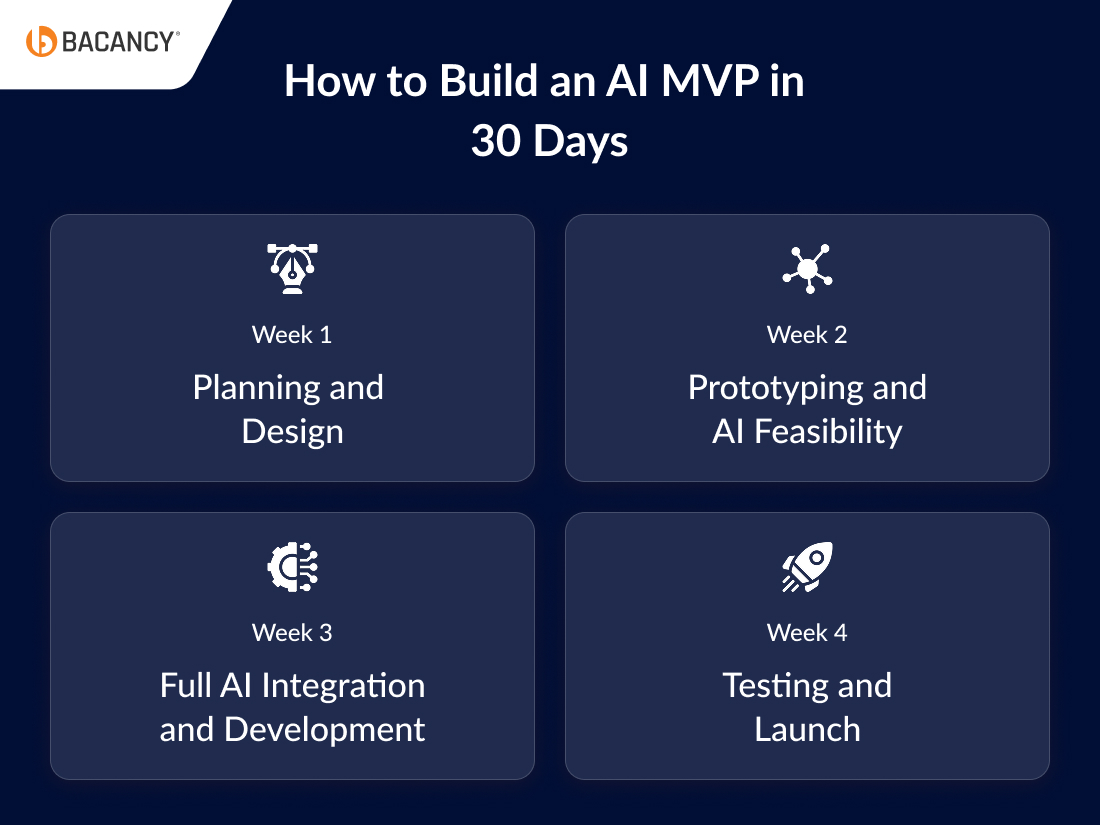
Building an AI MVP in 30 days may sound overambitious, but with the right structure and focus, it’s absolutely doable. Here’s how to plan your four-week journey step by step.
Week 1: Planning and Design
The first week sets the direction for everything ahead. Identify your target audience, define the main problem you want to solve, and outline the core features your MVP will include. Keep your goals realistic and measurable.
- Define your problem statement and success metrics.
- Sketch user flows or wireframes to visualize your idea.
- Finalize data sources and AI use cases you’ll begin with.
By the end of this week, you should have a clear product concept and a roadmap ready to execute.
Week 2: Prototyping and AI Feasibility
The second week focuses on bringing your idea to life by building a working prototype and seeing how your AI features perform in the real world. This is your opportunity to test, experiment, and determine what works best before proceeding to full development.
- Develop a basic prototype to showcase the main idea.
- Integrate AI APIs, such as OpenAI GPT, Hugging Face, or Cohere, for tasks like predictions, recommendations, or content generation.
- Prepare and structure datasets for testing, ensuring data flows correctly within your prototype.
- Collect early feedback from your team or a small group of users to identify usability issues or gaps in AI performance.
Your goal is to create a working model that effectively demonstrates the primary value of your idea.
Week 3: Full AI Integration and Development
This week is all about connecting your prototype to a fully functional AI MVP. You add the core AI features, link the front-end and back-end systems, and ensure that every part works together before the final testing phase.
- Integrate AI models or APIs to power your core features.
- Implement backend logic and connect data pipelines.
- Collaborate with data experts to refine predictions, recommendations, or automation.
By the end of this week, your MVP should have all the main features functioning smoothly.
Week 4: Testing and Launch
The final week focuses on quality, stability, and presentation. Thoroughly test your MVP to ensure both the AI model and user experience function as expected.
- Validate model accuracy and test with real-world data.
- Fix bugs, refine UI, and improve speed or usability.
- Launch your MVP to a small beta group for early feedback.
By the end of the 30 days, you will have a functional AI in MVP development ready to demonstrate value, attract users, and guide your next iteration.
Launch a Next-Gen MVP with AI
Our AI development company enables you to build an MVP that integrates machine learning, automation, and real-time analytics to accelerate your product.
Best AI MVP Tools for Rapid Development: AI APIs, Low-Code Platforms, and Vibe Coding
While everyone is focused on how to build an AI MVP in 30 days, fewer founders are aware of the importance of advanced tools. Let’s take it, creating an AI in MVP development in 30 days is not about hustle, but choosing the right tech stack that can multiply your results.
1. AI APIs That Let You Add Smart Features Quickly
AI APIs provide your MVP with intelligence without requiring you to build models from scratch. The tools will manage elements such as chat, recommendations, or image recognition, allowing you to focus on the product.
Bacancy’s Top Picks:
- OpenAI GPT-4 / GPT-4 Turbo: For chatbots, content generation, and natural language tasks.
- Hugging Face Models: Pre-trained models for text, images, or recommendations.
- Anthropic Claude: Great for conversational AI and reasoning tasks.
When to Use:
- You want a working AI feature fast.
- You don’t need a fully custom AI model yet.
When to Avoid:
- You need full control over the AI.
- Your data is sensitive and can’t leave your system.
No-code/Low-code platforms are the smart solution that every industry is adopting. It lets you design mobile development or web applications without writing a single line of code. These platforms are suitable for businesses that want to execute their test idea quickly.
Bacancy’s Top Picks:
- Bubble: For web apps with database and workflow support.
- FlutterFlow: For mobile-first MVPs, FlutterFlow simplifies data using spreadsheets.
- Retool: For dashboards or internal tools that need fast setup.
When to Use:
- You need to launch quickly with limited coding resources.
- You want to focus on features, not infrastructure.
When to Avoid:
- You plan to scale heavily soon.
- You need complex AI logic inside the app.
Vibe coding tools are dominating the market because of their less coding, more results approach. Using the tools, you can write and debug code faster. Moreover, they suggest code snippets, functions, and logic based on what you type.
Bacancy’s Top Picks:
- GitHub Copilot: An innovative tool that predicts your next move and suggests code while you type, helping you make AI MVP development smoother and faster.
- Lovable: An AI assistant that understands your project, offers thoughtful suggestions, and makes coding feel effortless.
- Cursor: A versatile AI code assistant for multiple languages that streamlines your workflow and writes clean code.
When to Use:
- You need custom code for your MVP.
- You want to save time on repetitive coding tasks.
When to Avoid:
- Your team doesn’t code; these tools help developers, not replace them.
- You are handling very sensitive or highly regulated code.
Quick Tip for Seamless Advance MVP AI Development-
To ensure the faster launch of an AI MVP in 30 days, you need to follow this simple combination:
- Utilize an AI API to incorporate intelligent features.
- Utilize a low-code platform to develop your app rapidly./li>
- Utilize a vibe coding tool to expedite custom logic.
How Much Will It Cost to Launch an AI MVP in 30 Days?
To build a successful AI MVP in just 30 days doesn’t have to break the bank. Costs vary depending on complexity, AI integration, and whether you rely on AI platforms or fully custom solutions. Here’s a clear breakdown of what to expect from a MVP development costs with AI:
| MVP Type
| Description
| Approx Cost
| Timeframe
| Best For
|
|---|
| Lean MVP with Low-Code
| Basic AI features with low-code/no-code and minimal coding.
| $5,000 - $12,000
| 2 - 4 weeks
| Startups. For testing ideas or proof-of-concept.
|
| Moderate MVP with Some Custom AI
| Mix of low-code and custom AI for smarter functionality.
| $12,000 - $25,000
| 3 - 5 weeks
| Startups need AI-powered differentiation.
|
| Advanced MVP with Full Custom AI
| Fully custom AI models, workflows, and scalability.
| $25,000 - $50,000+
| 4 - 6 weeks
| Enterprises or startups with specialized AI requirements.
|
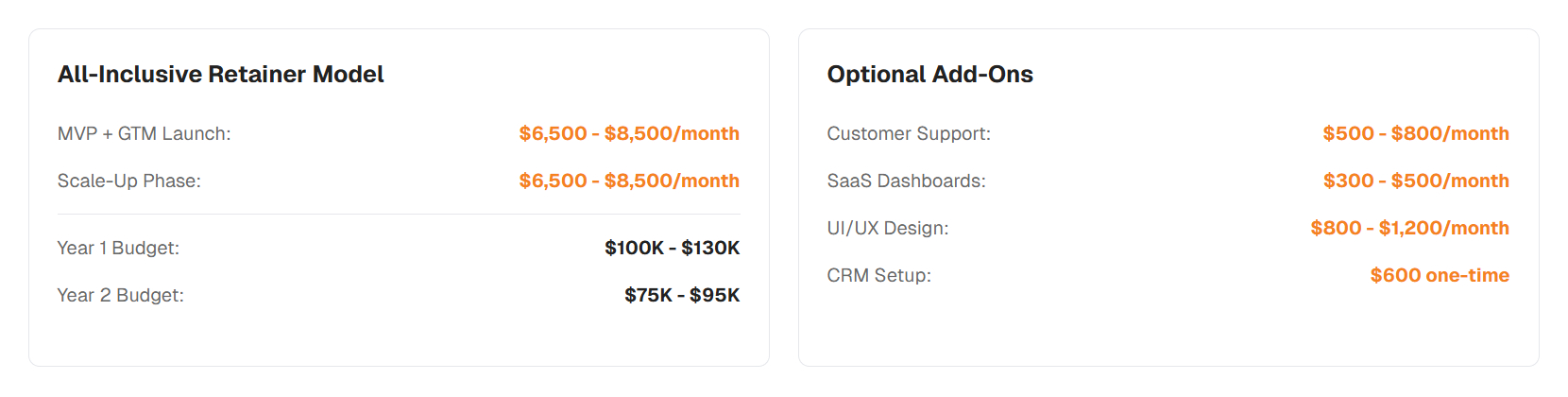
Bacancy’s Cost to Launch MVP Using AI
Common AI MVP Development Mistakes and How to Avoid Them for a 30-Day Launch
Even with a clear 30-day plan, many teams face roadblocks that push their launch date further. Knowing these mistakes in advance helps you stay on track and deliver your MVP on time.
1. Limited Data Availability for AI Features
AI depends on data to learn, predict, and perform accurately. If your dataset is too small, unstructured, or irrelevant, the model will fail to produce reliable outcomes. Many startups begin development before securing quality data, which later forces them to retrain their models and delays progress.
How to avoid it:
Prepare your data early. Identify what type of data your model needs and collect it from reliable sources. Use public datasets from Kaggle, Google Dataset Search, or Hugging Face to fill gaps in the beginning. If real data is limited, generate synthetic data to test your logic and model behavior.
2. Technical Limitations
Choosing the wrong frameworks, APIs, or tech stack can lead to performance bottlenecks and scalability issues. For instance, you can use a library that doesn’t support your deployment environment and can slow down integration or require a full rebuild later.
How to avoid it:
Select technologies that match your project goals and your team’s capabilities. Start with proven AI frameworks, such as TensorFlow, PyTorch, or LangChain, for model work. If you need quick results, rely on API-first platforms like OpenAI or Cohere that offer ready-to-integrate models. Avoid complex setups until your MVP proves real user value.
3. Time Constraints and Overcommitment
One of the biggest reasons AI MVPs miss deadlines is overcommitment. Teams often try to deliver multiple features or advanced AI models at once, which increases complexity and slows down output. Without clear milestones, the project drifts off schedule.
How to avoid it:
Break your 30-day plan into weekly milestones. In the first week, finalize design and core logic. In the second step, build your prototype with low-code tools. The third week should focus on API integration, and the fourth on testing and release. Keep your scope tight: one problem, one solution, one measurable outcome.
4. Lack of Team Alignment
AI MVP development requires collaboration between product owners, data scientists, and engineers. When these roles work in isolation, integration issues, data mismatches, and unclear priorities slow down progress.
How to avoid it:
Create a shared roadmap from day one. Make sure every team member understands the MVP goal, timeline, and dependencies. Use tools like Notion, Trello, or Jira to track updates and responsibilities. Regular sync-ups help the team stay focused and move together.
How Bacancy Builds AI MVPs in Just 30 Days?
Just like every founder wants to turn an idea into a product faster, one of our healthcare clients shared the same goal. Addressing it, we developed an MVP using AI, which could read patient forms, fetch out crucial details, and streamline EHR systems.
Our expert team followed an agile process and focused on what matters the most: automating form processing with AI. Once the path was clear, we established a 30-day roadmap to launch the MVP more quickly.
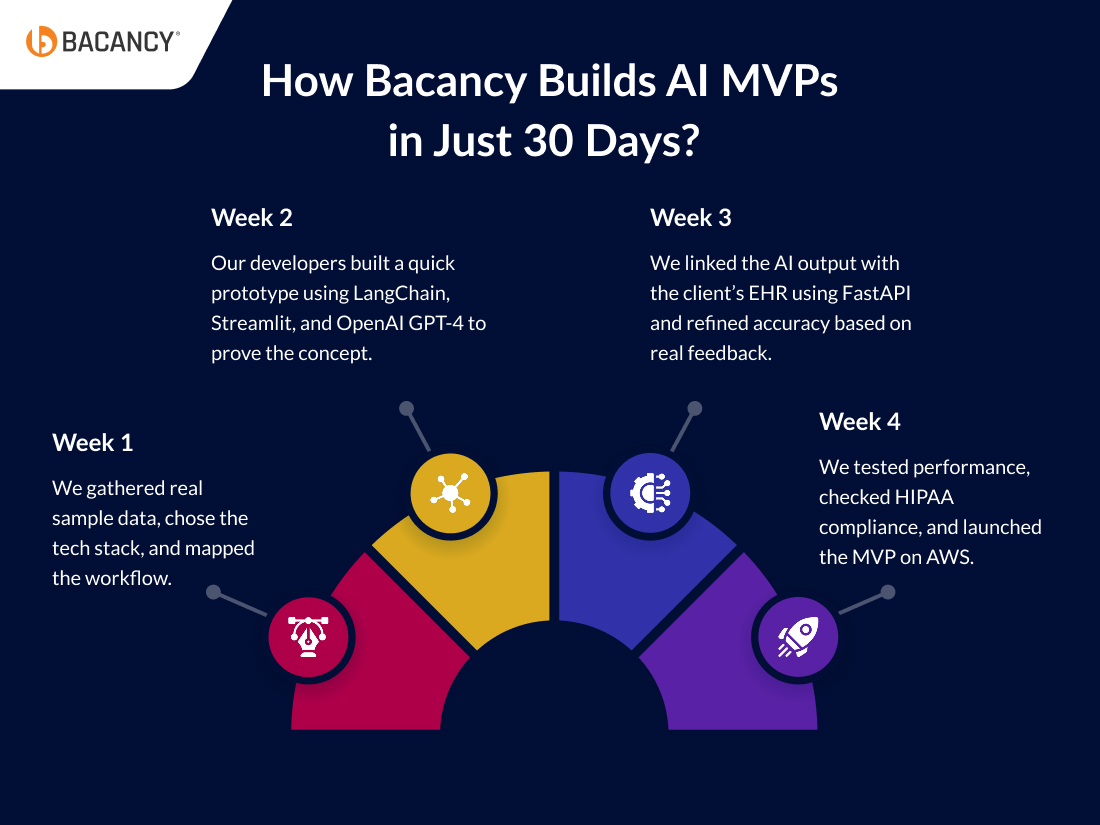
By day 30, the MVP was live. It processed 500+ forms per hour with 94% accuracy and reduced manual work by 80%. The client used the product in real clinics and secured their first round of investor funding soon after.
Ready To Launch AI MVP For Your Project?
After a clear roadmap, it is time to launch your AI MVP into your project. Creating an MVP is simpler, and with the help of AI, it is even simpler and smarter. All you need is the right tool and direction to follow the process. With a clear plan and the right AI tools, you can quickly validate your idea, gather user feedback, and make data-driven improvements without wasting time or resources.
As a trusted MVP development company, Bacancy guides startups and businesses through every step of building an AI MVP. Our team works closely with you to design, develop, and refine AI-powered MVPs tailored to your business goals. With the right balance of innovation and practicality, we help you test ideas faster and build a clear path toward a full-scale, investor-ready product within 30 days or less.
Frequently Asked Questions (FAQs)
An AI MVP (Minimum Viable Product) is the simplest version of an AI-powered product that includes only vital features to validate your idea. It helps you test your AI model, gather user feedback, and prove market demand before investing it entirely in full-scale development.
A traditional MVP focuses on validating a product’s core functionality; whereas, an AI MVP validates the intelligence layer, how well the AI performs its tasks, learns from data, and improves over time. It requires model evaluation metrics beyond just UX.
Building an AI MVP allows you to validate your assumptions, reduce development costs, and accelerate time-to-market. It will enable you to test your AI model’s accuracy, usability, and ROI with real users, which helps to refine your product based on data rather than guesswork.
An AI MVP can usually be developed in 30 to 60 days, depending on the project complexity, dataset size, and AI model type. Using low-code platforms, pre-trained models, and vibe coding tools can further reduce development time.
The hurdles every founder, startup, and CTO faces in AI MVP are:
- Model drift or reduced accuracy
- Data pipeline management
- Increased compute cost
- Compliance and privacy issues
- Re-architecting for performance and scalability
The average cost ranges from $10,000 to $50,000. It varies depending on scope, data complexity, and AI integrations. Costs can also be reduced by using open-source AI models and managed ML platforms instead of custom training from scratch.
The following are the metrics you need to follow for a successful MVP development through AI:
- Model accuracy or precision
- User engagement or satisfaction
- Processing time
- Cost per inference
- Feedback loop
- improvement rate
Ethical AI starts with data transparency. Avoid biased or unverified data, clearly disclose when automation is used, and implement explainable features. Even in MVPs, it’s vital to respect privacy regulations like GDPR and HIPAA.