Quick Summary:
This blog will help you understand the latest IT staff augmentation trends in 2026 and how they have influenced IT companies. You will learn how agile models, AI-powered talent discovery, and squad-as-a-service teams transform the hiring process and project delivery. It will also show you how compliance, data rules, and outcome-focused staffing can help your business scale efficiently, reduce risk, and provide high-quality outcomes.
Table of Contents
What Are the Staff Augmentation Trends for IT Companies in 2026?
The latest IT staff augmentation trends for 2026 showcase how companies, startups, and enterprises are paving the way for the hiring of augmented teams. Nearly 62% of enterprises rely on augmented teams to fill skill gaps quickly, while the global IT staff augmentation market is expected to reach $1.15 billion in 2026. Companies can focus on flexible, outcome-driven engagements, specialized experts, and agile hiring models to scale fast and meet evolving project demands.
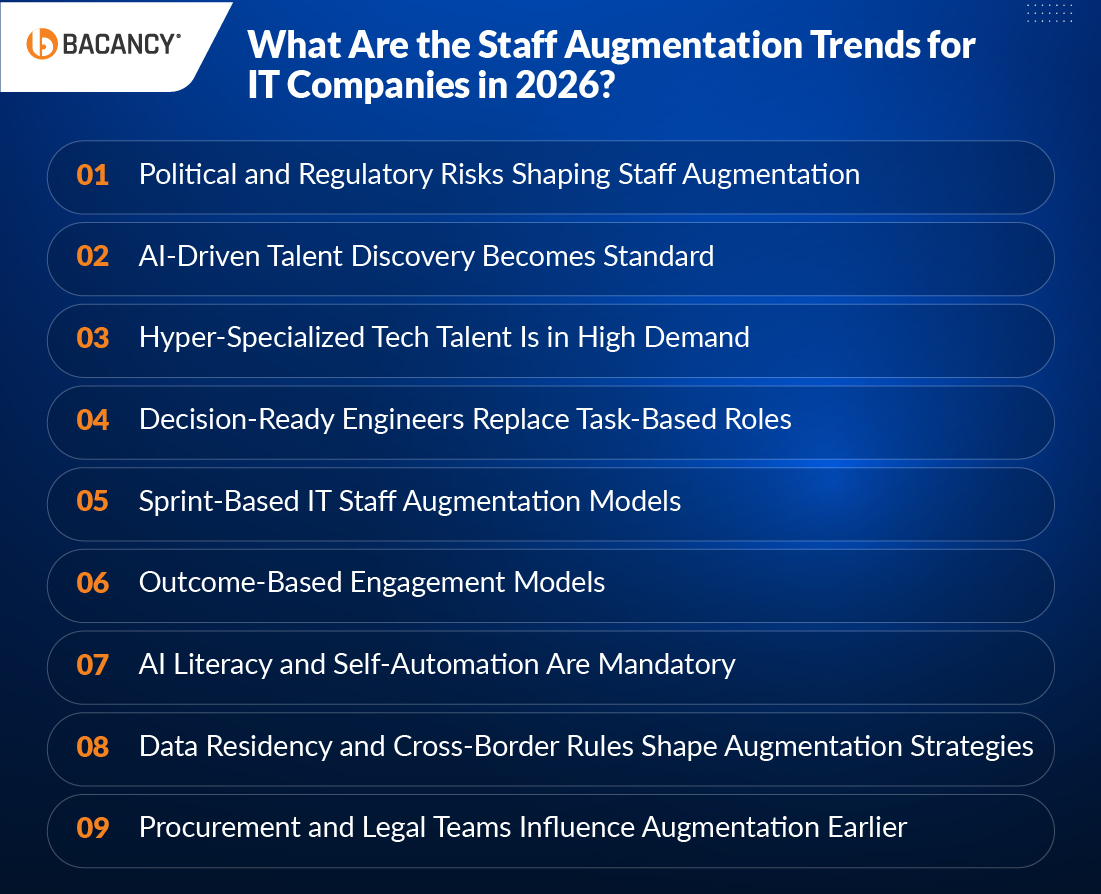
1. Political and Regulatory Risks Shaping Staff Augmentation
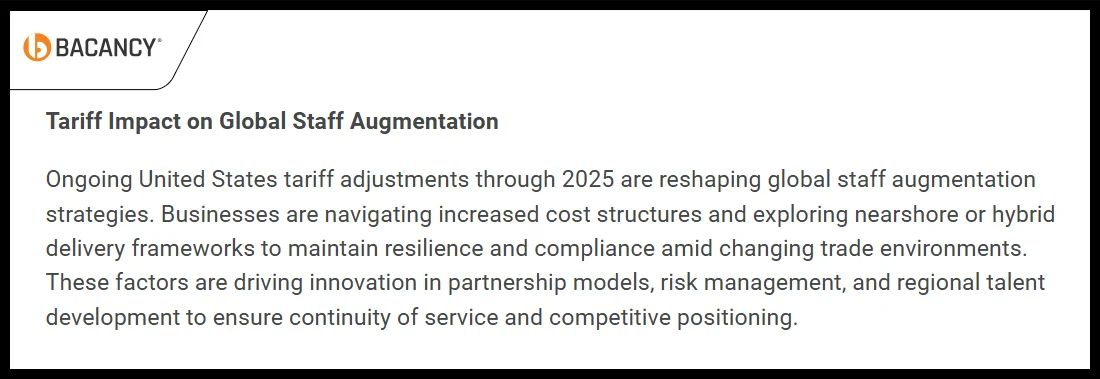
Most companies rely on global talent from large IT workforces, but we began to notice in 2025 that staff augmentation decisions are increasingly influenced by events such as trade restrictions, visa politics, and tariffs.
For instance, in recent events, the US President Donald Trump’s government imposed certain trade policies and visa reforms, which affected the US-India IT staffing equations. As a result, it impacts the business operations, their revenue, delays in projects, and increases unexpected expenses.
These developments have made IT companies more cautious about placing their augmented teams in a single geography. Several staffing choices have been influenced by factors such as political uncertainty, labor law changes, and cross-border compliance risks. The sudden regulatory actions apparently disrupt delivery and increase overall costs.
In the upcoming years, IT companies are expected to continue policy shifts and tighter control over global hiring models. To stay prepared, you need to adopt a diversified staff augmentation approach that includes nearshore, onshore, and multi-region offshore teams.
Impact on IT companies:
- Your project can face delays or disruptions because of political and regulatory changes while hiring offshore talent.
- If companies adapt diverse sourcing strategies like Global Capability Centers (GCCs) to ensure streamlined operations, even if one location becomes less inaccessible.
- It can increase business costs and administrative overhead because of legal compliance pressures, like visa approval for a contract with an augmented team.
- Your access to specialization may be limited due to geopolitical events and travel restrictions, creating a skills gap on crucial projects.
Use case:
Wipro’s experience indicates how migration law changes can affect revenue and operations, especially when a large portion of business comes from specific regions (62.3% from the U.S. and 27% from Europe). For IT companies, this shows the importance of diversifying talent sources, adopting nearshoring strategies, and building flexible teams to maintain continuity and reduce dependency on a single region.
2. AI-Driven Talent Discovery Becomes Standard
AI-driven talent discovery is not a new term in IT staff augmentation trends. Early experiments showed how IT organizations accelerate screening, reduce reliance on resumes, and enhance shortlisting accuracy. But back then, it was an efficient upgrade, and now it has become a structural necessity.
As IT cycles slow and timelines tighten, IT companies identify hidden inefficiencies and redesign processes with AI in staff augmentation. Eventually, manual matching and intuition-led shortlisting no longer come where speed, concision, and utilization matter the most.
Skills are now evaluated in context, past project performance matters more than a resume, and early experience with AI tools has become a key advantage.
For IT companies, the message is clear. Those who treat AI-driven talent discovery as a core system move faster, build teams that truly fit, and reduce delivery risk. Companies that delay will feel the gap, not in the number of hires, but in how smoothly and confidently work gets done.
Impact on IT Companies:
- Beneficial for IT companies as this trend shortens time-to-hire significantly and lets AI choose through thousands of profiles in minutes.
- Through AI-powered tools, you can enhance the quality and alignment. It also reduces the risk of mismatch hiring or choosing any underqualified staff for crucial projects.
- Automated screening lets your HR team focus on strategic work instead of repeating the same manual checks over and over.
- AI insights help your company with the staffing needs and proactive preparation for projects and fluctuating demand.
- By integrating AI with existing HR and project management systems, you can create smooth, end-to-end hiring workflows and make staff augmentation more efficient.
Use Case:
A well-known IT company, Tata Consultancy Services (TCS), utilizes AI to make its global talent sourcing smooth. The company incorporates AI-based skilled assessment for resume screening, writing job descriptions, and acquiring the best match for the role. They consider an assistant who helps them to quickly deploy an augmented team for critical client projects while maintaining high-quality standards.
3. Hyper-Specialized Tech Talent Is in High Demand
The demand for hyper-specialized tech talent has been growing quietly, but 2026 makes it unmistakable. As technology stacks grow and products become complex, IT companies require experts who can solve their specific problems with speed and depth.
This shift is happening for two main reasons. First, tighter budgets and longer project timelines are forcing IT companies to be very careful about where they use their talent. Second, AI and automation have taken over much of the routine work.
What is left are high-impact problems that need deep expertise, such as MLOps optimization, cloud cost management, real-time data pipelines, security, or AI-powered features.
In this situation, hyper-specialists provide much more value. They help teams make faster decisions, avoid mistakes, and move past learning curves that generalists often need more time to overcome.
For IT companies, success in IT staff augmentation trends 2026 will depend less on having a large talent pool and more on the ability to find, verify, and deploy specialists who can handle complex systems and deliver results quickly.
Impact on IT Companies:
- The pre-vetted hyper-specialized experts boost your project delivery and enhance product quality.
- A specialized engineer reduces the need for prolonged onboarding and lets your teams hit the ground running on crucial tasks.
- The IT companies can optimize team structure with hyper-specialized experts and full-stack engineers for maximum efficiency.
- It brings more innovative ideas and enhances your client project alignment because they are technically sound for the expected project outcome.
- Integrated hyper-special engineers maintain niche areas, fill the gap, and adapt rapidly as per the business evolution and trends.
Use Case:
Infosys, a renowned IT company, adapted hyper-specialized experts for cloud and AI to boost delivery timelines and enhance quality outcomes. It also helped them to maintain compliance and security standards, along with meeting tight deadlines.
4. Decision-Ready Engineers Replace Task-Based Roles
In 2026, IT staff augmentation trends show a shift from task-based roles to decision-ready engineers who contribute at both strategic and execution levels. Various IT companies face projects with unclear requirements, changing priorities, and tight deadlines. Decision-ready engineers understand the bigger picture, interpret vague requirements, and suggest the best technical solutions.
This trend is driven by agile workflows and fast-moving projects. IT companies can expect these engineers to work independently, handle complex tasks, and adapt quickly without constant guidance. By adding decision-ready engineers to their teams, companies can accelerate delivery, reduce reliance on senior staff, and achieve better results from their augmented teams.
Impact on IT Companies:
- The company experiences faster execution as engineers require minimal guidance and can independently drive solutions forward.
- Decision-ready engineers help to reduce the coordination overhead and let you deliver leads and architect to prioritize high-impact decisions rather than daily operations.
- Your project can get advantages from the higher technical consistency since the engineer understands system-wide implications.
- It will improve your client engagement and ensure augmented engineers participate in discussion, estimation, and solution planning.
- IT teams become more resilient to change, and these experts can recalibrate technical approaches whenever the scope or priority changes.
- Your IT firms strengthen long-term client relationships by consistently delivering engineers who add strategic value beyond execution.
Use Case:
Various IT firms now deploy decision-ready engineers for cloud modernization projects. These engineers own specific services, make technical decisions independently, and resolve risks early. It reduces approval delays and helps teams deliver faster with fewer dependencies.
5. Sprint-Based IT Staff Augmentation Models
In 2026, IT staff augmentation trends show that short-cycle, sprint-based teams have become the preferred way to engage. IT teams have started by experimenting internally with vibe coding AI tools like Lovable and Make to quickly prototype workflows, automations, or early product ideas. These tools help teams move fast, but only up to a point.
When requirements become more complex, such as production-ready features, scalable integrations, or deeper architectural work, IT companies rely on sprint-based teams to take over and deliver with speed and precision. Clients define projects with tightly scoped problems, clear outcomes, and short delivery windows. Also, teams are expected to understand the context quickly and align with what has already been built.
For IT companies, this trend reflects a shift from supplying resources to leading short-cycle execution. Moreover, where experimentation happens quickly and complexity rises rapidly, sprint-based augmentation helps projects stay on track and deliver results efficiently.
Impact on IT Companies:
- It lets businesses deliver faster cycles with clearly defined sprint outcomes.
- Businesses have lower cost risk compared to long-term resource commitments.
- There will be better alignment between engineering effort and business priorities.
- You can gain easier performance measurement through sprint-level results.
- Let you have higher accountability from augmented engineers with clear ownership.
Use Case:
IBM introduced the IBM Garage, which offers agile delivery practices and sprint-based task engagement for its enterprise modernization initiatives. IBM onboarded specialized engineers with clearly defined sprint objectives and ownership. Each sprint improved delivery speed, outcome visibility, and the ability to adjust the team based on the project progress.
6. Outcome-Based Engagement Models
In the end, every project focuses on outcome-based results. As a part of IT staff augmentation trends 2026, several companies shaped how they hire external talent. It has shifted from hours logged to results achieved.
Moreover, rather than paying for time, your businesses can connect engineers to deliver specific tasks, such as rolling out a feature, completing a platform upgrade, or optimizing workflow.
Outsource-based engagement models ensure that every resource and staff augmentation is directly accountable for business outcomes, not simply for technical execution. It enables companies to define success upfront, track progress, and help make better decisions. IT companies can restrict resource usage, avoid overstaffing, and ensure every augmented talent produces measurable value.
Impact on IT Companies:
- There will be a clear alignment between engineering effort and business outcomes.
- It reduces cost risk since payment is tied to completed deliverables.
- The faster value realization occurs as teams focus on tangible results.
- Higher accountability from augmented engineers who own their work.
- Flexibility to scale resources based on project performance and evolving priorities.
Use Case:
A global fintech company engaged augmented teams under outcome-based contracts to revamp its customer onboarding platform. The experts were assigned ownership of specific modules with defined deliverables, such as API integration, form validation, and workflow optimization. Rather than hours, the company completed the project on time.
7. AI Literacy and Self-Automation Are Mandatory
By 2026, IT staff augmentation trends show that clients expect external teams to handle AI and self-automation as part of standard delivery. IT companies that rely on AI to prototype ideas or streamline processes now expect any augmented team to match that pace and remove bottlenecks from daily workflows.
Teams that bring self-automation capabilities can deliver faster, reduce errors, and integrate smoothly into existing processes. That smooth integration depends on what happens before starting. A well-defined IT staff augmentation process gives AI-ready augmented teams the foundation to work independently from day one.
For IT companies, this means hiring external talent is no longer just about technical skills; it is about ensuring teams can work independently, improve efficiency, and maintain the speed and quality clients demand. Companies that ignore this shift risk slower delivery and lower confidence in project outcomes.
Impact on IT Companies:
- Augmented engineers contribute value rapidly because they rely less on internal support for routine tasks.
- Leaner teams as self-automation reduces dependency on manual work across development, testing, and operations.
- Faster delivery cycles because external teams can execute tasks independently without waiting on internal resources.
- IT companies decrease operational bottlenecks caused by repetitive approvals, checks, and handoffs.
- Talent quality standards rise as AI literacy becomes a clear qualifier during staff augmentation selection.
Use Case:
Wix has emphasized that AI-literate engineers have made their work better, faster, and helped them to work more independently. Their experts used AI tools for coding, testing, workflow automation, and debugging. The company also prioritized engineers who utilize AI in daily tasks to speed up delivery. This directly reflects the IT staff augmentation trends in 2026, on how augmented engineers are expected to automate routine work.
8. Data Residency and Cross-Border Rules Shape Augmentation Strategies
The IT staff augmentation operations have been changed in 2026, and thus, data residency laws and cross-border access rules are defined factors in IT staff augmentation decisions. Many governments across the USA,the Middle East, and the EU continue to enforce the strict rules and regulations on where sensitive data can be stored, accessed, and processed.
As a result, IT companies no longer freely deploy augmented engineers across borders without considering compliance, data sovereignty requirements, and jurisdiction. This trend also directly influenced how augmented teams are structured.
Staff augmentation strategies now include region-specific hiring, controlled access models, and nearshore teams instead of unrestricted global delivery.
Impact on IT Companies:
- Talent location must align with client data residency rules.
- Cross-border access controls affect team design and tooling.
- Compliance-driven staffing reduces legal and contractual risk.
- Nearshore and regional models gain priority.
- Security governance and audit readiness become standard planning steps.
Use Case:
The Salesloft Drift breach showed how uncontrolled third-party access and cross-border data flows can disrupt operations and grow compliance risk. For IT companies, this highlights the importance of region-specific staffing, nearshore teams, and strict access governance to ensure engineers work with sensitive data securely, maintain project continuity, decrease legal exposure, and upscale their teams safely across regulated jurisdictions.
9. Procurement and Legal Teams Influence Augmentation Earlier
IT companies often face delays or risks when external teams join without contracts and compliance fully defined. To address this, procurement and legal teams are now involved at the very start, reviewing agreements, setting compliance standards, and clarifying responsibilities before engineers begin work.
This trend ensures smoother onboarding and reduces disputes, but companies should expect these processes to evolve further, with stricter regulations and more standardized compliance checks becoming common.
IT companies can prepare by integrating procurement and legal teams early, establishing clear workflows for approvals, and creating a predictable risk-management framework. This approach in the IT staff augmentation trend helps maintain compliance, ensures business continuity, and allows teams to deliver efficiently without surprises.
Impact on IT Companies:
- Early involvement of procurement and legal ensures contracts, IP rights, and compliance obligations are clear before engineers start work.
- You can reduce onboarding delays caused by last-minute approvals or revisions.
- It minimizes the risk of contractual disputes, penalties, or regulatory violations.
- Businesses get consistent support in budgeting and predictable cost management for augmented teams.
- It will enhance the alignment between business priorities, project timelines, and legal requirements.
Use Case:
PWC had published a report in 2024 regarding a digital procurement survey, where they have highlighted that companies with the early involvement of procurement and legal teams reduce delays, manage compliance, and mitigate risks more effectively. This reflects the IT staff augmentation trend in 2026, that how strategic procurement and legal oversight help companies scale augmented teams smoothly and maintain compliance.
From Talent Gaps to Project Wins: How Bacancy Supports IT Companies
Bacancy understands that IT companies face constant pressure to deliver projects on time while accessing the right skills. Our IT staff augmentation services help to bridge the talent gaps and improve project outcomes.
With flexible, skilled, and outcome-focused teams, businesses gain a strategic extension of their workforce that can handle the immediate priorities and long-term goals.
Here’s how Bacancy drives success for IT companies:
- You can quickly onboard engineers with niche skills across cloud, AI, DevOps, full-stack, and other specialized areas.
- Your businesses can choose engagement models tailored to their needs, including sprint-based, outcome-driven, or squad-as-a-service approaches.
- Project timelines can be enhanced as decision-ready experts integrate seamlessly into existing teams and start contributing immediately.
- Companies can scale teams up or down without long-term commitments, reduce costs, or operational risk.
- Several crucial projects maintain momentum even during skill shortages or high-demand periods.
Frequently Asked Questions (FAQs)
General Strategy & Trends
The IT staff augmentation trends that shape 2026 include a shift toward outcome-based engagement models, the rise of AI-driven talent discovery, and the demand for hyper-specialized tech talent. In addition, IT companies also increasingly adopt sprint-based models and prioritize AI-literate engineers who can self-automate routine tasks to speed up delivery.
Unlike traditional outsourcing, which often involves long-term contracts and vendor-managed delivery, modern staff augmentation focuses on flexibility, transparency, and direct control. It allows IT companies to integrate augmented talent into their internal teams, maintaining ownership of the project while delivering faster and higher-quality outcomes.
Specialized Talent & Technology
IT companies are primarily seeking specialists in cloud architecture, DevOps, AI/ML development, data engineering, cybersecurity, and senior full-stack development. There is also a significant shift toward hiring decision-ready engineers who can suggest technical solutions and work independently rather than just performing task-based roles.
Beyond core development, augmented talent should possess AI literacy and self-automation capabilities. This includes expertise in LLM development, prompt engineering, MLOps, and AI integration to help streamline development cycles and reduce manual bottlenecks.
Hyper-specialists, such as experts in MLOps, cloud cost management, or real-time data pipelines, provide value by reducing onboarding time and solving complex problems with speed. They help teams avoid common mistakes and move past the learning curves that generalists typically face.
Strategic Operations & Risk Mitigation
IT companies should move away from single-geography hire and adopt a diversified sourcing strategy to minimize risks from trade restrictions or visa reforms. It includes nearshore, onshore, and multi-region offshore teams. This ensures continued operation even if it is a matter of one location facing regulatory hurdles.
AI & Advanced Talent Discovery
Unlike traditional resume-based screening, AI tools evaluate skills in context and prioritize past project performance. This system enhances shortlisting accuracy, reduces the risk of mismatch hiring, and allows HR teams to focus on strategic alignment rather than manual checks.
Clients can expect augmented teams to handle self-automation as a standard part of delivery. Engineers with AI literacy automate routine tasks, prototype faster, and remove daily operational bottlenecks, which leads to leaner teams and significantly faster delivery cycles.