Quick Summary:
This blog explains a structured IT staff augmentation onboarding process that helps you integrate external talent into your teams quickly and efficiently. It covers key stages like pre-start preparation, tool and access setup, team alignment, and collaboration practices. The goal is to help you reduce ramp-up time, avoid onboarding gaps, and ensure augmented teams deliver value from the start.
Table of Contents
Introduction
Augmented external developers are easy. But the struggle is to make them productive.
When a developer joins through staff augmentation without a working environment, a named contract, or a clear first ticket, the clock runs backward. You end up paying for sprint capacity while your new team member waits for repo access that should have been provisioned a few days ago.
A well-executed IT staff augmentation onboarding process helps you drive results faster and bridge the communication gap.
This guide breaks down the entire onboarding process of IT staff augmentation, from the week before the start date to the 30-day ramp milestone, with the technical specifics, failure points, and metrics productivity that actually matter to engineering leads and CTOs.
IT Staff Augmentation Onboarding Process Framework: Pre-Start to Month 1
The onboarding process of IT staff augmentation works best when you treat it as four clear phases, each with defined outputs. This structure helps you reduce delays, improve alignment, and keep delivery on track from day one.
Pre-Start Phase
Anything you can complete before the first day must happen before the start date. This phase is often ignored, yet it creates the biggest impact on early productivity.
Pre-start checklist for augmented IT staff:
- NDA and IP agreement signed at contract execution
- Repository access provisioned in GitHub or GitLab with correct permissions
- Development environment set up with Docker, environment variables, and clear build steps
- Communication access provided for Slack, email, and video tools
- Project access granted in Jira or similar tools, with sprint context shared
When this setup is complete before day one, the developer can start work immediately. When it is not, you lose at least one full billable day. In many cases, you lose two or three days before the developer writes the first line of code.
Day 1 Onboarding for Augmented IT Teams
It has 3 key goals: confirm access, set a security baseline, and establish clear ownership.
1. Access confirmation
Verify that every tool works as expected. Repo access that is not tested will block progress. Run through all tools with the developer in the first hour.
2. Security briefing
External developers need clear rules on how they handle data and credentials. Cover the following:
- Handling of API keys and credentials
- Data storage rules on local systems
- Bring-your-own-device policy, if applicable
- Offboarding and access removal process
Keep this session short and clear. A 30-minute walkthrough with written notes works well. Skipping this step increases risk around sensitive data and intellectual property.
3. Named point of contact
Each developer must know who owns their work. This includes:
- Who assigns tasks
- Who reviews pull requests
- Who answers questions
Avoid shared group emails. Assign one clear contact to remove confusion and delays.
Week 1 Onboarding Activities
Week one focuses on two goals: understanding the system and delivering the first piece of work.
1. Repository and system walkthrough
You need to run a live session that lasts about 60 to 90 minutes. Cover:
- System architecture
- Deployment flow
- Testing approach
- Code review standards
This session should include real discussion, not just slides or recorded material. Direct interaction helps the developer gain context faster.
2. Technical buddy assignment
You must assign a teammate as a go-to person for quick support. This step improves ramp-up speed and reduces hesitation.
Recent data shows that a majority of new team members perform better when they have a direct peer to guide them. Frequent interaction within the first few weeks leads to faster independence.
The buddy role does not need to be formal. It simply ensures that the developer has someone to ask when they face a blocker.
3. First low-stakes ticket
Defined a small but well-planned task. It can be a bug fix, a minor feature, or a documentation update. The goal is not output size. The goal is to validate the full workflow:
- Code changes
- Pull request submission
- Review process
- Merge and deployment
This step confirms that the developer understands the system and can move work through the pipeline without friction.
Month 1 Milestones
By the end of the first month, the developer should operate with minimal guidance inside the sprint cycle.
Expected outcomes from a developer:
- Selects and owns their tasks
- Estimates work with reasonable accuracy
- Completes tasks without constant supervision
- Participates fully in sprint planning and delivery
Mid-Ramp Feedback Loop
The mid-point check at day 14 is critical. Many teams skip this step, which creates hidden problems later.
You need to conduct a 30-minute review session and focus on:
- What is working well?
- What is blocking progress?
- Whether access and context are sufficient
- Whether output matches expectations
If issues surface at this stage, you can fix them quickly. If you wait until day 45, recovery takes far more time and effort.
Struggling to Reduce Delays in Your Staff Augmentation Onboarding Process?
Streamline onboarding with Bacancy’s IT staff augmentation services that enable faster access, clear workflows, and smooth team collaboration from the beginning.
Key Technical Onboarding Phases in Staff Augmentation
The staff augmentation onboarding process breaks down into 4 technical phases that run in parallel with the timeline above. Each one is distinct enough to be owned separately.
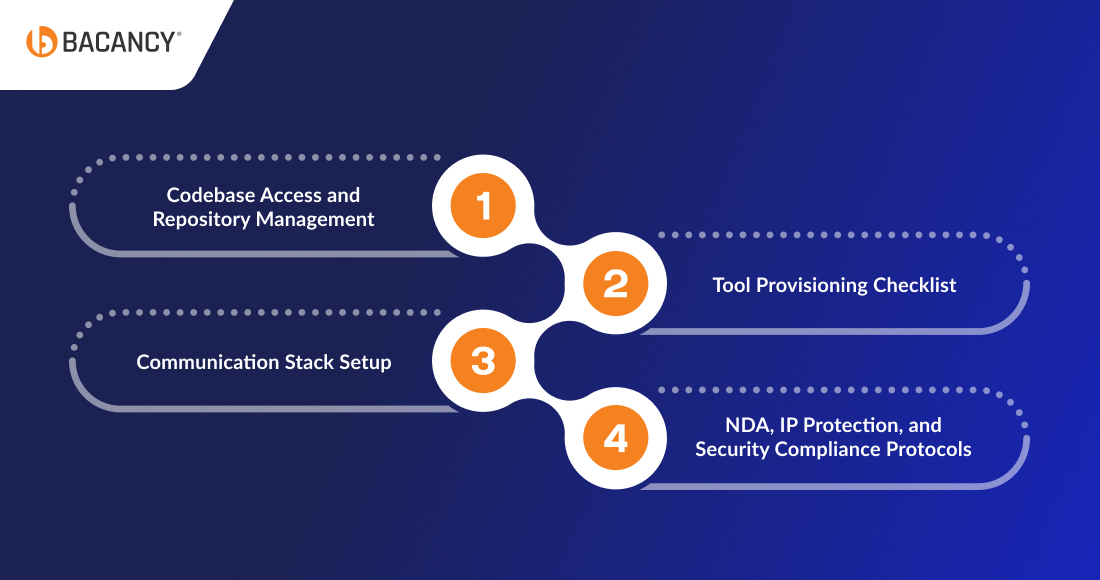
Codebase Access and Repository Management
When you give access to external developers, keep it simple and controlled. It should only have what they need to do their job, nothing more than that.
In most cases, it indicates that you need to provide read and write access to the specific repositories to work on. However, there is no requirement to offer specific admin access to the entire system. You need to keep your branch protection rules as they are, and do not skip pull request reviews just to save time.
In fact, the first pull request is when a proper review matters the most. It is also better to assign access based on roles instead of individuals. If you use GitHub teams or GitLab groups, just add the developers to the right teams. It keeps things organized and makes offboarding much easier, since you can remove their access everywhere in one step.
A standard tool provisioning checklist for the IT staff augmentation onboarding process covers:
- Version control: GitHub / GitLab (with correct team assignment)
- Project management: Jira, Linear, or equivalent (with access to the correct project boards)
- Communication: Slack channels (project-specific, not all-company unless relevant)
- CI/CD pipeline: Read access to pipeline config, trigger access for the relevant environments
- Documentation: Confluence, Notion, or equivalent (project documentation, not HR policies)
- Role-specific tools: Figma for frontend developers, Datadog or similar for DevOps engineers, cloud console read access where applicable
According to the report, several workers report misusing at least 1 tool when they need to do their job efficiently. For an augmented developer, it is a challenge to miss any tool, even if it matters for 1 week, because it directly affects productivity loss.
Communication Stack Setup for Remote and Offshore Augmented IT Staff
An onboarding IT staff augmentation process requires more than adding to Slack or any workspace. The developer needs clarity on how your team actually communicates day to day.
They should know which channels are used for project work and which ones are for general discussion. You must be clear about your expected response times for messages, whenever a standup happens, how they run, and whom to reach out to if they get blocked for more than an hour.
However, if you work with offshore developers or nearshore experts, time zones can overlap, and you need to do proper planning. You need to identify the hours when both teams are available and use that time for real-time conversations.
Outside of that window, you need to make sure everything works smoothly through async communications so that work does not slow down there.
NDA, IP Protection, and Security Compliance Protocols for External IT Contractors
The legal and security of staff augmentation onboarding needs to be completed before work starts, not treated as an administrative afterthought. The core documents required:
- A non-disclosure agreement covering the specific project scope
- An IP assignment clause that confirms code written during the engagement belongs to the client
- A data handling agreement if the developers get access to any customer data or personal identifiable information.
Bring Your Own Device (BYOD) policies for augmented contractors should be explicit. If developers are using personal machines, minimum security requirements (encrypted disk, current antivirus, no local storage of production credentials) should be documented and acknowledged in writing.
Common IT Staff Augmentation Onboarding Failure Points (and How to Prevent Them)
These are the specific points where the onboarding process of IT staff augmentation breaks down most often, and what to do about each one.
1. Unclear Ownership
This is the most common failure in staff augmentation onboarding. The vendor sends the developers. The client assumes the vendor manages them, and the client directs them. The developer gets daily standup attendance, but actually no guidance.
Solution: Fix this before you start it. Assign an internal technical lead with explicit ownership of the augmented developer’s ramp-up for the first 30 days.
Access delays are the most visible and preventable failure in the IT staff augmentation onboarding process. An augmented developer who spends day 1 submitting IT tickets to get information access loses an entire billable day before contributing anything.
Solution: Build a pre-start provisioning checklist with a sign-off deadline of 48 hours before the engagement start date. If access is not confirmed by that deadline, the start date will shift, but not the checklist.
3. No Technical Buddy or Mentor
Without a designated technical mentor or buddy, augmented developers tend to spend time solving problems silently rather than asking questions that would take 5 min to answer. It is a natural behaviour for external contractors who do not yet know whether their questions are appropriate or whether they are expected to figure things out independently.
Solution: Every developer should be assigned a technical expert who helps them to solve problems and address them directly. A formal buddy saves time if they are assigned from day 1.
4. Poor Communication Norms and Time Zone Misalignment
noticed is that the team does not define communication norms among members or individuals. The specific issues are: offshore developers who don’t know whether to wait for a stand-up or send a message. Onshore leads who assume the developers are when in reality they are actually waiting for a response.
Solution: Create a document that mentions the norms, particularly the expected response times, escalation paths, and async-first solutions in the onboarding package.
5. No Defined Onboarding Structure
An organization with structured onboarding can boost productivity among new team members. For augmented IT staff on short engagements, the absence of structure not only slows ramp time but can consume a significant portion of the entire engagement. Without a defined onboarding process, your contribution can leave a negative impact on brand value.
Solution: Map a simple onboarding plan that covers pre-start, day 1, week 1, and month 1. Ensure to define what needs to be completed at each stage, so when you move forward, there is no confusion, and you have clarity.
IT Staff Augmentation Onboarding vs. Full-Time Employee Onboarding: Key Differences
The onboarding IT staff augmentation process is fundamentally different from full-time employee onboarding in ways that matter operationally. Here’s the core difference that helps you as a CTO to make decisions:
| Onboarding Dimension | Augmented IT Staff | Full-time Employee | Insight for CTOs |
|---|
| Time to productive output | 1–4 weeks (ideal: faster with a strong setup) | 4–12 weeks (varies by role and complexity) | Impacts sprint velocity and delivery speed |
| Culture and team alignment | Light and workflow-focused | Deep and culture-driven | Balance between speed and long-term engagement |
| Legal and IP setup | NDA and contractor agreements are set before the start | Covered under employment contracts | Stronger upfront control for contractors |
| Tool and access provisioning | Should be completed before starting, but may vary | Typically completed during onboarding | Delays reduce early productivity |
| Offboarding and exit | Immediate access removal is critical | Managed through HR and notice period | Reduced security and access risk |
Key Operational Difference for CTOs
One of the significant differences is feedback cadence. With full-time employees, you need to assess performance and conduct a review within 60-90 days. The engagements are short, and performance needs to align with sprint cycles from the start.
But for an augmented developer, feedback is quite frequent and happens often every sprint. As a result, you do not have to wait for a quarterly review since the feedback model is already structured.
Metrics to Track Staff Augmentation Onboarding Success
Without any measurement, staff augmentation onboarding is invisible. The following are the 5 metrics that indicate whether your IT staff augmentation onboarding process is working in the right direction.
Time to First Pull Request
Time to first PR is the first concrete indicator that your technical setup is complete, and the developers need to navigate the codebase and contribution workflow. The benchmarks can be measured by the level of the job; for instance, senior augmented developers should hit their first PR within 1-2 days.
Whereas, mid-level developers within 2-3 days and junior developers within 3-5 days. A first PR that arrives in week 2 is a signal that something in the pre-start or day 1 phase failed.
Time to Independent Ticket Completion
To measure the best onboarding IT staff augmentation process, you need a reliable, independent ticket completion process. It is where the developers select, scope, execute, and close a ticket without direction.
It is also one of the best metrics for functional integration into the team. You can target benchmarks, such as senior to 10-14 days to junior developers within the end of the 1 month.
Ramp Time Benchmarks by Seniority Level
Your ramp time expectations should be set before the engagement starts and shared with both the internal technical lead and the developers. Here, the best way to plan a framework is by:
- Senior augmented developer: First independent sprint completion by day 14, full velocity contribution by day 21
- Mid-level augmented developer: Independent ticket ownership by day 21, and consistent sprint participation by day 30
- Junior augmented developer: Supervised contribution through week 2 and first independent ticket by week 3-4, and sprint velocity by day 45
Collaboration and Team Integration Metrics
Apart from the initial ramp indicators, you must PR review the pass rate. For instance, the ratio of PRs that pass review without major revision on the first submission, ticket cycle time, like average time from ticket start to merge, standup participation quality, and feedback from the internal team.
These metrics at the 30-60-90 day mark give a clear picture of whether your augmented developers have integrated or are still operating in isolation.
Bacancy’s IT Staff Augmentation Onboarding Process
When a healthcare company required developers to join rapidly, they expected onboarding to be smooth. Instead, their developer joined a live standup within a few days and started contributing in the first week.
This is possible because Bacancy follows one clear principle. Your sprint should not slow down because a new developer is ramping up. To make this happen, most of the preparation is completed before the engagement even begins.
To make this happen, most of the preparation is completed before the engagement even begins.
What Bacancy Does Before a Developer’s Start Date
Before a developer joins your team, Bacancy ensures they are prepared with the right context and setup.
- A detailed internal technical profile is created based on the developer’s experience and project requirements
- The developer is briefed on the client’s tools, workflows, and expectations
- NDA is completed at the time of contract signing, not on 1st day itself
- A pre-start checklist is shared with the client, covering repository access, tool provisioning, and communication setup
- A clear timeline is followed, so everything is ready at least 48 hours before the start date
This ensures the developer can start work without delays from day one.
Week 1 Deliverables Clients Can Expect
By the end of the first week, Bacancy ensures the developer is already part of your workflow.
- A complete architecture walkthrough is done
- The first pull request is submitted and under review
- The developer actively participates in standups
- Any access or tooling gaps are identified and documented
Each engagement also includes a dedicated Bacancy delivery contact. This is a real person you can reach out to directly if you have any concerns about ramp-up or progress.
How Bacancy Handles Communication and Ramp Tracking
Bacancy plans communication carefully to avoid delays, especially for distributed teams.
- Overlap hours are defined for US and UK clients to support real-time collaboration.
- A clear communication standard is shared, including response times and escalation paths.
- Async communication is structured so that work continues even outside overlap hours.
A structured 14-day check-in is built into every engagement. This helps identify and resolve any onboarding issues early, before they affect delivery.
Conclusion
A well-structured IT staff augmentation onboarding process is what separates a developer who can contribute from 1st day and the one who spends their first week chasing access and missing context. Even the most skilled hire can cost you valuable time without clear direction, proper setup, and team alignment from the start.
You must get the process right, from pre-start setup to first-month milestones; developers must hit the ground running. They need to align rapidly, contribute sooner, and do not quietly slow your sprint down while they figure out how things work. An IT consulting services partner can help you build this structure, identify gaps, and ensure your onboarding process is both practical and effective.
For CTOs and engineering leaders, the value of staff augmentation is not limited to adding headcount. It’s accelerating what your team can actually create, and that only happens when the first two weeks are planned as carefully as the hire itself.
Frequently Asked Questions (FAQs)
Common Onboarding Staff Augmentation
The IT staff augmentation onboarding process is the structured way external developers are integrated into a client’s team, ensuring they can start contributing quickly with the right access, tools, and context.
Onboarding ensures developers understand the project, workflows, and communication norms, which helps reduce delays and improve sprint productivity.
In staff augmentation, onboarding is faster and focused on immediate productivity, while full-time employee onboarding focuses more on long-term cultural alignment.
Pre-Start Phase in Onboarding
Before the start date, access to repositories, tools, communication channels, and project documentation should be fully prepared.
It ensures developers can begin working from day one without waiting for access or setup, which improves delivery speed.
Both the client and the service provider share responsibility for ensuring all onboarding requirements are completed before the start date.
Day 1 Onboarding Activities
Day one focuses on access validation, security guidelines, team introduction, and confirming the developer’s point of contact.
A clear point of contact ensures the developer knows who to approach for guidance, which reduces delays and confusion.
The security briefing should cover handling of credentials, data protection rules, and access control policies.
Common Onboarding Challenges
Common challenges include delayed access, unclear ownership, and poor communication setup.
By completing all setup before the start date and defining a clear onboarding process.
Onboarding fails when there is no structure, no clear ownership, or when access and context are not provided on time.