Quick Summary
AI in staff augmentation is set to reshape the way businesses build tech teams through innovation and automation. This blog covers how it removes manual tasks, closes skill gaps, and helps scale teams rapidly. Most importantly, it ensures you choose the right tech talent at the right time without guesswork. If you are an SME or entrepreneur looking for faster results, this guide is for you.
Table of Contents
Introduction
Top-performing companies no longer rely on outdated methods to build their tech teams. Traditional IT staff augmentation once offered flexibility, but now it leads to delays, mismatched talent, and rising delivery risks.
To stay competitive, 77% of businesses in 2025 prioritize reskilling and upskilling their workforce to work alongside AI, highlighting a clear shift toward AI-powered team structures.
AI in staff augmentation introduces a more accurate, data-driven approach to team expansion. It eliminates manual guesswork and offers real-time insights, helping companies scale faster and with better talent alignment.
This blog explores how this shift is reshaping the industry in 2026 and what it means for forward-looking teams.
Why Does Traditional Staff Augmentation Not Work for SMEs Anymore?
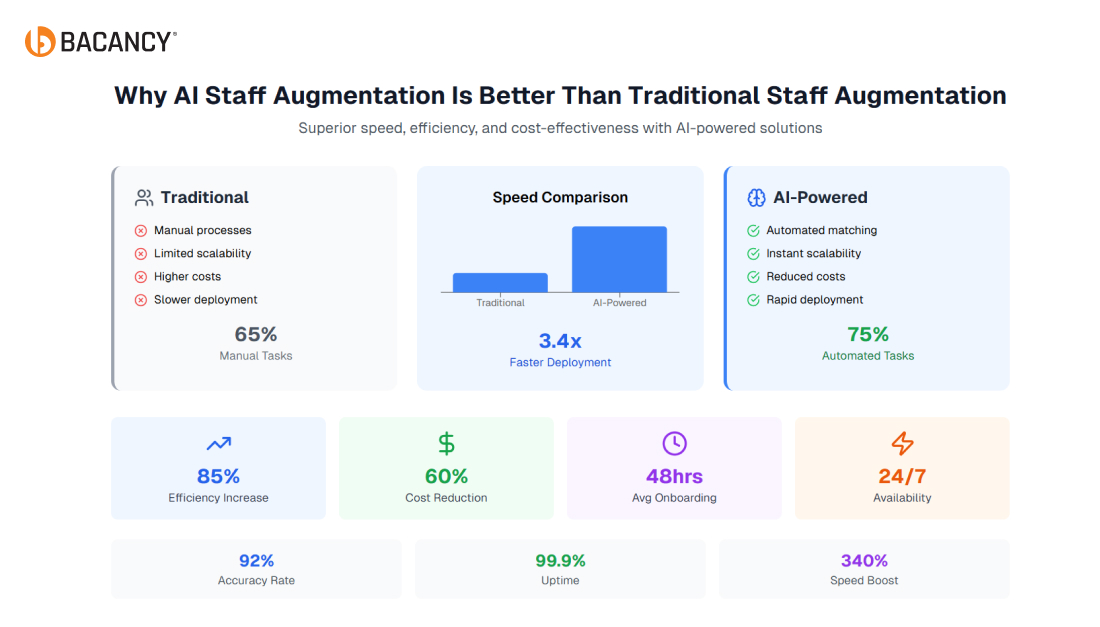
Traditional staff augmentation was built for a slower pace of business. It often involves long onboarding cycles, fixed contracts, and limited control. However, none of these work well for SMEs because they need speed and flexibility.
With fast-changing project needs, SMEs struggle to find talent that fits both technically and culturally. As a result, manual processes and outdated systems delay everything, leading to missed deadlines and wasted resources.
Key reasons why traditional staff augmentation is no longer a choice:
- Slow onboarding and talent sourcing
- Lack of visibility into skill fit or availability
- Rigid contracts with limited flexibility
- Poor alignment with fast-moving project goals
- High dependency on human coordination
Before we discuss how AI transforms staff augmentation, let’s ensure we are all on the same page. First, what is AI in staff augmentation, and its importance?
What is AI in IT Staff Augmentation?
AI in IT staff augmentation uses artificial intelligence to enhance and automate how businesses hire and manage external IT talent. It helps companies find the right candidates faster, forecast project needs, and reduce manual effort in sourcing, screening, and onboarding tasks.
7 Ways AI Is Revolutionizing Staff Augmentation in 2026
AI in IT staff augmentation changes how companies build, manage, and scale their tech accurately and quickly. For small and mid-sized businesses, this shift results in fewer hiring errors, lower ramp-up time, and more control over outcomes. Here’s how AI transforms each stage of staff augmentation efficiently.
1. Faster Talent Match with Smart Profiling
AI collects and compares detailed data points, such as skill level, role-specific experience, code repository quality, and work preferences. It reads between the lines of a candidate’s technical background and past work rather than depending on basic filters like job title or years of experience.
This kind of method helps SMEs avoid the time spent interviewing mismatched candidates. Moreover, AI connects your workflow with the developer’s capabilities in just a few clicks. It reduces early-stage screening to hours rather than weeks and immediately puts the most relevant talent in front of you.
2. Predictive Fit Before the Hire
Hiring a technically sound developer who does not fit your team culture often leads to missed deadlines, friction, or costly replacements. AI uses behavioral data, past team dynamics, communication trends, and task ownership patterns to project how a candidate would perform within your structure.
It predicts how well a candidate will integrate into your team, reduces the risk of friction, drop-offs, or costly rehiring. This predictive insight leads to better long-term fit, smoother collaboration, and more stable teams, without relying on guesswork or trial-and-error placements.
3. Automated Onboarding with AI Support
Most onboarding routines involve manual coordination, follow-ups, and delays. AI reduces that friction by assigning checklists, sharing documents, configuring systems, and setting up access the moment a candidate accepts the offer. It also personalizes each step based on the developer’s background and the project’s urgency.
With automated onboarding, you can save time for your internal team, avoid confusion about the wrong hire, and make the ramp-up phase more productive from the beginning. As a result, it creates a smoother experience and a more efficient workflow.
4. Timely Scaling Through Workload Analysis
Scaling decisions often happen under pressure. You realize too late that your team cannot handle the next sprint or the upcoming deadline. But with AI, you can address this by observing task load, project velocity, and utilization patterns. It identifies workload trends early and alerts you before you feel the resource crunch.
This helps you avoid delivery risks and prevents over-hiring when things slow down. Hence, you can make resource decisions based on evidence. Its predictability improves both cost control and team resources.
5. 24/7 Candidate Evaluation Using NLP & ML
Every team has working hours and regional limits, but AI systems don’t and run continuously. Natural Language Processing and Machine Learning models evaluate resumes, technical assessments, and portfolio links even while your business sleeps.
While you start your day, your AI system already has a curated list of high-fit profiles. It also ensures the suggestions and evaluated profiles are scored on relevance and readiness. This shortens the time to hire developers and expands your reach beyond your time zone or region.
6. Smarter Budget Allocation Through AI Insights
Hiring the right people is essential, but so is knowing where your money goes. Without clear data, it is quite common to overspend on the wrong roles or waste time on channels that don’t deliver.
AI in staff augmentation gives you the entire picture. It shows which positions cost more to fill, which sources actually bring in good talent, and where your hiring budget is stretched. With these insights, you can make smarter decisions, cut unnecessary spending, and focus your efforts where they bring the best return without compromising on quality.
Once a developer joins, AI does not switch off. It watches key patterns like delivery consistency, response time, quality of commits, and feedback loops. These metrics help it understand who performs at peak level and who may struggle with current tasks or team structure.
AI then provides insights, such as moving developers to another module where their skills apply better or prompting support if someone falls behind. It helps you maintain team health, meet deadlines, and avoid performance dips before they impact outcomes.
Struggling to Scale Your IT Team Without Slowing Down Delivery?
Let our IT support company drive your growth with AI-matched talent that hits the ground running.
What are the Top Benefits of Using AI in Staff Augmentation for IT Hiring?
Integrating AI staff augmentation speeds up the hiring process, provides structure, precision, and scalability. As SME owners and entrepreneurs, these benefits help reduce the friction that often comes with traditional recruitment.
Here are the 6 key benefits that show how AI can be used in staff augmentation for modern IT businesses:
1. Quick Access to Qualified Talent
Waiting weeks or months to find the right developer can stall product development and client delivery. An AI staffing agency or platform helps reduce this downtime by maintaining a pool of pre-vetted, role-ready candidates.
As soon as a requirement is defined, the system can almost instantly identify suitable matches based on skills, availability, and project relevance.
This speed is especially useful for SMEs that operate on tight deadlines or need to ramp up quickly after closing new contracts. You no longer depend solely on traditional outreach or traditional job boards, saving time while keeping your project momentum intact.
2. Candidates Who Fit the Role from Day One
A good hire has technical ability, relevant domain experience, understanding of similar project scopes, and the ability to blend into your workflow. With AI in IT staff augmentation, you can evaluate profiles using a broader set of data, project history, coding patterns, communication styles, and even soft skills.
This leads to better alignment between the candidate and your expectations. Instead of spending weeks onboarding someone who’s still getting up to speed, you gain a contributor who understands your stack and starts delivering actual value early in the engagement.
3. Teams That Scale with Your Business Needs
Hiring is not always predictable. You might need two frontend developers today and a cloud architect next month. AI in staff augmentation makes it easier to adjust your team size based on active demand.
Whether you want to launch a new feature, enter a new market, or just scale down post-deployment, this approach supports flexible engagement without long-term contracts.
This level of responsiveness gives you an operational edge. You can pursue new business confidently, knowing that the right talent is available and easily accessible when needed, without overburdening your internal team or infrastructure.
4. Lower Recruitment and Operational Costs
Traditional hiring processes involve multiple layers, such as posting jobs, screening resumes, coordinating interviews, negotiating offers, and handling documentation. Each of these steps requires time and manpower.
When these tasks are automated through AI systems, your business saves significantly on recruitment overheads.
Beyond the hiring phase, you also avoid costs tied to bad hires or prolonged onboarding. With higher-quality matches and smoother handovers, projects run more efficiently, with fewer delays and budget overruns.
5. Better Hiring Decisions Through Data and Insights
Selecting the right candidate often involves a lot of guesswork, especially for non-technical founders or lean HR teams. AI in staff augmentation can help remove that uncertainty by offering insights that go beyond resume bullet points.
You get access to analytics on previous project success, technical assessments, collaboration ratings, and team compatibility.
These data points allow for more objective decision-making. You’re not choosing based on a gut feeling but on actual signals that predict long-term performance and fit. This lowers the risk of hiring mismatches and contributes to a more stable, productive team environment.
6. Reduced Workload for Your Internal Teams
Hiring usually puts extra pressure on your HR, leadership, or technical team, especially when roles need to be filled quickly. With AI handling the time-consuming parts of the process, your internal staff stays focused on their primary responsibilities.
Through AI staff augmentation, resume sorting, interview coordination, skill verification, and documentation can all proceed with minimal human involvement.
This benefit compounds over time. With less time spent on hiring logistics, your team can invest more energy into delivery, strategy, and client outcomes, where their time adds the most value.
Real-World Example: How Bacancy Scaled 5x Faster with AI-Augmented Hiring
When Bacancy needed to scale its tech team rapidly for parallel fintech and healthcare projects, the traditional hiring process couldn’t keep up. The goal was clear: build a 20+ member team in under 30 days without compromising on skill or delivery timelines.
To meet this demand, Bacancy turned to an AI-backed staff augmentation approach. Instead of relying on manual sourcing and screening, the model enabled:
- Rapid access to developers already vetted for role-specific needs
- Early prediction of team fit and delivery potential
- Automated onboarding steps that removed internal HR delays
The impact of AI staff augmentation was clear:
- Team scaled 5x quicker compared to prior hiring cycles
- Time-to-hire reduced by 68%
- Developers became project-ready within 3 days
This shift proved that AI speeds things up when applied to staff augmentation and improves accuracy, fit, and operational efficiency across the board.
How to Get Started with AI Staff Augmentation
Getting started with AI-powered staff augmentation is easier than it sounds. Follow these steps to transition smoothly and maximize rapid workflow:
Step 1: Define Your Hiring Needs Clearly
Start with your requirements of roles, tech stack, domain knowledge, and expected timelines. This clarity helps AI tools deliver high-accuracy matches instead of generic suggestions.
Step 2: Choose the Right Staff Augmentation Partner
Look for a provider that combines AI with IT-backed services and understands your goals and objectives, technical abilities, and team gap. Also, understand behavioral insights, skill validation, and team-fit prediction to match your goal.
Step 3: Access a Pre-Vetted Talent Pool
Work with a partner who already maintains a curated developer network. AI works best when it can access clean, structured data across portfolios, code samples, and performance history.
Step 4: Review Candidates with Data-Backed Context
Go beyond resumes. Use AI-generated insights to understand how a candidate aligns with your team culture, project pace, and communication style, before you even schedule an interview.
Step 5: Onboard with Automation and Speed
Once you have selected a candidate, let the system handle onboarding steps like access setup, documentation, and task allocation. This reduces admin load and allows the developer to contribute better.
Step 6: Monitor, Adapt, and Scale as Needed
AI can help you track performance and adjust your team composition post-hire. Whether you are scaling up or reallocating, AI speeds up and makes resource planning more informed.
Power Up Your Growth with the Right AI-Driven Talent Partner
Building the right tech team is no longer about hiring rapidly, but it has now become about making the right decisions, at the right time, with the right data. AI in staff augmentation brings structure to that process, helping companies reduce delays, avoid hiring mismatches, and stay ahead of delivery goals.
But implementing technology is just one step toward success. You need a partner who understands your pace, your challenges, and what’s at stake when timelines slip or talent falls short.
At Bacancy, we follow an innovative approach to scale your business. Our IT staff augmentation services combine real-world experience with AI-backed precision to connect you with developers who fit, technically, functionally, and efficiently.
If you are planning to grow your team and want to do it with more clarity and control, we’re here to help you get there faster and better.
Frequently Asked Questions (FAQs)
Yes, that’s one of the biggest advantages. AI-powered staff augmentation is flexible. Whether you need talent for a 2-month MVP or a year-long platform build, it allows you to scale up or down as your needs change.
Yes. AI tools can analyze thousands of profiles, resumes, and project outcomes faster and more accurately than manual screening. It matches candidates by skills and performance history, availability, and cultural fit, which helps reduce hiring mistakes.
AI automates resume screening, skill assessments, and shortlisting. What typically takes weeks in traditional hiring can be done in days, sometimes even hours, making it ideal for startups or growing teams with urgent project timelines.
Absolutely. AI eliminates many administrative overheads, like job posting, initial screening, and repeated interviews, saving both time and money. Moreover, through AI staff augmentation, you are more likely to onboard the right person the first time, which reduces costly turnover.
AI in staff augmentation faces challenges, such as algorithmic bias, privacy concerns, complex system integration, and employee resistance to change. It also depends heavily on the quality of data.
The future of AI in staff augmentation is driven by intelligent automation, predictive talent analytics, and real-time skill matching to build agile, scalable teams. AI will likely replace manual screening with data-driven insights, reduce hiring time, lower costs, and improve workforce quality.