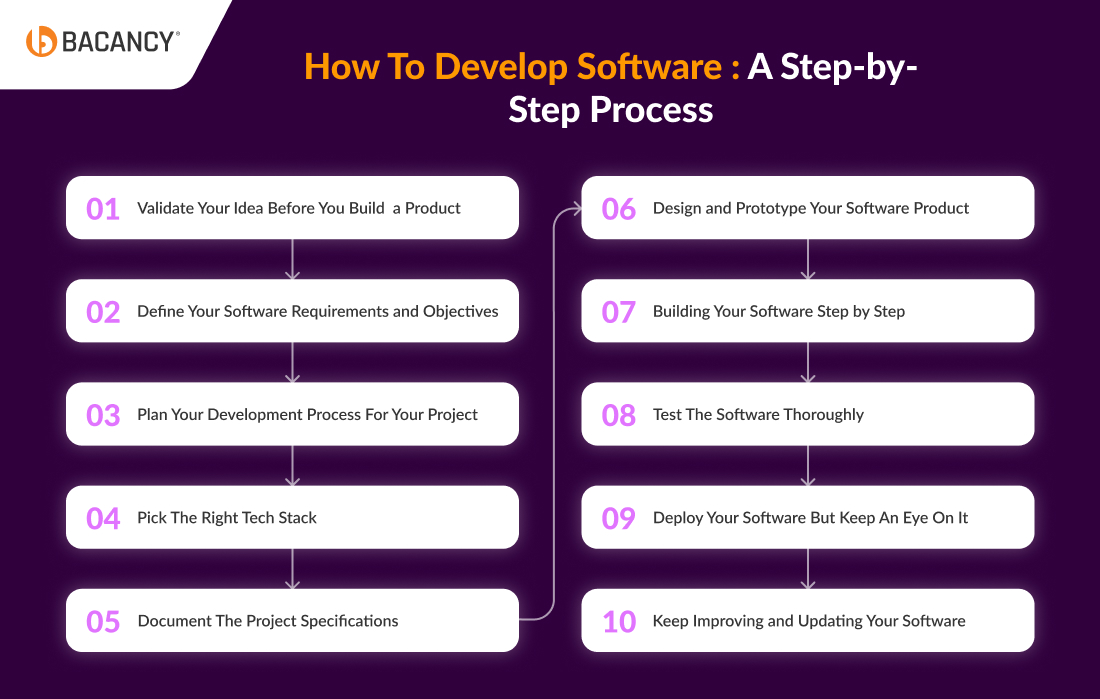
3. Plan Your Development Process For Your Project
Once your software idea and requirements are clear, the next step in understanding how to build a software is creating a strategic development plan. This phase involves defining the scope of your project, setting realistic milestones, and building a roadmap to ensure smooth execution. In this stage, defining the project scope can break down the development process into manageable tasks to avoid unnecessary hurdles later on. Businesses can outline the entire project scope with deliverables and case-specific KPIs, along with defining the software application type, be it mobile apps, web applications, or desktop apps that they want to develop.
- Define Your Project Scope: Businesses need to clearly outline the features, functionalities, and limitations of the software product they want to develop.
- Set Milestones and Deadlines: It will be better to establish achievable milestones and timelines to make sure the development process stays on track.
- Create a Strategic Roadmap: Prepare a strategic and well-structured plan of software development with all the details of each and every step associated with building software, from prototyping to deployment.
4. Pick The Right Tech Stack
Choosing the right tech stack is one of the most critical decisions when learning how to build a software. That is because your software’s performance, scalability, security, and overall development cost will directly depend on the tech stack you choose. It involves selecting the right programming languages, frameworks, libraries, and tools that will best suit your software’s requirements and scalability goals. On the other hand, making the wrong choice can result in unnecessary complications, higher costs, and reduced software quality.
- Assess Your Project’s Needs: You need to assess your project’s needs and consider factors like scalability, performance, security, and compatibility when you are selecting the right tech stack for your software development.
- Evaluate Popular Technologies: Research the latest frameworks, libraries, and AI tools for software development, and LLMs for software development that can speed up coding, automate testing, or optimize performance.
- Consult Experts: It would be better to consult with software development experts about which tech stack, frameworks, databases, cloud services, or software development tools to select to build your software product.
5. Document The Project Specifications
Before diving directly into the development process, it is crucial to document your software requirements thoroughly. The purpose behind this step is you or anyone else can refer to the documentation as the project blueprint guiding the entire development process. Documenting the project specifications can ensure all stakeholders are on the same page. Also, on the other hand, you can avoid possible misunderstandings and scope creep due to properly documented specifications.
- Create A Software Requirements Specification (SRS): You can prepare an SRS to better outline functional and non-functional software development requirements and use cases.
- Define System Architecture: Along with a well-defined system architecture, you should map out how various components of the software will interact with each other. Also, you should plan which functions to prioritize and which integrations to carry out.
- Establish Acceptance Criteria: To create successful software & implementation, you need to clearly define an efficient set of criteria for your development team to follow.
6. Design and Prototype Your Software Product
In this phase, the design and prototyping of the software product take place as per your vision. The software design and prototype development team will make sure to transform your software product ideas into visual representations and functional models. The team will prepare the software design, so you have a clear understanding of the user interface, user experience, and overall navigational flow of your software before the actual implementation begins.
- Create Wireframes and Mockups: Businesses can visualize the structure and layout of their software’s interface even before it is actually developed.
- Develop Prototypes: You can build interactive, powerful prototype models to validate user experience and functionality so that it will be feasible to refine the software product until it’s up to the mark.
- Gather Feedback: Developing a prototype model is beneficial as you can share it with the stakeholders and gather valuable insights to improve the design, functionality, or user experience before building the finalized product.
7. Building Your Software Step by Step
The development process actually begins in this phase. This is the step where developers combine their capabilities, skills, expertise, and know-how to build a software product. It involves writing clean, maintainable code based on your project specifications and design. It will be beneficial if your development team follows coding best practices, utilizes version control systems, and keeps track of progress with the help of project management tools.
- Set Up Your Development Environment: Companies should configure their tools, repositories, and version control systems to maintain consistency and track progress effectively.
- Follow Coding Standards: Encourage your developers to adhere to industry standards and maintain a clean, modular codebase that can be easily modified or scaled.
- Implement Features Incrementally: You should guide your development team to build software components one by one, testing and refining them to avoid overwhelming complexities during integration and facilitate easier testing and debugging.
Build Your Dream Software With Professional Experts
Hire software developers who have the skills, experience, and technical proficiency to turn your half-baked ideas into efficient, secure, and scalable software for your enterprise.
8. Test The Software Thoroughly
No software product can be said to be completely finished without thorough and proper testing. Knowing how to build software means ensuring your software functions as intended and meets the standards and criteria set during the planning phase. By following a rigorous testing process, enterprises can easily detect flaws in the software before deployment and ensure a smooth user experience.
- Conduct Various Testing Types: The QA team or software testers perform unit testing, integration testing, system testing, and user acceptance testing (UAT) to identify bugs and ensure seamless functionality.
- Automate Testing Where Possible: It will be advantageous to utilize automated testing frameworks similar to testRigor wherever possible to save time, improve accuracy, and enhance test coverage for your software.
- Fix Bugs and Enhance Performance: With rigorous testing, developers can address issues as they arise and continuously refine the software to improve its efficiency and usability.
9. Deploy Your Software But Keep An Eye On It
After successfully developing and testing your software, this step is all about launching the software and making it live for your end users. However, deployment is not a one-and-done process, as it is quintessential to continuously monitor the software product to make sure it runs smoothly and efficiently. With consistent monitoring, your software can meet user expectations and function without any errors after deployment.
- Deploy To The Desired Platform: Enterprises can select the most appropriate environment for their software deployment based on their needs and goals, whether it’s cloud-based, on-premise, or a hybrid solution.
- Monitor Software Performance: Developers can utilize cutting-edge monitoring tools to track key metrics like uptime, response time, user interactions, and overall performance.
- Implement Feedback Loops: Post-deployment of your business software, it is essential to continuously collect user feedback to identify potential improvements or issues that require immediate attention.
10. Keep Improving and Updating Your Software
Building software is more than just writing code once. Understanding how to build a software means planning for continuous updates, improvements, and evolving user needs. To keep your product relevant, efficient, and aligned with evolving business needs, regular maintenance, iteration, and software quality assurance are crucial.
- Update Your Software Regularly: Whether it’s adding new features, enhancing existing functionalities, or fixing bugs, businesses are advised to ensure their software remains up-to-date in terms of security, features, and performance.
- Adapt To Changing Market Demands: Make sure your in-house team continuously monitors user feedback for your software along with current industry and market trends to refine the software accordingly and keep it relevant.
- Optimize Performance: To deliver a flawless user experience and make your users satisfied, regularly reviewing and enhancing your software’s performance is what leads your business toward sustainable success and growth.
Read more in detail about: Cost of Hiring a Software Developer
Challenges in Building Software from Scratch and How Bacancy Solves Them
Building software from scratch is not easy. Knowing how to build a software requires careful planning, technical expertise, and the right team. Businesses often face challenges that can slow progress and affect the quality of the final product. Here are the top challenges you may encounter when building a software product, and how a professional software development company can help.
⚠️ Balancing Features With User Experience
Businesses often try to include every feature idea at once, making software development complex and confusing for users. Too many features can slow adoption and reduce satisfaction.
✅ Bacancy’s Solution:
We focus on core features that deliver real value first. By mapping user workflows, we ensure each function solves real problems, and add extra features gradually based on real usage.
⚠️ Connecting To Legacy Systems Is Tricky
New software often needs to connect with older CRMs, ERPs, or accounting systems. Without careful planning, this can cause data errors, mismatches, or slow down performance.
✅ Bacancy’s Solution:
We audit your existing systems, build custom connectors, and thoroughly test data flows. This ensures smooth, reliable software integrations without any disruptions to ongoing operations.
⚠️ Building for Real-Time Data and Scalability
Applications that work well for a small group of users may fail when handling hundreds of concurrent users or large datasets. Many businesses need to calculate the complexity well when it comes to scaling.
✅ Bacancy’s Solution:
We design cloud-ready architectures, implement caching strategies, and optimize databases for real-time processing. This ensures software performs reliably even under heavy usage or data spikes.
⚠️ Technical Debt and Messy Code
Rushing development can lead to messy code and hidden bugs that slow down future updates. Over time, these issues make adding new features risky and increase the chance of system failures. Proper coding practices are essential to avoid these pitfalls.
✅ Bacancy’s Solution:
We follow modular coding practices, maintain clear documentation, and use automated testing. This reduces errors, ensures clean code, and makes future enhancements safe, predictable, and faster to implement.
Read more in detail: How To Reduce Technical Debt in Software Development
⚠️ Handling Multiple Platforms and Devices
Users expect software to work seamlessly on desktops, tablets, and mobile devices. Many projects fail when responsiveness is overlooked, creating inconsistent experiences and user frustration.
✅ Bacancy’s Solution:
We build responsive designs, adaptive layouts, and conduct thorough cross-platform testing. Users enjoy a smooth, consistent experience on any device without functional or visual issues.
Essential Checklist To Follow When You Build Software From Scratch
Now, you must understand how to build a software from scratch and how essential it is to follow a meticulous planning and execution approach. To make it easier for you, we have curated a quick checklist for entrepreneurs, business owners, and decision-makers to keep your journey on the right track and ensure efficient software delivery.
| Pre-Development Essentials | Post-Development Essentials |
|---|
| Clearly define your software idea and validate it through market research.
| Thoroughly test your software for bugs and usability issues.
|
| Document all software requirements and specifications.
| Deploy the software to your chosen platform (cloud, on-premise, or hybrid).
|
| Plan your project timeline, budget, and milestones.
| Continuously monitor software performance and gather user feedback.
|
| Choose the right technology stack that suits your business needs.
| Ensure data security, compliance, and regular audits.
|
| Design prototypes and wireframes to visualize your product.
| Implement updates, fixes, and enhancements based on user feedback.
|
| Prepare a scalable architecture that can grow with your business.
| Maintain effective communication with stakeholders and end-users.
|
| Establish acceptance criteria for the software development process.
| Keep refining and optimizing your software for better performance.
|
Conclusion
The process of creating a software product from scratch is indeed extensive and requires not only meticulous strategic planning but also technical skill and expertise, along with continuous maintenance and refining as per industry and market trends. By going through our guide on how to build a software solution, any business or enterprise can follow it to develop high-quality software that helps them grow exponentially and achieve success.
In case you need expert assistance in developing software or want to hire well-experienced software developers, consider partnering with a leading software development company. Their immense expertise in the software development industry and top-notch developers can help turn your vision into a software product for your startup, business, or enterprise.
Frequently Asked Questions (FAQs)
Validating your software idea means confirming people actually need it before building it. Talk to your target users to understand their pain points, and analyze competitors to spot gaps. Create a simple prototype or proof of concept to gather feedback early. This approach saves time, reduces costs, and ensures your solution truly solves a real problem.
Well, the cost or expenses of developing a software product from scratch primarily depend on multiple factors, such as your software needs, project scope, complexity, resources required, technical expertise, design requirements, and even the development stage. The cost of developing simple software with basic features and functionalities might range between $10,000 to $70,000, depending on your project needs. While a more complex and customized software development may cost around $50,000 to $400,000 or more. It is best to connect with professionals to get an accurate cost estimation.
The development timeline may vary depending on your project’s complexity, scope, features, integrations, service location, and even development methodology. Building a scalable, high-performing, and feature-rich software that meets industry standards and compliance can take 8 to 20 months, depending on your specific business needs and goals.
You should choose a programming language or tech stack based on your software’s requirements, scalability, performance, use cases, and other crucial factors. Some popular choices include Python, Java, JavaScript (with frameworks like React and Node.js), C#, Ruby on Rails, and more. It will be beneficial to get assistance from technical experts to determine the best programming language, frameworks, and tools to develop a software for your business or enterprise.