Quick Summary
Custom build software is a strategic investment for enterprises looking to optimize operations, enhance customer experiences, and stay competitive. But if you are unsure about how it works or whether it’s right for your business, this blog covers the key benefits, types of custom built solutions, real-world examples, and practical tips to choose the right development partner for creating software tailored to your unique needs.
Table of Contents
Introduction
In today’s digitally-evolving world, every business or organization has unique needs and goals. Different industries face different challenges and workflows, which makes one-size-fits-all software less effective.
As companies embrace digital transformation, most rely heavily on software to manage day-to-day operations, from customer relationships to internal processes and data analysis. While off-the-shelf software may seem like a quick and affordable solution, it often lacks the flexibility and customization required to truly optimize your business operations.
Investing in custom build software can address these needs and deliver solutions tailored to your organization. Whether you are in manufacturing, healthcare, finance, or any other industry, custom build software can give you a competitive advantage.
The global custom software development market was estimated at USD 43.16 billion in 2024 and is projected to reach USD 146.18 billion by 2030, growing at a CAGR of 22.6% from 2025 to 2030. (source)
If you are considering investing in custom-built software, now is the perfect time to explore its benefits. But before diving in, let’s start with the basics.
What is Custom Build Software?
Custom-build software is a digital application designed and built specifically to meet the unique needs and purposes of any business or organization. Customized software solutions are developed with the intention of fulfilling the requirements and overcoming the challenges an enterprise faces. Dissimilar to off-the-shelf software, which is created to serve a broader audience with generic features, a customized solution is built from scratch or modified extensively to align with particular business objectives.
When it comes to custom-made software, all the features, functionalities, user interfaces, layouts, and interactions, everything can be customized to serve a specific purpose. For example, if we talk about a retail business, they should build an inventory management system that can be seamlessly integrated with their POS system. While banking firms need secure bespoke software to manage their customer data and financial transactions. All in all, any business or organization, regardless of their size, can build custom software to serve their specific goals and purposes.
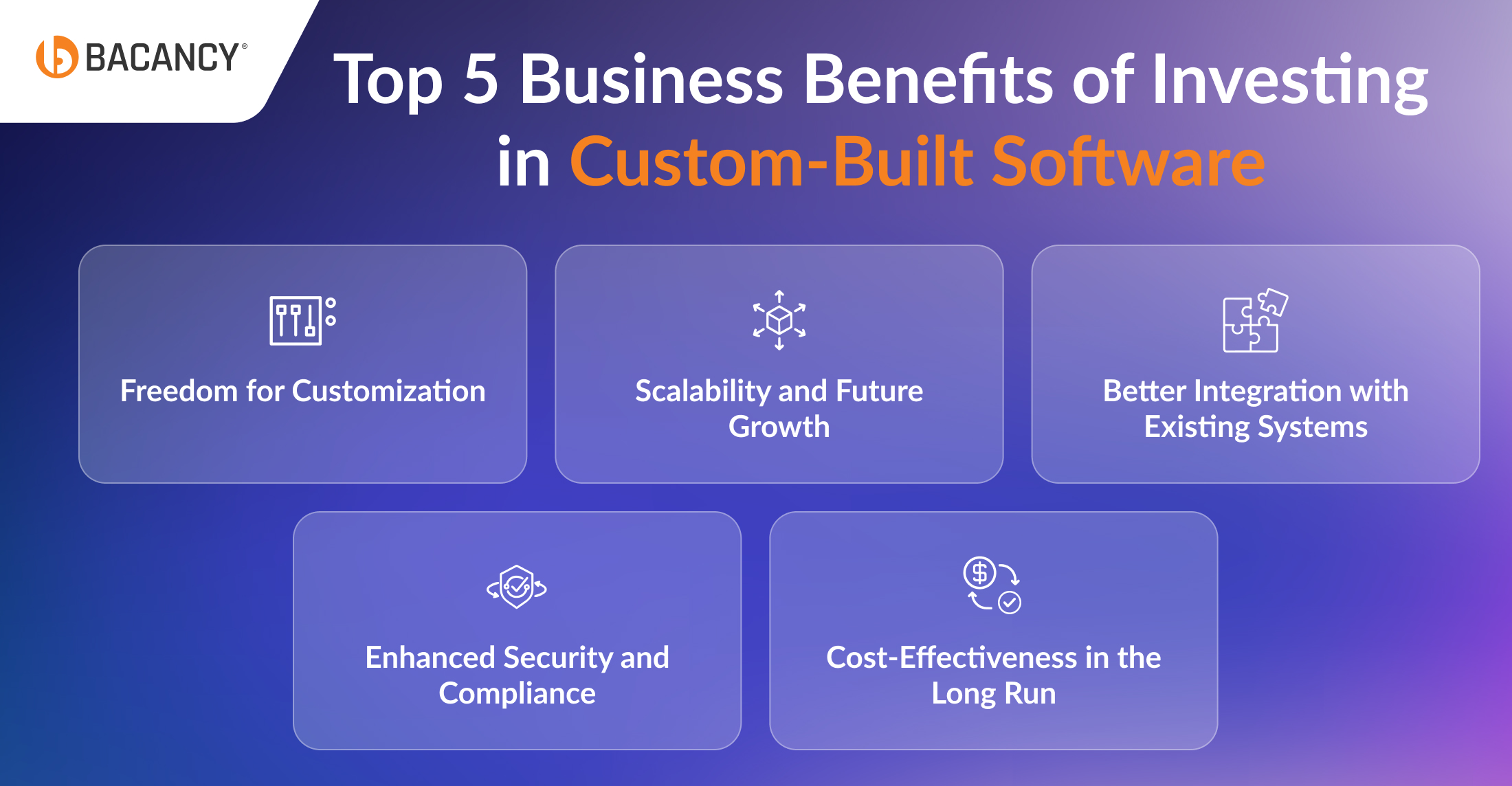
Top 5 Business Benefits of Investing in Custom-Built Software
More businesses are choosing custom built solutions because off-the-shelf tools often fall short of real operational needs. When software is designed around your exact workflows, it simply works better and delivers stronger results. Here are the key business benefits that make custom-built software a smart long-term choice.
1. Freedom for Customization
One of the primary advantages of custom-built software is the complete freedom that businesses get to customize every aspect of the software. This includes personalizing the functionality, user interface, and overall design to match the software perfectly with its specific workflows, processes, and branding. Custom software does not limit itself to pre-defined features or functionalities. Hence, businesses would not have to go through frustrations and workarounds for any missing features.
2. Scalability and Future Growth
As businesses tend to grow, their software development requirements evolve as well. While ready-made solutions do not provide the flexibility to scale as your business grows, which can often result in operational inefficiencies and increasing costs. On the other hand, relying on custom software solutions can provide you with the scalability businesses need to adapt and expand without any hassle.
3. Better Integration with Existing Systems
Many businesses rely heavily on software applications to manage their operations and processes. By using custom-built software applications, businesses can ensure seamless integration of different systems, APIs, and tools with existing platforms, whether it’s a CRM, ERP, or any other third-party software. This approach eliminates data silos, reduces the risk of manual errors, and enhances workflow automation.
4. Enhanced Security and Compliance
For instance, companies operating in the healthcare, financial, and e-commerce sectors, which deal with sensitive data, need to have full control over security mechanisms, access controls, and data encryption. This can be possible with the help of a personalized software solution. They can benefit from advanced security features and compliance measures that are designed based on their industry-specific regulations, such as GDPR and HIPAA, among others. This is especially important for companies that are looking for an effective way to solve all their problems.
5. Cost-Effectiveness in the Long Run
When we are talking about building custom software, it is sure that expenses are an important aspect that can have a significant impact. The initial cost of developing bespoke software might be higher as compared to ready-made software available. However, once the customized solution is deployed completely, it can provide numerous advantages, such as minimizing recurring costs, providing more control over maintenance costs, and reducing the risk of vendor lock-ins.
Get Scalable and Personalized Solutions For Your Enterprise
Hire software developers who have proven technical proficiency and experience to build customized, high-performing software designed to deliver for growth and success.
Types of Custom-Built Software
Custom-built software comes in many forms, each designed to solve specific business challenges. These solutions offer tailored features that match unique workflows and goals. Here are the main types of custom-built software that enterprises can choose from based on their needs.
1. Content Management Systems (CMS)
The first custom-built software type that we are going to discuss is the Content Management System (CMS), which is popular among organizations using websites for their business growth and to reach their target customers. With custom CMS solutions, organizations can get enhanced flexibility, security, and SEO optimization as compared to generic, ready-made CMS platforms.
Key Features:
- Customizable content templates and layouts
- Multi-user access with role-based permissions
- SEO and metadata optimization
- Supports workflow and content categorization
- Secure and scalable architecture
- Integration with marketing automation tools
2. Customer Relationship Management (CRM)
Customer Relationship Management (CRM) software allows businesses to track their consumer and prospect interactions, referrals, sales pipelines, and vendors for marketing departments. With a custom CRM system, it becomes easier for enterprises to keep tabs on prospective customers and monitor sales performance, everything from a single place. Additionally, CRM solutions can automate various processes and provide features that personalizes user experience.
Key Features:
- It helps to store customer information including names, addresses, and other data
- Automated sales and follow-up processes
- Custom reporting and analytics dashboard
- Track interactions to document communications with customers
- Multi-channel customer communication
- It can be easily integrated with emails and other interactive tools
3. Enterprise Resource Planning (ERP) Systems
A well-designed ERP system can make managing daily operations a piece of cake for the enterprise. From accounting and risk management to supply chain operations and inventory management, building custom ERP systems helps stakeholders manage numerous processes and tasks from a centralized system. An ERP system is a perfect example of custom software as it centralizes and streamlines business operations, benefiting various departments like finance, HR, supply chain, and customer service.
Key Features:
- It provides customizable dashboards for real-time insights
- Offers capabilities to analyze and monitor data-driven tasks
- Helps automate financial reporting and invoicing processes
- Enables employee performance tracking and HR automation
- Allows efficiently manage every aspect of sales and revenue for your business
4. Operations Management Software
With the help of Operations Management Software, enterprises can optimize a wide range of business processes, streamline workflow automation, and enhance overall efficiency as well as productivity. It’s a kind of custom-built software designed with the sole purpose in mind, and that is to ensure optimal operational efficiency and generate the best possible outcomes for customers.
Key Features:
- Provides real-time monitoring and analytics for better decision-making
- Task and project management tools to reduce operational bottlenecks
- Tools and features for better inventory planning and tracking
- Automated scheduling and workflow automation
- Integration with IoT, AI, machine learning, and such next-gen technologies
- Custom alerts and notifications for critical issues and better workflow control
5. Enterprise Software Solutions
Enterprise software solutions are what organizations with large-scale operations seek to effortlessly manage core business processes and boost productivity. With bespoke enterprise software, organizations can get the benefit of online payment processing, interactive product catalogs, automated billing systems, and security. Such customized solutions can help address industry-specific challenges, from compliance requirements to complex workflows. Go for customized enterprise solutions if you want to get a reliable all-in-one solution designed to cater to your industry-specific needs.
Key Features:
- Freedom to customize modules as per inter-departmental needs
- Helps in tracking, analyzing, and reporting business data efficiently
- AI-powered automation and predictive analytics
- Better employee management and performance analysis
- Offers a scalable and cloud-based infrastructure
Real-Life Examples of Companies Using Custom Software
Custom software development can indeed be the way you can transform your business challenges into opportunities. Here are some of the enterprises that have been excelling with the use of custom-built software.
McDonald's
Opting for custom build software, McDonald’s indeed took its customer experience to the next level with self-service kiosks and contactless payment systems. With the help of this custom software, the fast-food industry titan not only improved their order efficiency but also increased sales, reduced wait times, and streamlined dine-in and drive-thru operations.
Netflix
Netflix, the renowned streaming giant, has been taking advantage of its customized software to collect a massive amount of data and understand its customers’ viewing preferences, interests, and behavior. This streaming platform offers a personalized user experience and serves customers better through AI-powered recommendation systems.
Amazon
Amazon is indeed a perfect real-life example of how the company became the world’s largest online retailer through its custom-built software solutions. From AI-driven recommendation engines to warehouse automation systems, Amazon has been optimizing customer experience, streamlining operations, and enhancing efficiency. Its strategic use of custom software indeed transformed online shopping and improved customer retention.
Uber
By investing in custom-built software, Uber, a multinational transportation company, succeeded in providing exceptional experiences to drivers and riders alike. Through developing an intelligent dispatch system, Uber allows its riders to match and interact with the nearest driver available. It ensures a safe, smooth, and joyful ride experience for everyone through helpful navigation systems.
How To Choose The Right Partner To Build Custom Software Solutions?
Choosing the right partner to build custom developed software is one of the most important decisions for any growing business. A skilled development team ensures that your custom designed software is built correctly, meets your unique requirements, and supports long-term success. Here are the key factors to consider when selecting the right software development partner:
- Industry Experience and Expertise:
It will be advantageous for you to select a software development company that holds notable experience and unmatched expertise in the industry. So, they have the right experts who can understand your business challenges and address your custom build software needs.
- Technical Proficiency: Make sure to have a questionnaire ready to determine the expertise of your development partner. They should be proficient in core technologies, cutting-edge frameworks, and software development methodologies suited for your project.
- Portfolio and Case Studies: Have a glance through their past projects, success stories, and client testimonials to deduce their capabilities and potential to deliver world-class, custom-built software.
- Development Methodology: Before selecting a partner to develop customized software, you should make sure that they follow an agile software development methodology or any other proven methodologies and how they are going to keep you in the loop with the project updates.
- Scalability and Flexibility: Your partner for custom build software should be able to scale resources and solutions as your business or organization evolves. They should always be ready to adapt to your evolving project needs and offer ongoing support.
- Security and Compliance: You should know their approach to data security, regulatory compliance, and industry standards, before entrusting them with your project ideas, needs, and goals. The partner you select to develop bespoke software should follow security best practices and adhere to industry-specific compliances and regulations.
- Cost and Value: Do not haste when selecting a companion for building custom made software. Focus on the value you get in terms of quality, innovation, and credibility rather than just considering the cheapest option available.
Conclusion
It is certain that investing in custom build software is a smart and strategically advantageous move for businesses, regardless of their size, to upscale their productivity, enhance operational efficiency, and stay competitive. With custom-built software, businesses can ensure seamless adaptability, sustained scalability, and strong security.
Whether you are a startup or a large-scale enterprise, personalized software can be the future-proof solution that can streamline workflows and drive your business toward success. Partnering with a custom software development company can help businesses get the needed expertise, skills, and technical proficiency to build custom software solutions.
Frequently Asked Questions (FAQs)
Building custom-made software solution can significantly enhance efficiency, scalability, and productivity by providing personalized features and functionalities that align with specific business goals and addresses partticular challenges.
The time it takes to develop customized software will primarily depend on the complexity of the project, required features, team expertise, and customization needs. It can take around a few weeks for simple applications to several months for building a more complex custom-made software.
Customized software solutions are designed to seamlessly integrate with the existing systems, tools, databases, and third-party applications as well. It can be flawlessly connected with your existing business systems, which can facilitate smooth workflows and data consistency.
Well, the cost of building a customized software solution will entirely be subjected to your specific project requirements, scope, complexities, resources required, and development time. On an average, building simple software with basic features may cost around $30,000 – $100,000. While the cost of developing a more complex, customized software solutions may range around $100,000 to $300,000, depending on your particular software development needs.
Custom-built software is essential for long-term growth because it evolves with your business. As processes and customer needs change, the software can be upgraded to support new workflows, integrations, and features. This adaptability boosts scalability, eliminates reliance on rigid off-the-shelf tools, and helps businesses stay competitive.
Custom CRMs, ERPs, workflow automation systems, and project management tools offer strong customization options. They let businesses tailor features, add modules, integrate with existing systems, and adjust functionality as they expand. This keeps the software aligned with evolving operational needs without forcing teams to adapt to generic limitations.