Last Updated on February 3, 2026
Last Updated on February 3, 2026
Quick Summary
This blog post explains what Vibe Coding is, the principles behind it, and the tools that make it work. It is designed for founders, product leaders, and developers who want to understand how to leverage AI-driven software development to build custom, scalable solutions faster, more efficiently, and at a lower cost, while streamlining workflows and integrating seamlessly with existing systems.
Table of Contents
Running a small startup or a growing business always comes with its own set of unique challenges. You may have a brilliant idea that could change the way your business operates, but when you look for tools, you end up paying for multiple SaaS subscriptions that don’t fit your exact needs.
Your CRM may not match your workflow, an automation tool feels too limited, and productivity apps rarely adapt to how your team works. Traditionally, the only way around these gaps is to hire developers, pay for several subscriptions, and then adapt your business processes to the limitations of those platforms.
Well, not for Vibe Coding! It is more than just writing code. It helps you plan, visualize, and use the right combination of tools to build software exactly how you want. Instead of adjusting your business to fit rigid platforms, you can create workflows, automate tasks, and build solutions that truly meet your needs.
The ability to build custom software without spending a lot on development makes Vibe Coding more than just a special method; it points toward the future of software development and how businesses will build solutions in the years ahead.
In fact, the growing interest in AI-powered coding tools reflects this shift, with the market expected to expand from $15.11 billion in 2025 to $99.10 billion by 2034 (source), growing at a compound annual rate of 23.24 percent.
Vibe Coding is the natural next step in this evolution: fast, flexible, and vision-driven. But before we dive deeper, let’s understand the basics and how to actually get started with it.
Vibe Coding is a modern approach to AI-driven software development using large language models (LLMs). Rather than manually writing every line of code, you simply describe your requirements in clear, structured language, and the AI generates the corresponding code.
It means you are not limited to pre-built templates or drag-and-drop tools. Even with basic coding knowledge, you can build solutions that are tailored to your exact needs.
Let’s understand this with a vibe coding example,
Imagine you run a small event management business and need a simple tool to manage bookings, send reminders, and track payments. On platforms like Zoho, you might have to pay separately for each module, and customization options are often limited.
However, with Vibe Coding, you can use a tool such as Base44 to set up your booking system. In just a few steps, you have a fully functional, customized software solution built around your exact needs.
The core principle of Vibe Coding is clarity of vision. Without knowing your problem and what your ideal solution looks like, it is impossible to build effectively. This is why Vibe Coding for beginners can feel overwhelming if you only want to experiment. Instead, this approach is designed for those ready to map out their goals and translate them into structured solutions.
The best way to start is by building a minimum viable product (MVP). Focus only on one feature that solves your biggest problem. Once it is working, you can expand with new modules. This step-by-step approach allows small businesses to grow their software ecosystem without heavy upfront investments.
This also explains, in many ways, the difference between vibe coding vs traditional coding, where the focus shifts from writing every line of code to clearly defining the vision and letting AI bring it to life.
To get the best out of Vibe Coding, you need more than just the right tools; you need the right way of thinking. These vibe coding principles form the foundation of this approach, guiding how you think, plan, and communicate with AI.
Vibe coding starts with clear, structured thinking. You must have a defined vision of what you want AI to build. You need to decide:
Example: Let’s understand how our Base44 developers at Bacancy built a financial operations app using Base44, a Vibe Coding platform. Here is everything you need to be clear about!
When planning the app, you have to decide on key aspects such as:
AI can only deliver what you want if it knows your goals. A Product Requirements Document (PRD) acts as a blueprint, showing AI your rules, expectations, and objectives.
Think of the PRD as a structured way of communicating your vision to AI. It doesn’t need heavy technical details but should outline goals, rules, and expectations.
This is about understanding the foundation of your project. You need to decide:
Within the Same Example:
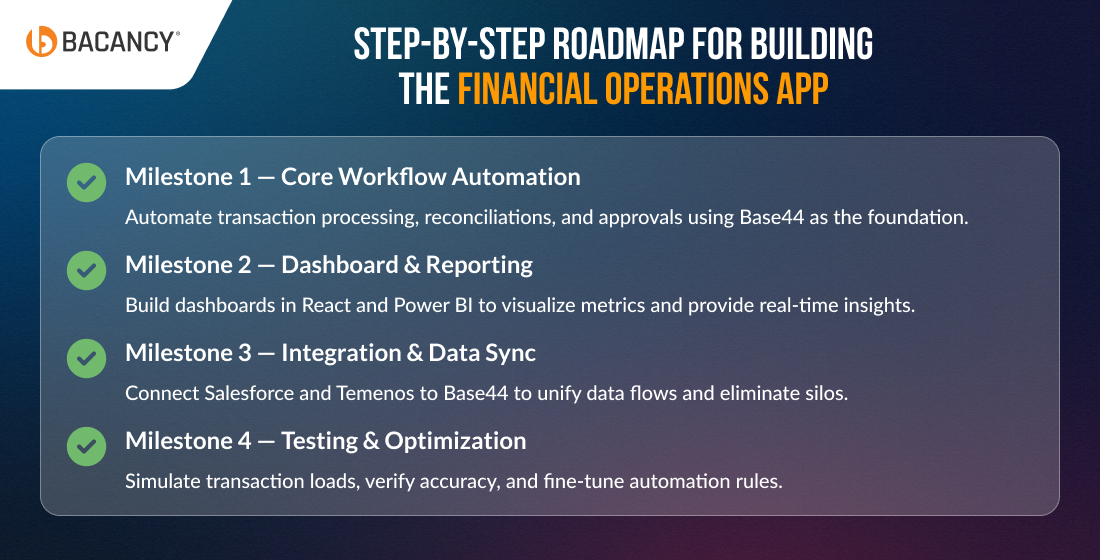
The financial operations platform automates transactions, reconciliations, and approvals. Its goal is to make processes faster, more accurate, and provide actionable insights through real-time dashboards.
Key features include:
This keeps operations efficient, accurate, and easy to manage.
Analytical thinking breaks the system into smaller, manageable parts. To do this effectively, you need to decide the key aspects of the system and the skills required to implement them.
Translate plans into code. Here, you decide how the system will actually work programmatically.
For our financial platform example, computational thinking involves deciding:
To make this easier to follow, here’s a simple step-by-step roadmap showing how the app can be built stage by stage:
Procedural thinking is about optimizing performance and outcomes.
You need to decide:
Together, these levels ensure the AI understands not just what to build, but how to build it effectively.
Guiding AI to use the right frameworks helps produce faster, more accurate, and efficient results.
For example, for the dashboard example, you could specify:
Like traditional coding, vibe coding also requires checkpoints. Always use version control; Git + GitHub is a reliable choice, so you can track changes and roll back if needed.
Ensuring your AI-generated code works reliably is critical. At every stage, Vibe Coding solutions should undergo thorough vibe testing and other quality checks, including, including:
This step guarantees that your final software is not only functional but also robust, secure, and ready for real-world use.
Make sure your app is reliable and safe. Don’t just test if it “works,” test if it’s secure.
Example:
This way, your dashboard is not only useful but also protected.
In vibe coding, context is everything. The more details you provide, the closer AI can reach your intended outcome.
The more details you provide, the more efficient results can be obtained. You can specify:
You can also share mockups, workflow diagrams, or detailed descriptions of financial processes. The richer the context, the more accurately AI can generate code that matches your vision.
Vibe Coding makes sure your data is never lost by combining backups, recovery options, and version control into the development workflow. Here’s how it works:
Every code update can be saved in GitHub or GitLab. If your Salesforce dashboard stops working after a change, you can restore the last working version quickly.
In Base44, each feature is linked to credits. If a workflow, such as invoice approvals, fails, you can restore the module from the last stable version without rebuilding it completely.
Business data such as transactions, bookings, or customer records can be backed up automatically in cloud storage like AWS S3, Azure Blob, or Google Cloud. This makes recovery straightforward in case of loss.
When syncing platforms like Salesforce and Temenos, errors can affect reporting or transactions. Recovery points allow you to restore data from the last safe state instead of losing progress.
Backups are encrypted, and only authorized users can restore them. For example, finance managers can access invoice recovery, while other roles have restricted permissions.
Your app or database can be restored within minutes of a system error, human mistake, or failed automation. This reduces downtime and ensures business continuity.
With these practices in place, Vibe Coding ensures that nothing gets lost and that your apps, workflows, and data remain secure, recoverable, and always ready to use.
Vibe Coding works best when paired with the right tools. These platforms take care of the repetitive and complex tasks so that you can focus on your vision.
Base44 is a credit-based platform where each credit can be used to create a module or feature. It makes planning and execution straightforward because you can track resources as you build.
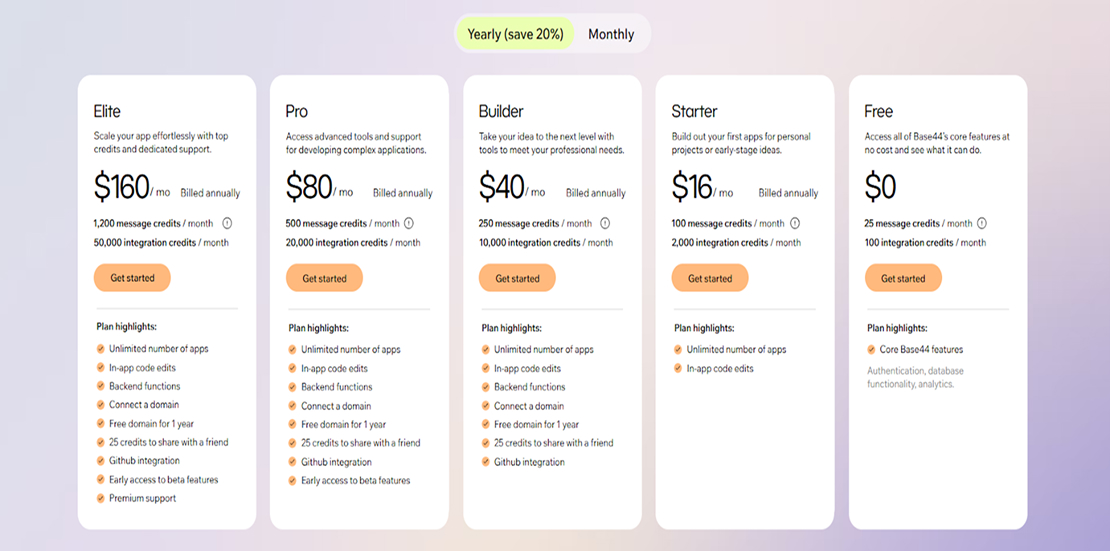
Source: (Base44 Pricing, Last Updated Date and Time: 26-09-2025, 14.33 UTC)
With its structured credit system, Base44 is particularly useful for teams seeking predictable delivery and cost efficiency. If you want to accelerate your next project, hire Base44 developers at Bacancy who can help you bring clarity, structure, and speed to your next project.
Lovable is an AI-powered automation platform that eliminates repetitive coding tasks. Instead of writing boilerplate code repeatedly, developers can use Loveable to generate reusable blocks, freeing up time to focus on innovative features and user experience.
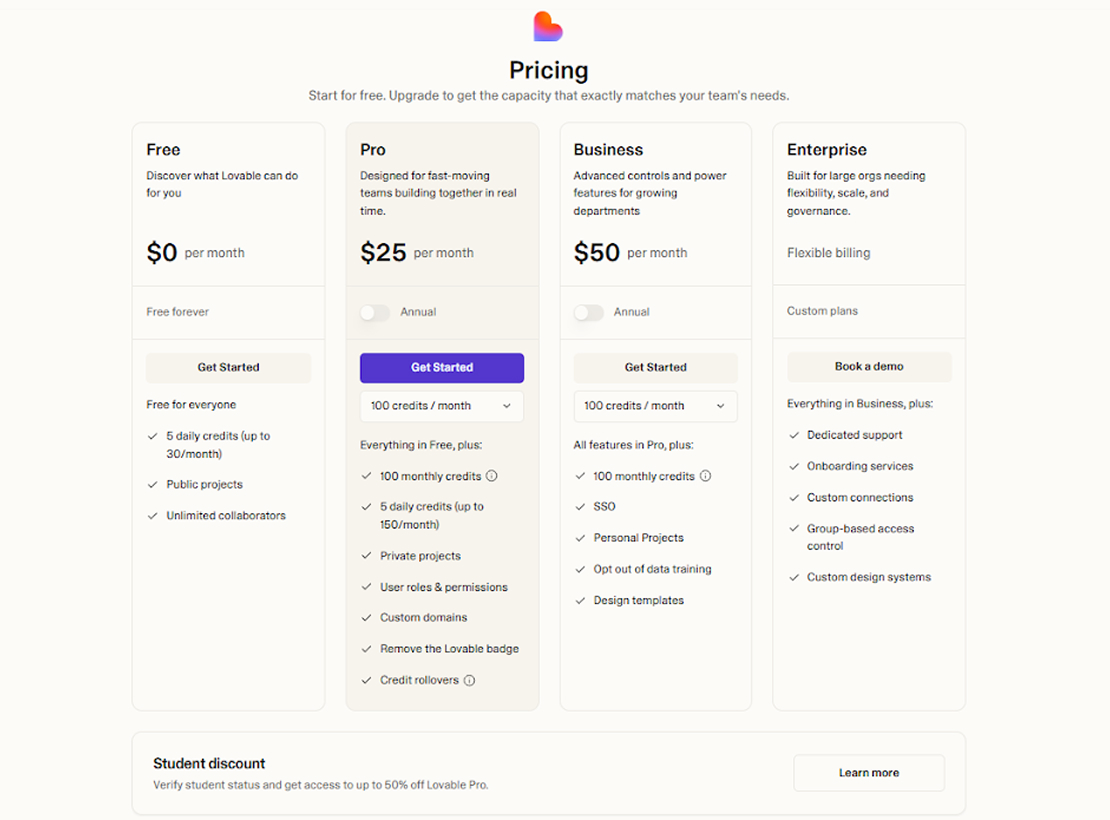
Source: (Lovable Pricing, Last Updated Date and Time: 26-09-2025, 14.33 UTC)
This dramatically improves productivity and reduces errors in everyday development workflows. For teams aiming to move faster, you can hire Lovable developers to make the most of this automation-first approach.
Bolt.new is a seamless integration platform designed to connect different software modules effortlessly. It ensures that all system components communicate and function together without the need for excessive custom coding.
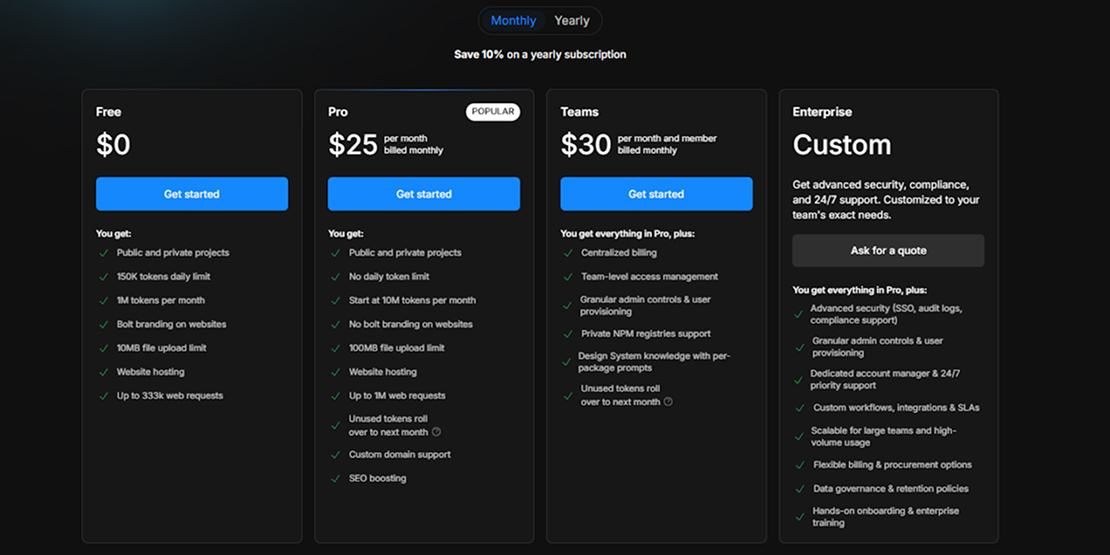
Source: (Bolt.New Pricing, Last Updated Date and Time: 26-09-2025, 14.33 UTC)
This means less time debugging integrations and more time delivering value to users. If your project relies on multiple moving parts, you can hire Bolt.new developers to streamline workflows and achieve smooth system interoperability.
Vibe Coding is not just about building apps; it is about connecting them to your existing tools and systems. Seamless integrations make your software more powerful, efficient, and automated. With Vibe Coding, you can:
1. Connect CRMs and Business Systems – Sync your app with Salesforce, HubSpot, or Temenos to manage customer and financial data directly.
2. Leverage Cloud Storage – Store backups, transaction records, or customer data securely in AWS S3, Azure Blob, or Google Cloud for fast recovery.
3. Enable Real-Time Analytics – Integrate dashboards with Power BI, Tableau, or similar tools to gain actionable insights instantly.
4. Automate Workflows – Connect with automation platforms like n8n, Zapier, or Bolt.new to trigger actions across multiple apps without extra coding.
5. Communicate Effectively – Send alerts and updates automatically via Slack, Microsoft Teams, or email to keep your team in the loop.
By integrating your Vibe Coding solutions with other platforms, you ensure smooth data flow, automated processes, and faster decision-making. Whether syncing multiple business tools or extending your app’s capabilities, integrations keep your software ecosystem connected, efficient, and ready to scale.
No matter what AI tool or platform you use, every system has a credit limit, even free trials. These seven core tips from Bacancy show you how to get more done with fewer credits while building software using Vibe Coding tools like MIRO, Base44, and Lovable.
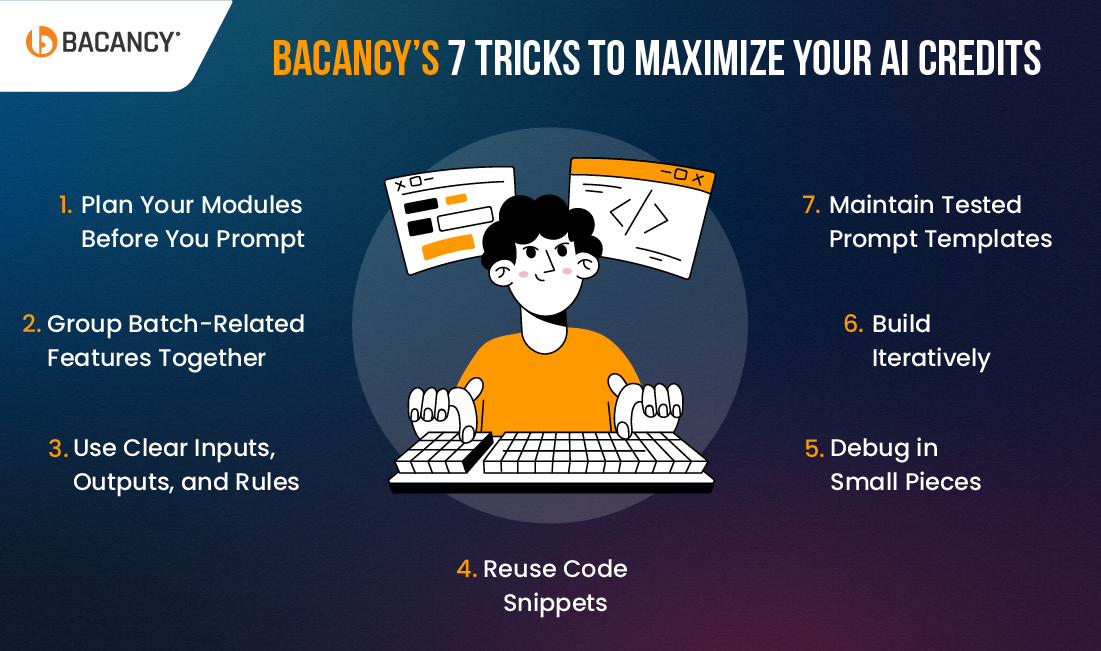
Before asking AI to generate code, create a detailed mind map of your entire project. Skipping planning may lead to an AI output that doesn’t fit your system, causing multiple retries and wasting credits.
How to do it practically:
Instead of sending separate prompts for UI, logic, and validations, combine related tasks into a single prompt. This keeps AI focused on the bigger picture and produces more consistent results.
How to do it practically:
Vague instructions make AI guess what you want, often producing incorrect results. Providing explicit examples of inputs, outputs, and edge cases helps AI generate accurate code on the first try. This technique is part of basic prompt engineering, where you design prompts carefully so the AI understands exactly what to deliver.
How to do it practically:
Hire Vibe Coding developers at Bacancy who can turn your vision into fully optimized, ready-to-use software.
If AI has already generated a function or module, do not ask it to start from scratch. Reusing and tweaking existing code is faster, cheaper, and saves credits.
How to do it practically:
When code does not work as expected, share only the problematic part instead of the full module. This keeps AI focused, saves credits, and reduces time spent on analysis.
How to do it practically:
Start with a minimum viable product (MVP) and add features gradually. Large modules are more error-prone, and building step-by-step allows you to correct mistakes early and save credits.
How to do it practically:
When a prompt works well, save it and reuse it. Structured, well-phrased prompts give better AI results, reduce trial and error, and save credits over time.
How to do it practically:
Through our Vibe Coding services, we help businesses turn complex ideas into fully functional, AI-driven software tailored to their unique needs. Every solution is built around your vision, ensuring flexibility, scalability, and efficiency.
How we make it happen:
Low-code tools give you pre-built templates and drag-and-drop features, but they often limit customization. Vibe Coding lets you describe exactly what you want in plain language, and the AI builds code tailored to your needs, giving more flexibility and control.
You don’t need to be an expert programmer to use Vibe Coding, but having some basic coding knowledge helps. Even non-developers can map out workflows and ideas while AI generates most of the code, and developers can refine or extend it further.
Yes, Vibe Coding is not just for experiments or prototypes. Businesses are already using it to build booking systems, finance dashboards, and workflow automation tools that connect with platforms like Salesforce, HubSpot, or cloud storage.
While it is popular among startups because of its cost-effectiveness, larger companies also benefit from Vibe Coding. Enterprises use it to create quick MVPs, automate internal workflows, and test new software ideas without committing to long development cycles.
Vibe Coding is ideal if you need a custom solution that existing SaaS tools don’t fully provide. If you have clear goals and want to move faster without building everything from scratch, it’s a great choice. For highly complex, niche systems, traditional coding may still be better.
Some popular tools include Base44 for structured credits and workflows, Lovebale AI for automating repetitive coding tasks, and Bolt.new for seamless integrations. These tools help you build, connect, and optimize applications quickly without heavy manual coding.
Yes, applications built with Vibe Coding can scale as your team and customer base expand. By integrating with cloud platforms like AWS, Azure, or Google Cloud, you can handle more data, users, and features while keeping costs predictable.
Instead of hiring a large team or paying for multiple SaaS subscriptions, Vibe Coding lets you build exactly what you need with fewer resources. The AI handles most of the heavy lifting, and you only spend time refining and customizing features.

Tech Geek at Bacancy
Tech-focused writer specializing in innovation, AI, and cloud frameworks.
MORE POSTS BY THE AUTHOR
Your Success Is Guaranteed !
We accelerate the release of digital product and guaranteed their success
We Use Slack, Jira & GitHub for Accurate Deployment and Effective Communication.