Quick Summary
This blog explains how staff augmentation for cybersecurity helps organizations to quickly access skilled security professionals, improve existing teams, and handle growing security demands without long hiring cycles. Along with the operational benefits, we also discuss contractor vetting, compliance considerations, engagement models, and the true cost comparison between augmented staff and full-time hires.
Table of Contents
Introduction
Cybersecurity teams are under growing pressure as threats become more advanced, yet organizations continue to struggle with a shortage of skilled professionals.
According to the 2025 ISC2 Cybersecurity Workforce Study, 95% of organizations report at least one cybersecurity skills gap, and 59% describe those gaps as critical or significant. The pressure is no longer just about finding bodies; it’s about finding the right specialized skills in time.
Staff augmentation for cybersecurity offers a secure solution by allowing businesses to quickly onboard experienced security experts on demand. In this blog, we explore how it works, where it adds the most value, and why it has become a preferred approach for modern security teams.
What is Cybersecurity Staff Augmentation?
Staff augmentation for cybersecurity rents specialized security capacity into your existing team while you keep control of tooling, process, and accountability. External security professionals integrate into your security organization, report to your internal leadership, work within your toolchain, and follow your incident response and change management procedures. The provider supplies the people; you direct the work.
This control distinction is what separates the model from the alternatives, and it’s why the comparison below matters more than any benefits list.
How It Compares to MSSP, Consulting, and Direct Hiring
Each model competes for the same security workloads and resolves a different tradeoff between speed, control, cost, and accountability.
| Aspects | Staff Augmentation | MSSP | Consulting | Full-time Hire |
|---|
| Authority | CTOs/Business Owners
| Provider | Consultant | CTOs/Business Owner
|
| Tooling | Business Owner
| Provider’s SOC and platform
| Businesses | Business Owner
|
| Contract Length
| Weeks to 18+ months
| Multi-year service contract
| Defined project scope
| Permanent |
| Cost structure
| Hourly or monthly rate
| Service fees, often per asset or seat
| Fixed fee or T&M
| Loaded salary plus benefits
|
| Speed to productivity
| 1 to 3 weeks
| 4 to 8 weeks onboarding
| 2 to 6 weeks scoping
| 60 to 90+ days
|
| Best for
| Time-bound, capacity, specialization
| 24x7 operations
| Independent assessments, defined deliverables
| Long-term operational roles |
The MSSP model chooses when you need continuous service-level outcomes that you don’t want to operate yourself, like 24×7 monitoring. Prefer consulting when you need an independent voice for an audit, a red team exercise, or a strategic assessment.
A full-time hire is for steady-state operational roles that you will need for several years. Staff augmentation for cybersecurity wins everywhere in between, especially when you need to retain the playbooks, runbooks, and detection logic that get built during the engagement.
Need Expert Guidance On Staff Augmentation for Cybersecurity?
Our IT staff augmentation services place pre-vetted security specialists into your team in weeks, with structured access controls and contract terms built for regulated work
When Staff Augmentation for Cybersecurity Works and When It Doesn't
Staff augmentation for cybersecurity works for time-bound, capacity-driven, and specialization-gap workloads where the CTO needs to retain control and institutional knowledge. It fails when the workload requires continuous operational service, independent assurance, or internal leadership that the organization doesn’t yet have.
The matrix below maps the most common security workloads to the engagement model that fits each one.
| Security Workload
| Best-Fit Model | Why It Doesn’t Work
|
|---|
| SOC 2, ISO 27001, or HIPAA audit preparation
| Staff Augmentation
| Time-bound, control-sensitive, knowledge needs to stay in-house after the audit
|
| Incident response surge
| Staff augmentation or consulting
| Sudden capacity need; choose based on whether the playbook stays with you
|
| 24x7 SOC monitoring
| MSSP | Continuous service-level outcome, tooling-heavy |
| Cloud migration security architecture
| Staff augmentation
| 3 to 9 months specialized capacity, deep integration with your engineering team
|
| Penetration test or red team engagement
| Consulting
| Independence is required for the deliverable to carry weight
|
| vCISO or fractional security leadership
| Staff augmentation
| Sustained advisory role with team management responsibility
|
| Vulnerability remediation backlog
| Staff augmentation
| Capacity-driven work that uses your tools and ticket queues
|
For cloud migration security work in particular, augmentation pairs well with our cloud consulting services when the workload spans architecture, security controls, and migration execution.
DevSecOps and AppSec roles often sit at the intersection of security and engineering, where DevOps services and embedded security contractors solve different parts of the same delivery problem.
When Staff Augmentation Is the Wrong Call
There are a few scenarios where CTOs may choose a different engagement model over staff augmentations. The following are the core reasons:
- When you need 24/7 monitoring without an internal SOC, augmentation offers you contractors; an MSSP with a tested service with established detection logic, escalation paths, and tooling.
- When you require an independent assurance. Audits, third-party assessments, and team engagements need independence between the implementer and the assessor. Staff augmentation will blur that line in a way that regulators and acquirers flag.
- When you want to miss internal security leadership, augmented contractors need a CISO, security director, or technical owner inside the organization to direct their work and integrate their output. Without that anchor, even strong contractors drift, and the engagement degrades into expensive freelancing.
For audits, third-party assessments, and strategic security roadmap work, our IT consulting services provide independent assessment capability with the skilled auditors and acquirers expected.
Which Cybersecurity Roles to Augment, and What Each Engagement Typically Looks Like
There are 8 cybersecurity roles that account for the majority of staff augmentation engagements at mid-market and enterprise companies. Each one comes with a different workload trigger, typical engagement length, and a contract structure.
| Role | Workload Trigger
| Typical Engagement Length
|
|---|
| vCISO | No internal CISO, board reporting required, audit prep underway
| 6 to 18 months
|
| Cloud Security Engineer
| Cloud migration, IaC security gap, multi-cloud posture work
| 3 to 9 months
|
| DevSecOps Engineer
| Secure SDLC build-out, security embedded in dev sprints
| 6 to 12 months |
| SOC analyst (L1, L2, L3)
| Follow-the-sun coverage gap, internal SOC capacity surge
| 3 to 12 months
|
| Incident responder
| Active incident, post-incident remediation, forensics support
| 2 to 8 weeks
|
| Penetration tester
| Annual test, pre-launch assessment, M&A diligence
| 2 to 6 weeks
|
| GRC consultant
| SOC 2, ISO 27001, HIPAA, PCI, NIS2 prep
| 2 to 6 months
|
| Threat intelligence analyst
| Sector-specific threat coverage, M&A diligence, executive protection
| 3 to 9 months
|
Two Roles That Don't Augment Well
A full-time CISO and junior security analyst do not augment well. A CISO with fiduciary responsibility requires board accountability, equity alignment, and continuous presence that contractor structures don’t provide. Till then, a vCISO works for you.
On the other hand, junior analysts don’t augment because the entry-level cybersecurity work depends on mentorship, internal context, and time to build pattern recognition. Augmented contractors are paid to arrive productive, which makes them an expensive way to train the next generation of your security team.
How to Vet Cybersecurity Contractors and the Providers Behind Them
Certifications alone are a weak signal in cybersecurity hiring. The strongest predictors of contractor quality come from a two-layer evaluation: the individual contractor’s role-specific capability and the provider firm’s compliance posture and operational track record.
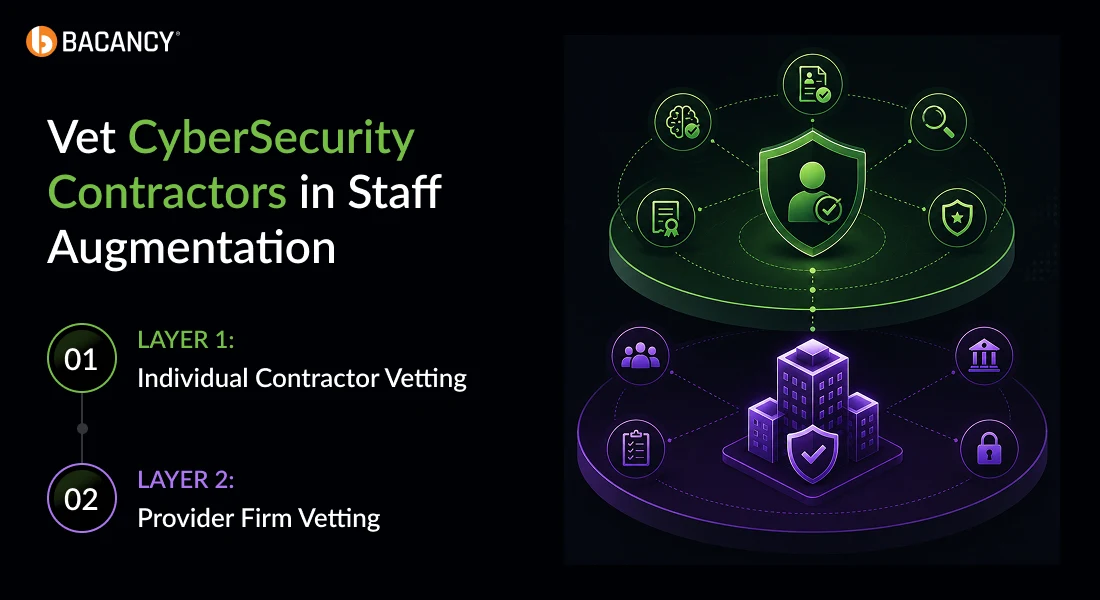
Layer 1: Individual Contractor Vetting
Different security roles correlate with various certification signals, and matching the credential to the role is the first check.
| Role Type
| Certifications That Correlate
| References Signals
|
|---|
| vCISO and security leadership
| CISSP, CISM, CRISC
| Board-level reference work and regulatory audit experience
|
| Offensive Security
| OSCP, OSCE, GPEN
| Public CVE history, conference talks, published research
|
| Cloud Security
| CCSP plus AWS, Azure, or GCP security specialty
| Cloud-native architecture reference in your provider’s environment
|
| GRC and Compliance
| CISA, ISO 27001 Lead Auditor, CIPP
| Audit deliverables under named frameworks
|
| SOC and detection engineering
| GIAC GCIH, GCFA, GMON
| Detection rule contributions, threat hunting case studies |
For a cloud security contract, you need an IaC review exercise. Whereas an incident response requires a timed triage scenario with realistic log data. Coming to an offensive security contractor, an attack-path mapping exercise on a simple environment.
Reference work in your specific industry, regulatory framework, and tooling stack carries the most weight. A HIPAA-experienced GRC consultant who has never worked in cloud-native environments will struggle on a healthcare engagement, regardless of credentials.
Red flags during vetting include generic resumes that don’t name specific tools or frameworks, refusal to provide client-side references, vague engagement histories with no measurable outcomes, and unwillingness to complete a hands-on exercise.
Layer 2: Provider Firm Vetting
On another layer, the provider firm’s compliance posture carries as much weight in procurement as the individual contractor. Buyers in regulated industries reject providers who cannot show the right certifications, regardless of the talent on offer.
The procurement-grade questions to ask every provider include the following:
- Do you hold SOC 2 Type II and ISO 27001 certifications?
- Are you willing to sign Business Associate Agreements for HIPAA work and Data Processing Agreements under GDPR or DPDP?
- What is your background check standard and certification verification process?
- What replacement guarantees apply if a contractor underperforms or leaves mid-engagement? What is your typical ramp speed from contract signature to first productive day?
- Can you support both time-and-materials and outcome-based contract structures?
The answers separate providers built for regulated cybersecurity work from generalist staff augmentation shops with a security badge added to the website.
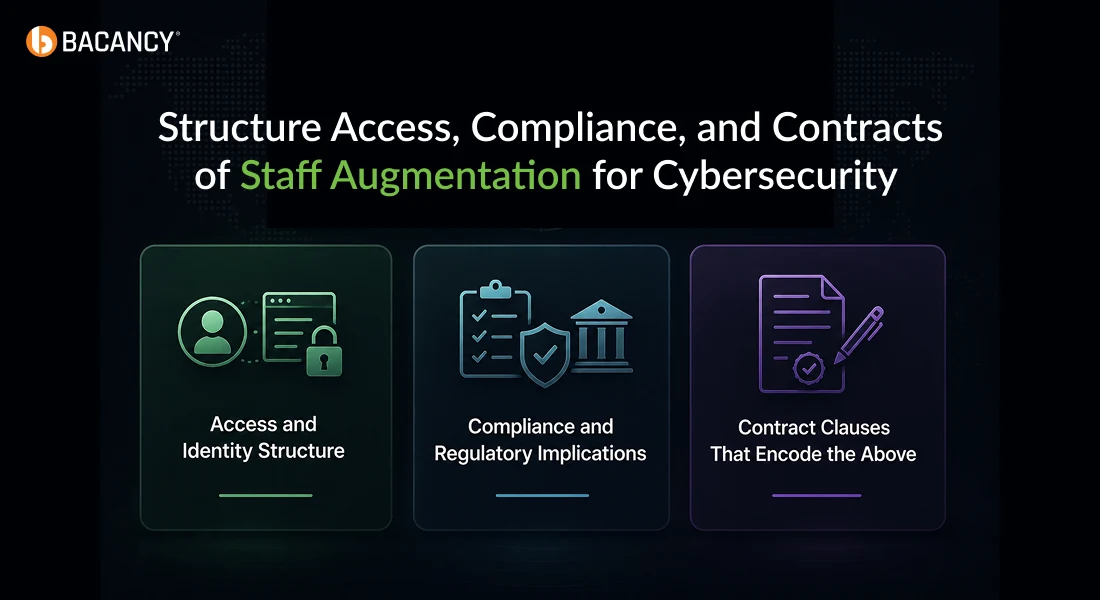
Structuring Access, Compliance, and Contracts for Augmented Security Staff
An augmented security professional gets the same privileged access as your internal team, and the difference in employment does not change the insider-threat profile. A CTO’s job is to encode access discipline, regulatory requirements, and contract terms that protect businesses from the first day of the engagement.
Access and Identity Structure
Least-privilege access is the foundation of the cybersecurity staff augmentation model. A contractor account should follow just-in-time elevation patterns, with time-boxed credentials scoped to the specific systems and particular tasks.
A contractor sits in the same identity provider as internal staff, but with a clear naming convention and automated lifecycle policies that revoke access at the engagement end.
While authentication standards should mirror internal staff: single sign-on with conditional access policies, hardware-key multi-factor authentication for production environments, and session logging tied to your SIEM with the same retention as internal user activity. Contractor actions in privileged systems should never live in a separate audit silo.
Offboarding deserves the same operational discipline as onboarding. Same-day credential revocation, hardware return, completion of documented knowledge transfer, and a security-relevant exit interview should be standard.
Access reviews for contractor accounts should run on a tighter cadence than internal staff, every 30 days rather than quarterly, because contractor scope changes faster than employee scope.
Compliance and Regulatory Implications
Regulated environments impose specific requirements on how external security professionals operate. HIPAA-covered workloads require Business Associate Agreements with the provider, documented PHI handling protocols, and audit trail completeness.
PCI-DSS environments demand scope-aware access for any contractor touching the cardholder data environment, with documented separation from out-of-scope systems.
NIS2 and DORA carry subprocessor disclosure and incident reporting obligations that the provider must support. GDPR and DPDP impose data residency requirements and processor agreements that the contractor’s location and tooling must respect. Federal and cleared work adds citizenship verification and clearance level requirements that not every provider can meet.
Contract Clauses That Encode the Above
The contract is where access policy, regulatory requirements, and IP protection get encoded into enforceable language. Five clauses deserve specific attention in any staff augmentation for cybersecurity engagement.
- Confidentiality and NDA scope should explicitly cover security architecture documentation, vulnerability data, incident details, and proprietary detection logic. Generic NDAs miss the security-specific content categories that matter most.
- IP retention language should confirm that playbooks, runbooks, detection rules, infrastructure-as-code modules, and threat models created during the engagement belong to the client, not the contractor or the provider firm.
- Indemnification terms should specify the provider’s professional liability and cyber liability coverage, with incident causation clauses that allocate responsibility cleanly when something goes wrong.
- Knowledge transfer obligations should require documented runbook handoff, a defined shadow period before the contractor exits, and retention of post-engagement escalation contacts for 30, 60, or 90 days as needed.
- Termination language should cover both cause and convenience triggers, with transition period requirements that prevent abrupt knowledge loss.
The Real Cost of Cybersecurity Staff Augmentation vs a Full-Time Security Hire
Staff augmentation for cybersecurity costs less than a full-time hire for engagements under 18 months, and for any role you would otherwise bench between projects. The numbers below are illustrative for benchmarking; verified rate ranges come during engagement scoping.
| Cost Components
| Staff Augmentation
| Full-Time Hire
|
|---|
| Base Compensation
| Contractor rate: $16,000-$20,000/month ($192,000-$240,000 annually)
| $175,000
|
| Benefits and payroll loading (28%)
| Included in the rate
| $49,000
|
| Recruitment cost (20% of base, standard for security roles)
| $0
| $35,000
|
| Onboarding ramp (45 days at reduced productivity)
| 5-15-day ramp with minimal productivity loss
| $22,000 opportunity cost
|
| Bench time during scope shifts
| $0, pay only for active engagement
| Variable, typically 10-15% of the year
|
| Tooling and certifications
| Typically included or provider-managed
| $8,000
|
| Severance exposure if the role is eliminated
| $0
| 2-4 months of base
|
| Year-one effective cost
| Approximately $192,000–$240,000, depending on expertise and engagement model
| $289,000+ before bench and severance
|
Note: These figures are illustrative for CTO planning purposes. Bacancy provides verified current rate ranges during engagement scoping.
The cost factors most competitors miss are the tax on speed and the cost of a failed hire. Each month spent searching for a security FTE is a month of unmitigated risk on the workload that the hire was meant to address.
Compliance deadlines, incident response capacity, and audit prep windows don’t pause for hiring cycles. The cost of a failed security hire (industry data suggests roughly 30% of senior security hires don’t reach 18 months) effectively doubles the recruitment and onboarding cost for those roles.
How Bacancy Approaches Cybersecurity Staff Augmentation?
Our cybersecurity staff augmentation engagements are built on the same operational discipline we apply to every contract under IT staff augmentation solutions: pre-vetted talent matched to your stack and regulatory framework, structured access controls from day one, and contract terms that protect your IP and compliance posture.
We screen security professionals against role-specific criteria rather than generic certification checklists. Our cybersecurity services vetting process tests hands-on capability under realistic scenarios for the role: incident triage exercises for SOC and IR candidates, IaC review for cloud security engineers, attack-path mapping for offensive security contractors, and audit deliverable walkthroughs for GRC consultants. Every candidate is vetted against your industry, your regulatory framework, and your tooling stack before placement.
Our staff augmentation for cybersecurity engagement models cover the full range of CTO needs: time-and-materials contracts for surge capacity, dedicated team models for sustained programs, project-based engagements for compliance prep windows, and fractional leadership placements for vCISO and security director roles. Knowledge transfer is built into every contract, with documented runbook handoff and a defined shadow period before any contractor exit.
Frequently Asked Questions (FAQs)
vCISO and fractional security leadership placements typically run 6 to 18 months because the role requires sustained organizational context. Cloud security engineers and DevSecOps contractors usually run 3 to 9 months around specific project windows. GRC consultants engaged for compliance prep run 2 to 6 months tied to audit cycles. Incident response specialists often run as short as 2 to 8 weeks during active response work.
Yes, but only with providers who explicitly support cleared talent pipelines. Public Trust positions are the most accessible and cover most federal civilian work. Secret clearances require sponsorship and full background investigation, typically taking 6 to 9 months for a new clearance or transferable within weeks for an existing one.
A pre-vetted cybersecurity contractor usually reaches productive work in 1-3 weeks from contract signature. A full-time hire for the same role averages 60 to 90 days from req opening to first productive day, and often longer for senior or specialized roles. The delta comes from three factors: the provider’s vetted bench eliminates the search phase, contractor onboarding focuses on access provisioning and environment familiarity rather than benefits enrollment and HR orientation, and contractors arrive with current tooling experience that reduces the technical ramp curve.
ROI measurement combines leading indicators that show whether the engagement is working and lagging indicators that show whether it produced the intended outcomes. Leading indicators include time-to-productivity, how quickly the contractor closed their first meaningful ticket or delivered their first artifact, ticket throughput compared to baseline, vulnerability remediation velocity, and stakeholder satisfaction signals from internal partners.
Institutional knowledge can be retained through proper documentation, knowledge transfer sessions, and collaborative workflows established during the engagement. Many organizations also use overlap periods and shared security to ensure continuity after the contractor exits.
Staff augmentation places individual contractors into your existing team structure, with each contractor reporting to your internal security leadership and integrating into your processes. A dedicated development team model places an entire team (including team leadership) into a more autonomous structure, typically for a defined program or product.