Quick Summary
This blog covers what’s changing for .NET Microservices in 2026, including .NET 10, Aspire, and the impact of AOT on performance and cloud cost. It breaks down when Microservices in .NET make architectural sense, how they compare to modular monoliths, and what trade-offs CTOs need to evaluate before adoption.
Table of Contents
Introduction
Most microservice architectures fail for the same reasons: the team splits the system before they are ready to run it. By 2026, that failure mode is well-documented, and the tooling finally exists to avoid it. .NET has quietly become one of the strongest platforms for doing this right.
The global microservices architecture market is projected to reach $8.94 billion in 2026, growing at a 20.9% CAGR, and the .NET stack has closed the tooling gaps that used to favor Java or GO. The harder question isn’t whether .NET can handle microservices. It’s whether your team, your roadmap, and your platform bench are ready for them.
This blog breaks down what actually changed in 2026, where .NET microservices fit, and how CTOs can evaluate them without buying the hype.
What's New for .NET Microservices in 2026: .NET 10, Aspire, and the AOT Shift
If your last serious evaluation of .NET Microservices happened on .NET 6 or .NET 8, the .NET Foundation has shifted in ways that change the architecture math.
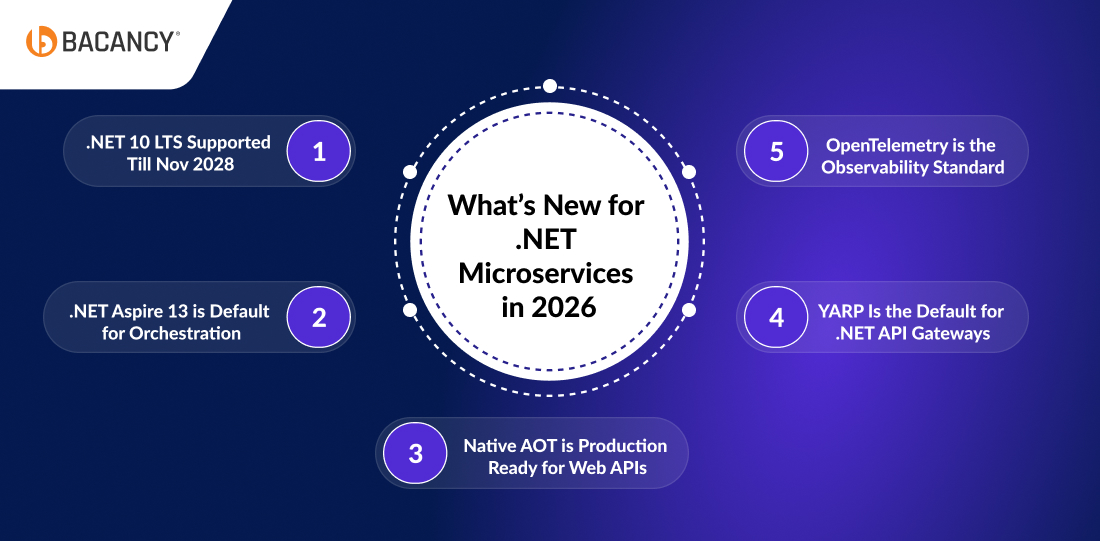
1. .NET 10 LTS Supported Till Nov 2028
The latest version, .NET 10, was released on November 11, 2025. It is a Long Term Support release with 3 years of support. For a CTO planning a microservices roadmap, it helps to govern your upgrade calendar for both .NET 8 and .NET 9 until the end of support on November 10, 2026.
It also means that every production .NET service in your portfolio needs to be on .NET 10 before that deadline.
2. .NET Aspire 13 is the default orchestration layer for new builds
AppHost project models your services, databases, caches, and queues in C# code, wires service discovery and OpenTelemetry automatically. It produces Kubernetes manifests, Docker Compose files, or Bicep templates on publish.
For teams that have spent years maintaining fragile Docker Compose files and custom service-discovery glue, Aspire 13 materially reduces the local-dev friction and the works-on-my-machine tax.
It does not replace Kubernetes, but it prepares services for Kubernetes without the usual YAML-and-shell-scripts rite of passage.
3. Native AOT crossed the production-ready line for web APIs
In the standard benchmark, cold-start time for a minimal API drops from 200-600 ms with JIT to 5-40 ms with Native AOT, memory usage from 100-150 MB to 30-60 MB, and container image size drops from around 200 MB to 20-40 MB.
For a serverless workload running on AWS Lambda, real-world benchmarks show AOT .NET 10 functions execute up to 7x faster on cold start than regular .NET 8 Lambdas.
That cold-start arithmetic is not a developer experience, but it can directly reduce the number of warm instances you have to keep running to hit your P95 latency SLO, which is a line item on your cloud bill.
AOT has real constraints around reflections, dynamic code generation, and EF Core compatibility, so it’s not a universal default yet, but for new latency-sensitive microservices, it is worth checking.
4. YARP is the default gateway
Yet Another Reverse Proxy (YARP) is an officially supported component of ASP.NET Core used in production inside Microsoft at hyperscale. That support lifecycle matters more than any feature comparison. Ocelot is still a preferable choice for simpler configuration-driven setups, but for anything enterprise- grade, YARP is the defensible choice.
5. OpenTelemetry is the observability contract
Aspire 13 service defaults to wire OpenTelemetry exporters automatically. Logs, traces, and metrics are emitted in open standards, which means you can switch from Azure to Datadog to Grafana without rewriting instrumentation.
For CTOs who have been frustrated by vendor-locked observability, this gives a way out.
Why Choose .NET for Microservices Architecture
Before going deeper into Microservices in .NET, the honest CTO-level question: why this runtime instead of Go, Java, or Node.js? Let us explore the key strengths of .NET for microservices that make it the right fit.
.NET 10 delivers real runtime improvements from JIT inlining, method devirtualization, and stack allocation optimizations. On throughput benchmarks, .NET typically sits alongside Java’s top-tier JVMs and ahead of Node.js, with Go taking the edge on cold-start and memory in untuned scenarios. Once you add Native AOT to the equation, .NET closes most of the gap against Go for microservice workloads.
A quick comparison for the runtime decision:
| Criterion
| .NET 10
| Java (JVM)
| Go
| Node.js
|
|---|
| Throughput (web API)
| High
| High
| High
| Medium
|
| Cold start (AOT/native)
| 5-40 ms
| 100+ ms
| 1-10 ms
| 50-200 ms
|
| Memory footprint (AOT)
| 30-60 MB
| 150-300 MB
| 20-40 MB
| 50-100 MB
|
| Talent pool depth
| Deep
| Deep
| Specialist
| Deep
|
| LTS commitment
| 3 years
| 5+ years (varies)
| 1 year
| Varies
|
2. Microsoft's roadmap commitment is the largest single variable
Annual November releases, alternating LTS and STS, with three-year LTS support windows, are now predictable enough to plan three upgrade cycles ahead. That predictability is worth more than any single performance benchmark, because architecture decisions live on five-year timelines and runtime abandonment kills platforms.
3. First-Party Azure integration
If your cloud footprint is Azure, the native integration points across Entra ID, Service Bus, Cosmos DB, Container Apps, and AKS make .NET the path of least resistance. Aspire’s Azure publisher generates Bicep templates directly through the Azure Developer CLI. If you’re AWS or GCP-centric, .NET still runs well, but you lose some of the first-class integration advantages and should expect integration validation work.
For teams planning a migration to Azure, our Azure migration services cover assessment, workload optimization, and .NET-specific deployment.
4. Talent pool economics favor .NET in most markets
ASP.NET Core is used by 19.7% of all developers as mentioned in the 2025 Stack Overflow Developer Survey, and the available pool of experienced .NET engineers is deep across North America, Europe, and South Asia. The supply-demand ratio generally produces more predictable hiring outcomes and compensation bands than Go vs Rust, where specialists still command a premium.
For a CTO modeling a three-year build, talent predictability is a risk variable that gets underweighted.
5. The .NET Foundation reduces vendor concentration risk
The runtime and core libraries are open source under the .NET Foundation. Microsoft is the dominant contributor, but the licensing and governance model means you are not exposed to the kind of single-vendor pricing change that has disrupted other ecosystems in the last two years.
Core Components of .NET Microservices Architecture
A .NET microservices architecture in 2026 is built on 5 architectural decisions that every team has to make. The defaults have changed meaningfully in the last two years.
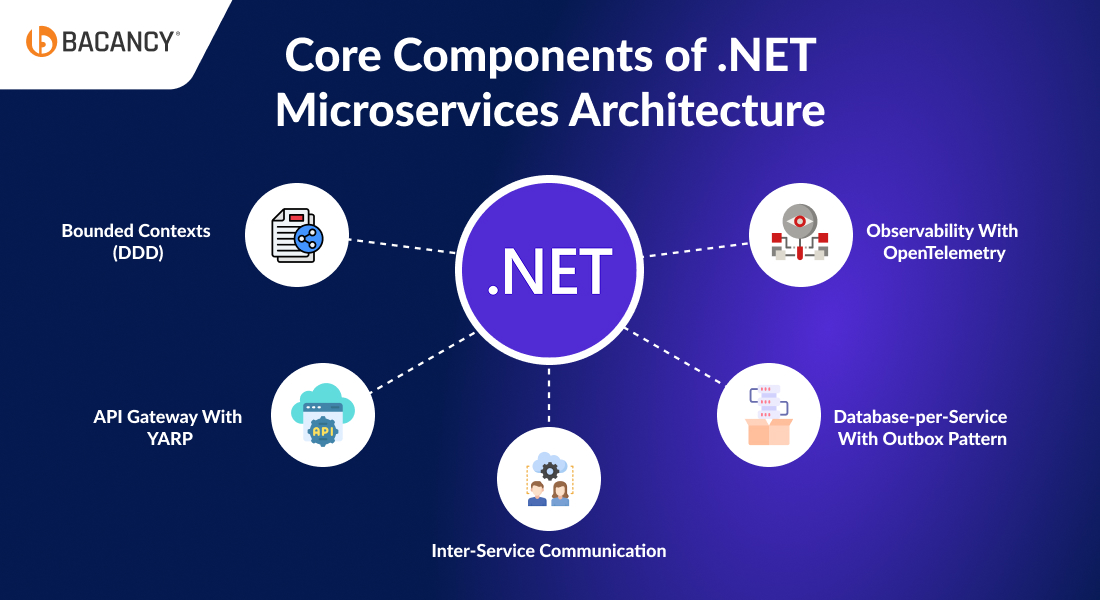
1. Bounded Contexts (DDD)
The service boundary is a domain boundary first and a deployment boundary second. Services should split along business capabilities (orders, billing, inventory), not technical layers (auth, notifications, data-access).
Technical-layer splits produce chatty inter-service calls and distributed transactions that never should have existed. If you cannot draw the business capability map first, you are not ready to split the system yet.
2. API Gateway With YARP
YARP for enterprise workloads, as covered above. YARP integrates into the ASP.NET Core middleware pipeline, which means routing rules, load-balancing policies, and header transformations are expressed in C# and are code-reviewable and unit-testable. Ocelot’s JSON-configuration model is faster to set up but harder to govern at scale.
YARP has become the standard gateway for new .NET microservices projects. It runs as part of the ASP.NET Core middleware pipeline, so routing rules, load-balancing policies, and header transformations are written in C#. That makes the microservices in .NET fit for code review, unit testing, and easy to pass through normal pull-request workflows.
Ocelot still works for simpler setups, but its JSON-configuration model gets harder to govern as the gateway grows.
3. Inter-Service Communication
This is the communication layer that connects services with each other and to the outside world. In a .NET microservices architecture, this layer has three parts:
- gRPC over HTTP/2 for service-to-service synchronous calls because it is faster, strongly typed, and produces generated clients in multiple languages.
- REST for synchronous external calls from frontends, mobile apps, and partner integrations. Works with every HTTP client, easy to version, and the format every external consumer can understand.
- Async messaging (Azure Service Bus, RabbitMQ, or Kafka) for anything that does not need a synchronous response, such as order placement, notifications, audit logs, and inventory updates.
4. Database-per-Service With Outbox Pattern
Each service owns its data. The pattern that turns a microservices architecture back into a distributed monolith is the shared database, so there are no backdoor joins, shared read replicas just this once, and cross-service schemas.
To close the gap between committing a business transaction and publishing a domain event, the transactional outbox pattern writes the event to the same database transaction and relays it asynchronously to the message broker. It is non-negotiable for systems that care about exact-once event semantics.
5. Observability With OpenTelemetry
The layer that lets teams understand what is happening inside the system at runtime. It captures three signals: traces (how requests flow across services), metrics (numerical measurements like latency and error rates), and logs (structured event records). Without it, debugging a microservices system is just guesswork. Here’s what it constitutes:
- OpenTelemetry as the instrumentation contract,
- Prometheus or your cloud provider’s metrics backend for storage, and
- Grafana or Application Insights for visualization.
Aspire 13 configures the OTel exporters by default.
Key Benefits of .NET Microservices for Enterprise Teams
Here are the advantages of using microservices with .NET that actually matter at the CTO level, each tied to a measurable outcome.
1. Independent Scaling Economics
Each service can scale on its own. During a peak event, the checkout service can run on 50 instances, while the catalog runs on 10 and the recommendations run on 5.
But, with a monolith, every component scales together, so trying to handle peak traffic on one feature requires paying for over-provisioning across the entire application. At scale, this is a real line-item difference on the cloud bill.
2. Release Independence, Measured in Deploy Frequency
Teams on a well-structured .NET microservices architecture ship their service on their own schedule, without coordinating across the whole codebase.
The metric to watch is deployment frequency per service per week. If that number is not materially higher than it was pre-split, you have paid the complexity cost of microservices without earning the velocity return.
3. Fault isolation that actually isolates
A failing recommendation service should not take down the checkout service for processing orders. The architectural promise only holds if you enforce it with circuit breakers (Polly is built into .NET 10’s resilience APIs), proper timeouts, and graceful degradation paths.
Using microservices with .NET gives you access to the tools. Whether teams use them is a separate question.
4. Technology heterogeneity without paying the polyglot tax everywhere
Individual services can upgrade to a newer .NET version, switch from SQL Server to PostgreSQL, or rebuild on a different pattern without forcing a coordinated org-wide migration. That optionality has real strategic value when you are planning a five-year runway.
When to Use .NET Microservices (and When to Stay on a Modular Monolith)
The cost of making this call wrong is measured in quarters of lost velocity. Most CTO-facing articles avoid it because the honest answer is uncomfortable.
Four conditions that justify a .NET microservices split:
- Multiple teams need to deploy independently: If you have one team of a variety of developers who require independent deployments, you do not need microservices. You need a modular monolith. Microservices earn their complexity when four or more teams have release cycles conflicting against each other.
- Your scaling profile is uneven across capabilities: One part of the system handles 100x the traffic of another, or has fundamentally different latency requirements. Splitting lets each capability scale to its own load requirement.
- Compliance or data-residency boundaries map to services: A payment service that has to be PCI-scoped separately from a marketing service requires a .NET microservice split.
- Domain complexity benefits from strictly bounded contexts: If your business has distinct subdomains like billing, fulfillment, identity, and recommendations, separating them into services helps teams work without any internal conflicts.
Need Expert Support to Split your .NET Application into Microservices?
Hire .NET developers from Bacancy with prior experience of shipping microservices on .NET.
Four signals to stay on a modular monolith:
- Team size under 15 engineers: Below this size, the coordination overhead of microservices outweighs the benefit.
- Roadmap is still finding product-market fit: If the domain boundaries are still changing monthly, locking them into service boundaries is the wrong move. Refactor inside a monolith. Refactoring across services is much harder.
- No platform team yet: Microservices need a dedicated platform capability (observability, CI/CD, service templates, secrets management). Without 2 or 4 engineers to own that, every product team pays the platform tax individually, and you launch slower.
- Your performance bottleneck is not inter-service: If your inter-service workflow has a slow database query, microservices will not fix it. Fix the query first.
.NET Microservices Best Practices and Common Pitfalls to Avoid
The architectural defaults are covered above. This section is the operational discipline that separates a working microservices build from a distributed monolith in disguise.
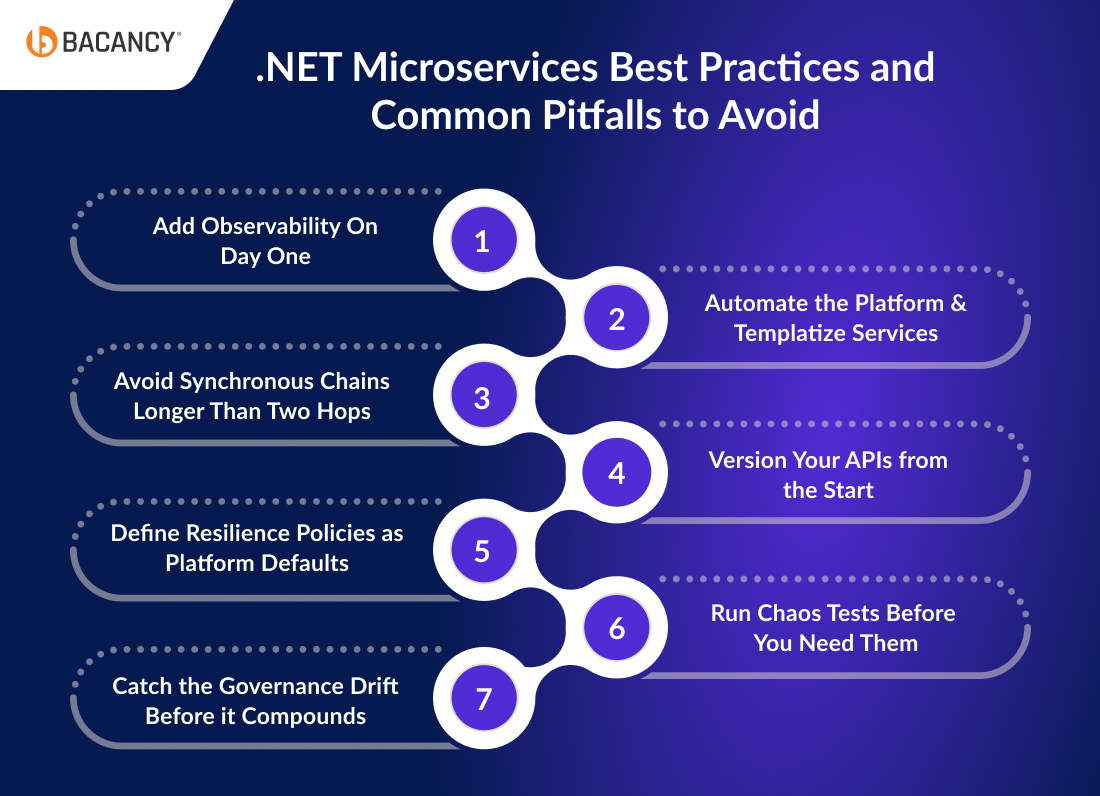
1. Add Observability On Day One
Distributed tracing, structured logs with correlation IDs, and service-level metrics are not a later ticket. Aspire’s service defaults make this close to free. Services that add without observability are services you cannot debug in production, and the first incident teaches this lesson expensively.
Create a service template (Aspire’s built-in templates are a reasonable starting point) that bakes in logging, tracing, health checks, resilience policies, and CI/CD. New services should inherit the platform, not reinvent it. Every deviation from the template is a future operational burden.
3. Avoid Synchronous Chains Longer Than Two Hops
A request that fans out across 5 services synchronously is a latency bomb and a reliability liability. Restructure async workflows or use the saga pattern for multi-service transactions. This single discipline prevents the most common P95 regressions in microservices migrations.
4. Version Your APIs from the Start
You will break a contract. A versioning scheme in place (URL-based or header-based) before you need it is cheap. Retrofitting one after three consumers have hardcoded v1 is not.
Timeout, retry, circuit breaker, and bulkhead policies should be baked into the service template via Polly or .NET 10’s built-in resilience APIs. Leaving resilience to each team guarantees inconsistent production behavior.
6. Run Chaos Tests Before You Need Them
Shut down a service in staging and watch how the rest of the system behaves. If it cascades, your isolation is theoretical. Teams that do not exercise their failure modes discover them in the worst possible context.
7. Catch the Governance Drift Before it Compounds
The slide back to a distributed monolith usually starts with one team adding a shared read replica, one service importing another’s internal model, or one migration shortcut that we will refactor later. Architecture review catches these. Retroactive cleanup is always more expensive than prevention.
How .NET Microservices Delivery Models Shape Your Project?
Architecture is half the decision. The other half is whether your delivery model can actually make a decision for your project. In this, three patterns work:
If you already have 2 to 4 engineers who can own the platform capability, and your product roadmap is settled enough that architectural investment pays back, in-house is usually the right default. You keep institutional knowledge, and the platform team compounds over time.
2. Hire Expert .NET Engineers to Fill Skills Gaps
If you know what you need to build but your team’s depth in distributed .NET patterns, Aspire, gRPC, or Kubernetes is thin, the play is to hire .NET expert with the specific experience gap you are closing. This works when you have a clear architectural direction and need execution velocity, not strategy.
3. Engage a Dedicated Team or Outsourced Partner
If your roadmap is pressing, you do not have an internal platform bench, and cannot wait a few months to build one, a dedicated team for engagement is the faster path. The failure mode here is treating the external team as another factor. You can acquire guidance from a .NET consulting services provider who offers an architectural roadmap from the components and a clean handover plan.
Conclusion
.NET Microservices in 2026 is a different proposition than it was two years ago. .NET 10 LTS, Aspire 13, Native AOT maturity, and YARP as a first-class gateway component have closed most of the tooling gaps that used to favor Java and Go.
At Bacancy, as a full-service .NET development company, we have built and scaled .NET microservices architectures for various industries, such as healthcare, fintech, and other clients across both greenfield builds and monolith-to-microservices migrations.
Our engineering teams work across the modern .NET stack (.NET 10, Aspire, AOT-optimized services, YARP, gRPC, Azure Container Apps, AKS).
If you are evaluating a microservices build, a migration off a legacy monolith, or a platform rebuild, we are happy to have the architecture conversation before the contract conversation. Start with a .NET consulting engagement or explore how to hire dedicated .NET developers for your next build.
Frequently Asked Questions (FAQs)
For most enterprise teams, yes. .NET 10 is LTS through November 2028, runtime performance is competitive with Java and ahead of Node.js, Native AOT closes the cold-start gap against Go, and Aspire 13 has materially reduced the local-dev friction that used to be a pain point.
A .NET monolith is a single deployable unit with all business capabilities sharing a process, a database, and a release cadence. A microservices architecture splits those capabilities into independently deployable services, each owning its own data, with communication over gRPC, REST, or async messaging.
There is no honest universal answer, but the realistic range for a mid-sized monolith (one to two million lines of code, 10-20 bounded contexts) is 12 to 24 months for a full migration, assuming a dedicated platform team and incremental strangler-pattern delivery. The projects that go faster usually do less.
The decision hinges on what you actually need. ACA is the right default for teams that want HTTP and event-driven autoscaling, revision management, and Aspire-native deployment without operating a cluster. Reach for AKS when you need service mesh, custom operators, StatefulSets for data workloads, cross-cloud portability, or any pattern that requires direct Kubernetes primitives.
Only if four signals hold: four or more teams pushing different release cadences, an uneven scaling profile across capabilities, compliance boundaries that map cleanly to services, and an existing 2-4 person platform bench. If any of those is missing, a modular monolith on .NET 10 + Aspire will likely outperform a premature microservices split.