Quick Summary
Web development is constantly undergoing transformative changes. Whether we talk about AI-driven coding tools, serverless architectures, or sustainable web practices, businesses must stay ahead of emerging trends to stay competitive. This post explores top web development trends, including AI-driven development, PWAs, low-code platforms, voice-enabled search, and enhanced cybersecurity, which help businesses and enterprise owners modernize their websites and optimization strategies.
Table of Contents
Introduction
“Did you know that 53% of users abandon a website if it takes longer than 3 seconds to load?” – As per a study, this fact highlights that website performance is no longer just a technical concern but a critical factor in user retention and business success.
In 2026, a slow-loading website can cost you more than just visitors; it can cost you revenue. Just like slow loading times, clunky interfaces, and outdated technologies also often drive users away, and they rarely return to the site. So, one thing is clear: businesses have to ensure their website stays updated and aligned with modern trends in web development.
With the latest web development trends involving heavy AI-adoption, progressive web apps, low-code development platforms, and other cutting-edge trends, it is essential for businesses to embrace innovation to uphold the momentum.
Whether you are creating a brand new site for your business or modernizing an existing one, keeping up with these must-know trends will help you drive optimal performance, user experience, and organic visibility, which ultimately will lead to conversions.
Let’s explore 2026 web development trends to help you future-proof your business web presence.
Top Web Development Trends To Stay Updated in 2026
The world of web development is destined to be constantly changing and progressing very fast. Technology is advancing faster than ever before, and therefore, companies need to keep up with the latest web development trends if they want to be competitive. Here are some key development trends worth monitoring:
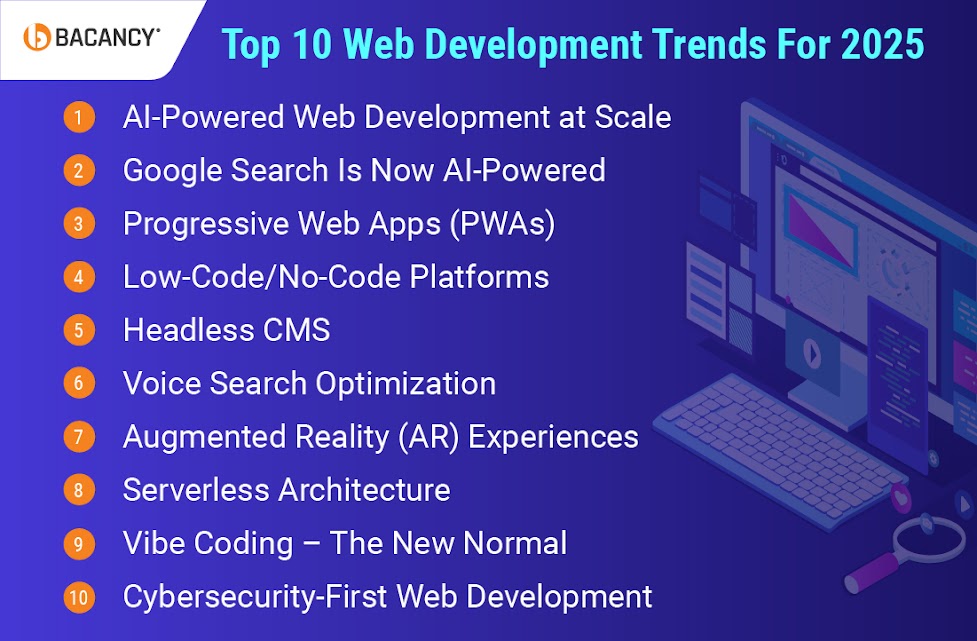
1. AI-Powered Web Development at Scale
Artificial Intelligence (AI) is indeed the transformative intelligent force that drives web development throughout 2026. By using the power of cutting-edge AI technologies, LLM models, Generative AI, and other advanced technologies, businesses are leading the way to create smarter, more efficient websites and applications.
AI-powered tools like GitHub Copilot, ChatGPT, and Tabnine are now integral to developer workflows, which help automate coding tasks, reduce errors, and improve efficiency. As per recent report, 90% of engineering teams are now using AI coding tools, and 62 percent among them have seen at least a 25% increase in productivity.
For instance, E-commerce giants like Amazon and Shopify use AI to personalize shopping experiences, recommending products based on browsing history, purchase patterns, and user preferences, which leads to increased conversion rates and customer satisfaction.
Moreover, the impact of AI-powered web development extends beyond coding. AI tools help enhance user experience through personalized content, adaptive layouts, and real-time UX adjustments, which further lead to more engaging and responsive websites.
Business Impact:
- Businesses can enhance customer satisfaction through real-time personalization and optimization, ensuring users receive seamless and relevant digital experiences.
- Great opportunity to increase conversion rates as AI-driven interactions, dynamic content, and intelligent design streamline user journeys and boost sales or sign-ups.
- Organizations can achieve improved customer retention by consistently delivering personalized experiences that encourage repeat visits and foster long-term loyalty.
2. Google Search Is Now AI-Powered
Google’s AI Overviews (sometimes called “AI Mode”) have rolled out widely in 2026. Instead of only showing just website pages or links, Google often generates an answer box using AI. This means your website might appear less often in AI overview section unless you focus on AI search optimization for your site.
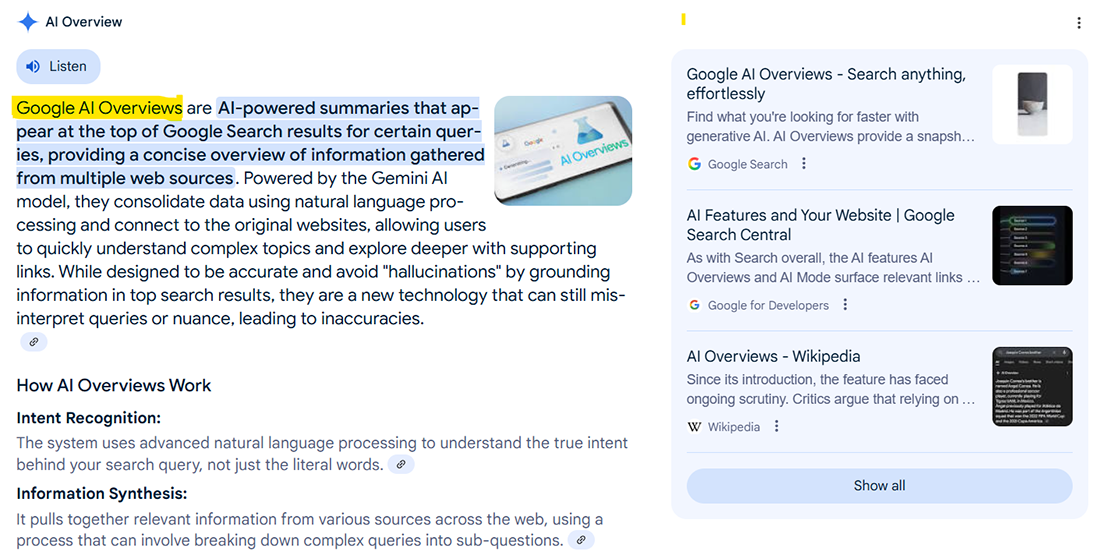
This latest shift in search engine technology is actually transforming the way people find information online. With Google’s AI-powered search, user experience gets enhanced as it delivers more relevant, personalized results with advanced natural language processing.
In modern AI-powered Google search, businesses can benefit from connecting with their audience even if their website does not rank in the top results. This directly highlights the increasing adoption of AI in web development to align with advanced search algorithms and optimize content for AI-generated responses.
Business Impact:
- It is crucial for businesses to focus on structuring content for AI-generated answer boxes.
- AI search provides more personalized, relevant results, which directly impacts the customer journey.
-
To drive higher user satisfaction, businesses should align their web content to meet users’ intent by using AI tools to analyze trends and user behaviors.
3. Progressive Web Apps (PWAs) For Enhanced User Experiences
Progressive Web Apps (PWAs) have quickly become a megachange for businesses that want to offer superior user experiences across devices. PWAs are basically web applications designed specifically to deliver a UX similar to native mobile apps.
PWAs act like a bridge between a web page and native mobile apps, featuring the best of both apps and providing fast, reliable, and engaging experiences, even on unreliable networks. With the ability to load in under two seconds and offline capabilities, hire PWA developers to help you deliver a flawless browsing experience, whether on a desktop or mobile device.
As per research, progressive web apps market size was estimated to grow from USD 2.08 billion in 2024 to USD 21.24 billion by 2033, increasing at a CAGR of 29.9% throughout the period. Compared to other web development trends, the reason for the surge in PWAs is the increasing ratio of mobile users, especially for eCommerce sites.
Business Impact:
- As PWAs load in under two seconds, businesses get the benefit of improved retention rates, reduced bounce rates, and keeping users engaged longer.
- Faster load times and offline capabilities ensure a smoother, uninterrupted user experience, boosting customer satisfaction and improving conversion rates
- Due to their scalability and flexibility, businesses should adopt PWAs to grow without the need to manage separate apps.
Low-code/no-code solutions are what every business is leaning towards due to their characteristics of offering even non-tech users the ability to build functional sites and apps. It becomes easier to create a web application with all the basic features without any coding expertise.
When it comes to streamlining the development process, low-code/no-code solutions win out. This can be considered a web development trend that you should not miss if, as a growing business, your aim is to reduce time-to-market for new products or features.
Although relying on such NC/LC solutions can help with basic development, prototyping, workflow automation, and internal tools, you will need specialized or skilled developers for complex development needs.
Business Impact:
- Low-code/no-code platforms empower business owners or product managers to build functional apps and sites quickly, which reduces reliance on development experts.
- Businesses can focus on innovation and customer needs due to streamlined development.
- You can cut down the costs as NC/LC platforms provide a cost-effective way to create and deploy basic applications without needing a large development team.
5. Headless CMS for Flexible Content Management
Headless CMS (Content Management Systems) is indeed one of the most impactful web development trends, especially for those organizations that aim to deliver content faster using CDNs.
With the adoption of headless CMS, you can decouple content from the front-end presentation, which allows you to deliver personalized content across multiple platforms (websites, apps, digital displays).
This decoupled approach gives businesses the freedom to select any frontend framework, be it React, Vue, Next.js, or Svelte. You can select your preferred front-end technology while ensuring that your content remains consistent, reusable, and scalable.
In an age where users interact with brands across multiple digital touchpoints, headless CMS provides the agility and flexibility needed to deliver personalized, channel-specific experiences. This flexibility leads to faster, more efficient content updates and a better user experience. Companies adopting headless CMS solutions can expect faster content delivery, reduced overhead, and the ability to scale content management systems.
Business Impact:
- Organizations can launch campaigns across different platforms simultaneously without depending heavily on developers to update each channel.
- Since the frontend is decoupled, companies can adopt new technologies (e.g., AI-powered search, voice assistants, AR commerce) without needing a complete content migration.
- A headless CMS makes omnichannel personalization easier, ensuring your customers see consistent branding and tailored experiences across all devices and platforms.
Future-Proof Your Digital Journey By Adapting Latest Trends
Hire web developers who have the knowledge, experience, and expertise to transform your business vision into secure, scalable, and trend-driven web solutions.
6. Voice Search Optimization for Enhanced Accessibility
In 2026, it is no longer optional to optimize your site for voice search, all thanks to the evolution of voice-driven, smart assistants like Google Assistant, Alexa, or Siri. Due to the easy availability and accessibility, users are more habituated to commanding these smart assistants to find information, shop online, or interact with any digital product.
As per research, 41 percent of US adults use voice search in their day-to-day life, for various things. Hence, businesses would have to prioritize voice search optimization to get higher online visibility and better user engagement. By ensuring websites and applications are optimized for voice queries, businesses can not only improve SEO performance but also expand their reach to a broader, more inclusive audience.
Business Impact:
- Voice search gives businesses the opportunity to increase customer engagement and improve brand recognition across global users.
- Voice search optimization helps to rank high on voice search queries, which leads to achieving a higher conversion rate.
- By making digital platforms voice-friendly, businesses enhance accessibility, aligning with modern user expectations and technological trends.
7. Augmented Reality (AR) Enhancing User Engagement
Have you ever tried on a pair of sneakers virtually or previewed how a sofa would look in your living room before buying it online? That’s the cool capability of Augmented Reality (AR), and in 2026, it’s moving far beyond just “cool gimmicks” to become a mainstream web development trend.
Augmented Reality (AR) is quickly becoming one of the most engaging ways to connect with customers, especially for ecommerce businesses. With the AR technology, users can simply visualize products in their real-world environment before making a purchase.
Whether you need your customers to try on virtual clothes, see how a specific furniture would look in their balcony, or visualize their wishlist-products, Augmented Reality makes it possible. It enhances the shopping experience by merging the physical and digital worlds.
For businesses targeting tech-savvy, experience-driven consumers, AR is a must-follow trend to boost engagement, deliver immersive experiences, and enhance decision-making.
Business Impact:
- Businesses can enhance product visualization, get higher engagement, and improve conversion rates through AR solutions.
- Interactive 3D product demos, AR filters, and immersive storytelling capture user attention far longer than static content.
- Businesses can track how users interact with AR features, which products they visualize, and how long they engage, which allows for targeted marketing and promotions.
8. Serverless Architecture for Scalable Solutions
Serverless architecture is the driving force of transformation in how businesses scale their applications. Listed in the popular web development trends in 2026, serverless architecture’s market value is projected to reach USD 124.52 billion by 2034, growing at a CAGR of 24.23%.
With the use of serverless architectures, programmers can create their products without worrying about a server’s underlying architecture. For handling infrastructure management tasks like database maintenance and third-party app integrations, developers can rely on server providers, like Google Cloud Run or Microsoft Azure. Serverless platforms automatically scale based on demand, which makes them ideal for websites with fluctuating traffic.
For example, companies like Netflix have adopted serverless architecture to automate video encoding and backup processes. By using AWS Lambda, they efficiently split and encode videos into parallel streams to ensure smooth streaming and real-time scalability without managing complex infrastructure.
Consider serverless architecture as a cost-effective solution that provides you with the flexibility to grow without the heavy upfront costs of traditional server management. It is a perfect solution to lower operational costs, faster time-to-market, and provide an enhanced user experience.
Business Impact:
- Serverless solutions offer businesses the flexibility to only pay for what they use. This eliminates wasted spending on underutilized servers while still ensuring peak performance during demand surges.
- With automatic scaling, businesses can confidently launch campaigns or new features without worrying about infrastructure bottlenecks.
- Serverless platforms often provide built-in edge computing, meaning your application can deliver content faster to users anywhere in the world.
9. Vibe Coding - The New Normal in Web Development
Well, coding in 2026 doesn’t look like it used to before the emergence of AI and other cognitive technologies. Vibe Coding is a term that you can consider as coding less, like in the context of typing, and more like collaborating with AI copilots for smarter coding.
Nowadays, instead of sweating over syntax errors or building the same login form for the hundredth time, developers choose to rely on AI tools for software development as well as web development. They like the concept of vibe coding, which allows them to describe what they want in natural language to generate boilerplate code, suggest optimized functions, or even build prototypes from scratch.
By adopting this web development trend, businesses train and encourage their development teams to use AI tools like GitHub Copilot, ChatGPT, and Tabnine to handle repetitive tasks while they focus on solving higher-level, critical tasks. With the vibe coding trend, development is becoming more conversational, iterative, and creative.
Business Impact:
- Businesses can experience accelerated product development due to faster prototyping and iteration cycles, which means deployment and launch can happen in weeks.
- Reliance on AI-powered development tools reduces the need for extensive manual coding, allowing smaller teams to achieve more without scaling headcount.
- Even non-technical stakeholders can interact with AI tools to mock up ideas, making collaboration between business and development teams more seamless.
10. Cybersecurity-First Web Development
Cybersecurity is no longer a “checklist item” left for IT teams, you can think of it more like a strategic business priority. As cyberattacks grow more sophisticated with AI-driven hacking, deepfake scams, and large-scale data breaches, businesses that don’t build security into their web platforms risk losing more than just data, they risk their reputation, customers, and revenue.
Every new website, app, or digital product needs to be built with a “security-first” mindset, where safeguarding data and user trust is just as important as delivering a great user experience. This includes practices like end-to-end encryption, multi-factor authentication, zero-trust architectures, AI-powered threat detection, encrypted APIs, and compliance with industry-specific privacy regulations (GDPR, CCPA, HIPAA, etc).
Business Impact:
- Following this trend, businesses can protect revenue and reduce the risk of multi-million-dollar losses from cyberattacks, lawsuits, and compliance fines.
- Cybersecurity surely strengthens customer trust and retention, which can further lead to higher conversions and repeat purchases.
- Compliance with GDPR, CCPA, and other regulations makes it easier to enter new markets without legal roadblocks.
Latest Web Development Trends - At a Glance
| Web Development Trend
| What It Means
| Why It Matters
|
|---|
| AI-Powered Web Development at Scale
| Using AI assistants to speed up coding, design smarter websites, and personalize user experiences.
| Faster product launches, reduced development costs, and better customer engagement.
|
| Google Search Is Now AI-Powered
| Search engines are shifting to AI-driven results (SGE), changing how people discover brands.
| New SEO strategies to stay visible, win clicks, and protect customer acquisition.
|
| Progressive Web Apps (PWAs)
| Websites that act like mobile apps, ensuring a fast, offline-ready, and seamless experience across devices.
| Higher user retention, better conversions, and no heavy app store costs.
|
| Low-Code/No-Code Platforms
| Drag-and-drop tools to build websites and apps without large dev teams.
| Faster time-to-market, lower IT spend, and more agility for product teams.
|
| Headless CMS
| A content system that pushes updates to websites, apps, and other channels from one place.
| Consistent customer experiences, scalable content, and future-proof operations.
|
| Voice Search Optimization
| Making websites discoverable through Alexa, Siri, and mobile voice queries.
| Expands reach, improves accessibility, and captures new customer segments.
|
| Augmented Reality (AR) Experiences
| Virtual try-ons, 3D product views, and immersive online interactions.
| Boosts customer confidence, increases conversions, and reduces product returns.
|
| Serverless Architecture
| Cloud platforms that automatically scale as traffic grows, with no servers to manage.
| Pay only for what you use, handle demand spikes easily, and ensure uptime.
|
| Vibe Coding - The New Normal
| Developers working alongside AI copilots to build products faster.
| Shorter development cycles, fewer errors, and faster feature delivery.
|
| Cybersecurity-First Web Development
| Websites built with security at the core, enabling data protection, compliance, and resilience.
| Prevents costly breaches, helps build customer trust, and supports global expansion.
|
Best Practices To Drive Digital Transformation With Bacancy
When you are on the path to adapting the latest web development trends, you should remember that it’s not just about staying relevant but transforming your digital ecosystem to achieve sustainable, long-term value.
However, the challenge lies in turning fast-evolving technological trends into practical, scalable solutions. With Bacancy’s strategic consulting, agile execution, and technical expertise, businesses can not only adapt to top web development trends but also embrace them as a catalyst for growth and innovation.
Here are some best practices to stay ahead, and how Bacancy can help:
Start Small, Scale Fast
Adopt emerging technologies (like AI-driven personalization, WebAssembly, or edge computing) in smaller projects or MVPs before scaling across your entire digital ecosystem.
How Bacancy helps: Bacancy can help you chart a clear adoption roadmap and build scalable solutions with an agile approach, ensuring your business can validate new trends quickly and expand confidently.
Focus on Security by Design
With the rising adoption of blockchain, decentralized apps, and headless CMS, prioritize cybersecurity from the start rather than patching later.
How Bacancy helps: Our team can integrate DevSecOps best practices to help businesses embed security into every stage of development and guarantee future-ready web development.
Leverage Cloud-Native and Edge Solutions
As web apps move towards faster, distributed architectures, it would be a wise choice to invest in cloud-native solutions and edge computing for speed, resilience, and scalability.
How Bacancy helps: We have proven expertise in architecting cloud-native web solutions designed for high-traffic enterprises and startups alike.
Prioritize Human-Centered Design and User Experience
Trends like AI, AR/VR, PWAs, and conversational UIs are powerful but only if they enhance the user experience. Focus on accessibility, inclusivity, and usability during web development.
How Bacancy helps: Bacancy applies design-thinking methodology to ensure cutting-edge tech is always aligned with user-centric needs.
Invest in Talent and Expert-led Partnerships
The pace of innovation and advancements is faster than ever, especially when we talk about web development trends. Hence, businesses need the right talent and partner to stay competitive.
How Bacancy helps: As your extended tech team, we provide dedicated developers and cross-functional squads that bring trend-specific expertise to your projects.
Measure ROI and Business Impact Continuously
Trend adoption is an ongoing process. Every new adoption should link back to business outcomes, performance, conversions, customer retention, or cost optimization.
How Bacancy helps: Our team helps align every engagement with measurable KPIs, ensuring you see tangible results from adopting new trends.
Conclusion
In this blog post, we explored that the top web development trends are no longer just about building functional websites; they are more about creating intelligent, immersive, and future-ready digital ecosystems. Trends like AI-driven personalization, PWAs, and low-code/no-code solutions are setting the stage for a more connected and experience-driven web experience. For digitally-driven businesses, this means embracing innovation not as a one-time upgrade, but as an ongoing journey.
With the right strategy and a trusted web development company like Bacancy, you can have the guidance and technical assistance to turn these trends into long-term opportunities. Let expert professionals help you ensure your digital presence not only thrives in 2026 but continues to evolve well into the future.
Frequently Asked Questions (FAQs)
Staying updated with the latest trends in web development ensures businesses can deliver modern, user-friendly, and secure digital experiences. Not only does this help improve customer engagement, conversion rates, and long-term competitiveness, but it also future-proofs your business by keeping you adaptable to evolving technologies and ever-changing customer expectations.
Artificial Intelligence or AI is indeed the cutting-edge technology adopted widely in every domain, including the web development. AI enables real-time personalization, smarter user journeys, automated content optimization, and predictive analytics-driven solutions. It also assists developers with coding, testing, and bug detection, making development faster and more efficient.
The future of web development will be shaped by intelligent, immersive, and user-centric technologies. AI will play a central role by powering up intelligent solutions that can help businesses offer hyper-personalized experiences, automated development workflows, and predictive user experiences. Alongside AI, trends like AR/VR, voice-enabled search and progressive web apps will redefine how businesses deliver digital products. The focus will shift from simply building websites to creating scalable, secure, and highly engaging digital ecosystems that adapt in real time to user needs.