Last Updated on October 31, 2025
Last Updated on October 31, 2025
Quick Summary
Vibe coding has transformed the software development process, reducing deployment time. It enables building a solution with a smart prompting technique to generate, refine, and rebug the code. In this blog, we will explore all the necessary aspects, key studies, and trends that have proven Vibe coding to be the future of software development.
Table of Contents
If you are measuring the reliability of the software development trend by the investment flowing in, then you must be amazed by the popularity of Vibe coding. It has crossed the threshold with OpenAI’s $3 billion investment in acquiring Windsurf, but the deal has not been closed. Google promptly moved in with a $2.4 billion talent and licensing agreement. A few days later, Cognition AI moved quickly to acquire Windsurf’s remaining assets for an undisclosed amount.
This series of transactions by large giants highlighted the AI Vibe Coding becoming popular in transforming the software development approach. In short, Vibe coding is a process where ideas are transformed into functional code through specific prompts. Unlike other modern approaches, Vibe coding requires careful planning and management to fulfill the enterprise software development needs.
This indicates “Vibe Coding isn’t just the future, it’s the only future.”
From financial centers to product engineering teams, everyone’s tuning into the same revolution, Vibe Coding.
To understand why this approach is gaining traction in the industry, let’s examine how it’s transforming every layer of the development ecosystem.
The software world has evolved beyond manual coding; it’s now driven by intent. Developers are shifting from writing syntax to designing strategies, orchestrating AI models that turn natural language into production-ready applications.
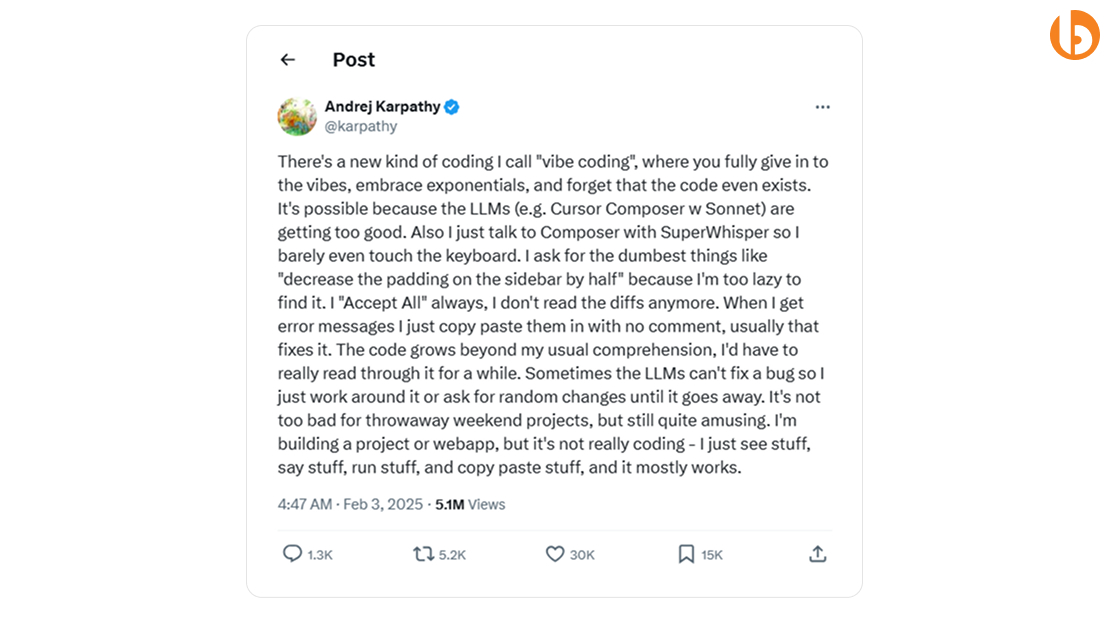
This new reality has a name, “Vibe Coding,” which was coined by Andrej Karpathy, co-founder of OpenAI. It redefines the development as an art of writing creative prompts and interaction between humans and machines. Developers no longer spend hours fine-tuning brackets and functions; they simply describe what they want created, and AI systems determine the best way to build it.
And the shift isn’t subtle. Google searches for “Vibe Coding” in the U.S. jumped 6,700% within three months, starting in February 2025. This makes it a faster mainstream breakout than “low-code” or “no-code” ever achieved.
That figure isn’t a mere digital trend; it marks the beginning of a fundamental shift in developer behavior. When an idea evolves from niche talk to a global trend within weeks, it reveals a profound cultural transformation in the way innovation unfolds.
For businesses, that surge means something bigger: the gap between an idea and its execution is collapsing.
Teams no longer need to wait for scarce engineering bandwidth to validate ideas; they can co-create with AI, test faster, and iterate with real code, not wireframes.
Low-code made development simpler. Vibe Coding makes it limitless.
The popularity of “vibe coding” is not a tested notion. It is already changing the way startups operate. Founders are no longer dependent on large development teams to bring their concepts to life. They now work collaboratively using AI tools to create minimal viable products in days instead of months, a clear sign that vibe coding is the future of software development.
This helps startups with flexibility and ensures long-term scalability without compromising product quality.
One of the strongest indicators of this shift comes from he world’s most influential startup accelerator Y Combinator on YouTube. As reported by ExplodingTopics (July 2025), around 25% of Y Combinator’s latest cohort now uses AI to write 95% or more of their code. For these innovators, code generation has evolved into a creative, prompt-driven process that converts ideas into functional solutions more quickly than ever before.
Y Combinator CEO Garry Tan noted that this new way of building has transformed their overall growth. “It’s not just the top one or two companies,” he said. “The entire batch is growing 10% week on week.”
That growth rate is a reflection of something more profound: the speed at which humans can write code is no longer the limiting factor in startup growth. Now, it all relies on how well people can guide AI systems to write code.
The meaning is evident. Early-stage success has evolved into a creative and iterative competition. Founders who know how to explain their vision to AI can test concepts, make quick changes, and launch products with few technological obstacles.
In this fresh environment, prompt literacy is starting to hold equal value as programming itself, demonstrating that Vibe Coding is a new norm for startup development rather than a passing trend.
Hire Vibe Coding Developers from Bacancy to create user friendly and integrated solutions.
While startups are proving how quickly AI can turn ideas into products, the strongest validation comes from enterprises that operate at scale. These organizations measure success not just in speed but also in consistency, governance, and long-term productivity. And they are now proving that vibe coding is the future of scalable innovation.
At Intuit, Chief Technology Officer Alex Balazs recently shared how thousands of engineers began using AI coding tools such as Windsurf, Cursor, and Qodo, compared to just a few hundred before. This surge in adoption has already delivered efficiency gains of up to 40%, showing that AI-driven development is not just a trend but a tangible business advantage.
SAP’s Global Head of AI, Walter Sun, describes this transformation as “a further evolution of productivity for development.” His perspective reflects how Vibe Coding is helping large organizations move beyond the repetitive work of writing and debugging lines of code. Instead, engineers now focus on architecture, validation, and performance, while AI handles the operational bulk of development.
Similarly, Pendo’s CEO, Todd Olson, explains that Vibe Coding has inspired leaders like him to return to hands-on experimentation. It allows teams to “prototype faster and test more ideas than ever before,” creating an internal culture that rewards iteration and innovation.
Across all these examples, one pattern stands out. Enterprise engineers are no longer typing code from scratch. They are editing, reviewing, and orchestrating AI outputs with business intent. This shift transforms software creation from an individual task into a collaborative system between human expertise and machine intelligence.
As enterprises adopt this approach, they are not only improving development speed but also redefining what engineering excellence looks like in the AI era.
As billions flow into Vibe Coding platforms, a quieter but equally powerful transformation is unfolding inside engineering teams. Developers are no longer valued for how many lines of code they write but for how intelligently they can guide, review, and refine what AI produces.
This evolution has been captured in multiple research studies. In “Vibe Coding: Programming through Conversation with Artificial Intelligence”, researchers Advait Sarkar and Ian Drosos observed that modern developers now spend more time setting context, validating outputs, and orchestrating feedback loops than typing code. The skill lies in defining the right intent and ensuring that the generated code fits the business logic, scalability, and compliance requirements.
This shift is already visible across enterprises. At SAP, engineers now operate in what they call evaluation mode, where performance is measured by decision quality rather than typing speed. Intuit’s engineers follow a similar rhythm, allowing AI to automate repetitive development work so that teams can focus on architecture, optimization, and innovation.
At Bacancy, our engineering culture is evolving in the same direction.
Across multiple product teams, developers are now pairing with AI coding assistants to generate boilerplate code, auto-generate test cases, and perform quick architecture validations before human review. What once took hours of setup and configuration now happens in minutes.
The result is clear: our teams are shipping proof-of-concept builds up to 35% faster, and QA teams are leveraging AI to detect logic inconsistencies during early-stage development, well before manual testing begins.
But what’s most important is how this changes the mindset. Bacancy’s engineers no longer see AI as a shortcut. They see it as a collaborator that amplifies judgment, not replaces it. The role of a developer has evolved from code author to AI orchestrator, someone who connects creativity, business logic, and machine capability into one workflow.
The future of engineering will not belong to those who type faster, but to those who think in systems, design with clarity, and communicate intent with precision.
And as Vibe Coding becomes the global standard, Bacancy is already living that future, every day, in every sprint.
Recent benchmark studies, such as SWE-Bench and Artificial Analysis Coding Index, show how far AI has come. In 2023, top models solved barely 5% of coding challenges. By mid-2025, they consistently passed 60% or more, with new reasoning models like Claude 3.7 Sonnet and GPT-4o closing the gap between AI-written and human-reviewed code.
These results are not limited to labs. Intuit reports up to 40% efficiency gains, while SAP developers record around 20% faster delivery using AI-assisted workflows. The gains are steady and measurable: speed, quality, and maintainability improve together.
According to the 2025 Stanford AI Index and benchmarks such as SWE-Bench (developed by Amazon) and AI Coding Benchmarks, AI models have demonstrated rapid progress in solving real-world software engineering challenges.
At Bacancy, we embody this discipline through internal test harnesses and code-quality scoring, ensuring that every AI contribution meets production standards. The focus is simple: let AI accelerate the process while humans uphold reliability.
The message is clear. Vibe Coding has matured into a measurable, impactful system, and it’s redefining the question every leader is asking: is vibe coding the future?
The future of coding will not be judged by its appearance, but by its consistent performance.
Recent reports from Cognizant’s 2025 enterprise AI survey reveal that while 94% of senior leaders see AI as essential for productivity, only 43% have formal guidelines for its use. This gap creates the risk of Vibe Chaos- when enthusiasm outpaces governance and AI adoption in the routine workflow.
Without a proper review of AI-generated code, you typically encounter security flaws, licensing issues, and version control conflicts more quickly than teams can identify and address them. And as AI begins to write more of the production stack, these small oversights can compound into systemic risk.
The solution isn’t resistance; it’s responsibility. Enterprises that succeed with Vibe Coding are already embedding quality protocols, explainability, and robust compliance frameworks within their development workflow.
At Bacancy, we approach it the same way: every AI-assisted build is tracked, reviewed, and validated before merging. The excitement of speed is balanced with the assurance of discipline.
Vibe Coding is powerful, but like any powerful tool, it rewards control. The future will not belong to teams that adopt AI the fastest, but to those who adopt it safely and scale it smartly.
The AI-enabled engineering framework requires in-depth verification to ensure enhanced scalability and reliability. For this reason, Bacancy uses the VIBE principles to make sure the code is scalable, secure, and authentic.
At Bacancy, we believe the true strength of Vibe Coding is in its management. Our V.I.B.E. Framework ensures that every AI-generated result is traceable, testable, and reliable by converting creativity into organised engineering.
Our engineering philosophy and vibe coding services are built on a simple idea: creativity needs structure. Vibe Coding delivers speed and accessibility only when it is balanced with validation, testing, and governance.
It is a philosophy, not a tool, that enables our creative teams and clients to transform purpose into outcome. For us, Vibe Coding is not just the future. It is the only future worth building and transforming the business workflow.
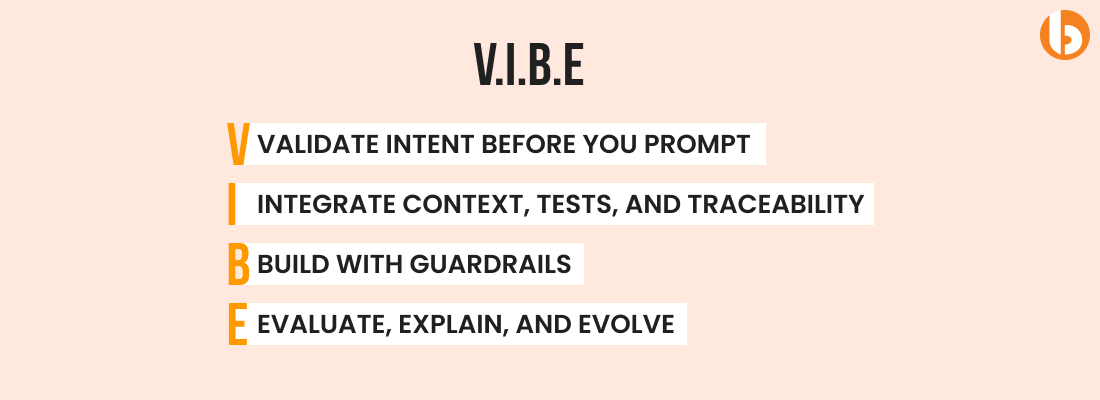
Every build begins with clarity.
Before any prompt is written, our teams define the business goal, user story, and measurable success criteria. This ensures that the AI does not just generate code but delivers solutions that align with purpose.
Intent first. Code later.
AI is only as good as the context it understands. It provides the output based on intent and the requirements are clarified. We connect models with repositories, documentation, test cases, and architecture notes, ensuring that each output reflects the system’s complete environment.
Integration keeps the AI grounded in reality and aligned with existing standards.
Context is the new codebase.
Speed means nothing without safety.
Our workflows include security checks, license compliance validation, and data-protection policies from the very first prompt.
AI suggestions are automatically reviewed and tested before being merged into any branch.
Every innovation deserves a safety net.
The final step is reflection.
Each AI contribution is tested, benchmarked, and reviewed to measure accuracy, maintainability, and performance.
The insights feed back into improved prompts, cleaner models, and stronger outcomes.
Evaluation turns speed into sustained excellence.
The V.I.B.E Framework helps Bacancy teams move faster without losing precision. Every AI-assisted workflow at Bacancy follows our AI-Assisted Engineering Framework, where intent is defined before code is generated, and every output is thoroughly tested before being trusted.
A thorough testing, validation, and compliance process is applied to each line of AI-generated code. This approach ensures that our clients move faster with confidence. It turns AI from a simple assistant into a reliable co-engineer.
When validation, integration, guardrails, and evaluation come together, development moves from guesswork to governance.
Any development team can follow the same rhythm.
By applying the principles of V.I.B.E, organizations can approach AI-assisted software development with clarity, structure, and confidence.
With the increasing precision in AI algorithms, it is now capable of understanding intent, learning from a large amount of complex data, and implementing ideas that would require much human effort to execute. This evolution in AI-driven development simplifies experimentation and accelerates innovation, making many wonder, is vibe coding the future of how we build and create?
Vibe coding is not just another development approach; it is a shift in the planning and analysis approach to software development. This modern approach integrates advanced technology and human efforts to provide a balanced ecosystem that ensures scalability.
The future will not be written in syntax, but rather spoken in intent, organized by AI, and safeguarded by engineers who describe, critique, and lend meaning to everything that is released. The next chapter of software engineering will be written through collaboration between human intent and machine intelligence because vibe coding is the future.
However, advanced development approaches make Vibe coding easy to ensure data-driven intelligence, a reliable codebase, and create value through human editing, making it indispensable for high-tech solutions. The next decade in technology will be determined by those who can see the advantages of the collaboration between machine precision and human purpose.
Vibe coding is a modern software development method in which developers explain in natural language what they desire, and AI produces, optimizes, and debugs the code. It does not focus on syntax, but rather on intent, thereby accelerating its development process and reducing barriers to progress.
The Vibe coding involves AI to process conversational code in contrast to manual coding, where the coder writes the program line by line in detail. The developers are more like guides, curators, rather than exclusive authors.
Yes. Since all one needs to do is define the desired outcome in simple terms, Vibe coding makes software development accessible to individuals who lack extensive coding knowledge.
Absolutely. AI is capable of producing server-side code, APIs, and database integrations, enabling the quick prototyping and development of the backend.
It improves prototyping, reduces human error, democratizes software development, enhances productivity, and facilitates real-time testing and feedback.
Humans determine the purpose, and the uses of AI are reviewed by humans, who also provide creative solutions and moral oversight. They collaborate with the AI instead of giving it control.

Tech Geek at Bacancy
Story-driven writer blending research, passion, and full-stack web clarity.
MORE POSTS BY THE AUTHOR
Your Success Is Guaranteed !
We accelerate the release of digital product and guaranteed their success
We Use Slack, Jira & GitHub for Accurate Deployment and Effective Communication.