Quick Summary
In this blog, we have covered the core Nuxt vs Next.js comparisons for CTOs. Nuxt follows a structured Vue-based architecture while Next.js provides a flexible React ecosystem with broader capabilities. Both frameworks have their own strengths and limitations; let’s find out which one fits your project the most.
Table of Contents
Introduction
The Nuxt vs Next.js debate looks simple on the surface. Vue or React. SSR or SSG. Pick one and move on. But that shortcut often leads the team into slow builds, rising costs, and architecture that does not scale the way they expect.
Both frameworks promise modern web performance, server-side rendering, static generation, and a developer experience that does not slow you down. Next and Nuxt js largely deliver on that promise.
However, now performance is no longer optional; data shows that more than 53% of users won’t stay on the website that takes longer than 3 seconds to load, which makes every architectural decision count.
Under the hood, Nuxt and Next.js are solving similar problems through genuinely different philosophies. The way each one handles routing, data fetching, rendering strategies, and caching has real downstream consequences for your team’s velocity and your infrastructure bill.
This guide breaks down the crucial aspects of Nuxt vs Next.js comparison. We will break down where each framework creates the advantages, where it saves time, and how those differences compound as your product moves from MVP to scale.
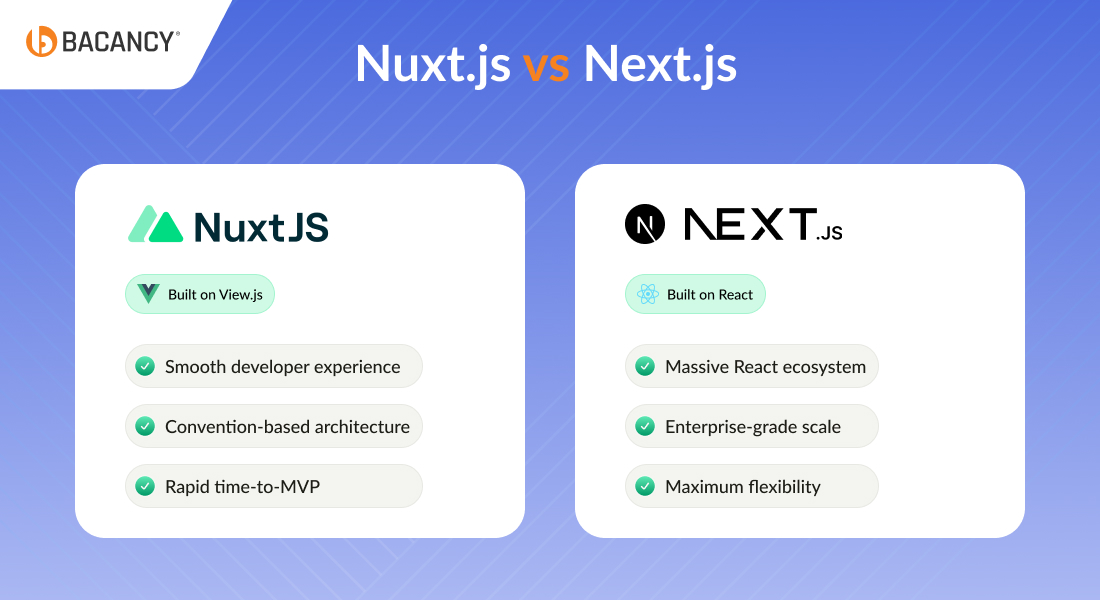
Nuxt vs Next js: Quick Comparison Table
| Factor | Nuxt
| Next js
|
|---|
| Underlying library
| Vue js 3
| React 19.2
|
| Server engine
| Nitro (multi-runtime)
| Vercel-tuned, Node and Edge
|
| Default bundle
| Vite 8 (Rolldown stable)
| Turbopack (Stable)
|
| Default rendering
| Universal SSR with routeRules
| RSC + Cache Components
|
| Hosting flexibility
| Node, Deno, Cloudflare, Lambda, Bun, Vercel Edge
| Optimized for Vercel and runs elsewhere
|
| Module ecosystem | First-party (@nuxt/content, @nuxt/image, @nuxt/ui)
| Third-party assembly
|
| Talent pool (Stack Overflow 2025)
| Vue 17.6%
| React 44.7% |
| Best fit | Content platforms, multi-runtime, faster MVPs
| React-committed teams, AI tooling, Vercel-native
|
Nuxt or Next.js: Why This Choice Impacts More Than Just Frontend
Comparing Next vs Nuxt is not limited to the frontend decision. What starts as a framework choice quickly extends into how the entire application functions across environments, teams, and release cycles.
Next.js and Nuxt.js both solve modern web delivery through SSR and static generation. The difference is how each one structures your system as it evolves. That structure will either support your roadmap or slow it down once complexity increases.
Let’s move beyond the Vue vs React Debate
As a CTO, it is a trade-off between speed of execution and long-term control. One approach gives your teams more flexibility to design systems their way. The other reduces variance, so multiple teams can operate without drifting from the architecture standards. Your choice will dictate how much engineering oversight you need later.
How This Choice Impacts Your Product:
- Time-to-market
If your priority is to speed up the release cycles, the framework must reduce coordination overhead. The wrong structure leads to repeated refactoring as the features and team scale.
- Hiring cost
Your framework choice will define your talent pool. It impacts how quickly you can hire, onboard, and make engineers productive in your stack.
- Architecture decisions
Routing patterns, data flow design, and caching strategy are not implementation details. Once locked in, you need to define your system’s scalability ceiling and future engineering cost.
Struggling to balance speed, structure, and scalability in your frontend choice?
Hire Vuejs developers who turn Nuxt into a production-ready system that launches faster and scales without architectural burden.
The Hidden Decision Layer in Nuxt vs Next js
Most teams select a framework based on syntax preference or prior experience. What does not appear is the process layer beneath the features. The architectural consequences only surface once the product is in active development.
This is the hidden decision layer. It is about what each framework demands from your team over time.
When Next.js Gives You Too Much Freedom
Next.js does not prescribe how your team should structure data flow, manage server-client boundaries, or organize shared logic. It means every senior engineer will have a different mental model of how the application should be built.
React Server Components in Next.js require a clear server-client boundary maintained consistently across the entire codebase. On teams without a defined architecture standard that boundary erodes. The result is mixed server and client logic with no clear ownership, and alignment debt that compounds as the team grows.
When Nuxt’s Conventions Reach Their Limit
Nuxt reduces decision overhead through auto-imports, centralized routeRules, and a structured app/ directory. For early-stage products, this is a genuine advantage. The hidden layer surfaces when the product outgrows those conventions.
Auto-imports become difficult to trace at scale. routeRules work well for standard content architecture, but become a bottleneck when different sections of the product require distinct rendering behavior.
Teams do not abandon Nuxt at that point; they work around it. Those workarounds accumulate, and the codebase carries the weight of solutions that exist outside the framework’s intended structure.
Nuxt vs Next.js Performance: Which One is Faster?
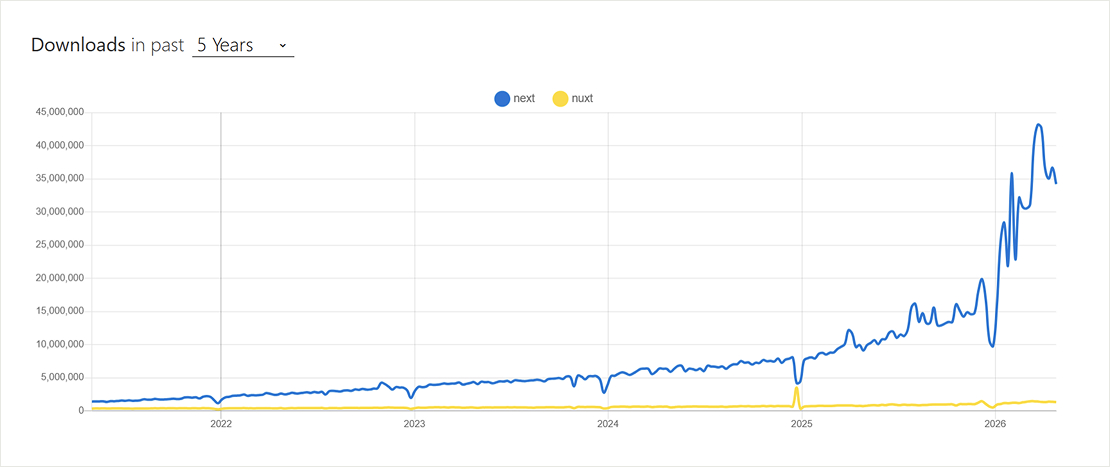
Source: NPM trends
Nuxt vs Next.js performance comparisons are one of the benchmarks for the project. The framework choice rarely dominates production performance; infrastructure and implementation do.
Frameworks Support SSR, SSG, ISR, and Hybrid Rendering
Both provide server components or equivalents. It delivers competitive Core Web Vitals when configured properly. You can analyze that Nuxt delivers comparable results to Next.js in SSR scenarios, with the differences sitting in deployment portability and developer experience rather than raw speed.
Hydration and API Latency
In Next vs Nuxt performance, both frameworks stream HTML and hydrate progressively. Next.js’s cache components and React give you finer hydration control. Nuxt introduced async data handler extraction that reduced bundle sizes by up to 39% on prerendered sites, which translates to faster first paints on content-heavy pages.
Edge Rendering vs Server-based Delivery
This is where Nuxt’s Nitro engine pulls ahead. The same Nuxt codebase runs on Cloudflare Workers, Vercel Edge, Deno, Bun, AWS Lambda, and traditional Node servers without re-architecture. Next.js runs outside Vercel but loses optimizations the further you stray.
When performance differences actually matter:
For instance, a marketing site with 100,000 monthly visitors, the framework will not move your conversion rate. For a global commerce platform processing 10 million sessions a day with strict latency budgets, the difference between these two frameworks’ delivery is where the performance differentiation lies.
Need predictable performance across SSR and edge setups?
Hire JavaScript developer who designs and optimizes systems for real-world load that ensure faster response times, cleaner hydration, and stable performance across environments.
What is the Cost to Build a Project with Nuxt or Next.js?
For a CTO, it is crucial to compare the cost of Next js vs Nuxt js to determine the best framework. It takes a 3-year total cost of ownership in the number to review; let’s find every way to calculate the cost.
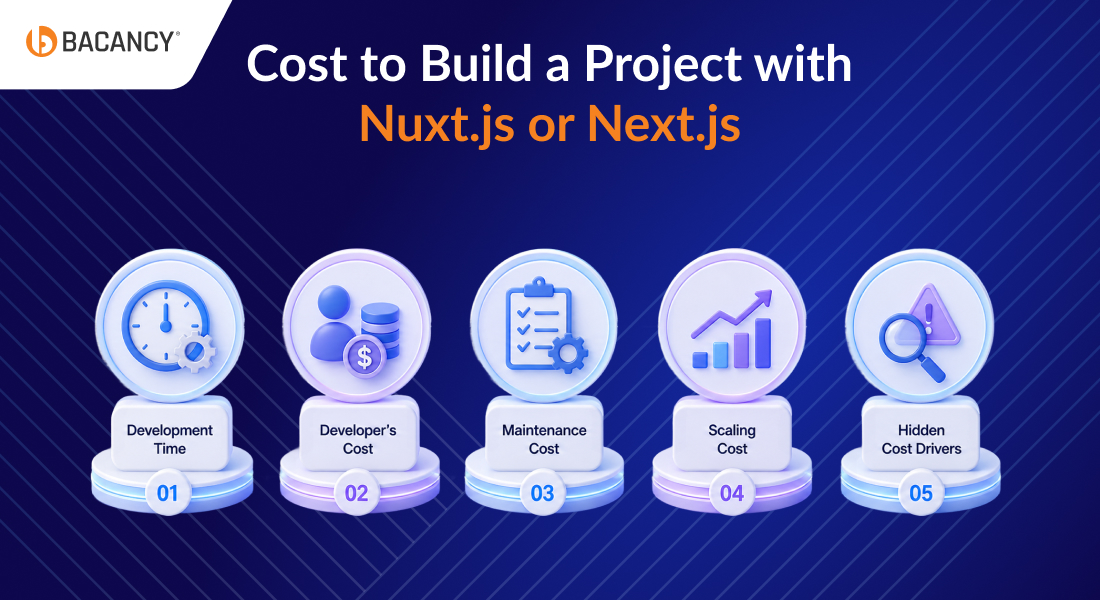
Development Time
Nuxt’s convention-first setup compresses in the 1st week, including create-nuxt-apps routing, auto-imports, and a preconfigured folder structure. Next js asks for TypeScript, ESLint, and routing decisions on initialization.
For instance, an MVP that will launch in 8 to 12 weeks will compress in real-time. For a multi-year platform build, there is no gap, and execution is smooth.
Developer’s Cost
Hiring costs vary depending on complexity and project scope. However, as per the job market report, React (Next) has around 89,000 globally, and Vue (Nuxt) has around 12,000 globally.
Even the average US salaries of these two frameworks report $115,000 for Next and $108,000 for Nuxt. Hence, React has more candidates and faster outsourcing, while Vue has a smaller but loyal pool with stronger satisfaction.
Maintenance Cost
Nuxt’s first-party modules are versioned together. Next.js relies on third-party libraries for the equivalent stack, each with its own release cadence and breaking-change risk.
Scaling Cost
Hosting bills go in different directions. Nuxt’s multi-runtime support means you can negotiate across Cloudflare, AWS, or self-hosted Kubernetes without rewriting code. Next.js is cheapest where it is most optimized, which is Vercel.
Hidden Cost Drivers
Two patterns repeat in real engagements. Next.js teams overengineer simple sites with caching layers and server components they do not need. Nuxt teams hit limits earlier on backend-heavy custom workflows. Both costs are real and rarely modeled in initial estimates.
The fix on both sides is the same: hire full stack developers talent who scopes architecture before writing the first line of code, across Vue/Nuxt and React/Next stacks alike.
What are the Challenges of Next js and Nuxt js?
Both Nuxt and Next js are powerful in their own way, but each comes with clear limitations. It is crucial to understand limits early to reduce risks and avoid costly decisions later.
Challenges of Nuxt JS
- Nuxt has a smaller talent pool, which can slow down your hiring process and increase developer acquisition costs.
- Its ecosystem offers fewer enterprise-grade libraries and integrations compared to React.
- Major upgrades like Nuxt 3 or the introduction of Nuxt 2 complex migration require teams to adapt to new patterns.
- Performance optimization for SSR, caching, and hydration often demands deeper technical expertise.
- Dependence on community plugins can lead to long-term maintenance and stability concerns.
Challenges of Next.js
- Next js can feel overly complex for smaller or less demanding applications because of its extensive feature set.
- Rapid framework evolution brings a continuous learning curve for development teams.
- Several advanced features are optimized for Next js, which may create some level of vendor dependency.
- Multiple rendering strategies increase architectural decision-making complexity.
- Build times and infrastructure costs can grow significantly at scale.
- Debugging across server and client boundaries becomes more challenging with modern rendering approaches.
Use Case: Choosing the Right Framework for Your Product
The clean way to answer Nuxt vs Next js is to map product type to framework, then validate against the team you already have.
Choose Next.js if:
- You are building a SaaS platform, an enterprise dashboard, an AI-driven product, or anything where you need flexibility and the deepest tooling ecosystem.
- If your team is React-committed, if you are hiring at scale in the US, UK, or EU markets, or if you are building an AI-native frontend where the Vercel AI SDK is part of your roadmap.
If your choice is Next.js for SaaS platforms, enterprise dashboards, or AI-driven products, hire Next js developers from Bacancy to build flexible, scalable, and high-performance applications.
Choose Nuxt if:
- You are building a marketing site, a content platform, a headless commerce frontend, or a multi-region site where edge delivery is a business requirement.
- Your team is already productive in Vue. If you need MVP velocity with a smaller team, or if your hosting story has to be portable across providers for compliance, cost, or vendor-risk reasons.
If your choice is Nuxt for marketing sites, content platforms, or fast MVPs, hire Nuxt js developers from Bacancy to deliver structured, reliable, and scalable applications with speed.
The default tiebreaker
When the product analysis is a coin flip, your existing team is the deciding factor. Switching libraries to chase a framework rarely pays off in the upcoming years.
Migration Reality: Switching Between Nuxt and Next.js
Re-platforming is the most expensive consequence of getting the first decision wrong. It is also sometimes the right call.
When Migration is Worth the Cost
The honest signal is a two-year-plus project where a performance, hosting, or hiring bottleneck is now tied to revenue. Migrate when your team cannot hire fast enough, your edge story is broken, or your hosting bill is unsustainable. It is rational engineering economics.
Realistic Timeline and Effort
You must make the timeline and effort realistic if you are switching from Nuxt to Next. For instance, a 40-page content site with standard CMS integration is usually a 4-12 week migration. A SaaS app with custom auth, billing, and complex state management operates longer and often extends to 6 months. The variable is in how much business logic lives in framework-specific patterns.
What Transfers Cleanly and What Does Not
Component logic, CSS, design systems, and static assets transfer well in either direction. What does not transfer cleanly: framework-specific data fetching (server actions and React Server Components on the Next.js side; useFetch and useAsyncData on the Nuxt side), routing conventions, middleware logic, and any custom server code tied to the runtime.
Hidden Migration Costs
SEO is the underestimated risk. URL structures, redirects, sitemap generation, and meta-tag handling behave differently across frameworks, and a migration can cost months of organic traffic. Analytics instrumentation needs to be re-validated. Team retraining is the cost nobody puts in the spreadsheet.
If Your Team Is Recommending a Stack Switch: Questions to Ask Before You Approve It
When a tech lead, a vendor, or an architect proposes Nuxt vs Next.js as a switch, the right response is not yes or no. It is a tighter set of questions.
1. What is the business outcome this migration unlocks, in measurable terms? “Better DX” is not an answer. “Reduce hosting cost by 30%, cut hiring time in half, or unlock a feature we cannot ship today” is.
2. What is the realistic dollar cost across engineering hours, lost velocity, retraining, and SEO risk? A multi-month migration on a 10-engineer team is six-figure spend before opportunity cost.
3. What breaks if we do not migrate? If the answer is “nothing for the next 18 months,” the migration is a preference, not a need.
4. Who on the team has shipped this stack in production before, and at what scale? A migration led by people learning the target framework is a different risk profile than one led by veterans.
5. What is the rollback plan if the migration takes 50% longer than estimated? Half of all framework migrations do.
6. How do we keep the existing product shipping during the migration? Migrations that pause feature work for two quarters cost real revenue.
7. What changes in our hosting, CI/CD, and observability stack? Framework switches usually have hidden infrastructure tails.
If your team cannot answer these clearly, the proposal is not ready. If they can, you have your business case.
What Does the AI Roadmap Mean for Your Framework Choice Today?
The Nuxt vs Next.js comparison in 2026 cannot ignore where both frameworks are heading, and the answer should change what you do this quarter.
Server-first and Edge-first Architectures
Both frameworks now treat the server as the first-class runtime. Next’s cache components and React’s caching primitives are a server-first bet. Nuxt engine is built for edge from the ground up. The architectural philosophies are converging, with Nuxt holding the portability advantages and Next js holding the tooling advantage.
AI-native Frontend Patterns
Streaming UIs, agent interfaces, RAG dashboards, and LLM chat experiences are the dominant new-build category in 2026. Next.js currently leads here because the Vercel AI SDK is React-first. After the NuxtLabs and Vercel, the tool AI tools are bringing to the Nuxt side, including v0 collaboration and MCP work. The gap is closing.
If you are integrating an AI product in the upcoming years, Next.js is the safer bet on tooling availability. If you are launching within 12 to 18 months, the calculus may shift toward Nuxt for products where edge inference and multi-runtime hosting matter more than ecosystem depth.
Conclusion
Determining Next.js vs Nuxt is daunting and challenging when picking the better framework. But picking should be based on which framework fits your product, team, and long-term goals.
Nuxt.js offers a structured, Vue-first approach that works well for teams that value simplicity and consistency, while Next.js provides a larger ecosystem, React-committed teams, AI-native greenfield builds, and native deployments.
For a CTO, the right choice to select Nuxt vs Next.js depends on how quickly you want to move, the expertise your team already has, and how your application is expected to grow. Partnering with a trusted Vue.js development company makes it more valuable and helps you align architecture with your business goals, reduce rework, and achieve rapid time to market.
With the data-driven solutions and proven expertise, our team assists you in moving ahead with the right framework and building a scalable architecture from the ground up. We deliver significant apps that support your business growth without unnecessary complexity.
Frequently Asked Questions (FAQs)
Nuxt.js works well for enterprises that prefer a structured Vue-based architecture and faster onboarding. Next.js is often a stronger fit for large-scale enterprise applications due to its mature ecosystem, flexibility, and deeper support for complex use cases.
Nuxt developers can be slightly more expensive or harder to find due to a smaller talent pool. Next.js developers are more widely available, which can make hiring faster and sometimes more cost-effective depending on the region.
Yes, Nuxt.js can match Next.js performance when optimized properly. However, Next.js often has an edge in real-world production due to its advanced rendering strategies and infrastructure support.
Migration is only worth it if there is a strong business reason, such as aligning with a Vue-based team or simplifying development. Otherwise, the cost and effort may outweigh the benefits.
Next.js is generally a better choice for AI-native applications because of its strong React ecosystem, support for server-side logic, and compatibility with modern AI tools and workflows.
Choose Nuxt if your team works with Vue and prefers simplicity. Choose Next.js if you want React, broader ecosystem support, and long-term scalability for complex applications.
Nuxt is generally easier for beginners because Vue has a simpler learning curve. Next.js may feel more complex initially due to React concepts like hooks, state management, and rendering strategies.