Quick Summary:
Healthcare organizations face mounting challenges with legacy systems that impede innovation, compromise patient care, and drive up operational costs. This guide provides key insights into the modernizing legacy system in healthcare, its risks, costs, and strategies to upgrade these systems, along with a step-by-step plan for successful transformation.
Table of Contents
Introduction
Are your healthcare systems still running on legacy technology? Well, you are not alone. According to McKinsey & Company, 47% of healthcare organizations say outdated systems are their biggest barrier to digital transformation. What’s more is that maintaining these systems can cost 2–3 times more than the budget required for modern alternatives.
However, the growing burden is leading several healthcare organizations to face common challenges, such as:
- Outdated technology that slows operations and compromises patient outcomes
- Lack of clarity around modernization options, suitable vendors, and implementation strategies
- Difficulty in justifying IT investments to leadership focused on short-term financial goals.
Hence, modernizing legacy systems in healthcare is no longer just a technical decision; it’s a strategic imperative. In this blog, we will walk you through the risks of operating outdated systems, explore proven modernization paths, and offer a step-by-step guide to help your organization evolve confidently and clearly.
What is a Legacy System in Healthcare?
A legacy system in healthcare refers to outdated software used by healthcare organizations. It also indicates that new or upgraded systems are available, but medical facilities struggle to work well with them because of digital security risks and expensive maintenance.
Moreover, a healthcare legacy system is no longer supported due to neglect over time or technological advancements. It could be systems that run on operating systems like Linux or Unix, or any old hardware, such as networking equipment and servers.
As a result, it might have trouble integrating with newer healthcare systems, compromise patient data security, and fail to meet the latest healthcare standards like HIPAA and FHIR.
Types of Legacy Healthcare IT Systems
Legacy software systems show up in different parts of a healthcare organization. Each type brings unique challenges that can slow down operations, impact care quality, and increase costs.
1. Electronic Health Records (EHR)
The older EHR systems often lack integration capabilities, have outdated interfaces, and struggle to support modern healthcare data standards like FHIR. It also makes it difficult to share or access patient data seamlessly.
2. Hospital Information Systems (HIS)
Legacy HIS platforms cannot keep you up with real-time data demands and frequently operate in silos. Hence, it creates delays in clinical, financial, or administrative decisions.
3. Laboratory Information Systems (LIS)
Outdated LIS may not smoothly integrate with modern diagnostic tools or lab equipment. It will lead to delays and potential data mismatches.
4. Picture Archiving and Communication Systems (PACS)
Legacy PACS restricts image resolution, retrieval speed, and cloud compatibility. As a result, it will slow down clinical workflows and image-based diagnostics.
5. Radiology Information Systems (RIS)
Older RIS platforms may lack automation and integration with billing or scheduling systems. It results in repetitive tasks, manual errors, and inefficiencies in radiology departments.
6. Telemedicine Platforms
The early telehealth solutions often lacked secure video, compliance features, or mobile access. And makes it harder to deliver reliable virtual care in a digital-first environment.
7. Claims and Billing Systems
Legacy systems for claims processing may not adapt well to modern coding updates or payer rules. It causes claim denials, revenue loss, and compliance risks.
8. Patient Engagement Tools
Outdated portals or apps for patient communication may not support mobile access or real-time updates. The tools bring poor engagement, missed appointments, or low treatment adherence.
What are the Risks of Continuing With Legacy Systems?
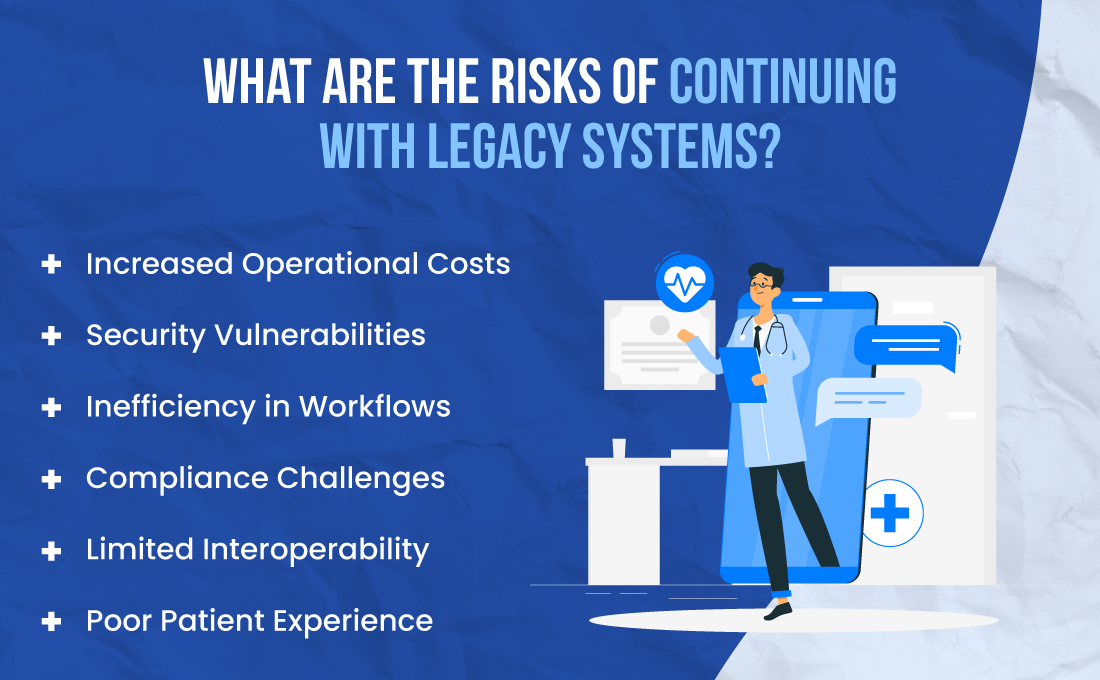
The continuous use of legacy systems in healthcare can cause several critical risks that can affect patient care, data security, and overall operational efficiency. Here are the significant risks:
1. Increased Operational Costs
Legacy systems often require extensive maintenance, manual work, and outdated hardware, leading to higher operational costs over time. These inefficiencies drain resources that could be invested in modernizing infrastructure.
2. Security Vulnerabilities
Outdated healthcare systems are prone to cyber threats, as they lack modern security protocols. This increases the risk of data breaches, compromising sensitive patient information, and violating regulatory standards like HIPAA.
3. Inefficiency in Workflows
Legacy systems are not designed to handle the fast-paced demands of modern healthcare. They often require duplicate data entry, create delays in decision-making, and lead to significant inefficiencies, impacting staff productivity and patient care.
4. Compliance Challenges
Healthcare regulations evolve rapidly. Legacy systems are often not equipped to adapt to new standards, leading to compliance risks and potential fines. It results in damage to the organization’s reputation and finances.
5. Limited Interoperability
These systems struggle to integrate with newer technologies, leading to siloed data and fragmented workflows. The lack of interoperability can cause errors in patient records, hinder coordinated care, and reduce the quality of service.
6. Poor Patient Experience
Outdated patient portals and engagement tools result in a poor user experience. As a result, it can lead to missed appointments, decreased patient engagement, and dissatisfaction with the care process.
7. Inability to Scale and Innovate
Legacy systems are rigid and difficult to scale, which makes it even more challenging for healthcare organizations to grow or adopt new technologies, such as AI, telemedicine, or data analytics. This lack of flexibility limits innovation and a competitive edge in the market.
Is Your Organization Running on Legacy Systems?
Various healthcare organizations continue to operate on legacy systems without realizing the extent of their limitations. With the early signs recognition, you can make proactive decisions before issues become critical.
Here are some clear indicators that your healthcare system may be run on outdated technology:
- When your systems are over 8-10 years old and built on obsolete platforms like Unix or unsupported Windows versions.
- Integration is difficult or impossible with newer healthcare technologies like EHR, AI-driven diagnostics, or telehealth platforms.
- You relied on manual workarounds because your system does not support automated processes or implement security standards like HL7.
- Security updates are no longer available, which exposes your data to HIPAA or other compliance issues with healthcare regulations.
- Maintenance costs keep increasing, and your IT team spends more time fixing bugs rather than enhancing performance.
- Vendors have stopped supporting your software or hardware, which makes upgrades or fixes nearly impossible.
Understand the Hidden Cost Behind Digital Debt in Healthcare
Digital debt in healthcare indicates the growing gap between outdated technologies and modern patient care demands. While legacy software solutions may still work, but the cost goes beyond basic maintenance. Apparently, it silently drains financial, operational, and human resources.
Let’s understand the types of healthcare digital debt, a hidden cost you must know before modernizing legacy systems in healthcare for your project.
Types of Digital Debt in Healthcare:
- Technical Debt
As the name suggests, technical debt signifies an outdated tech stack that healthcare organizations no longer use. It is because of resource shortages, cost constraints, and older digital versions.
It is often based on a platform that doesn’t support modern features like AI, cloud integration, and Machine Learning. Moreover, the longer these systems remain in place, the harder it becomes to integrate new solutions, resulting in costly and complex future upgrades.
For instance, if a healthcare provider continues to rely on a legacy Electronic Health Record (EHR) system with limited interoperability, it may struggle to integrate with telemedicine platforms, patient portals, or new clinical decision support systems.
- Data Debt
Data debt occurs when patient records, clinical data, and operational information are stored in a fragmented or disorganized manner. In several cases, legacy systems have led to incomplete, inaccurate, or inaccessible data, which can severely impact patient care, decision-making, and compliance with healthcare regulations.
Without a single source of truth, medical professionals may struggle to gain a comprehensive view of a patient’s medical history, leading to poor clinical decisions and delayed treatments.
For instance, if patient data isn’t regularly updated or synchronized, it may lead to errors in diagnosis or treatment plans, jeopardizing patient safety.
- Innovation Debt
Innovation debt occurs when healthcare organizations are unable to adopt modern tools or technologies due to their reliance on legacy systems. As a result, it creates a roadblock to implementing newer solutions like AI-powered diagnostics, predictive analytics, and cloud-based health platforms.
Moreover, your healthcare organization can fall behind in technological advancements and its ability to stay ahead of the curve. This can also restrict compliance with transforming healthcare standards.
For instance, if a healthcare organization is still using a legacy system that doesn’t support AI integration, it misses out on opportunities to enhance clinical decision-making or improve operational efficiency through automation.
- Escalating Modernization Costs
As technology continues to evolve, the cost of modernizing legacy systems grows exponentially. The longer healthcare organizations delay upgrades or replacements, the more complex and expensive the process becomes.
Eventually, the effort required to overhaul an entire system to meet current standards can exceed the cost of incremental upgrades, leading to higher expenses.
For instance, a mid-sized hospital that postponed its EHR modernization for over a decade had to invest over $3.5 million in a complete system replacement, more than double the projected cost had they started. Moreover, the downtime, training, and data migration challenges further compounded the costs.
Healthcare Modernization Approaches: What are Your Options?
Modernizing legacy systems in healthcare is not a one-size-fits-all. In fact, it depends on your system’s condition, business needs, and budget. The following are the different approaches you can choose from to bring your healthcare IT up to speed.
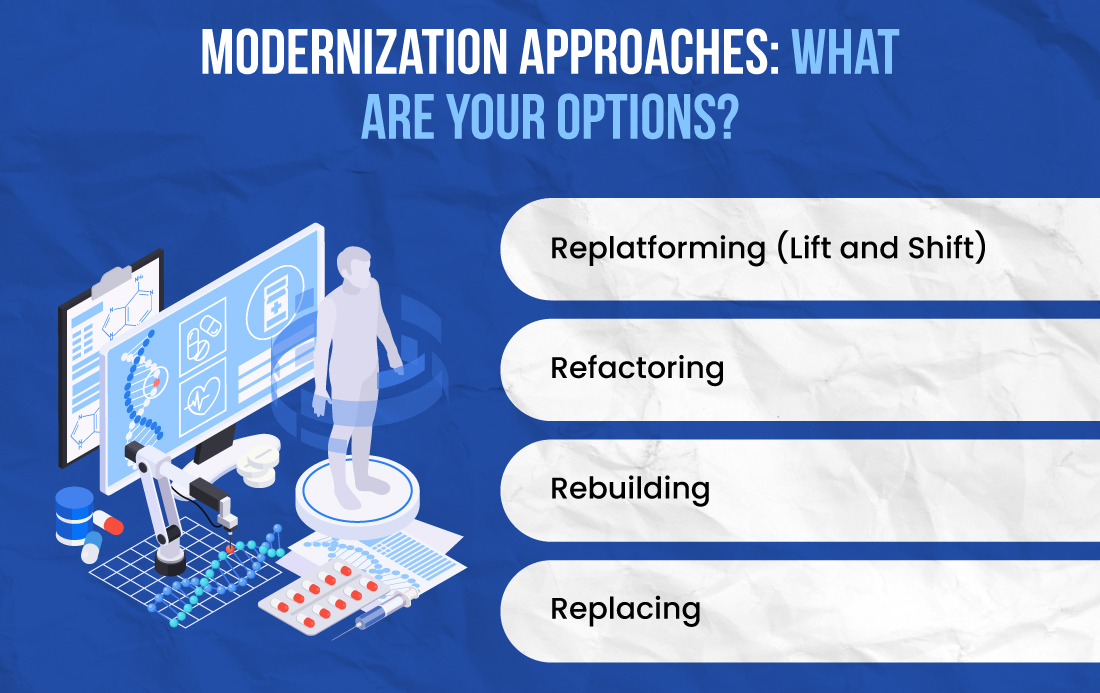
This method moves your existing application to a new infrastructure, usually the cloud, without changing the application’s core code.
Use case: When your system works fine but needs better scalability or reliability.
Benefits:
- Faster and less expensive than a full rebuild
- Improves performance and flexibility
- Minimal disruption to existing workflows
Example: Move an old EHR system from on-premise servers to AWS or Azure for better uptime and scalability.
2. Refactoring
Refactoring means restructuring the existing code to improve performance, security, and maintainability without changing its core functionality.
Use case: When your system is still helpful but has an outdated or clunky architecture.
Benefits:
- Improves system speed and security
- Reduces future maintenance costs
- Makes your platform easier to integrate with modern tools
Example: Upgrading code in a legacy PACS to support faster image retrieval and modern data standards.
3. Rebuilding
In legacy systems in healthcare, this approach involves recreating the entire system from scratch using new technology and architecture, often with added or improved features.
Use case: When your current system is too outdated or can’t support future needs.
Benefits:
- Tailored to your current and future requirements
- Full control over design, functionality, and scalability
- Enables the use of modern interfaces, AI, and mobile support
Example: Building a custom cloud-native telemedicine platform to replace an outdated communication system.
4. Replacing
Replacing in healthcare legacy system modernization approaches means retiring your legacy medical system entirely, and adopting an off-the-shelf legacy healthcare solution.
Use case: When your current system is no longer usable or supported, and a modern alternative already exists.
Benefits:
- The fastest way to adopt modern features
- Often includes vendor support and updates
- Meets compliance and integration standards out of the box
Example: Switching from a custom-built billing software to a modern HIPAA-compliant SaaS billing solution.
Challenges in Modernizing Healthcare Legacy Systems
Modernizing healthcare systems requires switching from old software to new, but hurdles come when it involves navigating people, technology, budgets, and regulations. Below are the common challenges healthcare providers face during the transition:
- Staff resistance to change due to unfamiliar interfaces or fear of losing control over workflows.
- Training requirements for clinical and administrative teams to adapt to new tools and features.
- Data migration risks include loss, duplication, or misalignment during system transfer.
- System downtime can disrupt patient care if not properly planned and phased.
- Vendor lock-in from outdated proprietary systems makes integration with new tools complex.
- Budget limitations prevent timely investment in scalable and secure infrastructure.
- Lack of executive alignment or unclear healthcare modernization goals that stall decision-making.
- HIPAA compliance concerns must be maintained throughout the migration process.
Can’t afford downtime while upgrading legacy systems?
Our healthcare web development company ensures seamless modernization with zero disruption to your critical services.
How to Plan a Smooth Healthcare Modernization Transition: Step-by-Step Guide
Modernizing legacy healthcare systems is a complex process that requires careful planning and coordination. To avoid disruption and maximize value, follow these structured steps:
Step 1: Assess Your Current Systems
Begin with a thorough audit of your existing IT infrastructure, data architecture, and software systems. It contains identification of performance gaps, integration issues, and compliance risks.
Step 2: Define Clear Modernization Goals
Set specific goals that align with your organizational objectives, whether it is about improving patient outcomes, enhancing data security, or increasing operational efficiency.
Step 3: Build a Cross-Functional Team
Bring together stakeholders from IT, clinical departments, administration, compliance, and executive leadership to ensure shared responsibility and smooth decision-making.
Step 4: Choose the Right Technology and Partners
Select modern and innovative solutions that align with your business goals. Connect with vendors who have proven experience in healthcare system modernization and regulatory compliance.
Step 5: Start With a Pilot Project
Test new systems on a smaller scale to evaluate performance, usability, and workflow fit. Use the results to refine processes before deploying them organization-wide.
Step 6: Train Staff and Prepare for Change
Create a structured training program to upskill staff and address resistance. It provides continuous support to ease the transition and promote adoption.
Step 7: Monitor, Measure, and Improve
Track key performance indicators (KPIs) and gather feedback from users. You can use this data to make iterative improvements and ensure the modernization delivers its intended value.
Healthcare System Modernization Case Study: Success Example
This case study showcases how Medikcare Health Providers tackled legacy systems in healthcare by modernizing their system through a structured 4-phase journey. Also, how our modernizing healthcare system approach improved patient care, operational efficiency, and regulatory compliance.
Phase 1: Assessment and Awareness
MedikCare recognized critical challenges: fragmented workflows, outdated tech infrastructure, and compliance concerns. Disconnected systems were hindering data sharing and operational efficiency.
Phase 2: Strategic Modernization Planning
Partnering with Bacancy, the organization developed a robust modernization roadmap utilizing Microsoft Azure. The plan emphasized scalable architecture, seamless integration, and secure cloud adoption.
Phase 3: Seamless Implementation
With careful coordination, Bacancy deployed Azure Logic Apps for workflow automation, Azure Functions for real-time event processing, and Azure Active Directory for unified, secure access. Integration with legacy systems was achieved through Azure API Management, ensuring continuity and compliance.
Phase 4: Measurable Transformation
Post-modernization, MedikCare saw a significant improvement in system performance, cost efficiency, data security, and user experience. Staff productivity rose, while IT overhead and downtime dropped notably.
How Bacancy Can Enhance Modernized Legacy Systems in Healthcare?
Modernizing outdated healthcare systems is no longer just a tech upgrade; it’s also about improving care, boosting efficiency, and staying compliant. At Bacancy, our healthcare experts specialize in turning legacy IT challenges into future-ready healthcare solutions.
Here’s how we help:
➜ Assess Your Legacy Infrastructure
We begin by auditing your current systems to spot inefficiencies, risks, and areas holding back innovation.
➜ Build a Modernization Roadmap
We tailor a strategy that aligns with your clinical, operational, and compliance goals, whether it’s a full rebuild or a phased approach.
➜ Migrate Without Disruption
From EHRs to billing systems, we ensure smooth data migration with zero downtime and strict adherence to HIPAA and regulatory standards.
➜ Cloud-Powered Scalability
We move your systems to secure cloud platforms like AWS or Azure, ensure better access, faster performance, and long-term cost savings.
➜ Boost Communications
Our team connects fragmented systems and allows data to be shared seamlessly between departments, providers, and even patient apps.
➜ Add Modern Capabilities
From telemedicine features to AI-based analytics and mobile patient portals, we enhance your ecosystem to deliver smarter care.
➜ Train and Support Your Teams
We guide your staff through the new systems, offer training, and help them stay involved post-launch for ongoing optimization.
Why Bacancy for Healthcare Modernization?
✔ Proven experience with healthcare IT
✔ Expertise in cloud, compliance, and custom development
✔ End-to-end support- from planning to long-term success
Conclusion
Legacy systems may have served healthcare well in the past, but they weren’t built for today’s data-driven and patient-centric environment. The longer organizations hold onto outdated tech, the greater the cost, not just in dollars but also in terms of efficiency, care quality, and compliance risk.
Modernization of the healthcare system is a technical upgrade and strategic move toward better outcomes, streamlined operations, and future-proof care delivery. Whether it is cloud integration or the implementation of secure telehealth services, adapting modern legacy systems in healthcare has become more crucial than ever.
Moreover, partner with a team of healthcare mobile app development company that understands both healthcare and technology. It transforms your legacy systems into smart, scalable, and secure solutions.
Frequently Asked Questions (FAQs)
Here are the powerful reasons that indicate when and why you should modernize your healthcare systems:
Strategic drivers for better patient care, improved interoperability, and reduced costs.
Regulatory triggers to compliance updates, audit findings.
Competitive advantage assists data analytics, patient apps, and AI tools.
It is extremely crucial because maintaining legacy systems may ensure short-term stability, but modernization is essential to improve patient care, security, and scalability.
A healthcare modernization legacy system refers to the process of upgrading or replacing outdated healthcare software and infrastructure to meet modern standards.
A full modernization can take several months to a few years, it depends on the scope of transformation, data migration needs, and regulatory compliance. Agile methodologies and phased rollouts can accelerate timelines.