Quick Summary
This guide provides a comprehensive analysis of Epic integration for revenue cycle management in healthcare. It highlights the basics of RCM and EHR in relation to Epic, the challenges faced during Epic EHR integration with RCM systems, and how service providers can help healthcare organizations for the implementation of Epic into their routine processes.
Table of Contents
Introduction
Hospitals are struggling with rising operational costs, constant staff shortages, and a fragmented billing cycle. These disruptions hamper the revenue cycle, claim processing, and document management.
Sustainable revenue cycle management and EHR can resolve these challenges by implementing a modern and integrated approach. However, successful RCM implementation depends on a robust system, smooth communication, and trained staff.
Epic is the leader in EHR with a 42% market share in the USA. Its global adoption continues to shape the future of hospital information systems with AI-enabled and cloud platforms. Epic integration for revenue cycle management enables hospitals to align with clinical and financial processes, streamlining billing, claims, and reimbursement workflows for better accuracy and transparency.
Let’s understand how Epic can simplify complex processes, solve common RCM challenges, and help ensure smooth process management.
Understanding Epic & Revenue Cycle Management
Epic is one of the widely adopted Electronic Health Record (EHR) and Electronic Medical Record (EMR) platforms worldwide. It helps you to integrate clinical, financial, and patient engagement features. It also supports comprehensive healthcare workflows, including outpatient, inpatient, specialty care, analytics, and digital patient engagement.
Revenue Cycle Management is the streamlined process of managing the financial operations of healthcare organizations. It includes scheduling, patient registration, billing, coding, claims submission, payment collection, and post-payment analysis. In short, RCM ensures that your healthcare organization is paid accurately and promptly for services provided.
How Do EHR and RCM Systems Work Smoothly with Epic Integration?
When EHR and RCM systems are integrated with Epic, healthcare organizations can achieve seamless workflow between clinical care and financial operations. Revenue cycle management Epic integration helps eliminate duplicate data entries and reduce administrative errors.
For example, Epic routes clinical documentation directly into billing, automating coding and submission of insurance claims. This helps enhance reimbursements, minimize lost revenue, and improve compliance by keeping clinical and billing records in sync across departments.
There are diverse Epic modules available that help healthcare organizations fulfill specific requirements. Here is a table of key Epic modules and their primary purposes:
| Epic Module | Purpose |
|---|
| EpicCare Ambulatory | Place orders, visit documents, manage prescriptions, perform in-office procedures, review results, and send communication to patients. |
| ASAP | Emergency department workflow and patient flow |
| OpTime | Surgical scheduling, pre-op/intra-op/post-op management |
| Stork | Obstetrics (pregnancy, delivery documentation) |
| Radiant | Radiology workflow, imaging, reporting |
| Beacon | Oncology, chemotherapy treatment plans, and administration |
| Willow | Pharmacy management (inpatient and outpatient) |
| MyChart | Patient portal, communication, and access to health records |
| Healthy Planet | Population health management, analytics |
| Cadence | Scheduling and patient check-in |
| Beaker | Laboratory and pathology information management |
| Wisdom | Dental care workflow, planning, and scheduling |
| Phoenix | Transplant patient management |
| Prelude
| Patient registration, admissions, and insurance
|
| Grand Central
| Admission/Discharge/Transfer (ADT) management
|
| Caboodle | Data warehouse, analytics, reporting |
| Kaleidoscope
| Ophthalmology (eye care) documentation
|
| Cupid
| Cardiology management, EKG integration
|
| Haiku/Canto
| Mobile app access to Epic for providers |
| ClinDoc | Clinical documentation and reporting |
| Radar | Dashboard analytics for departments |
| Care Everywhere | Health information exchange across organizations |
How Epic Integration Solves Revenue Cycle Management Hurdles?
Epic integration for Revenue Cycle Management helps hospitals and clinics resolve the challenges by streamlining workflows between clinical and financial systems. It helps automate key processes, such as patient registration, billing, and claims submission, to reduce errors and speed up reimbursements. Let’s understand a few of the challenges resolved by Epic revenue cycle management:
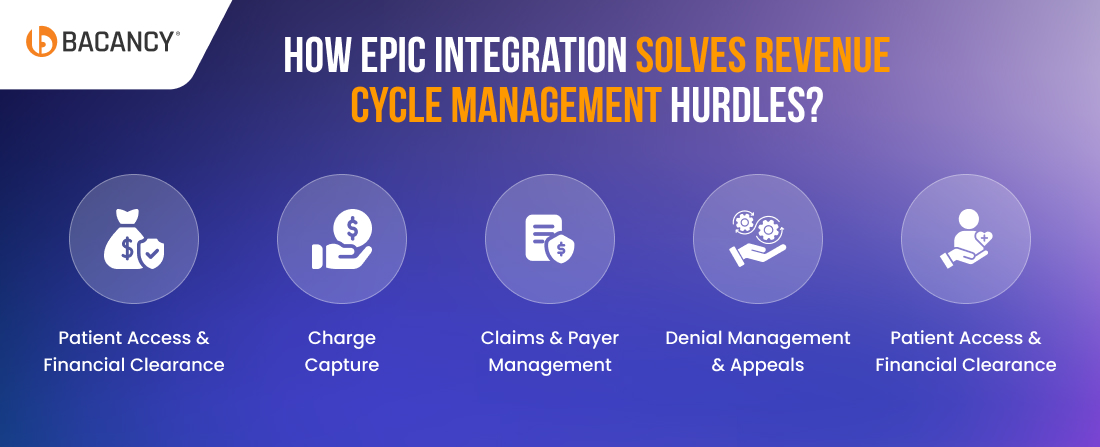
1. Patient Access & Financial Clearance (Front-End)
The errors during patient scheduling, registration, and insurance verification often lead to claim denials due to inaccurate insurance or demographic data.
Epic EHR integration with RCM systems addresses these challenges through two key modules:
-
-
- The Epic Cadence (scheduling) module helps optimize patient and provider scheduling with diverse tools like decision trees. Epic revenue cycle management support and other tools ensure efficient appointment matching based on patient needs, provider availability, and location. This helps reduce cancellations, missing appointments, and scheduling errors, thus improving patient throughput and resource utilization.
- Epic Prelude (registration) helps streamline patient registration and pre-admission workflows by automating insurance eligibility verification, pre-authorization management, and preventing duplicate records. It seamlessly integrates with payers to ensure real-time benefit verification and tracks pre-certification needs in the registration process.
Cadence and Prelude are integrated with Epic’s core EHR and other necessary modules to help smooth patient data flow between scheduling, registration, insurance verification, and billing. This ensures accurate demographic and insurance data, reducing claim denials and billing delays.
Impact and Benefits
- Instant insurance verification means providers flag coverage issues for follow-up or correction, reducing denied claims due to eligibility errors.
- Automation in pre-authorization and eligibility verification provides denial prevention to ensure smoother approvals and reduces manual workload.
- Clearing the patient’s financial transactions helps increase point of sale collections and enhance the reimbursement cycle, which improves healthcare organizations’ cash flow.
2. Charge Capture (The Clinical-to-Financial Link)
Charging in a clinical organization can be done through documents, orders, and capturing the charge preference list. To ensure the smooth flow of financial transactions, it is essential to manage them effectively.
When your staff fails to accurately maintain charges or manually enters false information, it may lead to missed revenue, claim denials, compliance risks, and delayed payments for healthcare organizations.
However, the major question is, where should you start to automate charges? The most common answer is to focus on specific automation areas that can create the most impact. Diverse areas help streamline charge capturing, improve accuracy, and reduce manual entry effort. The major ones are:
- Flowsheet-Based Charges
- Note-Based Charging
- Charge and Order Linking
- Explosion Charges
- Procedure-Based Documentation
Epic integration for RCM helps automate financial data entry using tools like Charge Router, which connect clinical documentation with the billing process.
Once the clinician completes the necessary documentation for a service, the system triggers the related charges based on flowsheet logic and procedure notes to implement charges accurately.
Costs for complex services can be bundled to ensure further accuracy, and staff can verify missed charges. Epic integration for revenue cycle management helps hospitals reduce their dependencies on manual processes and align charges with the clinical service provided.
Impact and Benefits
- Automation helps you enhance accuracy and efficiency in managing financial transactions. According to HFMA, shifting from manual approaches to a document-based charge automation can offer 65-75% accuracy. This helps you recover lost revenue by implementing Epic revenue cycle Management.
- Your clinics or hospitals can benefit from reduced manual tasks, more time to focus on patient care, and fewer reconciliation processes.
- With the Epic integration for RCM, you can avoid missed charges and reduce underpayments.
- Epic charge automation directly helps enhance the reimbursement process, reduce claim denials, and quickly process bills.
3. Claims & Payer Management
In revenue cycle management, errors in claim details, such as missing data or wrong entries, lead to denials and resubmissions, which impact cash flow and operational efficiency.
Epic Resolute gathers all relevant data from available clinical records, demographics, insurance, and charge capture modules to maximize operational efficiency and financial performance. This helps ensure claims are accurate and finalized based on complete data.
This module utilizes advanced automation and coding assistance to format the claims properly, verify insurance details, and resolve potential errors before submission.
In addition, the key feature of this module is the scrubbing process, which helps you scan claims to detect integrity issues, coding errors, and payer-specific needs so that corrections can be made in advance. Claims are submitted online to payers, reducing manual intervention and facilitating payment cycles.
Impact and Benefits
- Automated scrubbing and formatting in Epic Resolute help reduce rejected claims, increase acceptance rates, and boost the reimbursement process.
- Real-time analytics helps determine error trends, ensure proactive training, and process improvements.
- Epic revenue cycle management helps hospitals process insurance claims faster and reduce administrative costs.
- Epic’s Resolute workflow provides high-quality claims with automated pre-submission quality checks and accurate data integration, helping maximize operational efficiency and financial performance.
4. Denial Management & Appeals
Denied claims disrupt cash flow and demand experts to resolve the issues, which can lead to lost revenue if not properly tracked and managed.
Epic’s denial management module helps determine the reason for each claim denial using standardized reason codes (CARC and RARC codes) shared by payers. This system for Epic integration RMC automatically assigns each denied claim to work queues, ensuring claims are organized by denial type (e.g., eligibility, medical necessity, coding errors) and routed to an expert to resolve that issue.
In addition, integrated analytics and dashboards help track claim denial trends in real time, which allows the revenue team to spot patterns, deploy resources effectively, and automate task prioritization for claim appeals and corrective actions.
The Epic’s automated documentation features facilitate and streamline resubmission, reducing the risk of missing timelines for valid appeals.
Impact and Benefits
- By automating the workflow for denied claims, Epic integration for revenue cycle management reduces administrative delays, enables staff to focus on high-priority recoverable denials, and reduces the time it takes to resolve and resubmit claims.
- Healthcare organizations can experience improved cash flow, higher recovery rates, reduced costs, and time spent managing denials and appeals.
- Consistent claim routing and automated appeal workflows help maximize team efficiency by adhering to best practices and minimizing write-offs related to denials.
- Epic’s denial management automation helps transform manual processes into efficient, data-driven systems for smooth claim resolution and improved financial management.
5. Patient Financial Experience & Collections
Patients usually struggle to understand complex medical bills and payment responsibilities, which can lead to dissatisfaction, delayed payment, and increased inquiries.
MyChart helps establish centralized management of financial data. It enables patients to view outstanding balances, detailed charges, and price estimates in the same portal where they access their clinical data.
The portal provides up-front, personalized service cost estimates and consolidates expected charges. In addition, MyChart offers single-click bill pay, flexible payment plans, and various digital communication channels (text, email, and portal notifications), allowing patients to receive reminders and settle balances from any device.
Patients can use MyChart to set up payment plans, apply for financial assistance, and reach billing support. This helps streamline their necessary processes without contacting different departments.
Impact and Benefits
- Healthcare organizations that utilize MyChart have reported a significant increase in patient self-pay collections and reductions in billing-related calls and paperwork. This helps them grow in online payment and labor savings.
- Financial clarity and easy payment tools, facilitated by Epic integration for revenue cycle management, enhance patient satisfaction by informing them and providing support throughout the payment process.
- The digital first collection process helps increase revenue cycle and organizational efficiency by processing payments quickly with less manual intervention.
- In short, using MyChart resulted in a 20-30% increase in self-pay patient collections and a 15-25% drop in billing-related calls.
Ready to optimize the workflow that aligns with your clinical needs?
Hire Epic developers from us to get a one-stop solution to manage your hospital’s operations.
What are the Common Challenges in Epic Integration for Revenue Cycle Management
Epic integration for revenue cycle management involves a multi-stage process to ensure a smooth workflow. Still, if not managed properly, it poses technical, organizational, and operational challenges that can affect performance, cash flow, and user satisfaction.
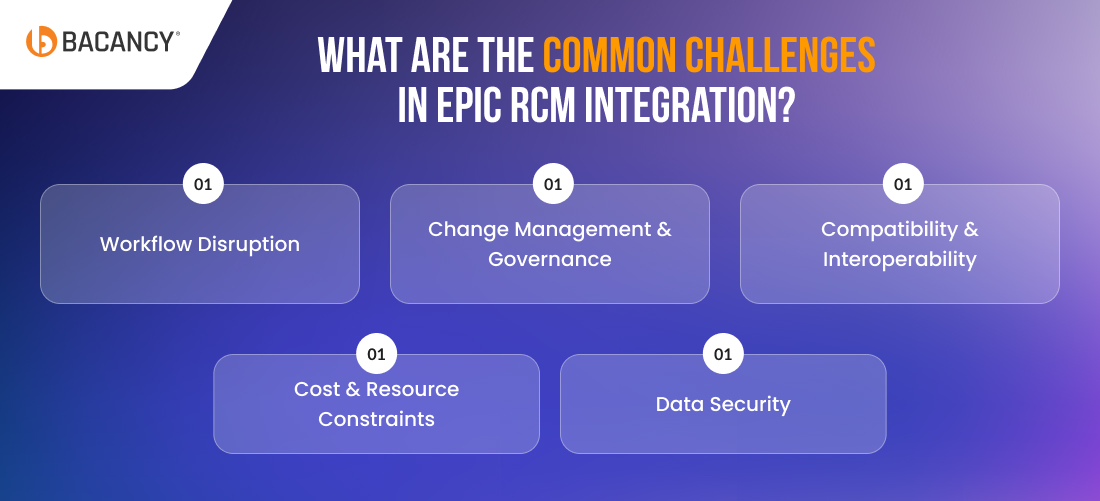
1. Workflow Disruption
Healthcare organizations may face reduced staff efficiency when migrating legacy workflows to Epic. They usually try to replicate their old processes directly into Epic revenue cycle management without redesigning the workflows for modern automation. Additionally, over-customization or replicating legacy processes can introduce complexity, making the system more difficult to maintain and train. This leads to inefficiency, sub-optimal use of Epic features, increased long-term costs, and extended go-live timelines.
2. Change Management & Governance
Change management is frequently underestimated. Migration and Epic integration for revenue cycle management impacts workflows across finance, clinical, and operations teams. Many healthcare organizations lack a strong governance structure, which leads to slow decision-making, fragmented accountability, and inconsistent system adoption.
3. Compatibility & Interoperability
Ensuring revenue cycle management Epic integration works efficiently with existing clinical, billing, and payer systems is important. However, this becomes a hurdle when disparate hardware, third-party software, or non-standard data formats are involved. These compatibility issues delay deployment, cause workflow interruptions, and can result in data silos or denial increases.
4. Cost & Resource Constraints
Epic RCM integration is resource-intensive and requires up-front and ongoing investment. Unexpected implementation hurdles can raise costs, ultimately reducing ROI and delaying the deployment. Budget overruns can impact other critical improvement efforts within the healthcare organization.
5. Data Security
New interfaces and integrations increase the risk of HIPAA violations and data breaches, particularly when encryption and access controls are weak. Hospital IT teams must ensure that all Epic integrations for RCM are HIPAA compliant, that data is encrypted, and that unauthorized access is tightly controlled to protect patient health information and avoid fines or legal exposure.
In short, hospitals struggle largely because they consider revenue cycle management Epic integration rather than a strategic transformation that requires workflow redesign, rigorous governance, interoperability analysis, realistic budgeting, and high-tech security. However, partnering with experienced Epic integration service providers helps prevent these challenges and ensure financial and operational efficiency.
Partnering with Bacancy- Epic Integration Experts
Epic EHR integration with RCM systems requires expertise and advanced skills to establish customized workflows without disrupting existing processes. You must also be facing issues integrating Epic to reduce manual processes, as one of our clients did before approaching us.
However, through our EHR consulting services and integration process, they were able to eliminate manual data entry, shorten diagnostic turnaround, and improve report accuracy. This helped them reduce lab turnaround times by 40%, compliance errors dropped, and clinicians gained instant access to necessary processes.
Partnering with Bacancy enables you to integrate EHRs with RCM systems for seamless interoperability, smooth operations, and a patient-centric digital transformation. Our team provides Epic revenue cycle management support, EMR consulting and integration services, including those for billing, laboratory, imaging, telehealth, and third-party applications, by navigating unique workflows and fulfilling compliance requirements.
With expertise in integrating Epic using HL7, FHIR, and robust API methodologies, we ensure real-time data flow that helps smooth clinical decision-making and administrative efficiency.
Our Epic integration RMC approach begins with in-depth analysis and workflow mapping, followed by secure interface configuration, rigorous testing, and ongoing monitoring for reliability and compliance. Throughout our process, we adhere to security needs and implement high-tech security protocols, including HIPAA, GDPR, and industry best practices for protecting PHI data.
So, are you ready to experience streamlined operations and superior patient care through robust Epic integration for RCM, but still restrict yourself? Connect with our Epic integration experts to establish a connected ecosystem.
Frequently Asked Questions (FAQs)
- Assess current RCM workflows before integration
- Engage stakeholders (finance, IT, clinical staff) early
- Ensure data compliance and security protocols
- Partner with experienced Epic integration specialists
- Continuous monitoring and optimization after go-live
Healthcare leaders should evaluate the success ratio of Epic integration to align with business goals and patient care priorities. They are also required to assess Epic modules and their adaptability to existing Revenue Cycle Management workflows. Additionally, leaders should verify security measures, compliance readiness, and vendor support capabilities, and develop a comprehensive plan to fulfill the desired objectives.
Compliance with HIPAA and secure data exchange using APIs and FHIR standards are essential. Epic integrations provide access controls, and regular audits protect patient information.
Modules like Resolute (Hospital and Professional Billing), Prelude (Registration and Eligibility), and Cadence (Scheduling) help to automate core RCM tasks and facilitate real-time data updates across departments.