Quick Summary
This guide covers EHR interoperability and explains how seamless data exchange enhances collaboration across care teams, prevents redundant diagnostics, optimizes operational efficiency, and ensures compliance with healthcare regulations. It also provides actionable strategies for creating a resilient, scalable, and forward-looking digital health ecosystem.
Table of Contents
Introduction
A patient arrives at your emergency department unconscious. Your team needs their medication history, allergy records, and recent lab results immediately. But those records are locked in three different EHR systems across two other health networks that don’t talk to yours.
Well, this is not a hypothetical. It is the daily reality for healthcare executives managing fragmented IT ecosystems. And it is costing organizations more than they realize in avoidable readmissions, duplicate testing, compliance risk, and administrative overhead that bleeds operational budgets dry.
EHR interoperability is the solution to this fragmentation. But for CTOs and healthcare executives, it is also a strategic investment decision, one that carries regulatory obligations, vendor complexity, and organizational change management challenges.
This guide cuts through the technical noise and gives you what you actually need: a clear-eyed view of what EHR interoperability means for your organization, challenges, and best practices to deliver real outcomes, lower costs, better compliance, and a data infrastructure ready for value-based care.
What is EHR Interoperability?
Electronic Health Record (EHR) interoperability refers to the ability of separate EHR systems to securely share, understand, and use patient health data across different healthcare organizations without the need for manual input.
In simpler words, it ensures that your hospitals, clinics, labs, pharmacies, and healthcare providers can instantly retrieve and share up-to-date patient records, regardless of the systems or technologies powering their operations.
To understand how this works in practice, EHR interoperability is structured into four progressive layers. Each layer builds on the previous one, moving from basic data exchange to full cross-organizational coordination.
The 4 Layers of EHR Interoperability
1. Foundational
Foundational interoperability allows your healthcare system to transmit data to another system and ensures the receiving system can accept it.
At this level, data exchange occurs, but the receiving system may not interpret or process the information automatically. The data may require manual review or entry before it becomes clinically actionable.
For a healthcare provider, it means your patients’ information can move between systems, but it may not yet integrate seamlessly into your clinical workflows.
2. Structural
Structural interoperability ensures that the data your system exchanges follows standardized formats and predefined structures. This allows the information to be placed into the correct fields within the receiving EHR system.
Standards developed by HL7 International support this level by defining how clinical data should be formatted and transmitted.
At this stage, your system can automatically populate lab results, medication lists, and clinical notes into the appropriate sections, reducing manual documentation and improving your operational efficiency.
3. Semantic
Semantic interoperability ensures that your healthcare system interprets exchanged data consistently and accurately.
It relies on standardized clinical terminologies and coding systems supported by organizations such as SNOMED International and LOINC.
At this level, your patients’ diagnoses, medications, allergies, and lab values retain their clinical meaning across platforms. This enables you to provide reliable decision support, run population health analytics, and coordinate treatment planning effectively.
For you, this translates into safer care delivery and improved clinical outcomes for your patients.
4. Organizational
Organizational interoperability can extend beyond your technology. It aligns with your governance frameworks, privacy regulations, data-sharing agreements, and your clinical workflows across institutions.
This level ensures that your healthcare organization can exchange information securely, comply with regulatory requirements, and collaborate effectively with other care providers.
When achieved, it allows you to support seamless transitions of care, implement value-based models, and enhance efficiency across your healthcare network.
5 Benefits of EHR Interoperability
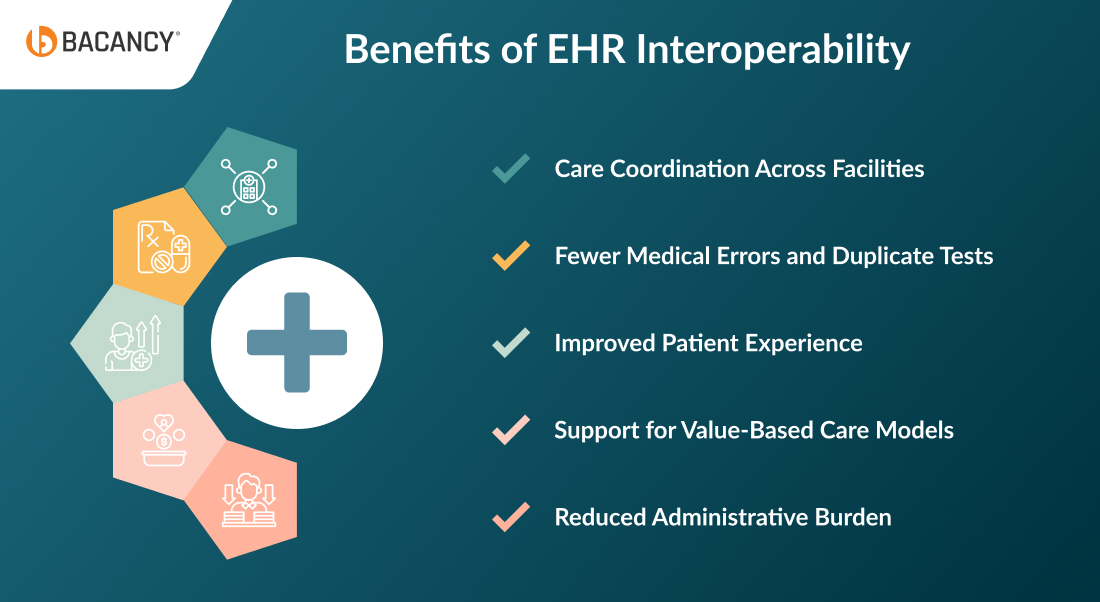
EHR interoperability transforms how you deliver care and manage clinical information across your organization. When your systems communicate seamlessly, you gain clearer visibility into patient histories, faster access to critical data, and stronger control over outcomes.
1. Care Coordination Across Facilities
Interoperability gives you and your care teams a consolidated view of each patient, even when treatment spans multiple facilities within your network or external partners.
When your hospital, specialty clinics, and diagnostic centers can access the same accurate records, you reduce communication gaps and support timely clinical decisions. This continuity strengthens collaboration across your care ecosystem.
2. Fewer Medical Errors and Duplicate Tests
When you have direct access to complete and verified patient information, you lower the risk of prescription conflicts, overlooked allergies, and incomplete treatment histories.
Your clinicians can review previous lab results and imaging reports before ordering new tests, which protects your patients and helps you control avoidable expenses.
3. Improved Patient Experience
Your patients expect consistency and efficiency at every touchpoint. Interoperability removes the need for them to repeat their medical history or carry physical reports between providers.
When you can retrieve accurate data without delay, your patients experience smoother visits, faster clinical action, and greater confidence in your organization.
4. Support for Value-Based Care Models
If you participate in value-based reimbursement programs, interoperability strengthens your ability to measure performance and demonstrate outcomes.
With comprehensive patient data at your fingertips, you can track quality benchmarks, manage risk populations, and maintain accountability across episodes of care. This positions your organization for stronger financial performance.
5. Reduced Administrative Burden
Fragmented records often increase workload for your administrative and clinical teams. Interoperability reduces this strain by enabling direct system-to-system communication.
Your staff spends less time on record retrieval, manual updates, and reconciliation tasks, which allows you to redirect resources toward patient-centered priorities.
Empower Your Organization With Interoperable Health Systems
Let our EHR developers design and implement secure, scalable integrations that strengthen care coordination and compliance.
Key Standards Powering EHR Interoperability
You do not need to implement these standards yourself, but you do need to understand them well enough to hold vendors accountable and make informed purchasing decisions. Here is what each one means in plain business terms.
| Standard | What It is
| What to Know
|
|---|
| HL7 & CDA | The foundational messaging framework most legacy EHR systems were built
| Widely adopted but aging. Many vendors still lead with HL7 v2; ask whether they are actively migrating to FHIR
|
| FHIR | The modern API-based standard for real-time data exchange
| This is the standard your vendors must support today. If a vendor cannot demonstrate FHIR R4 compliance, that is a red flag
|
| DICOM | The universal standard for medical imaging data, including X-rays, MRIs, and CT scans
| Critical if your organization shares imaging across facilities or with specialist networks. Non-DICOM systems create imaging silos
|
| SNOMED CT
| A standardized clinical terminology system is used globally
| Ensures that a diagnosis or procedure means the same thing across systems. Essential for semantic interoperability and analytics.
|
Note: Follow this checklist: When evaluating any EHR vendor, ask these three questions: (1) Are you FHIR R4 certified? (2) What is your FHIR implementation timeline for all core modules? (3) Do you support SMART on FHIR for third-party app integration?
Regulatory & Compliance You Must Follow in EHR Interoperability
Compliance in EHR interoperability is no longer a back-office function. Federal enforcement is active, penalties are financial, and the obligations sit at the leadership level. Here is exactly what matters and what you need to act on.
Data Privacy & Security
Every new integration point, FHIR API, third-party vendor, and data sharing agreement expands your HIPAA liability surface. Your security risk analysis must keep pace with every connection you add.
- Security Risk Analysis must be updated before any new integration goes live, not annually as a routine exercise
- Business Associate Agreements are required for every vendor that handles ePHI, with no contract exceptions
- Non-compliance penalties reach up to $1.9M per violation category annually
Your Action: Update your HIPAA security risk analysis with every new integration. BAAs are non-negotiable and must be part of every vendor contract before signature.
Federal Interoperability Mandates
- ONC Certification & Information Blocking Rule
Enforcement is no longer theoretical. As of July 2024, healthcare providers face direct financial penalties, and nearly 1,600 complaints have already been filed through the federal portal.
- Information blocking includes any practice that restricts, delays, or discourages access to electronic health information through technology, contracts, or internal policy
- Medicare penalty is a loss of up to 75% of your annual Medicare payment update
- MSSP exclusion applies to ACOs that commit information blocking, who become ineligible for the program for a minimum of one year
- MIPS impact results in a zero score in the Promote Interoperability performance category
USCDI v3 is the federally mandated minimum data set your certified EHR must support for health data exchange. It became mandatory on January 1, 2026.
- New required data classes include social determinants of health, expanded patient demographics, and health insurance information
- Any EHR vendor not yet USCDI v3 certified is now out of federal compliance, and so is your organization if you rely on that system
- MSSP exclusion applies to ACOs that commit information blocking, who become ineligible for the program for a minimum of one year
- Verify status independently on the ONC Certified Health IT Product List (CHPL) and do not accept roadmap promises
Note: Confirm your EHR vendor’s USCDI v3 certification status on the ONC CHPL today. You require a written attestation in your next contract renewal.
- CMS Interoperability Rule
Two direct obligations exist here, one already active and one that takes effect in 2026, with financial penalties and CMS program exclusion for non-compliance.
- Patient data access requires your systems to expose FHIR-based APIs that allow patients to retrieve their complete health information through third-party applications
- Electronic prior authorization (2026 mandate) requires prior authorization requests and responses to flow electronically through certified EHR technology via FHIR APIs, which eliminates manual phone and fax workflows
- Revenue cycle impact means organizations that delay adoption face claims delays and avoidable administrative overhead
Your Action:: Confirm your EHR vendor has both capabilities deployed and not in development. Engage your revenue cycle team on the 2026 prior authorization mandate now, not at the deadline.
TEFCA is the federal framework for nationwide health information exchange. It is already operational and not a future roadmap item.
- 500M+ health records exchanged through TEFCA as of February 2026, with the network live and growth accelerated
- Currently voluntary, but participation is on a rapid rise, and future mandates are a realistic near-term prospect
- Early movers gain a structural advantage with a nationwide data exchange capability at a lower cost than point-to-point integrations
Additional Information: Ask your EHR and integration vendors directly whether they are QHIN-connected. If not, that is a gap in your long-term interoperability strategy that belongs in your next vendor negotiation.
Clinical Coding & Data Standardization
These are vendor obligations and not something your team handles directly. Without them, data moves between systems, but neither system understands what that data actually means.
- LOINC standardizes lab results and clinical observations so they carry the same meaning across every connected system
- SNOMED CT standardizes clinical terminology that covers diagnoses, procedures, and findings to enable true semantic interoperability
- Both are explicitly required under USCDI v3 and the CMS Interoperability Rule, which makes them federal compliance expectations and not optional standards
Your Action: Require explicit LOINC and SNOMED CT support confirmation from every EHR and lab vendor. “FHIR-compliant” alone is not sufficient. Push for terminology standard attestation.
ICD-11 is the WHO’s full replacement for ICD-10. It is broader in scope and more complex in transition than anything your organization has faced in clinical codes since 2015.
- 55,000+ codes vs ICD-10’s 14,400, with a limited direct crosswalk between the two systems
- Native FHIR API support is built in, which makes it a more interoperability-ready code system by design
- US federal adoption is projected from 2025 to 2027, with no hard mandate date confirmed yet, but the ICD-10 transition showed that late preparation is expensive
- Organizations that waited for ICD-10 paid significantly more and faced major operational disruption
Note: Ask your EHR vendor for their ICD-11 readiness roadmap today. Start a preliminary impact assessment with your clinical informatics and revenue cycle teams before a federal deadline forces your hand.
Common Challenges Faced in Achieving EHR Interoperability
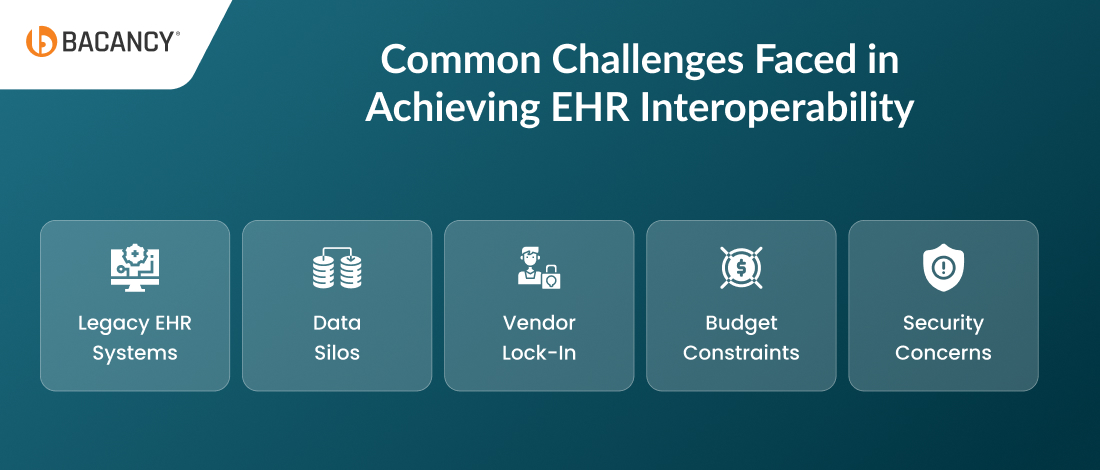
These challenges often stem from technology limitations, organizational structures, and regulatory requirements. Understanding these obstacles helps you plan more realistic and sustainable interoperability strategies.
1. Legacy EHR Systems
Many healthcare providers still rely on older EHR platforms that were not designed with interoperability in mind. These systems often lack modern data exchange capabilities and struggle to support current interoperability standards.
If your organization operates legacy systems, integration with newer platforms can require complex customization, middleware solutions, or system upgrades. This can slow down your interoperability initiatives and increase implementation complexity.
2. Data Silos
Patient information often exists in separate systems across departments such as radiology, laboratory services, billing, and clinical care. When these systems do not communicate effectively, the result is fragmented patient data.
Data silos limit your ability to gain a complete view of a patient’s health history. They also make collaboration between care teams more difficult, which can delay clinical decisions and reduce operational efficiency.
3. Vendor Lock-In
Some EHR vendors use proprietary architectures that restrict how easily their systems integrate with external platforms. As a result, your organization may face limitations when you attempt to connect with other healthcare providers, laboratories, or partner networks.
Vendor lock-in can reduce flexibility and make it harder for you to adopt new technologies or expand your digital health ecosystem.
4. Budget Constraints
Achieving full interoperability often requires investments in infrastructure, integration tools, and skilled technical resources. For many healthcare organizations, especially smaller providers, these costs can present a significant challenge.
Without proper financial planning, interoperability initiatives may progress slowly or remain limited to specific departments rather than across the entire organization.
5. Security Concerns
The exchange of sensitive health information across multiple systems raises valid concerns about data privacy and cybersecurity. Healthcare organizations must ensure that patient data remains protected during transmission and storage.
You must implement robust security frameworks, encryption protocols, and compliance measures to meet regulatory requirements, maintain patient trust, and enable data exchange.
Real-World Use Cases of EHR Interoperability
Theory is useful. Real-world outcomes are more convincing. Here is how EHR interoperability translates into tangible impact across common healthcare scenarios.
1. Emergency Care Data Access
When an unconscious patient arrives without family or ID, integrated systems pull their medication history, allergies, and prior diagnoses from connected networks in seconds. The clinical impact is faster, safer treatment decisions. The operational impact is reduced liability exposure and better documentation for claims.
2. Remote Patient Monitoring Integration
Wearable and home monitoring devices generate continuous patient data, such as blood pressure, glucose, and oxygen saturation, which feed directly into the EHR when systems are interoperable. This powers proactive chronic disease management, supports your telehealth strategy, and creates the data trail required for remote physiologic monitoring reimbursement under CMS.
3. Multi-Hospital Network Integration
For health systems managing multiple facilities, interoperability eliminates the version of patient records that exists independently at each site. A patient seen at your community hospital whose records are immediately available at your academic medical center is a patient whose care is safer and whose experience is better, and whose repeat testing costs are lower.
4. Lab & Imaging System Integration
Connecting laboratory information systems and PACS (picture archiving and communication systems) to your EHR ensures results are available in context, linked to the right patient encounter, visible to the ordering provider, and flagged for follow-up automatically. The cost savings from eliminating duplicate orders are immediate and measurable.
5. Population Health Analytics
Interoperable data at scale becomes the fuel for population health programs. When your systems aggregate clean, standardized data across your patient population, risk stratification becomes accurate, care gap identification becomes automated, and quality reporting to CMS becomes dramatically less labor-intensive.
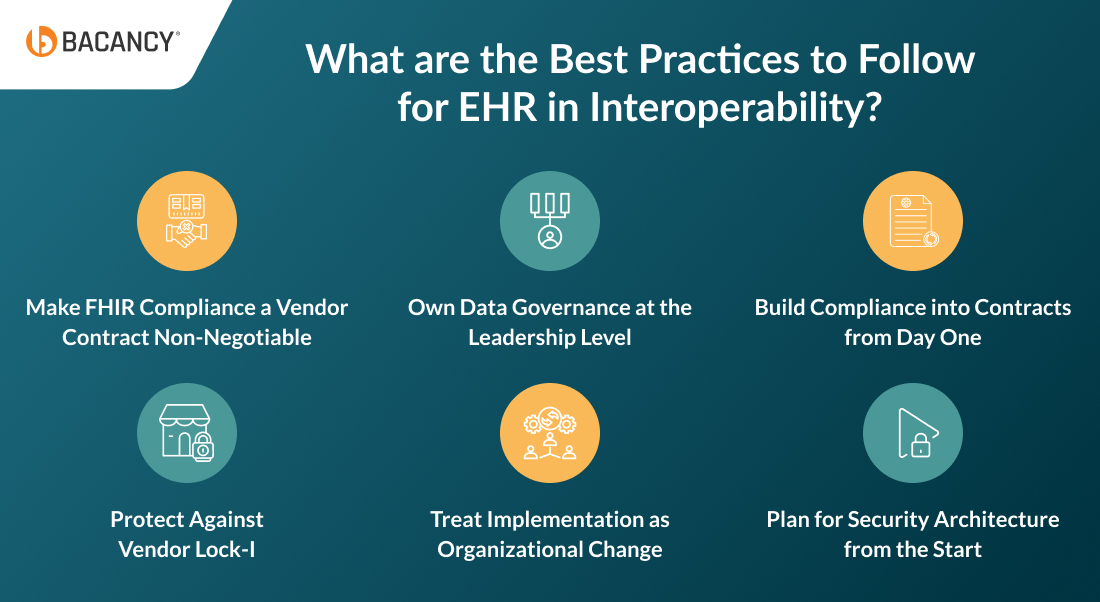
What are the Best Practices to Follow for EHR in Interoperability?
Stop accepting FHIR compliance as a roadmap promise. Require it as a contractual deliverable with specific versions, timelines, and penalty clauses for non-delivery. This shifts accountability where it belongs: to the vendor.
1. Make FHIR Compliance a Vendor Contract Non-Negotiable
Stop accepting FHIR compliance as a roadmap promise. Require it as a contractual deliverable with specific versions, timelines, and penalty clauses for non-delivery. This shifts accountability where it belongs: to the vendor.
2. Own Data Governance at the Leadership Level
Data governance failures are the most common reason interoperability projects stall after technical implementation. Executive leadership must own the policies that govern data sharing, consent management, and data quality standards. These cannot be fully delegated to IT.
3. Build Compliance into Contracts from Day One
Retrofitting compliance requirements into vendor relationships is expensive and contentious. Require ONC certification, HIPAA Business Associate Agreement terms, and information blocking compliance attestation in every vendor contract before signature.
4. Protect Against Vendor Lock-In
Proprietary integration architectures that make switching vendors prohibitively expensive are a long-term organizational risk. Insist on open standards, documented APIs, and data portability clauses. Your interoperability strategy should give you flexibility, not trap you in a single vendor ecosystem.
5. Treat Implementation as Organizational Change
The organizations that fail at interoperability implementation typically underinvest in change management. Clinicians and administrative staff need training, workflow redesign support, and visible leadership commitment to adopt new data exchange capabilities effectively. Technology without adoption is infrastructure without value.
6. Plan for Security Architecture from the Start
Every new integration point is a potential attack surface. As you open data exchange pathways, your security architecture must evolve in parallel. Zero-trust network principles, API security monitoring, and regular penetration testing are not optional add-ons; they are foundational to a sustainable interoperability program.
Conclusion
EHR interoperability plays a critical role in helping healthcare organizations create a connected, efficient, and patient-centered care environment. When your systems can securely share and access patient data across providers, labs, and healthcare networks, your teams gain the visibility they need to make faster clinical decisions, avoid duplicate tests, and improve care coordination.
At the same time, interoperability helps your organization reduce operational inefficiencies, strengthen compliance, and build a reliable data foundation that supports future healthcare innovation.
Implementing interoperability, however, requires the right strategy, standards expertise, and system integration capabilities. Through our expert EHR consulting services, healthcare organizations can simplify this complex transition and ensure their systems communicate effectively.
We help healthcare providers design and implement reliable interoperability solutions that connect diverse EHR systems. Our EHR experts enable you to transform fragmented data into actionable insights that help your organization deliver better care, operate more efficiently, and build a truly connected healthcare environment.
Frequently Asked Questions (FAQs)
Strategic and Business Impact Questions
EHR interoperability helps healthcare organizations reduce unnecessary spending caused by duplicate diagnostics, fragmented patient data, and inefficient administrative workflows. When systems exchange patient information seamlessly, providers can avoid repeated tests, shorten patient wait times, and optimize resource utilization.
Yes, interoperability enables healthcare providers to access comprehensive patient records across multiple care settings, which improves care coordination and population health management. This data continuity supports value-based care models by enabling providers to track outcomes, reduce readmissions, and measure performance throughout the care journey.
Technical and Infrastructure Questions
Application Programming Interfaces (APIs) allow different healthcare systems to communicate and exchange structured data in real time. Modern interoperability frameworks often rely on APIs built on standards like HL7 FHIR to enable secure and standardized data exchange between applications.
Legacy systems can be integrated using middleware platforms, interoperability layers, or API gateways that translate older data formats into modern standards. This approach allows organizations to maintain existing infrastructure while enabling secure data exchange with newer healthcare technologies.
Health Information Exchange (HIE) refers to the infrastructure or network that enables healthcare organizations to share data. Interoperability, on the other hand, refers to the technical ability of systems to exchange, interpret, and use that data effectively across different platforms.
Compliance and Regulatory Questions
Interoperability allows healthcare providers to securely exchange patient data while maintaining transparency and auditability. Compliance frameworks, such as the 21st Century Cures Act, require healthcare organizations to prevent information blocking and enable data access, which interoperability solutions help achieve.
Interoperable systems can enforce standardized security protocols, identity verification, and data access policies across connected platforms. This improves control over sensitive health data and ensures that only authorized users access patient records.
Operational and Implementation Questions
Successful interoperability projects usually involve multiple stakeholders, including IT leaders, clinical teams, compliance officers, and operations managers. Collaboration across departments ensures that technical integration aligns with clinical workflows and regulatory requirements.
Implementation usually takes 4-12 months, depending on system complexity and integration scope. Connecting two systems may take 3-4 months, while enterprise-wide projects involving multiple EHRs, legacy systems, and external networks can take 9-12 months.
Future Trends and Innovation Questions
Interoperability creates unified datasets across healthcare systems, which allows artificial intelligence models to analyze broader patient information. This enables better predictive analytics, early disease detection, and improved clinical decision support tools.
Yes. With interoperable healthcare systems, patients can access their medical records through digital portals and health applications. This improves transparency and allows individuals to share their data with multiple providers when needed.