Quick Summary
This blog explores the 22 best Kubernetes DevOps tools in categories such as CI/CD, deployment, monitoring, security, and cost optimization. Discover how each tool helps streamline workflows, automate operations, and scale cloud-native applications efficiently.
Table of Contents
Introduction
In the fast-paced world of cloud-native development, Kubernetes has become the go-to container orchestration platform. However, managing complex deployments, scaling applications, and ensuring smooth CI/CD workflows can be challenging without the right DevOps tools.
That’s where Kubernetes DevOps tools come in. These tools streamline automation, enhance observability, improve reliability, and make it easier to build, test, and deploy apps in a Kubernetes environment.
In this blog, we’ll explore the top 22 Kubernetes DevOps tools that can help you simplify operations, boost developer productivity, and accelerate delivery, all while maintaining security and scalability.
Top 22 Kubernetes DevOps Tools List
Explore how these 22 Kubernetes DevOps tools can help you streamline processes, enhance automation, and manage your cloud-native infrastructure more efficiently for a better workflow.
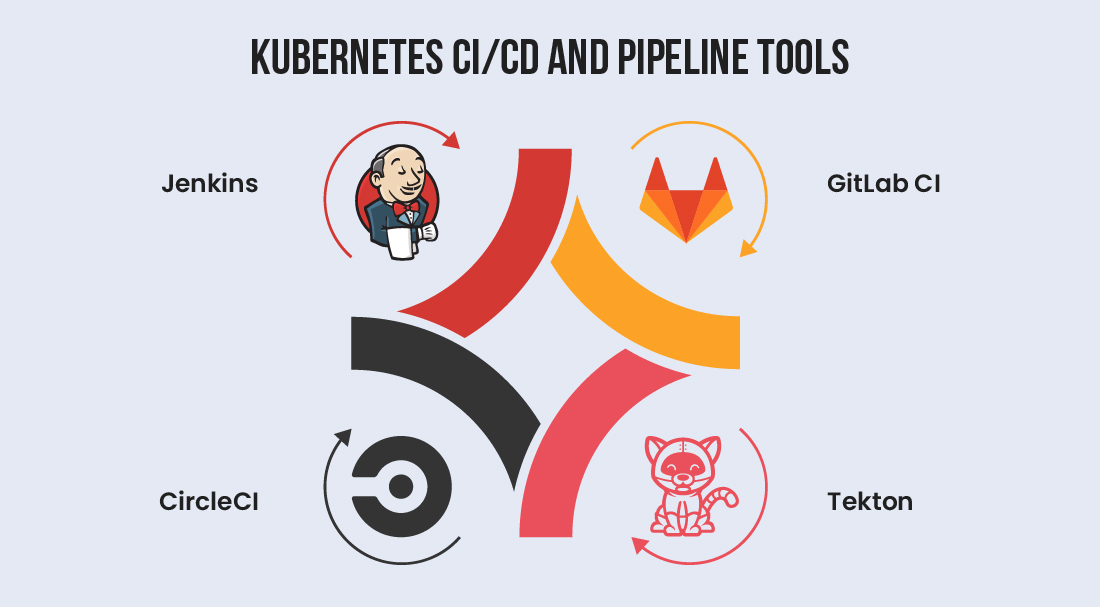
1. Jenkins
Jenkins is a popular automation server used to build, test, and deploy applications in Kubernetes environments. It dynamically provisions Kubernetes pods to run CI/CD tasks, helping teams automate every stage of delivery.
With a vast plugin ecosystem, it integrates well with most DevOps tools. Jenkins brings speed and structure to your Kubernetes workflows.
Key Features of Jenkins:
- Automates CI/CD pipelines to streamline the entire software delivery lifecycle.
- Integrates seamlessly with a wide range of DevOps tools through plugins.
- Provides real-time monitoring and notifications for build statuses.
- Ensures security with Kubernetes role-based access control (RBAC) and Lightweight Directory Access Protocol (LDAP) integration.
Ideal Use Cases:
- Automate build, test, and deployment workflows in Kubernetes environments.
- Integrate with container registries, Git repositories, and testing tools.
- Run CI/CD pipelines using dynamic Kubernetes pods.
- Manage complex delivery pipelines with multi-stage jobs and plugin integrations.
2. GitLab CI/CD
GitLab CI/CD is a built-in continuous integration and continuous delivery (CI/CD) tool within GitLab that automates the process of building, testing, and deploying applications.
As one of the widely used Kubernetes DevOps tools, it works seamlessly with Kubernetes by running pipeline tasks inside pods, making it ideal for cloud-native development and efficient DevOps workflows.
Key Features of GitLab CI/CD:
- Enables smooth version control and code collaboration within a unified interface.
- Offers built-in templates to simplify pipeline creation and deployment setup.
- Offers built-in CI/CD templates to simplify pipeline creation and configuration.
- Executes pipelines within Kubernetes pods for consistency and scalability.
- Supports secure role-based access with RBAC and LDAP integration.
- Integrates smoothly with Git repositories, container registries, and deployment tools.
Ideal Use Cases:
- Automate pipelines directly inside Kubernetes pods.
- Set up fast deployments for review and production environments.
- Manage access and roles with built-in RBAC and LDAP.
- Connect Git repositories with container registries effortlessly.
3. CircleCI
CircleCI is a Kubernetes DevOps tool that helps teams efficiently build, test, and deploy applications in Kubernetes environments. It supports reusable configuration blocks called orbs, which simplify and accelerate Kubernetes workflow setup.
With deep container integration and flexible pipelines, CircleCI simplifies complex deployments and is an excellent choice for microservices and fast-paced DevOps teams.
Key Features of CircleCI:
- Runs jobs in production-like Kubernetes environments for consistent testing.
- Supports orbs to simplify and standardize Kubernetes configurations.
- Provides secure handling of container images within CI/CD pipelines.
- Offers deep integrations with popular DevOps tools for continuous delivery.
Ideal Use Cases:
- Set up flexible Kubernetes CI/CD workflows with minimal configuration.
- Standardize Kubernetes tasks using pre-built orbs for faster setup.
- Push container images and deploy them to Kubernetes clusters.
- Automate builds and tests for microservices in cloud-native environments.
- Connect third-party tools like Helm, Docker, and Git for end-to-end delivery.
4. Tekton
Tekton is a Kubernetes-native framework designed to build custom CI/CD pipelines with modular, cloud-native workflows. It allows you to define pipelines as code, with each task and step running as a Kubernetes resource.
This approach makes workflows more modular, transparent, and easier to manage. Tekton fits well into Kubernetes environments, giving teams complete control over how applications are built and delivered.
Key Features of Tekton:
- Natively integrates with Kubernetes, ensuring cloud-native scalability and resilience.
- Defines CI/CD pipelines as Kubernetes resources (CRDs) for better reuse and version control.
- Enables event-driven pipeline triggers using Tekton Triggers.
- Seamlessly integrates with other tools like Git, Docker, and Helm.
Ideal Use Cases:
- Build Kubernetes-native CI/CD pipelines directly within your cluster.
- Standardize and reuse pipeline components across teams using CRDs.
- Automate deployments triggered by Git events or external webhooks.
- Customize complex delivery workflows for microservices and containerized apps.
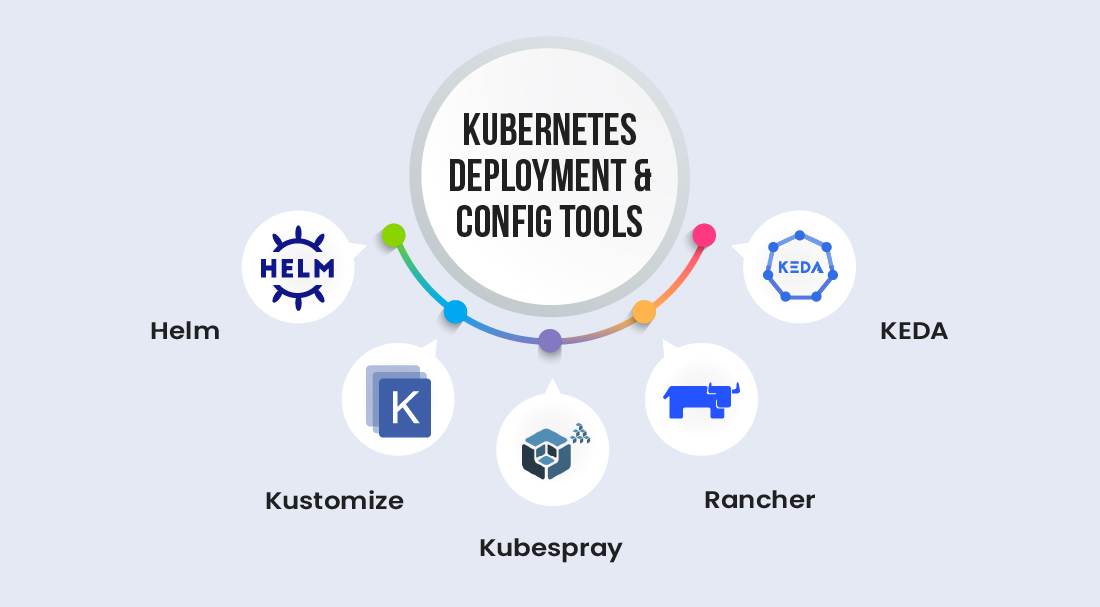
5. Helm
Helm is a Kubernetes DevOps tool that simplifies application installation and management by using reusable packages called charts. These charts allow for consistent and efficient deployment across different Kubernetes environments and clusters.
Helm helps standardize configurations and reduces the complexity of managing Kubernetes resources. This makes it easier for teams to deploy and maintain applications reliably at scale.
Key Features of Helm:
- Defines, installs, and upgrades Kubernetes applications using Helm charts.
- Package applications with all dependencies into reusable YAML-based charts.
- Simplifies the deployment of multi-service applications and microservices.
- Supports version control and rollback of application releases.
Ideal Use Cases:
- Deploy complex Kubernetes applications quickly with standardized templates.
- Create reusable, shareable DevOps workflows for Kubernetes environments.
- Maintain consistency across development, staging, and production environments.
- Roll back failed deployments effortlessly using Helm’s release history.
6. Kustomize
Kustomize is one of the popular Kubernetes DevOps tools that manages configuration variations without using traditional templates. It allows teams to maintain base YAML configurations and apply custom overlays, such as patches and variable substitutions, for different environments like development, staging, and production.
This makes it easier to manage Kubernetes configurations as code, especially in large-scale, multi-environment setups.
Key Features of Kustomize:
- Allows fine-grained customization by applying selective overlays to specific Kubernetes configuration parts.
- Facilitates unified resource sharing across diverse configurations to reduce redundancy.
- Integrates smoothly with GitOps workflows for managing Kubernetes configurations as code.
- Provides plugins and extensions for enhanced functionality and integration with Kubernetes tools.
Ideal Use Cases:
- Manage environment-specific configurations easily with overlays and patches.
- Implement GitOps by tracking configuration changes in version control systems.
- Share and reuse common Kubernetes resources across multiple deployments.
- Extend Kubernetes configuration management with plugins and integrations.
7. Kubespray
Kubespray is a Kubernetes DevOps tool that automates the deployment of clusters across cloud and on-premises environments. It leverages tools like Ansible, Terraform, Helm, and Kustomize to provision, configure, and scale Kubernetes clusters with consistency and repeatability.
Designed for flexibility, Kubespray supports multi-cloud and hybrid deployments, making it a reliable choice for production-grade Kubernetes setups.
Key Features of Kubespray:
- Automates the provisioning and configuration of Kubernetes clusters.
- Supports popular infrastructure-as-code tools like Ansible and Terraform.
- Integrates with Helm and Kustomize for streamlined resource management.
- Cloud-agnostic, compatible with AWS, GCP, Azure, OpenStack, and bare metal.
Ideal Use Cases:
- Automate Kubernetes cluster deployment on any cloud platform or on-premises.
- Manage cluster lifecycle tasks with infrastructure-as-code tools like Ansible and Terraform.
- Handle cluster upgrades and scaling with minimal manual intervention.
- Deploy consistent Kubernetes environments using Helm charts and Kustomize.
8. Rancher
Rancher is an open-source platform that makes deploying and managing Kubernetes clusters easier. It offers a centralized dashboard to control multiple clusters across environments.
With built-in tools for security, monitoring, and app deployment, it simplifies day-to-day operations. Rancher is perfect for teams managing Kubernetes at scale.
Key Features of Rancher:
- Automated provisioning of Kubernetes clusters on various infrastructures.
- Built-in tools for monitoring and logging Kubernetes environments.
- Simplified application deployment and lifecycle management on Kubernetes clusters.
- Tools for enforcing security policies and ensuring compliance across clusters.
Ideal Use Cases:
- When managing multiple Kubernetes clusters from a single platform.
- To automate cluster provisioning across cloud, on-premises, or hybrid environments.
- When you want to simplify deploying and managing applications across clusters.
- To enforce consistent security and compliance policies at scale.
9. KEDA
KEDA (Kubernetes-based Event-Driven Autoscaling) adds event-driven scaling to Kubernetes workloads. It works with the Horizontal Pod Autoscaler to scale pods based on external events like messages, database activity, or queue length.
This ensures your apps scale only when needed. KEDA helps improve performance while keeping cloud costs under control.
Key Features of KEDA:
- Automatically scales applications based on events, optimizing responsiveness.
- Provides a library of over 50 scalers for platforms, databases, messaging systems, and more.
- Enables scale-to-zero, reducing resource usage and environmental impact.
- Offers seamless integration to run and scale Azure Functions on Kubernetes for production workloads.
Ideal Use Cases:
- When you need event-driven, automatic scaling for Kubernetes workloads.
- If your applications rely on various external systems, like databases or messaging queues.
- When implementing scale-to-zero to save costs during idle periods.
- To run serverless workloads like Azure Functions within Kubernetes clusters.
10. Flux CD
Flux CD is a GitOps tool that automates Kubernetes deployments by syncing your cluster with Git. It applies changes directly from version control to keep your environments consistent and traceable.
This reduces manual intervention and ensures reliable, secure workflows, allowing teams to deliver updates faster with confidence.
Key Features of Flux CD:
- Automatically deploys applications by syncing with Git repositories, including automated container image updates.
- Integrates with GitHub, GitLab, Bitbucket, container registries, and CI/CD tools.
- Enforces Kubernetes security best practices using pull-based deployments and least privilege access.
- Supports multi-cluster environments with centralized control and integration with Cluster API.
Ideal Use Cases:
- Implement GitOps workflows for automated application deployment and updates.
- Integrate Kubernetes with Git and container registry platforms for traceable releases.
- Enforce secure, pull-based deployment mechanisms in line with Kubernetes best practices.
- Manage multiple Kubernetes clusters with centralized control and policy enforcement.
11. Prometheus
Prometheus is a powerful open-source Kubernetes DevOps tool designed for collecting and storing time-series data. It automatically scrapes metrics from Kubernetes services, nodes, and pods to offer deep visibility into your infrastructure’s health and performance.
It’s commonly used to create alert rules and trigger autoscaling, making it essential for maintaining cluster stability and responsiveness.
Key Features of Prometheus:
- Automatically discovers and collects metrics from Kubernetes pods, services, and nodes.
- Creates dynamic dashboards for visualizing collected metrics in real time.
- Supports automatic scaling and remediation actions based on Kubernetes events and operational statuses.
- Backed by a vibrant community with extensive documentation and deployment resources.
Ideal Use Cases:
- Monitor Kubernetes cluster health and performance through detailed metrics collection.
- Visualize real-time data for proactive operations and troubleshooting.
- Automate scaling and remediation based on live cluster events.
- Integrate with various Kubernetes components and third-party systems for comprehensive monitoring.
12. Grafana
Grafana is a visualization and analytics platform widely used as a Kubernetes DevOps tool. It works with data sources like Prometheus to display real-time metrics in customizable dashboards, helping teams understand performance trends and detect issues visually.
Grafana simplifies monitoring by providing intuitive visual feedback across all Kubernetes layers, from pods to clusters.
Key Features of Grafana:
- Customizes dashboards with interactive panels tailored to specific metrics.
- Integrates seamlessly with Prometheus and other data sources for smooth connectivity.
- Provides detailed insights into resource usage, application performance, and user activity.
- Allows marking important events like deployments directly on graphs for enhanced analysis.
Ideal Use Cases:
- Visualize and analyze metrics collected from Kubernetes and other systems.
- Combine data from multiple sources, like Prometheus, for comprehensive views.
- Track resource utilization and application health to optimize performance.
- Correlate critical events with metrics to improve troubleshooting and decision-making.
13. Thanos
Thanos extends Prometheus by offering long-term storage, high availability, and centralized querying across clusters. It keeps your monitoring data scalable and reliable.
With global query support and archival features, Thanos ensures consistent observability. It’s useful when Prometheus alone isn’t enough for growing environments.
Key Features of Thanos:
- Stores Prometheus metrics in a scalable and fault-tolerant way.
- Enables querying metrics across multiple Prometheus instances and clusters.
- Supports long-term retention and archival of Prometheus metrics data.
- Ensures high availability for metrics querying and visualization services.
Ideal Use Cases:
- When you need scalable and reliable storage for Prometheus metrics.
- To aggregate and query metrics from multiple Prometheus instances or clusters.
- For long-term retention and archival of monitoring data.
- To ensure continuous observability and avoid data loss during Prometheus downtime.
14. Datadog
Datadog is a full-stack observability tool that monitors Kubernetes metrics, logs, and events in one place. It integrates easily with clusters to collect real-time data for analysis and troubleshooting.
Datadog simplifies operations with pre-built dashboards, smart alerts, and detailed log analysis. It is excellent for managing large-scale, dynamic Kubernetes environments.
Key Features of Datadog:
- Provides dashboards, alerts, and log management tailored for Kubernetes environments.
- Automatically collects metrics from Kubernetes resources to monitor performance.
- Centralizes logs for easier troubleshooting and analysis across clusters.
- Offers pre-built dashboards for Kubernetes monitoring, namespace mapping, and cluster troubleshooting.
Ideal Use Cases:
- When you need centralized log management across multiple clusters.
- For faster troubleshooting and root cause analysis in complex Kubernetes environments.
- To leverage pre-built monitoring templates and reduce setup time.
- When working with highly dynamic Kubernetes environments, real-time tracking is required.
Ensure smooth performance and reliability across your cloud-native infrastructure.
Hire Kubernetes developers and build scalable, observable, and well-monitored systems.
15. KubeCost
KubeCost is a Kubernetes cost monitoring and optimization tool that helps teams track real-time cloud spending. It breaks down costs by namespace, workload, and resource usage to reveal where your budget is going and how to optimize it.
By offering actionable insights and budget alerts, KubeCost helps prevent overspending and supports efficient cloud cost optimization in Kubernetes environments.
Key Features of KubeCost:
- Breaks down costs by namespace, deployment, service, or label to identify cost drivers.
- Provides up-to-date information on current spending for proactive cost management.
- Offers recommendations to reduce waste and optimize resource usage.
- Sends alerts for unusual spending patterns or budget breaches.
Ideal Use Cases:
- Enable proactive management and optimization of cloud costs.
- Identify inefficient resource usage and reduce waste effectively.
- Generate accurate cost reports for budgeting and forecasting.
- Receive alerts to monitor unexpected cost spikes or budget limits.
Read more: Kubernetes Cost Optimization.
16. Istio
Istio is an open-source service mesh platform tailored for Kubernetes DevOps tools. It excels in managing traffic, enforcing security policies, and boosting observability for microservices within Kubernetes clusters.
By enabling secure communication and efficient service management, Istio plays a pivotal role in ensuring the reliability and security of cloud-native applications.
Key Features of Istio:
- Secures service-to-service communication using mTLS encryption, access control, and policy enforcement.
- Enables observability through monitoring, logging, and tracing of microservices interactions.
- Enhances service resilience with circuit breaking, rate limiting, and fault injection.
- Integrates seamlessly with Kubernetes for deploying and managing microservices applications.
Ideal Use Cases:
- Manage complex microservices traffic with fine-grained control and routing.
- Gain deep insights into microservices behavior through observability tools.
- Improve service reliability with fault tolerance and rate-limiting features.
- Deploy and operate microservices efficiently on Kubernetes environments.
17. Weave Net
Weave Net is a simple, secure networking solution for connecting and managing containers and microservices across multiple hosts. It offers a network fabric that extends across various environments, ensuring smooth communication between services.
As a part of Kubernetes DevOps tools, Weave Net enhances the networking capabilities essential for efficient container orchestration and microservices management.
Key Features of Weave Net:
- Provides encrypted communication between containers for secure networking.
- Supports large-scale deployments with efficient network management.
- Automatically discovers and connects containers within the cluster.
- Fully compatible with Kubernetes for seamless container orchestration.
Ideal Use Cases:
- Enable encrypted communication between containers in Kubernetes.
- Manage networking for large-scale Kubernetes deployments.
- Ensure automatic discovery and connectivity of containers.
- Integrate container networking seamlessly with Kubernetes environments.
18. Calico
Calico delivers high-performance networking and network security for Kubernetes workloads. It supports fine-grained access control using flexible policies.
Whether in cloud or hybrid environments, it scales easily while securing traffic. Calico is ideal for secure, large-scale Kubernetes networking.
Key Features of Calico:
- Supports high-performance networking for large-scale Kubernetes deployments.
- Enforces detailed network security policies for granular access control.
- Adapts to various deployment models, including cloud and on-premises environments.
- Integrates seamlessly with Kubernetes and other orchestration platforms.
Ideal Use Cases:
- Deliver high-performance networking for large or complex Kubernetes environments.
- Implement fine-grained network security policies across your clusters.
- Support hybrid deployments spanning cloud and on-premises infrastructure.
- Integrate networking solutions with Kubernetes and other orchestration tools.
19. Falco
Falco is a runtime security tool for Kubernetes that detects suspicious behavior in containers. It monitors system calls and alerts on unusual activities, helping teams secure workloads in real time.
By integrating natively with Kubernetes, Falco enforces security policies and supports compliance across containerized environments.
Key Features of Falco:
- Detects and alerts on abnormal behaviors and security threats within containers.
- Integrates natively with Kubernetes to monitor and secure containerized workloads.
- Enforces security policies and regulatory compliance within Kubernetes clusters.
- Offers auditing capabilities to support compliance requirements.
Ideal Use Cases:
- Monitor Kubernetes environments continuously for security threats and anomalies.
- Detect and respond to suspicious container behaviors in real time.
- Secure container workloads with native Kubernetes integration.
- Enforce security policies and maintain compliance across clusters.
20. Aqua Security
Aqua Security is a comprehensive security solution for Kubernetes that safeguards containerized applications throughout their lifecycle. It identifies vulnerabilities, enforces runtime policies, and ensures compliance across workloads.
By embedding security into CI/CD pipelines and supporting DevSecOps practices, Aqua helps maintain secure and scalable Kubernetes environments.
Key Features of Aqua Security:
- Protects running containers and Kubernetes workloads against cyber threats.
- Automates compliance checks and enforces security policies across Kubernetes clusters.
- Facilitates rapid incident response and forensic analysis within Kubernetes environments.
- Integrates security into the DevOps pipeline for continuous monitoring and enforcement.
Ideal Use Cases:
- Identify and manage vulnerabilities in containerized applications and Kubernetes clusters.
- Automate compliance auditing and policy enforcement in Kubernetes environments.
- Respond quickly to security incidents with detailed forensic insights.
- Embed security into DevOps processes for continuous protection and compliance.
21. KubeVirt
KubeVirt is a virtualization extension for Kubernetes that enables users to run and manage virtual machines (VMs) alongside containerized applications within the same Kubernetes cluster.
It bridges the gap between traditional VM workloads and modern containerized environments, enhancing Kubernetes as a versatile DevOps platform.
Key Features of KubeVirt:
- Manages virtual machines and containers within a unified Kubernetes platform.
- Supports live migration of VMs between cluster nodes for seamless availability.
- Shares compute resources efficiently between VMs and containers for better utilization.
- Provides high availability and fault tolerance for virtual machine workloads.
Ideal Use Cases:
- Run and manage both VMs and containers on a single Kubernetes platform.
- Migrate virtual machines live between nodes without downtime.
- Optimize resource usage by sharing compute resources across VMs and containers.
- Integrate VM management into existing Kubernetes workflows and tooling.
22. Telepresence
Telepresence is a developer-centric Kubernetes DevOps tool that connects local development environments to remote Kubernetes clusters. It proxies traffic between your machine and the cluster, allowing you to run, test, and debug services locally as if they were deployed remotely.
By eliminating the need to push every code change to the cluster, Telepresence accelerates development cycles and streamlines Kubernetes-based workflows.
Key Features of Telepresence:
- Enables live code changes locally that are instantly reflected in the Kubernetes environment.
- Reduces the need for separate development setups by leveraging the cluster for testing and debugging.
- Optimizes cloud costs by eliminating redundant development environments and databases.
- Speeds up iteration cycles by allowing rapid development and debugging within Kubernetes.
Ideal Use Cases:
- Develop and test applications locally while connected to a remote Kubernetes cluster.
- Make live code changes that are immediately reflected in the Kubernetes environment.
- Eliminate the need for separate test environments by leveraging the existing cluster.
- Reduce cloud costs by minimizing duplicate environments and resources, supporting effective cloud cost optimization.
Conclusion
Kubernetes DevOps tools simplify automation, workload management, and scaling in today’s fast-paced cloud environments. But with so many tools available, finding the right fit and configuring them correctly can be overwhelming.
Opt for Kubernetes consulting services, where experts can help you evaluate your needs, integrate the right Kubernetes DevOps tools, and build a secure, scalable, and efficient infrastructure tailored to your goals.
Frequently Asked Questions (FAQs)
When selecting Kubernetes DevOps tools, prioritize compatibility with your infrastructure, essential features like monitoring and security, strong community support, and seamless integration with your DevOps pipeline.
They offer role-based access control (RBAC), encryption (e.g., TLS), and vulnerability scanning to secure applications and infrastructure within Kubernetes clusters.
Automation streamlines repetitive tasks like building, testing, and deploying applications, ensuring consistency and efficiency in development workflows.