Quick Summary
This blog explores the top 24 Kubernetes monitoring tools for 2026, covering metrics, logs, traces, visualization, and observability across cloud-native and containerized environments. It highlights open-source and commercial solutions to help teams monitor cluster health, application performance, and microservice behavior in real-time.
Table of Contents
Introduction
Kubernetes is now the backbone of modern application delivery, powering everything from fast-moving startups to large enterprises. But as adoption accelerates, so does the challenge of keeping clusters reliable, secure, and high-performing.
The data clearly shows this trend. In 2024, 66% of organizations were already running Kubernetes in production, while another 18% were still in the evaluation phase, according to the CNCF Cloud Native Survey. Source (ITPro Today)
Just one year later, the 2024 survey reported that 80% of organizations now have Kubernetes in production. This rapid growth underscores how central Kubernetes has become to modern infrastructure and why effective monitoring is no longer optional.
Without strong monitoring in place, teams lack visibility into resource usage, pod health, and system bottlenecks. This makes them more vulnerable to slowdowns and outages that can disrupt critical business operations.
Monitoring provides the insights needed to stay ahead of these challenges, ensuring that applications remain stable, resilient, and performant at scale.
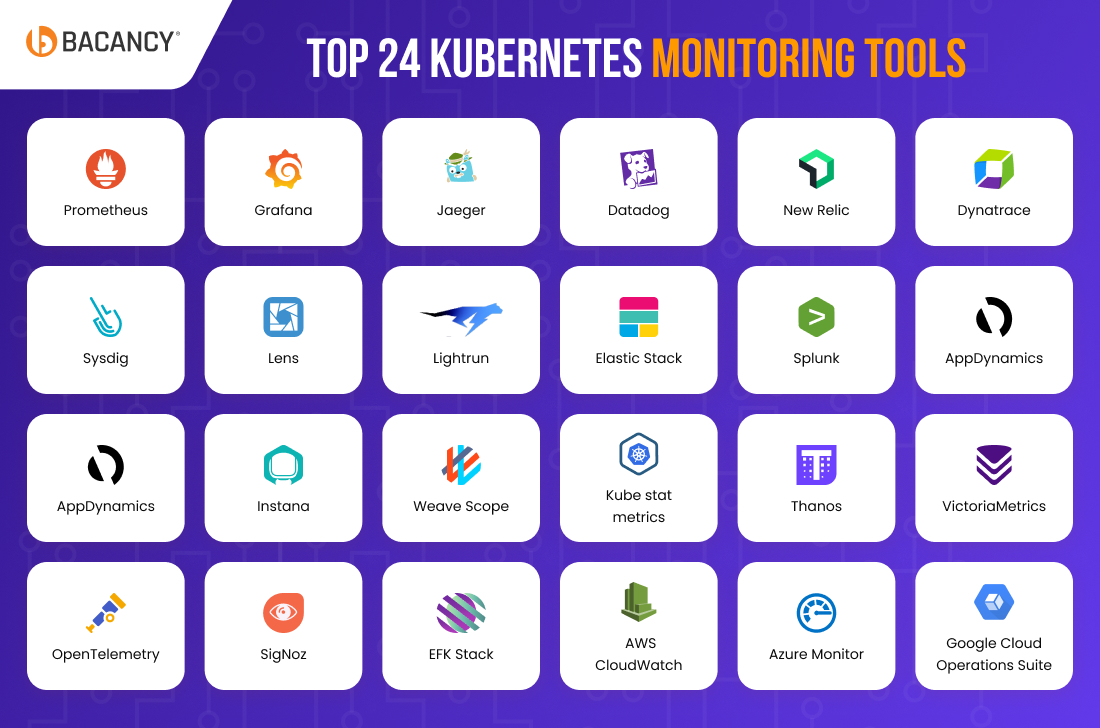
This guide explores 24 of the most effective Kubernetes monitoring tools for 2026, carefully selected to help DevOps teams achieve complete visibility, troubleshoot issues faster, and keep microservices running smoothly in production.
Top 24 Kubernetes Monitoring Tools You Need To Know
Explore a carefully curated list of the leading Kubernetes monitoring tools trusted by DevOps teams to ensure performance, reliability, and full-stack visibility.
1. Prometheus
Prometheus is a monitoring and alerting toolkit designed to collect and store metrics from various systems. As one of the leading open-source Kubernetes monitoring tools, it’s widely used for tracking performance and health in cloud-native and containerized environments.
Key Features of Prometheus:
- Offers a flexible dimensional data model using metric names and key-value pairs.
- Provides powerful PromQL for advanced querying and data transformation.
- Enables precise alerting with PromQL rules and Alertmanager notifications.
- Supports independent operation with local storage and easy Go binary deployment.
- Includes extensive instrumentation libraries for major programming languages.
Ideal Use Cases:
- Monitor Kubernetes clusters and containerized microservices at scale.
- Track real-time application and infrastructure metrics (CPU, memory, disk, etc.).
- Set up custom alerts for system failures, latency spikes, or performance anomalies.
- Integrate with Grafana for rich visualization and real-time dashboards.
- Observe time-series metrics in cloud-native environments without external dependencies.
2. Grafana
Grafana is a powerful visualization and analytics platform often used as part of a Kubernetes monitoring tool stack. While it doesn’t collect metrics, it integrates with tools like Prometheus to display real-time data through customizable dashboards, helping teams monitor and analyze Kubernetes environments effectively.
Key Features of Grafana:
- Delivers customizable, interactive dashboards tailored for diverse data visualizations.
- Integrates seamlessly with numerous data sources, including Prometheus, Elasticsearch, and others.
- Provides advanced alerting with flexible rules and multiple notification channels.
- Supports team collaboration via dashboard sharing, annotations, and role-based access control.
Ideal Use Cases:
- Visualize metrics from multiple data sources like Prometheus, InfluxDB, and Elasticsearch.
- Build interactive dashboards to monitor application and infrastructure health.
- Track logs, metrics, and traces in one unified observability interface.
- Trigger visual alerts and status panels for key performance indicators.
- Enable team collaboration through shared dashboards and annotations.
3. Jaeger
Jaeger is an open-source, end-to-end distributed tracing tool that helps monitor and troubleshoot complex microservices environments, especially within Kubernetes and cloud-native architectures.
Key Features of Jaeger:
- Enables distributed context propagation to trace requests across microservices.
- Provides root cause analysis by visualizing service dependencies and latency bottlenecks.
- Supports performance and latency monitoring with detailed trace data.
- Integrates with popular monitoring tools and supports multiple storage backends like Elasticsearch and Cassandra.
Ideal Use Cases:
- Trace requests across distributed microservices in real-time.
- Identify latency issues and pinpoint performance bottlenecks between services.
- Perform root cause analysis for failed or delayed transactions.
- Monitor full request paths in Kubernetes and cloud-native environments.
- Correlate trace data with metrics through Prometheus or Grafana integrations.
4. Datadog
Datadog is a cloud-based Kubernetes monitoring tool that provides deep visibility into dynamic, containerized environments. It helps teams monitor and manage Kubernetes clusters effectively, ensuring performance, reliability, and seamless operations at scale.
Key Features of Datadog:
- Offers unified monitoring for infrastructure, applications, logs, and traces in a single platform.
- Provides Kubernetes-specific monitoring with auto-discovery of clusters, nodes, and workloads.
- Features customizable dashboards and advanced analytics for proactive alerting and troubleshooting.
- Integrates with hundreds of services and cloud providers for comprehensive observability.
Ideal Use Cases:
- Monitor Kubernetes clusters, nodes, containers, and workloads at scale.
- Display infrastructure, logs, metrics, and traces in unified dashboards.
- Trigger alerts based on machine learning-driven anomaly detection.
- Trace distributed services to identify application-level performance issues.
- Connect with cloud providers, CI/CD tools, and third-party platforms for full-stack observability.
5. New Relic
New Relic is one of the most popular cloud-based Kubernetes monitoring tools. It offers real-time visibility into applications, infrastructure, and environments. It helps teams optimize performance and quickly troubleshoot issues across their clusters.
Key Features of New Relic:
- Provides end-to-end observability with deep application performance monitoring (APM).
- Offers Kubernetes monitoring with real-time cluster health and workload insights.
- Includes AI-powered anomaly detection and alerting for proactive issue resolution.
- Supports extensive integrations with cloud platforms, third-party tools, and custom data sources.
Ideal Use Cases:
- Monitor application performance and infrastructure health across Kubernetes clusters.
- Gain real-time insights into workloads, deployments, and resource usage.
- Detect anomalies automatically and trigger alerts before they affect users.
- Correlate metrics, logs, and traces to troubleshoot issues faster.
- Integrate with cloud platforms and Kubernetes DevOps tools to enable full-stack observability.
6. Dynatrace
Dynatrace leverages AI to provide automatic, comprehensive monitoring and observability across Kubernetes clusters and cloud-native applications.
Key Features of Dynatrace:
- Delivers automatic discovery and monitoring of Kubernetes clusters and microservices.
- Utilizes AI-driven root cause analysis to identify and resolve performance issues quickly.
- Provides real-time metrics, tracing, and log analytics in a unified platform.
- Supports seamless integration with cloud providers, CI/CD pipelines, and DevOps tools.
Ideal Use Cases:
- Automatically discover and monitor all Kubernetes services and workloads.
- Monitor service-to-service communication to detect latency and dependency issues.
- Access real-time metrics, logs, and traces in a single dashboard.
- Connect monitoring with CI/CD pipelines to ensure release reliability.
- Optimize cloud-native operations through intelligent observability.
7. Sysdig
Sysdig is a container and Kubernetes security and monitoring platform that provides deep visibility into containerized environments for performance monitoring, security, and compliance.
Key Features of Sysdig:
- Offers real-time container and Kubernetes monitoring with detailed metrics and troubleshooting.
- Provides runtime security and threat detection tailored for container environments.
- Supports compliance auditing and vulnerability management for Kubernetes clusters.
- Integrates seamlessly with CI/CD pipelines and cloud-native tools for automated security and monitoring.
Ideal Use Cases:
- Track real-time container metrics and performance in Kubernetes environments.
- Detect threats and enforce runtime security across containers and clusters.
- Conduct compliance audits and manage vulnerabilities proactively.
- Integrate monitoring and security into DevOps workflows and CI/CD pipelines.
- Gain deep visibility into microservices behavior and resource usage.
8. Lens
Lens is an open-source Kubernetes integrated development environment (IDE) with a user-friendly graphical interface that simplifies managing and monitoring Kubernetes clusters.
Key Features of Lens:
- Provides a unified dashboard to manage multiple Kubernetes clusters efficiently.
- Offers real-time monitoring of cluster health, workloads, and resource usage.
- Includes built-in terminal access and context-aware configuration for easy cluster management.
- Supports extensions and plugins to enhance functionality and customization.
Ideal Use Cases:
- Manage multiple Kubernetes clusters through a centralized visual dashboard.
- Check the real-time status of pods, nodes, and deployments with detailed metrics.
- Access built-in terminal and kubeconfig switching to streamline operations.
- Configure and troubleshoot workloads with context-aware tools.
- Extend functionality using custom plugins and community extensions.
9. Lightrun
Lightrun allows teams to debug, log, and monitor live applications without redeployments, making identifying and resolving issues directly in production environments easier.
Key Features of Lightrun:
- Enables real-time insertion of logs, metrics, and traces into running applications.
- Integrates seamlessly with popular IDEs like IntelliJ, VS Code, and Eclipse.
- Ensures enterprise-grade security with encryption and Kubernetes role-based access control.
- Operates with minimal performance overhead to avoid impacting live systems.
Ideal Use Cases:
- Inject logs, metrics, and traces directly into running applications without redeployments.
- Debug live code in real time using integrations with popular IDEs.
- Resolve issues quickly in production without affecting system performance.
- Secure observability workflows using role-based access and encryption.
10. Elastic Stack (ELK)
Elastic Stack (ELK) collects, processes, and visualizes logs and metrics from Kubernetes clusters to provide deep insights into cluster health, application performance, and troubleshooting.
Key Features of Elastic Stack:
- Centralizes log and metric collection from Kubernetes nodes, pods, and containers using Beats and Logstash.
- Automatically discovers Kubernetes services and workloads, adapting to dynamic environments.
- Offers rich Kibana dashboards tailored to visualize Kubernetes cluster metrics and logs.
- Enables anomaly detection and alerting with integrated machine learning for proactive monitoring.
Ideal Use Cases:
- Aggregate logs and metrics from Kubernetes nodes, pods, and containers.
- Visualize cluster health and application performance using Kibana dashboards.
- Adapt to dynamic Kubernetes environments with automated service discovery.
- Use machine learning to detect anomalies and trigger proactive alerts.
11. Splunk
Splunk is a leading real-time platform for searching, monitoring, and analyzing machine-generated data. It is widely used for log management, security, and monitoring in Kubernetes and cloud-native environments.
Key Features of Splunk:
- Collects and indexes large volumes of log and metric data from Kubernetes clusters and applications.
- Provides powerful search and analytics capabilities for troubleshooting and performance optimization.
- Offers customizable dashboards and visualizations tailored to Kubernetes monitoring.
- Supports real-time alerting and anomaly detection to identify issues proactively.
Ideal Use Cases:
- Collect and index high volumes of Kubernetes logs and metrics for deep analysis.
- Search and analyze data to troubleshoot system and application performance.
- Visualize Kubernetes cluster activity through custom dashboards and reports.
- Detect anomalies and trigger alerts using real-time data insights.
Need Help To Set Up the Right Monitoring Stack?
Hire Kubernetes developers to tailor and manage monitoring tools that give you complete visibility into your clusters.
12. AppDynamics
AppDynamics is an application performance monitoring (APM) solution that provides real-time insights into application behavior, infrastructure, and user experience.
Key Features of AppDynamics:
- Delivers end-to-end visibility into application performance across Kubernetes clusters.
- Uses AI-powered anomaly detection to identify and diagnose performance issues quickly.
- Maps dynamic Kubernetes services and microservices dependencies for accurate monitoring.
- Provides business transaction monitoring to correlate technical performance with business impact.
Ideal Use Cases:
- Track application performance across Kubernetes clusters with business context.
- Optimize resource utilization by identifying overprovisioned or underused Kubernetes components.
- Map service dependencies and microservices relationships in real-time.
- Correlate backend performance with user experience and business impact.
13. Instana
Instana is an automated application performance monitoring (APM) and observability platform designed for dynamic cloud-native environments.
Key Features of Instana:
- Automatically discovers and monitors Kubernetes clusters and microservices in real-time.
- Provides AI-powered root cause analysis to pinpoint performance issues quickly.
- Offers distributed tracing, metrics, and log correlation for end-to-end observability.
- Delivers automatic instrumentation with minimal manual setup for fast deployment.
Ideal Use Cases:
- Discover and monitor Kubernetes services and microservices automatically.
- Track performance trends over time to proactively plan scaling and resource allocation.
- Validate performance after deployments to ensure new code doesn’t degrade service quality.
- Enable fast setup with automatic instrumentation and zero manual effort.
14. Weave Scope
Weave Scope visually represents your infrastructure, applications, and services to simplify debugging and performance analysis in Docker and Kubernetes environments.
Key Features of Weave Scope:
- Automatically maps containers, pods, and services into a real-time topology view.
- Offers deep visibility into running processes, network connections, and resource usage.
- Enables interactive monitoring and troubleshooting directly from the UI.
- Integrates seamlessly with Docker, Kubernetes, and cloud-native ecosystems.
Ideal Use Cases:
- Visualize real-time service-to-service communication across microservices to detect misconfigurations.
- Trace memory leaks by inspecting container-level process trees and live metrics.
- Identify containers with excessive open connections during DDoS or network spikes.
- Access and manage stuck pods or misbehaving containers directly through the Scope UI.
15. Kube-state-metrics
Kube-state-metrics collects information about Kubernetes objects and turns it into readable metrics for tools like Prometheus.
Key Features of Kube-state-metrics:
- Exposes Kubernetes resource states (e.g., pod status, replica counts, resource requests) as Prometheus metrics.
- Provides detailed insights into cluster health and object states beyond node-level metrics.
- Designed to work seamlessly with Prometheus for alerting and visualization.
- Supports a wide range of Kubernetes objects, including pods, deployments, services, config maps, secrets, and more.
Ideal Use Cases:
- Expose deployment replica mismatches to Prometheus when HPA fails to scale up workloads.
- Monitor pod eviction counts across nodes to detect pressure on specific availability zones.
- Track job completions and failure rates for CronJobs running in batch-processing namespaces.
- Alert on excessive pending pods caused by CPU or memory resource limits.
16. Thanos
Thanos is an open-source monitoring system that works with Prometheus to provide a central way to collect, store, and query metrics data across multiple environments. It helps extend Prometheus by adding scalability, durability, and global visibility to monitoring setups.
Key Features of Thanos:
- Combines data from multiple Prometheus instances to provide a single, global query view.
- Stores historical metrics in cloud object storage (e.g., AWS S3, GCS, Azure Blob) for long-term retention.
- Ensures high availability by allowing redundant querying even if some Prometheus servers are down.
- Removes duplicate metrics from overlapping data sources to deliver clean, consistent results.
Ideal Use Cases:
- Retain metrics beyond Prometheus’ default retention by storing them in Amazon S3.
- Enable historical analysis and capacity planning with long-term storage of time-series metrics.
- Run federated queries to correlate performance metrics across staging and production environments.
- Deduplicate overlapping metrics from multiple Prometheus sources to eliminate inconsistencies in long-term data.
17. VictoriaMetrics
VictoriaMetrics is a fast, scalable, cost-effective open-source monitoring solution that stores and queries time-series data. It supports Prometheus metrics and is used for high-performance monitoring in large-scale environments.
Key Features of VictoriaMetrics:
- Supports ingestion of Prometheus metrics, InfluxDB, and OpenTSDB data formats for flexible integrations.
- Offers a high-performance query engine optimized for low-latency and high-throughput workloads.
- Provides built-in long-term storage with efficient compression and low resource usage.
- Scales easily from a single-node setup to a clustered, highly available deployment.
Ideal Use Cases:
- Store high-frequency Prometheus metrics from large-scale Kubernetes clusters with minimal storage cost.
- Handle multi-tenant monitoring setups by ingesting metrics from different environments into a single back end.
- Query large historical datasets at high speed to analyze long-term trends in container performance.
- Deploy a compact, single-node solution in resource-constrained edge clusters.
18. OpenTelemetry
OpenTelemetry is an open-source observability framework that collects telemetry data such as metrics, logs, and traces from cloud-native applications. It helps developers monitor performance and behavior across distributed systems using standardized APIs and SDKs.
Key Features of OpenTelemetry:
- Supports the collection of metrics, traces, and logs through unified instrumentation.
- Integrates with tools like Prometheus and Jaeger for seamless data export.
- Offers vendor-neutral observability using open standards and APIs.
- Provides language-specific SDKs such as Java, Python, and Go for easy implementation.
Ideal Use Cases:
- Collect consistent telemetry data from Java and Go microservices running in Kubernetes.
- Standardize observability instrumentation across teams using vendor-neutral APIs.
- Export metrics to Prometheus and traces to Jaeger from a single unified collector.
- Correlate logs, metrics, and traces to diagnose performance issues in distributed systems.
19. SigNoz
SigNoz is an open-source observability platform designed for Kubernetes monitoring metrics, traces, and logs in modern cloud-native environments. Built on OpenTelemetry, it provides deep visibility into Kubernetes applications through a single unified dashboard.
Key Features of SigNoz:
- Monitors application metrics, distributed traces, and logs from Kubernetes clusters.
- Offers flame graphs and trace timelines to analyze request latency and bottlenecks.
- Enables service-level monitoring with customizable dashboards and alerts.
- Seamlessly integrates with OpenTelemetry for vendor-neutral instrumentation.
- Supports log aggregation and correlation with traces for streamlined debugging and RCA.
Ideal Use Cases:
- Analyze flame graphs to locate the exact function causing latency in Kubernetes apps.
- Track error rates across microservices and compare traces for abnormal performance.
- Monitor custom business-level metrics (e.g., order counts and checkout duration) in the same dashboard.
- Correlate trace failures with logs to quickly perform root cause analysis.
20. EFK Stack
As a popular Kubernetes monitoring tool, EFK Stack combines Elasticsearch, Fluentd, and Kibana to collect, process, and visualize logs. It provides centralized insight into the behavior of Kubernetes clusters and applications, helping teams troubleshoot and monitor effectively.
Key Features of EFK Stack:
- Collects container and node logs using Fluentd as the log forwarder.
- Stores and indexes log in Elasticsearch for fast search and analysis.
- Visualizes logs and system events through customizable Kibana dashboards.
- Supports structured log transformation, filtering, and enrichment.
- Enables real-time log monitoring, troubleshooting, and alert configuration.
Ideal Use Cases:
- Collect structured logs from containerized applications and enrich them with Kubernetes metadata.
- Search across multiple node logs to troubleshoot failed deployments or service restarts.
- Visualize log patterns and spot anomalies during blue/green deployments.
- Forward logs from specific namespaces to external systems for compliance storage.
21. Sematext
Sematext is among the most powerful Kubernetes monitoring tools. It delivers full-stack observability by combining monitoring, log management, and real user insights across Kubernetes clusters and applications.
Key Features of Sematext:
- Monitors Kubernetes cluster health, pod metrics, and container resource usage.
- Collects and correlates logs, metrics, and events for faster troubleshooting.
- Provides out-of-the-box dashboards and alerting for Kubernetes components.
- Supports anomaly detection, SLA tracking, and root cause analysis.
- Offers easy integration with cloud-native stacks and log shippers like Fluentd and Logagent.
Ideal Use Cases:
- Monitor memory and CPU usage of individual pods across all namespaces from a central dashboard.
- Correlate pod failure logs with node-level resource saturation for fast debugging.
- Use anomaly detection to catch irregular traffic patterns in API gateways.
- Create SLA-based alerts for application performance metrics across clusters.
This was our expert-curated list of some of the best Kubernetes monitoring tools. However, the right choice depends on your architecture, scale, and operational goals, so be sure to evaluate what best fits your environment.
22. AWS CloudWatch
Amazon CloudWatch is AWS’s observability service that provides metrics, logs, and events for cloud resources. With Container Insights, it extends monitoring to Amazon EKS, giving deep visibility into cluster performance, workloads, and resource utilization. It helps teams detect issues, automate responses, and optimize containerized applications at scale.
Key Features:
- Automatic collection of EKS cluster, node, pod, and service-level metrics.
- Centralized log aggregation with CloudWatch Logs.
- Prebuilt dashboards for monitoring container health and performance.
- Anomaly detection with customizable alarms and predictive insights.
- Native integration with AWS services like Lambda, SNS, and EventBridge.
Ideal Use Cases:
- Monitor EKS workloads and microservices in real time.
- Correlate logs, metrics, and events across AWS resources.
- Set up automated alerts for failures, latency spikes, or scaling needs.
- Optimize performance and cost with visibility into resource usage.
- Build end-to-end observability pipelines for cloud-native workloads.
23. Azure Monitor
Azure Monitor delivers end-to-end observability for applications, infrastructure, and networks on Azure. Its Container Insights feature simplifies AKS monitoring by automatically discovering clusters and workloads while offering real-time performance data. It enables proactive troubleshooting, log analysis, and optimization of Kubernetes environments.
Key Features:
- Auto-discovery of AKS clusters, pods, and nodes for monitoring.
- Preconfigured dashboards for CPU, memory, and storage utilization.
- Deep log analysis with Log Analytics queries and workbooks.
- Intelligent alerts and built-in recommendations for cluster health.
- Correlation of container data with app and infrastructure metrics.
Ideal Use Cases:
- Monitor and troubleshoot AKS workloads at scale.
- Track real-time health of containers, pods, and nodes.
- Query logs to detect anomalies and performance bottlenecks.
- Set alerts for critical failures, scaling thresholds, or policy violations.
- Unify monitoring for hybrid workloads running in Azure and on-premises.
24. Google Cloud Operations Suite
Google Cloud Operations Suite provides monitoring, logging, and tracing for cloud-native workloads. Natively integrated with Google Kubernetes Engine, it offers instant visibility into container health, performance, and reliability. Teams can monitor SLOs, analyze logs, and optimize distributed systems with minimal setup.
Key Features:
- Native GKE integration with no extra setup required.
- Centralized logging and error reporting across Kubernetes clusters.
- Prebuilt dashboards with customizable visualization options.
- Smart alerting with SLO/SLA-based monitoring policies.
- Integration with Cloud Trace and Profiler for end-to-end performance insights.
Ideal Use Cases:
- Monitor GKE workloads with out-of-the-box observability.
- Collect logs, metrics, and traces across distributed services.
- Set alerts on application reliability, SLOs, or latency spikes.
- Troubleshoot performance bottlenecks with tracing and profiling tools.
- Enable cloud-native observability across multi-cluster environments.
Simplify Kubernetes With The Right Monitoring Tools
Choosing the right Kubernetes monitoring tool depends on your environment, scale, and observability goals. Whether you need advanced alerting, distributed tracing, or real-time visualization, these tools offer many features to meet modern monitoring needs.
For businesses looking to streamline implementation and get expert guidance, opt for Kubernetes consulting services, where experts can help you choose the right tools, integrate them seamlessly, and align your monitoring strategy with long-term business goals.
It improves performance, helps your teams respond faster to incidents, and delivers a better user experience.
Frequently Asked Questions (FAQs)
Kubernetes monitoring tools are platforms or software solutions that track the health, performance, and resource usage of Kubernetes clusters, nodes, pods, and containers. They help detect issues early, ensure uptime, and optimize infrastructure efficiency.
Monitoring is essential in Kubernetes to ensure workloads run smoothly, detect failures or resource bottlenecks, and maintain application performance across dynamic, containerized environments. It also supports scaling, debugging, and compliance efforts.
Look for tools that offer cluster health tracking, container-level visibility, alerting, log and trace correlation, real-time dashboards, auto-discovery, and seamless integration with cloud-native ecosystems like Prometheus, Grafana, and OpenTelemetry.
Some of the best open-source Kubernetes monitoring tools include Prometheus, Grafana, Jaeger, cAdvisor, OpenTelemetry, and Kube-state-metrics. These tools offer flexible, cost-effective observability for Kubernetes environments.
Yes, many Kubernetes monitoring tools, such as Datadog, Dynatrace, and Thanos, support multi-cloud and hybrid cloud environments, allowing centralized monitoring and visibility across clusters deployed on AWS, Azure, GCP, and on-premises.
Tools like Prometheus with Alertmanager, Grafana, and Splunk allow you to set custom alerting rules based on thresholds, anomalies, or events. Alerts can be sent via email, Slack, PagerDuty, or other notification channels.
Yes, tools like Sysdig, Datadog, and Sematext offer security monitoring features such as runtime threat detection, compliance auditing, anomaly detection, and performance monitoring.
Yes. Monitoring tools for Kubernetes help teams optimize CPU, memory, and storage by tracking resource usage and identifying underutilized workloads. This reduces unnecessary scaling and cloud spending while ensuring applications still perform well.