Quick Summary
GCP vs AWS vs Azure can be confusing, with each platform providing unique advantages and AI capabilities. In this comparison blog, we have simplified the differences to let you make the smartest cloud decisions for your business. Choose the platform that delivers the best combination of efficiency and growth potential.
Table of Contents
Introduction
When we talk about cloud platforms, the conversation is no longer about “which one is the best.” Instead, the question is simple: which cloud provider helps your business reduce risk and stay strong for the next 5 years?
You have probably heard about the big 3 cloud platforms: Amazon Web Services (AWS), Google Cloud Platform (GCP), and Microsoft Azure. These platforms hold 63% of enterprise cloud adoption and control nearly two-thirds of the global cloud infrastructure market share.
AWS stands out for its huge global presence, GCP is expected to grow rapidly with strong data and AI capabilities, and Microsoft Azure remains unbeatable in the hybrid cloud environment. In this blog, we provide a comprehensive comparison of GCP vs AWS vs Azure to help you make an informed choice.
| Features | GCP | AWS | Azure |
|---|
| Adoption | Ai-innovative cloud provider widely used for AI, ML, and big data | Largest cloud provider and widely adopted | Strong enterprise adoption and a hybrid cloud leader |
| Compliance & Security | HIPAA, ISO, SOC, GDPR | SOC 2, ISO 27001, HIPAA, GDPR | HIPAA, FedRAMP, ISO, GDPR |
| Global Reach | 38 regions, 77+ zones, data centers optimized for AI & analytics | 32+ regions, 100+ availability zones, the largest global network | 31+ regions, 60+ availability zones, strong presence in enterprise & government |
| Talent Availability | Smaller pool, specialized in AI, ML, and data engineering | Largest developer and architect pool worldwide | High, especially Microsoft-stack aligned teams |
| Cost | Simplified per-second billing and optimized for data workloads | Flexible pricing and complex cost management | Enterprise contracts and discounts for Microsoft customers |
| Free | 90-day free trial | $100 sign-up credit up to 6 months | Pay-as-you-go and $200 credit to use in your first 30 days |
| Innovation | Data analytics, Kubernetes, and cloud-native applications | Serverless, IoT, machine learning, DevOps | Hybrid solutions, Microsoft SaaS integration, and enterprise IT modernization |
| Best for | AI-driven, analytics-focused modern cloud initiatives | Global scale, large workloads, and diverse apps | Regulated industries and a hybrid enterprise environment |
GCP vs AWS vs Azure Overview: How Each Cloud Platform Positions Itself Globally
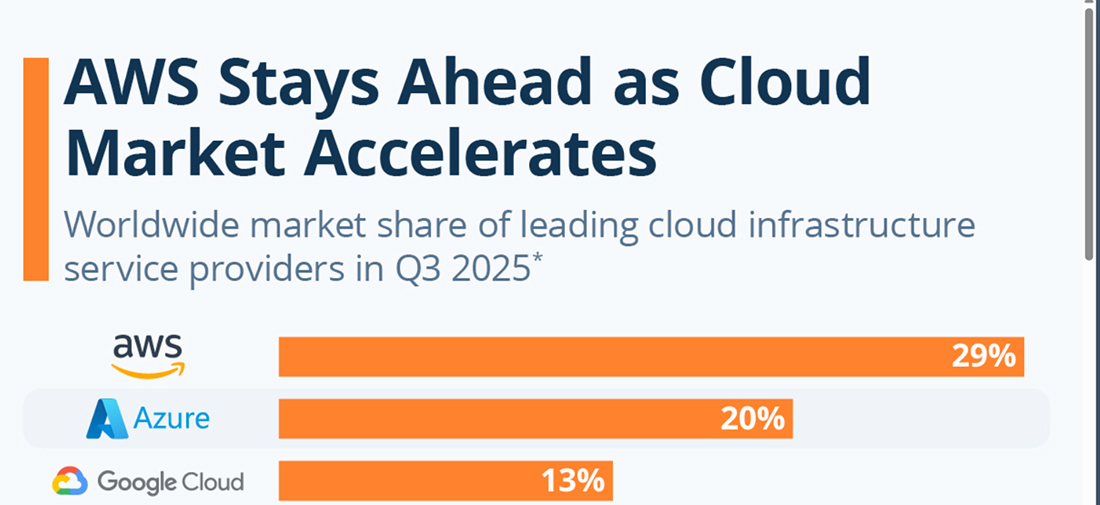
Image: Source
The data clearly indicates how AWS is ahead in the game with a 29% share. Whereas Azure and Google Cloud Platform are in close proximity, giving AWS tough competition with 20% and 13% market share.
- AWS leads the global cloud market by doubling down on breadth, more services, more regions, and more maturity. Enterprises choose AWS for its reliability, deep feature portfolio, and proven track record with large-scale workloads.
- Azure takes a hybrid-cloud first approach. Thanks to Microsoft’s enterprise dominance, Azure is the top choice for industries with legacy systems, Windows-heavy workloads, or regulatory environments that demand tight compliance.
- GCP positions itself as the innovation cloud. It’s the preferred choice for AI-driven, data-intensive, and modern application workloads, powered by Google’s unmatched data analytics, ML, and Kubernetes leadership.
Cloud Platform Choices Across Industries: GCP vs AWS vs Azure
Different industries gravitate toward different clouds based on their maturity, cost model, compliance requirements, and innovation needs:
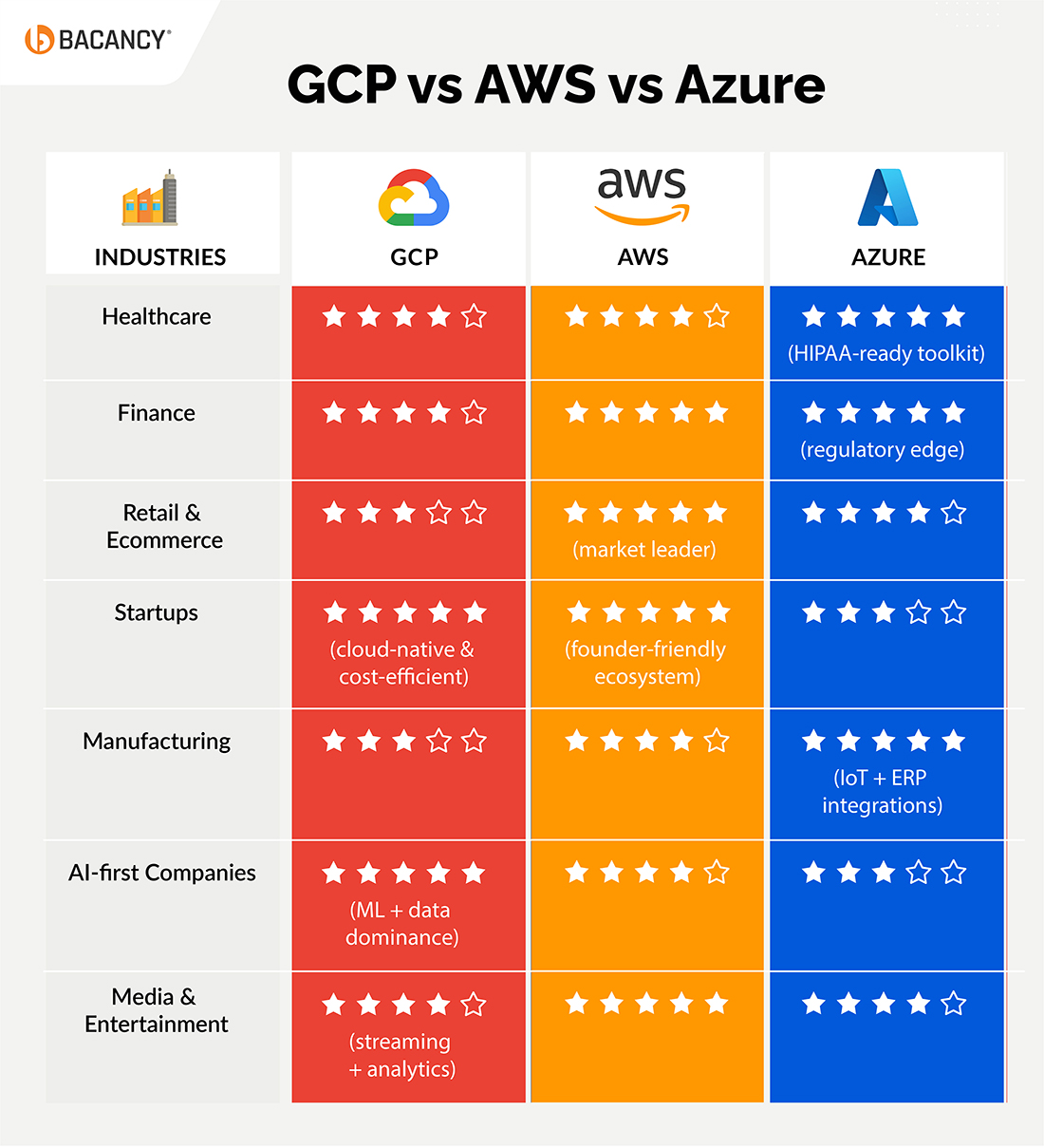
Necessary Certifications of GCP, AWS and Azure
| Cloud Provider | Beginner Level | Mid Level | Advance Level |
|---|
| GCP | Cloud Digital Leader | Associate Cloud Engineer | Professional Cloud Architect/DevOps |
| AWS | Cloud Practitioner | Solutions Architect Associate | DevOps Engineer / Architect Professional |
| Azure | Azure Fundamentals (AZ-900) | Azure Administrator Associate (AZ-104) | Azure Solutions Architect Expert (AZ-305) / Azure DevOps Engineer Expert (AZ-400) |
At Bacancy, our DevOps engineers and cloud experts are fully certified and deeply experienced. We help you evaluate diverse cloud environments to optimize infrastructure, ensure peak performance, and deliver scalable, secure solutions.
Pricing Comparison: GCP vs AWS vs Azure - 2026
To compare Azure vs GCP vs AWS, the most important matters are crucial. All the cloud providers charge as per the usage of tools and features. However, cloud costs are more than just VM prices, so here’s a simple breakdown of what you need to consider-
1. Compute Pricing – This cost includes the operation of virtual machines, containers, or serverless functions. It also accounts for options such as pay-as-you-go, reserved instances, and spot instances.
2. Network Costs – It charges for outgoing data (egress), inter-region transfer, and content delivery. Incoming traffic is usually free.
3. Storage & Data Fees – The cost depends on storage size, access frequency, and replication. Different tiers (hot, cold, archive) affect pricing.
4. Compliance & Security – Includes basic security, advanced compliance tools, encryption, and enterprise-grade security, which adds extra cost.
5. Support Costs – Premium support plans for enterprises come with additional monthly fees.
6. Scaling & Operational Costs – Autoscaling, monitoring, and management tools may increase expenses during high traffic periods.
7. Service-Specific Costs – Databases, AI/ML services, serverless workloads, and other managed services often have their own pricing.
Now, after understanding the types of features and factors that come under the cloud pricing comparison, let’s look in detail at the factors for each cloud platform.
Compute Pricing (On-Demand, per vCPU/hour, US Regions)
| Provider | Instance Type | Per vCPU (/hour) | Total( per hour) | Notes |
|---|
| GCP |
n1-standard-1
| $0.03275 | $0.03275 | 1 vCPU |
| AWS | t3.medium | $0.0208 | $0.0416 | 2 vCPUs |
| Azure | B-series (B1s) | $0.032 | ~$0.0042 | Burstable |
Data Transfer Costs (Outbound per GB)
| Provider | Standard Rate | Free Tier | Higher Volume Tiers |
|---|
| GCP | $0.08-$0.12 | 1-10 GB/month | $0.01-$0.09+ |
| AWS | $0.09 | Same region free | $0.085 (10-40TB), $0.05+ |
| Azure | $0.087 | Inbound free | Varies by zone |
Storage & Data Fees (Standard Storage per GB/month)
| Provider | Rates | Notes |
|---|
| GCP | $0.02-$0.023 | Standard Class |
| AWS | $0.023 | S3 Standard |
| Azure | $0.0184 | Blob Storage |
Scaling & Operational Costs
| Platform | Auto-Scaling | Load Balancer Example |
|---|
| GCP
| Free | $0.025/hour |
| AWS
| Free | $0.0225/hour |
| Azure
| Free | $0.0059/GB |
Support Costs (Monthly, Basic/Developer Tier)
| Platform | Basic | Developer | Notes |
|---|
| GCP
| Free | $29 | Per user |
| AWS
| Free | $29 | Per user |
| Azure
| Free | $100 | Flat |
Compliance & Security
| Provider | Direct Fees | Examples |
|---|
| GCP
| None | SOC/HIPAA included |
| AWS
| None | Certifications free |
| Azure
| None | Sentinel $2.40/GB |
How Innovations Differ in GCP vs AWS vs Azure?
When you compare cloud innovation, each platform moves in its own way. You will notice that all three are fast, but the direction and focus feel very different. The right choice depends on what your product needs in the years ahead.
Which cloud innovates faster?
- GCP moves quite fast in AI, data, and advanced engineering. You will often see Google release new AI tools, BigQuery updates, and Kubernetes features before others. If your product depends on strong tech depth, GCP provides you with the fastest progress.
- AWS brings the highest number of new services each year. If you want wide coverage across compute, storage, networking, DevOps, and managed tools, AWS feels the fastest. Their pace helps teams that want more choices and more flexibility.
- Azure remains at a steady pace that suits enterprises. Most new features support Microsoft tools, such as Windows Server, SQL, Office 365, and Teams. If your company depends on a Microsoft setup, Azure feels very comfortable and predictable.
Which cloud among GCP vs AWS vs Azure is future-ready?
- GCP suits teams that aim for an AI-first or data-first future. It also suits you if you want a cloud that supports modern app patterns and multi-cloud flexibility. Google builds for the next decade of digital products.
- AWS is relevant for you if the future involves global reach, large user volume, or working across many industries. AWS has the widest footprint and the most mature services, so it supports long-term expansion with ease.
- Azure is suitable for enterprises that want a clear path toward hybrid cloud and strong integration across business systems. If your future goals focus on stable digital transformation, Azure supports that path very well.
What are the AI Native Strengths in GCP vs AWS vs Azure?
When you look at AI strengths in GCP vs AWS vs Azure, you should see how each platform helps you move faster with models, data, and automation.
- GCP provides you with strong, ready-made modules because it has deep roots in data science.
- AWS provides scale and reach because it offers a vast catalog.
- Azure delivers robust support for enterprises and teams that already work with Microsoft tools.
| Factors | GCP | AWS | Azure |
|---|
| Core AI Platform
| Vertex AI with Gemini models, AutoML, TensorFlow leadership | Azure OpenAI Service (exclusive GPT-4/o1, DALL-E), Azure ML | Amazon Bedrock (widest multi-model access: Claude, Llama, Mistral, Titan) |
| Key Differentiators | AI-first design, BigQuery integration, TPUs for advanced ML, data analytics excellence | Enterprise Microsoft integrations (Copilot, Power Platform), content safety, and fine-tuning | Model customization, agents, guardrails, native AWS service integration (SageMaker, Lambda) |
| Model Variety & Access | Proprietary Gemini/PaLM, Model Garden, grounding with Google Search | OpenAI exclusives, embeddings, Whisper | Broadest third-party models, provisioned throughput |
| Infrastructure Edge | High-performance computing, Kubernetes-native | Maia accelerators, GPU/HPC VMs | Extensive regions, pre-trained services for vision/language |
| Use Case | Cutting-edge research, real-time analytics, containerized AI workloads | Business apps, hybrid enterprise, and responsible AI | Scalable general AI, RAG/knowledge bases, compliance-heavy (FedRAMP, HIPAA) |
How Security and Operations Functions in GCP vs AWS vs Azure
| Security & Operational Functions | GCP | AWS | Azure |
|---|
| Threat Detection | Security Command Center | Amazon GuardDuty
| Microsoft Defender for Cloud |
| Anomaly Detection | Machine learning-based detection | Automated Threat Analysis | Behavioral Analytics |
| Security Monitoring & SIEM | Google Chronicle
| AWS Security Hub
| Azure Sential |
| Compliance & Governance | Policy Intelligence | AWS Configuration
| Azure Policy |
| Automated Assessments | Event Threat Detection | Amazon Inspector
| Microsoft Secure Score |
| Security Best Practices | Cloud Security Best Practices | Well-Architected Framework | Security Baseline |
| Incident Response | Cloud Incident Response | AWS Systems Manager | Azure Automation |
| Disaster Recovery | Cloud Backup & DR
| AWS Backup & Recovery | Azure Site Recovery |
| Data Protection | Cloud KMS & Secret Manager | KMS & Secrets Manager | Key Vault & Data Protection |
A cloud project is defined by its security and operations. GCP vs AWS vs Azure all offer strong capabilities, but each platform has different approaches to governance, delivery pipelines, and automation in its own way.
Infrastructure as Code (IaC) shapes the reliability and repeatability of your deployments. Terraform remains the most universal option since all three clouds support it well, and teams can maintain one workflow across environments.
- GCP offers a Deployment Manager. While it supports declarative resource control, many teams prefer Terraform on GCP because it provides better consistency across multi-cloud setups.
- AWS offers CDK. It allows your developers to define infrastructure with real code, which helps teams create reusable patterns and improve standardization.
- Azure provides Bicep. It offers clear syntax, strong validation, and deep integration with Azure Resource Manager.
If your organization works across more than one cloud, Terraform delivers the highest stability. If you work primarily inside one cloud, the native tool may offer better control and alignment with the platform’s resource model.
CI/CD Ecosystem Comparison (Azure DevOps, Cloud Build, CodePipeline)
In GCP vs AWS vs Azure, each cloud supports modern software delivery, but the depth and structure of its CI/CD tools differ.
- GCP Cloud Build focuses on speed and simplicity. It offers fast build and deploy workflows, strong support for container workflows, and a lightweight structure that suits modern applications.
- AWS CodePipeline offers deeper integration with the full AWS ecosystem. It supports advanced delivery paths, approval gates, and strong automation hooks. This makes it ideal for applications that require strict pipeline governance.
- Azure DevOps provides an end-to-end solution. Boards, Repos, Test Plans, and Pipelines sit in one environment, which creates a unified delivery workflow for enterprise teams.
The right choice depends on your priorities. Choose Azure DevOps for a centralized environment, granular control, and hire Azure developer to reduce overhead and streamline the operations.
Automation strength impacts how well your environment responds to operational events, workflow demands, and scale requirements.
- GCP provides Cloud Tasks, Workflows, and Cloud Functions. These tools support clean, cost-efficient automation paths and simplify orchestration for modern applications.
- AWS offers Step Functions, Lambda, and EventBridge. These services support event-driven architectures, long-running workflows, and complex operational logic.
- Azure provides Automation Accounts, Logic Apps, and Functions. These tools support enterprise-level workflows and structured process design.
| Aspect | GCP | AWS | Azure |
|---|
| Job Growth
| 34% | 20% | 40% |
| Talented Pool
| Smallest with 10-11% global market share | Largest with a 3:1 ratio over other cloud providers | Moderate with 23% global market share |
| Hiring Difficulty
| Highest with niche shortage | Easiest | Moderate |
| Key Demand Roles
| Professional Cloud Architect, Data Engineer, SRE | Solutions Architect, DevOps Engineer | AZ-104 Admin, AZ-305 Architect, DevOps/App Services |
| Certifications Impact
| Professional tracks and high growth in security | Most recognized | Enterprise-valued and 70% pros certified |
Performance and Reliability of GCP, AWS, and Azure
Performance and reliability shape the day-to-day experience of your cloud environment. The benefit of each platform appears through its global region layout, uptime record, and real-world latency results. AWS, Azure, and GCP follow different expansion strategies and service commitments, so the user experience varies across workloads and locations.
Availability Zones and Regions
- GCP maintains a smaller footprint, yet its regions often deliver very high network performance due to Google’s private backbone. GCP focuses on fewer but more optimized zones that offer strong reliability.
- AWS maintains the largest global footprint with the highest number of regions and availability zones. This helps you place workloads closer to your users and reduce delay across continents.
- Azure follows a region-first strategy with strong coverage in enterprise-heavy locations. It offers a wide presence across Europe, the US, and Asia, which supports compliance-driven teams.
Your choice depends on where your users sit and how much global distribution your product needs.
Uptime History and SLA Comparison
- GCP maintains strong uptime for core compute and storage services. Its SLAs match industry standards, with some services backed by aggressive performance guarantees due to Google’s network strength.
- AWS maintains consistent uptime across core services and offers SLAs that align with its mature infrastructure. Its long track record reflects stability across high-load environments.
- Azure’s uptime has improved in recent years. Its SLAs match AWS in most categories, though service performance can vary across regions with heavy enterprise demand.
- Overall, AWS shows the most stable uptime history, Azure demonstrates strong enterprise reliability, and GCP appears to have high performance on network-driven services.
Speed and Latency Benchmarks
- GCP frequently leads raw latency tests because it uses Google’s private fiber network. This makes GCP a strong choice for data-intensive workloads, AI applications, or real-time applications.
- AWS often delivers consistent latency due to its dense region network. This helps teams with global traffic or latency-sensitive apps.
- Azure shows strong performance inside regions where Microsoft has a strong enterprise presence. Local traffic often benefits from optimized routes in Europe and the US.
Your latency result ultimately depends on the region you target, but GCP often takes the lead in low-delay workloads, AWS offers the most consistent global performance, and Azure provides strong speed for enterprise zones.
A millisecond can kill the user experience of an entire real-time app.
Hire GCP developers from Bacancy and ensure your AI and data-heavy apps stay fast and responsive.
When to Choose GCP, AWS, or Azure?
After a comprehensive comparison of AWS, Azure, and GCP, these guidelines clarify which cloud platform best aligns with your project needs, team expertise, and business objectives.
Consider Azure Over AWS and GCP When:
- Deep Microsoft ecosystem integration (Active Directory, Office 365, Power Platform, Dynamics).
- Enterprise hybrid/multi-cloud strategies with on-premises Windows/SQL Server migrations.
- AI/ML workloads using exclusive OpenAI models (GPT-4o, Phi) via Azure OpenAI Service and Copilot Studio.
- Regulated industries like healthcare or finance need Azure Sentinel for security and compliance tools.
- Building low-code/no-code apps with PowerApps or .NET-heavy enterprise solutions.
- Teams require strong Windows VM performance, Azure DevOps CI/CD, and enterprise support tiers.
- Global enterprises value the fastest-growing talent pool in enterprise roles and predictable pricing.
Consider AWS Over Azure and GCP When:
- Building highly scalable, global applications with extensive service depth and the largest ecosystem.
- Enterprise workloads require mature compliance (FedRAMP, HIPAA) and multi-region redundancy.
- Using serverless like Lambda, containers (EKS), or machine learning with the broadest model access via Bedrock/SageMaker.
- Cost optimization is critical for high-volume usage with Savings Plans and spot instances. Your team has DevOps expertise in IaC and needs maximum third-party integrations.
- Designing IoT, big data (EMR), or hybrid cloud with on-premises VMware.
- Startups prioritize the market-leading job market and talent availability for rapid hiring.
Struggling with unpredictable cloud bills?
Take control and hire AWS developer to optimize your infrastructure for smarter, cost-effective management solutions.
Choose GCP Over AWS and Azure When:
- Data analytics, ML research, or real-time processing with BigQuery, Dataflow, and Vertex AI/Gemini.
- Container-native, Kubernetes-first development (GKE, Anthos) for microservices and multi-cloud portability.
- Cost efficiency for data-heavy workloads with sustained-use discounts and TPUs for AI training.
- Startups or AI-first companies need rapid innovation with AutoML, Looker, and Google Workspace integration.
- High-performance computing, genomics (Terra), or media processing with premium networking.
- Teams skilled in Python or TensorFlow prioritize seamless data-to-ML pipelines and serverless (Cloud Run/Functions).
- Building modern apps with emphasis on developer productivity and native AI grounding via Google Search.
The Hidden Factor: Cloud Ecosystem Interference Cost
Cloud decisions also include the cost you pay when your teams switch between services, platforms, IAM models, or delivery patterns. This cost does not appear on your bill, but it affects team efficiency, delivery speed, and long-term maintainability.
How Bacancy Can Help You Choose the Right Cloud: GCP vs AWS or Azure?
Determining the right cloud platform can be overwhelming with so many options and features to consider. Comparing GCP vs AWS vs Azure is the first step for every business to find the cloud that truly fits its business objectives.
With Bacancy as your cloud managed services provider, you gain setup support and a team that ensures your cloud works efficiently, stays secure, and adapts as your business evolves. The right guidance turns your cloud from a tool into a strategic advantage, which gives you flexibility, scalability, and robust business impact.
Frequently Asked Questions (FAQs)
AWS offers the widest range of services and the largest global impact, and Azure integrates best with the Microsoft enterprise ecosystem. Whereas, GCP is ideally known for high-performance analytics, and AI/ML workloads. Each cloud serves different business priorities based on stack, scale, and data requirements.
GCP is the most cost-effective option for startups, offering simpler pricing and lower compute costs, especially for steady workloads. However, AWS has become more cost-effective as you scale, while Azure offers value if you already use Microsoft licenses.
GCP leads for AI/ML and analytics, utilizing BigQuery and Vertex AI, offer unmatched performance for large datasets. AWS and Azure provide strong ML ecosystems, but GCP remains the top choice for data-driven innovation.
Yes, multi-cloud is fully possible, and tools like Anthos, Azure Arc, and AWS Outposts support it. It’s beneficial for flexibility and avoiding vendor lock-in, but adds complexity, so it’s best for growing or regulated businesses rather than early-stage teams.