Quick Summary:
Have you ever experienced your website going down or slowing unexpectedly due to CDN issues? Situations like these highlight the risks of relying on a single provider. In this blog, we have handpicked the top-ranked Cloudflare alternatives that can help you maintain uptime, protect your site, and keep everything running smoothly.
Table of Contents
Introduction
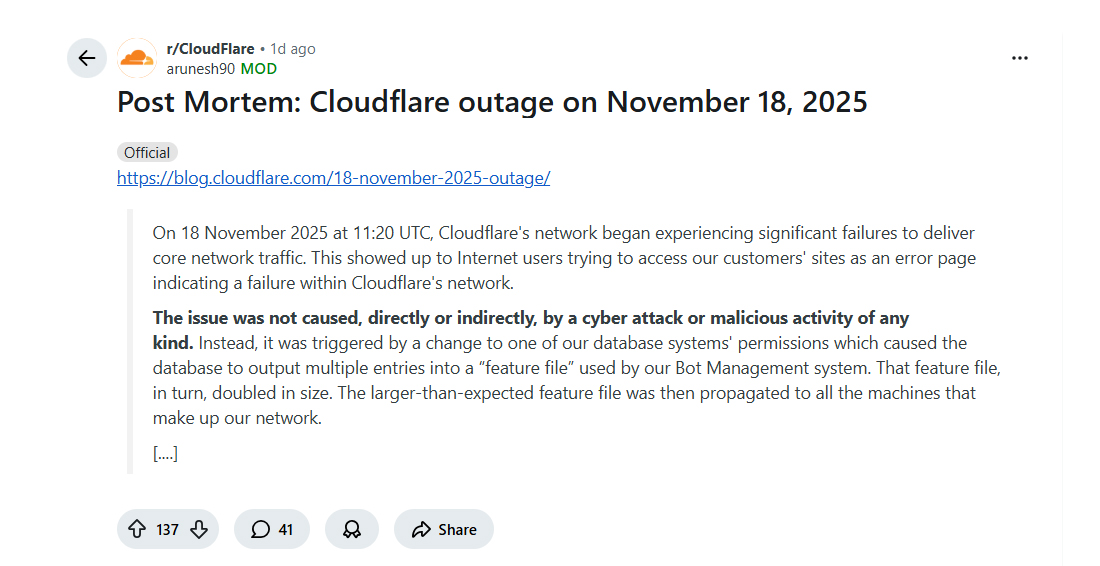
On November 18, 2025, around 11:20 UTC, Cloudflare experienced a major outage that caused disruptions across websites and online services worldwide. Popular platforms such as X, OpenAI, and Anthropic were affected, leaving users frustrated as pages failed to load, applications stalled, and some services went temporarily offline.
The problem was not with the network itself, but with Cloudflare’s backend systems, which started returning widespread 5XX errors.
So, what caused this disruption?
A recent change to one of Cloudflare’s databases caused a “feature file” used by their bot management system to grow much larger than expected.
This oversized file spread across the network and overloaded the software responsible for routing traffic. The system failed repeatedly, and the team initially suspected a DDoS attack.
Impact on services
The outage affected multiple Cloudflare services. Core CDN and security features displayed error pages, Workers KV and Cloudflare Access experienced delays, and logging into the Cloudflare dashboard was difficult for some users. The errors appeared and disappeared intermittently, making it harder for the team to identify the root cause quickly.
This incident highlighted the risks of relying entirely on a single CDN provider. Even industry-leading platforms can face downtime, which can affect performance, accessibility, and user trust.
Thus, in this blog, we have covered the top-ranked Cloudflare alternatives to help you reduce single-point dependency and keep your websites and applications online, even when major providers face disruptions.
Top 5 Ranked Cloudflare Alternatives Every Business Should Check Out
Below, we’ve handpicked the top Cloudflare alternatives, highlighting their pros, cons, and guidance on which is the right choice for your business.
| Rank | Alternative | Primary Focus
| Awards/ Recognition
| Rating (G2/Gartner Avg.)
| When to Choose
|
|---|
| 1 | Fastly | Real-Time Edge Compute & High-Performance CDN
| Fastly was named Gartner Peer Insights Customers’ Choice for Cloud WAAP for the 7th consecutive year (2025).
| 4.8 / 5
| When you need Cloudflare-level edge programmability, instant cache purging, and developer-driven control
|
| 2 | Akamai | Enterprise CDN & Security (WAAP)
| Akamai was the only vendor to be recognized as a Customer's Choice for Online Fraud Detection in the August 2025 "Voice of the Customer" report.
| 4.5 / 5
| When you are an enterprise with massive traffic, global users, and strict uptime requirements
|
| 3 | Imperva | Dedicated Web & API Security (WAAP)
| Imperva was named a Leader in KuppingerCole’s Leadership Compass 2025 for Web Application and API Protection (WAAP)
| 4.6 / 5
| When security is your top priority and you need a strong WAF, bot defense, and compliance
|
| 4 | Amazon CloudFront
| Hyperscale CDN & AWS Ecosystem Integration
| Second largest CDN Traffic Volume (Dominant Market Share among Hypercloud Vendors).
| 4.6 / 5
| If you're already heavily in the AWS ecosystem.
|
| 5 | Bunny.net
| Cost-Optimized, High-Speed Performance CDN
| Highest Score for Value and Speed in SMB/Startup CDN comparisons (2025).
| 4.8 / 5
| When you want fast global delivery at a low cost without complex setups
|
1. Fastly
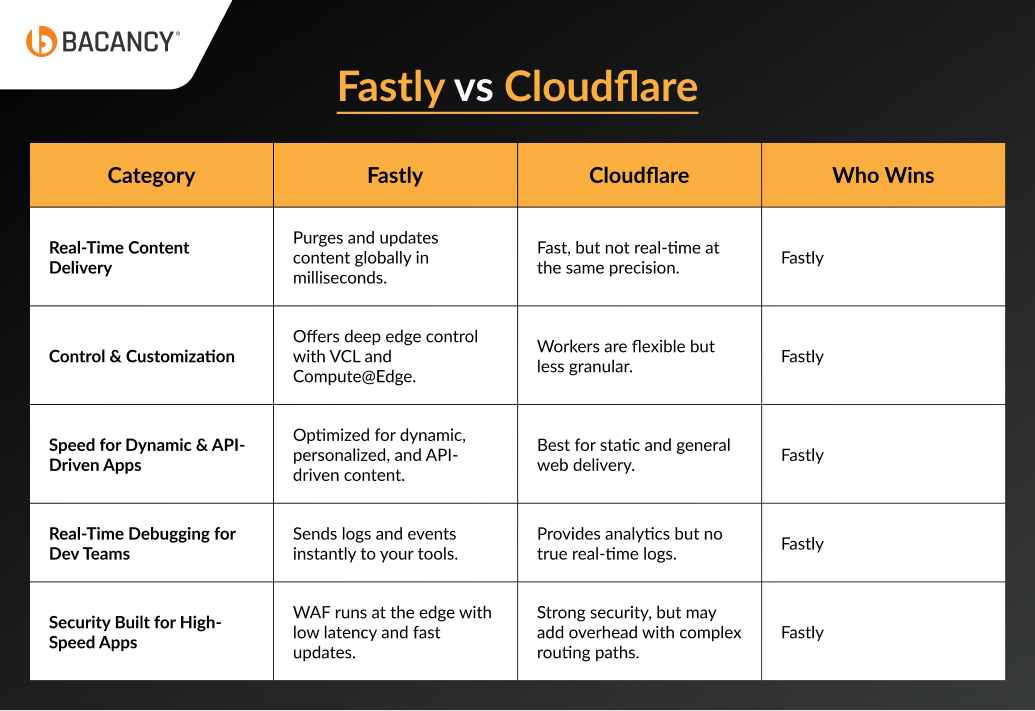
Fastly is a high-speed content delivery network that helps websites load quickly, especially when they have a lot of dynamic or constantly changing content. What makes Fastly stand out is its ability to run custom code right at the edge, which means it’s very close to your users. This gives businesses more control over how content is delivered.
For example, an e-commerce site can instantly update product pages during a flash sale without waiting for caches to refresh, ensuring customers always see the latest prices and availability. This makes Fastly a cloudflare alternative that is popular with SaaS platforms, media companies, and high-traffic online stores.
Pros of Fastly:
- Offers highly configurable caching policies to optimize performance for different types of content.
- Supports edge-based routing and load balancing to ensure minimal latency during high-traffic events.
- Provides real-time analytics and detailed logging to help teams monitor traffic patterns and detect issues quickly.
- Provides strong security through TLS/SSL and includes a Web Application Firewall for additional protection.
Cons of Fastly:
- Generates unpredictable costs under usage-based billing, especially during sudden traffic spikes.
- Requires technical expertise to configure edge logic or VCL, which can slow down less experienced teams.
- Adds unnecessary complexity for simple static websites that only need a basic CDN solution.
- Makes debugging and monitoring edge functions more challenging compared to traditional CDNs.
When Should Businesses Choose Fastly?
Fastly works best for businesses that need speed, control, and advanced edge capabilities. Consider using Fastly when your business:
- Handles real-time web applications or dynamic websites that need very fast responses.
- Requires precise control over caching and edge behavior for better performance.
- Needs to run logic at the edge for personalization, A/B testing, or API responses.
- Expects sudden traffic spikes or high-demand events and wants to maintain a smooth user experience.
2. Akamai
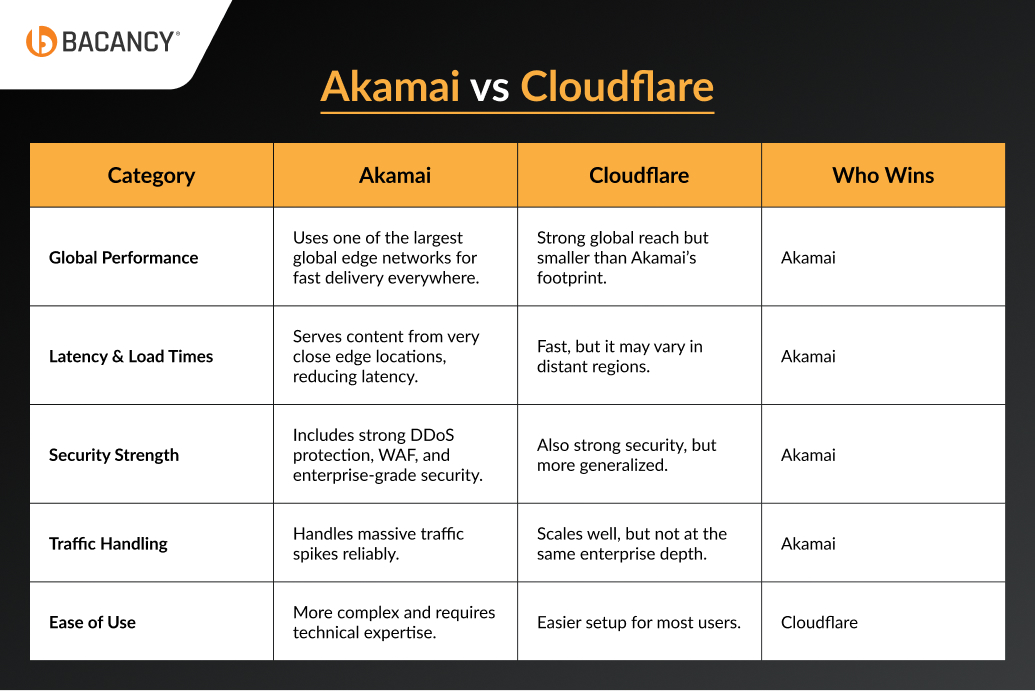
Akamai is a global content delivery network designed to deliver websites and applications quickly and securely. What makes Akamai stand out is its massive network of servers around the world, which ensures content is served from the closest location to users, reducing latency and improving performance.
For example, a streaming platform can deliver high-quality video to viewers worldwide without buffering, even during peak traffic hours. Akamai is widely used by media companies, e-commerce platforms, and enterprises that need reliable global delivery.
Pros of Akamai:
- Offers intelligent traffic routing and load balancing to maintain consistent performance across regions.
- Provides detailed analytics dashboards to monitor traffic trends and optimize performance.
- Provides strong security features, including DDoS protection, TLS/SSL, and a Web Application Firewall.
- Supports content acceleration for dynamic applications, reducing the impact of traffic spikes.
Cons of Akamai:
- Pricing can be higher compared to smaller CDNs, which may not be suitable for small businesses.
- Complex setup and configuration may require dedicated technical resources.
- Some advanced features can be overwhelming for teams without prior experience with CDNs.
- Customizing caching rules or edge logic may require specialized expertise.
When Should Businesses Choose Akamai?
Akamai works best for businesses that need global reach, reliability, and advanced security. Consider using Akamai when your business:
- Serves content to a global audience and wants minimal latency everywhere.
- Handles high-volume traffic or events that can cause sudden spikes.
- Requires strong security protections against DDoS attacks and other threats.
- Needs detailed analytics to monitor performance and optimize delivery.
- Wants a CDN with proven reliability for media, e-commerce, or enterprise applications.
3. Amazon CloudFront (AWS)
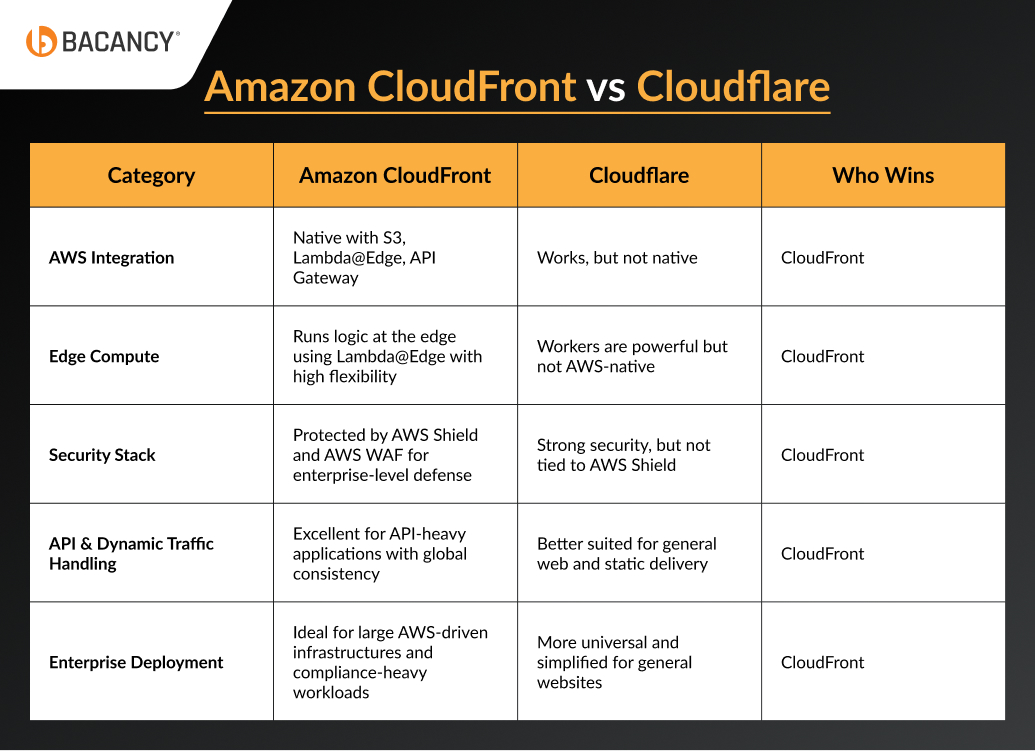
Amazon CloudFront is a high-performance content delivery network that integrates easily with the AWS ecosystem. It delivers both static and dynamic content quickly by caching it at edge locations worldwide, reducing latency and improving user experience.
For example, an e-commerce platform can serve product images and videos globally with minimal delay while integrating CloudFront with AWS Lambda@Edge to run custom code at the edge, such as personalizing user experiences or handling API responses. CloudFront is one of the most popular Cloudflare alternatives for SaaS companies, media platforms, and large-scale web applications.
Pros of Amazon CloudFront:
- Offers intelligent routing and cache optimization to maximize performance across regions.
- Integrates with AWS services like S3, Lambda@Edge, and API Gateway.
- Supports dynamic content personalization at the edge with Lambda@Edge.
- Provides strong security with TLS/SSL, AWS WAF, and DDoS protection via AWS Shield.
Cons of Amazon CloudFront:
- Costs can be unpredictable, especially with heavy data transfer or dynamic content usage.
- Advanced features like Lambda@Edge and custom caching rules require technical knowledge.
- Some configurations can be complex for teams new to AWS or CDNs.
- Troubleshooting edge functions or integrations may require familiarity with AWS tools.
When Should Businesses Choose Amazon CloudFront?
CloudFront works best for businesses that want fast, scalable, and secure content delivery with deep AWS integration. Consider using CloudFront when your business:
- Runs dynamic web applications or APIs that need low-latency global delivery.
- Uses AWS services extensively and wants effortless integration across the stack.
- Needs to personalize content or run logic at the edge using Lambda@Edge.
- Experiences variable traffic and wants automatic scaling without performance loss.
- Requires strong security, including DDoS protection, WAF rules, and SSL/TLS encryption.
Looking to Keep Your Applications Fast, Secure, and Scalable Across Multiple CDNs?
Hire DevOps engineers to manage your cloud delivery, optimize performance, and prevent downtime.
4. Imperva
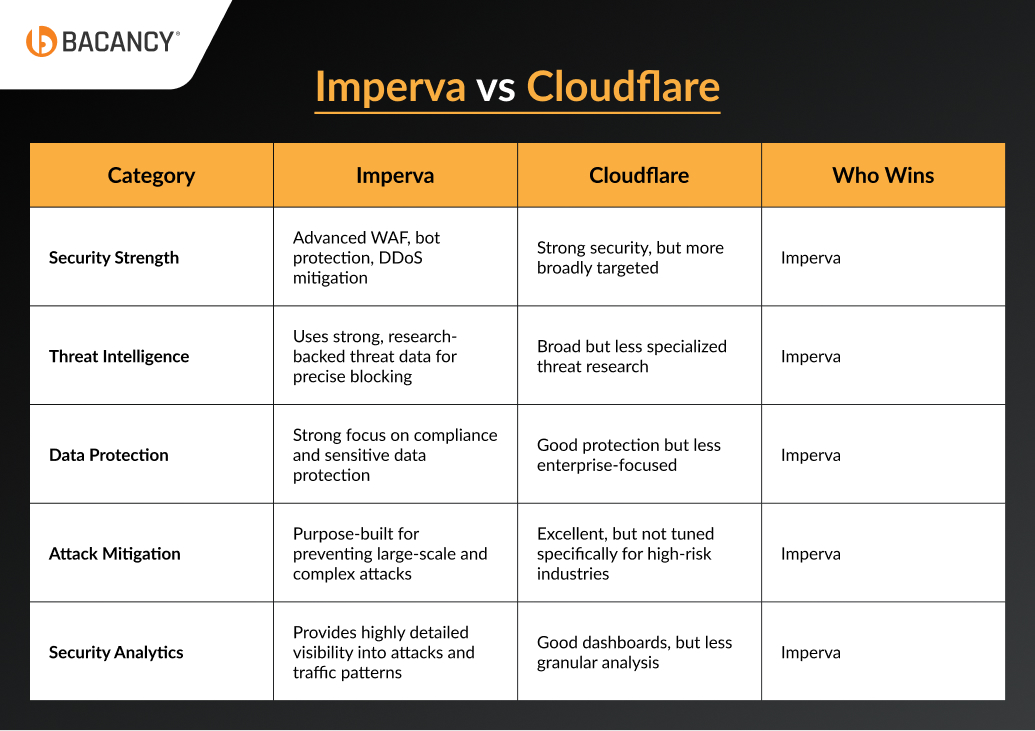
Imperva is a content delivery and web application security platform that helps businesses deliver websites and applications quickly while protecting them from cyber threats. What makes Imperva stand out is its combination of global content delivery with advanced security features, including DDoS protection and a powerful Web Application Firewall (WAF).
For example, an online retailer can ensure product pages load fast worldwide while blocking malicious traffic automatically, protecting both the site and customer data. Imperva can be widely used Cloudflare alternative for enterprises, e-commerce platforms, and media companies that need fast, secure delivery.
Pros of Imperva:
- Offers configurable caching and delivery optimization to handle varying traffic efficiently.
- Provides advanced threat detection and automated mitigation to protect applications in real-time.
- Enables edge-based performance enhancements, reducing latency for global users.
- Provides detailed analytics and reporting to monitor traffic and security events.
Cons of Imperva:
- Pricing can be higher than simpler CDNs, which may not suit smaller businesses.
- Requires technical expertise to fully configure caching, edge rules, and security settings.
- Some advanced security features can be complex for teams without prior experience.
- Limited flexibility compared to developer-focused CDNs for custom edge logic.
- Customization and fine-tuning may take time during deployment.
When Should Businesses Choose Imperva?
Imperva works best for businesses that need both performance and strong security. Consider using Imperva when your business:
- Serves content globally and wants fast, reliable delivery.
- Needs advanced protection against DDoS attacks and other web threats.
- Wants a combined CDN and security solution in one platform.
- Requires detailed insights into traffic patterns and security events.
5. Bunny.net
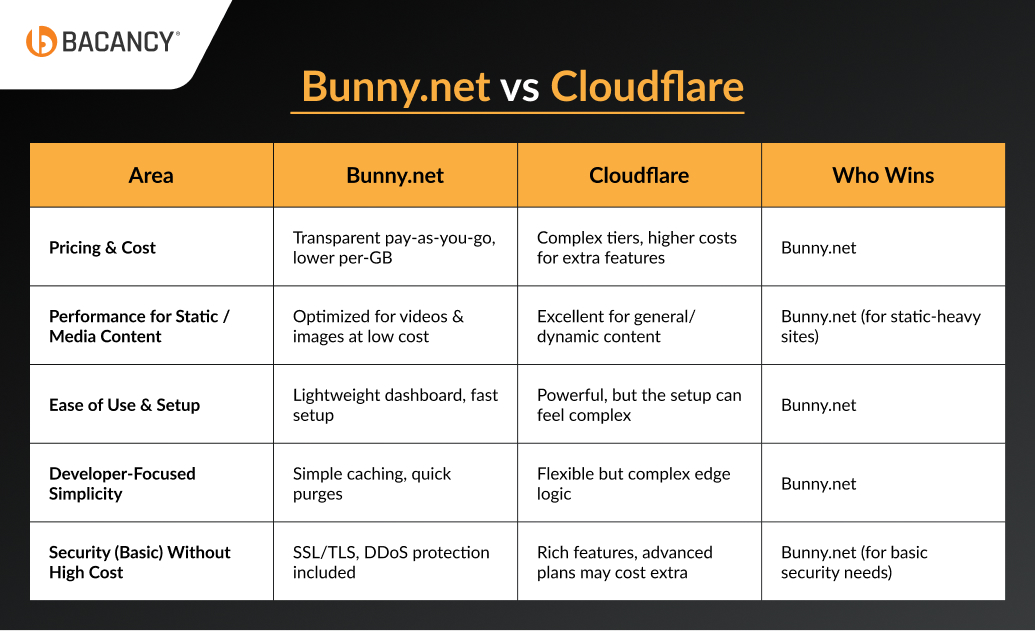
Bunny.net is a high-performance, cost-effective content delivery network designed to deliver websites, videos, and applications quickly worldwide. What sets Bunny.net apart is its simplicity and developer-friendly platform, offering fast delivery with easy setup and transparent pricing.
For example, a small e-commerce site can serve images and videos globally without worrying about complex configurations, while also scaling efficiently during seasonal traffic spikes. Bunny.net is a popular Cloudflare alternative for startups, SMBs, and content creators who want fast, reliable delivery without high costs.
Pros of Bunny.net:
- Offers flexible caching and content optimization to ensure consistent performance for different file types.
- Supports regional edge routing for faster media delivery in multiple locations.
- Provides cost controls and usage monitoring to help businesses manage budgets effectively.
- Supports video delivery and caching for both static and dynamic content.
Cons of Bunny.net:
- Smaller global presence compared to major CDNs, which may affect latency in some regions.
- Advanced edge logic or custom scripting is limited compared to developer-focused CDNs.
- Analytics and reporting features are less detailed than enterprise-grade CDNs.
- May not scale as efficiently for extremely high-traffic enterprise applications.
When Should Businesses Choose Bunny.net?
Bunny.net is ideal for businesses that seek fast, simple, and affordable content delivery. Consider using Bunny.net when your business:
- Serves websites, videos, or applications that need fast global delivery.
- Seeks an easy-to-use platform with minimal configuration requirements.
- Values predictable, cost-effective pricing for growing traffic.
- Handles moderate traffic spikes and seasonal traffic surges.
Conclusion
Choosing the right CDN can make a huge difference in website performance, security, and user experience. While Cloudflare remains a popular choice, outages like the one on November 18, 2025, show the risks of relying on a single provider.
Cloudflare alternatives Fastly, Akamai, Amazon CloudFront, Imperva, and Bunny.net each offer unique strengths, whether it’s edge computing, global reach, advanced security, or cost-effective delivery.
By exploring these top alternatives, businesses can ensure faster content delivery, stronger protection, and greater reliability, keeping their websites and applications running smoothly, regardless of the circumstances.
Frequently Asked Questions (FAQs)
Bunny.net is a great choice for small businesses and startups. It offers fast global delivery, easy setup, transparent pricing, and basic security features without the complexity of enterprise-grade CDNs. It’s ideal for sites with moderate traffic and seasonal spikes.
Fastly is best for businesses needing advanced edge computing and real-time updates. Akamai excels for enterprises with high global traffic and strict reliability needs. Amazon CloudFront works well if your infrastructure is heavily tied to AWS and you want seamless integration with services like Lambda@Edge. Consider your technical requirements, traffic patterns, and ecosystem alignment carefully before making a decision.
Yes. A multi-CDN strategy can enhance redundancy, reduce latency by serving content from the nearest location, and mitigate outages resulting from a single provider. It can be complex to manage, but DevOps teams or CDN management platforms can help efficiently orchestrate traffic across multiple CDNs.
Most major CDNs like Imperva, Akamai, and Fastly offer robust security features, including DDoS mitigation, TLS/SSL encryption, and Web Application Firewalls. Bunny.net provides basic security suitable for small to medium businesses. It’s essential to evaluate each CDN’s security capabilities in relation to your site’s traffic and threat exposure.