Quick Summary
Application modernization strategies help businesses update legacy systems to meet demanding performance, scalability, and integration needs. They include approaches such as rehosting, re-platforming, refactoring, and rebuilding, each suited to different goals and technical realities. The right strategy reduces risk, improves agility, and sets the foundation for long-term growth.
Table of Contents
Introduction
Legacy systems can slow progress due to high upkeep costs, limited flexibility, and poor integration with innovative tools. As technology improves, relying on outdated applications becomes a serious challenge for growth and performance.
According to MarketsandMarkets, the application modernization services market was $19.82 billion in 2024 and is predicted to reach $39.62 billion by 2029, showing how many businesses are prioritizing this shift.
The application modernization strategy plays a key role in this transition. Whether you choose to rehost, re-platform, or refactor, the right approach helps reduce disruption and adds long-term value.
In this blog, we will discuss when to start modernizing and which application modernization strategy will make the biggest impact in 2026.
When Should You Start Modernizing Your Applications?
Modernization is a combination of internal limitations and external pressures that trigger it. Here are key signs that it’s time to begin your application modernization journey:
- If your current systems and performance are slow, prone to crashes, or can’t handle peak load times, it’s a clear signal to consider migration.
- Maintaining old infrastructure often consumes more time, operational cost, and resources than it’s worth, especially when modern solutions offer lower TCO.
- Legacy systems cannot scale on demand, which limits your ability to support business growth, customer expansion, or data surges.
- Some systems don’t integrate easily with APIs, cloud platforms, or third-party services, which leads to slow innovation.
- Outdated software can expose your organization to vulnerabilities and make it harder to stay compliant with evolving regulations.
- If your developers spend more time fixing bugs than building features, your system is holding your team back.
Hence, it is crucial to adapt modernization strategies before issues arise. Let’s understand the need for proactive approaches that ensure minimal disruption, better resource planning, and smoother execution of your migration strategy.
7 Legacy Application Modernization Strategies to Reform Your Businesses
Choosing the right modernization strategy depends on your application’s complexity, business goals, time constraints, and budget. Below are the 7 most common and effective approaches to modernize legacy applications in 2026:
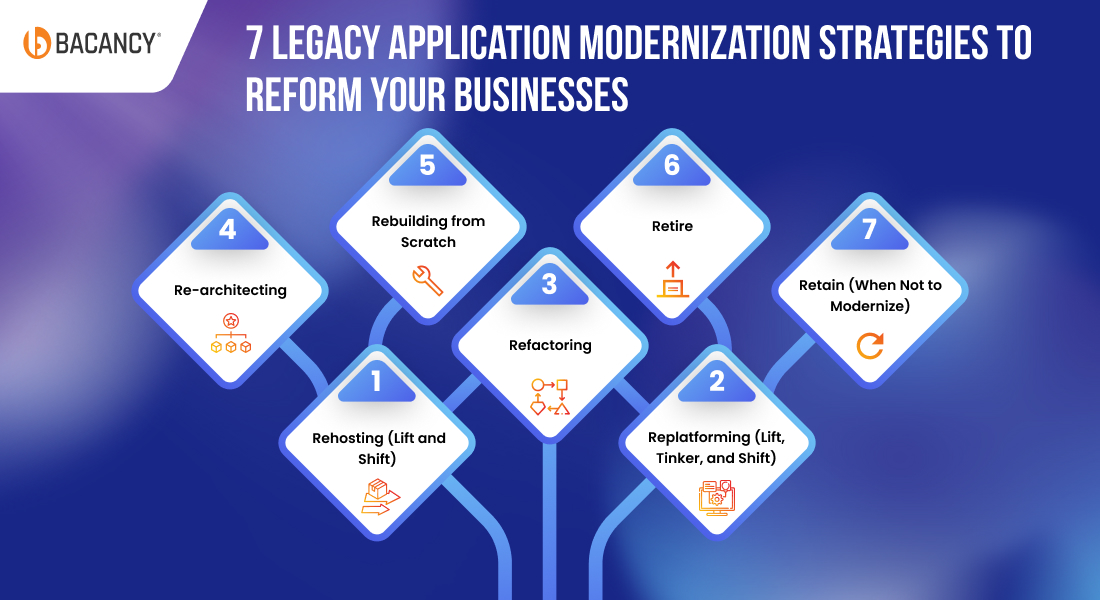
1. Rehosting (Lift and Shift)
Rehosting means migrating an application from on-premise infrastructure to the cloud with little or no changes to the codebase. It is ideal for businesses looking for a fast, low-risk transition that reduces data center costs and improves infrastructure scalability. The Lift-and-Shift approach is best suited for stable systems that require more flexible hosting.
Replatforming involves minor modifications during migration, such as upgrading databases or adopting managed services, without altering the app’s core architecture. It offers improved performance and scalability while keeping development effort and risk low, a great middle ground between quick wins and long-term gains.
3. Refactoring
Refactoring focuses on restructuring the internal code of the application to improve performance, readability, and maintainability, without changing its external behavior. This strategy is ideal when legacy code is holding back feature delivery or integration with modern services.
4. Re-architecting
Re-architecting involves redesigning large portions of the application to align with modern architectures, such as microservices, serverless, or event-driven systems. It’s the right choice when your current system lacks scalability or cannot support new business requirements.
Though more complex and time-consuming, it results in high agility and better long-term maintainability.
5. Rebuilding from Scratch
Rebuilding strategy means creating an entirely new application using modern technologies, frameworks, and design principles. It is ideal when the existing system is outdated, lacks flexibility, or cannot be extended.
While it requires more time and resources, it ensures a future-ready platform with better performance, user experience, and scalability.
6. Retire
Some legacy applications no longer provide business value or are rarely used. In such cases, retiring the application helps reduce overhead, simplify the tech stack, and free up resources. To avoid disruptions, the retire strategy includes a detailed assessment of dependencies and usage patterns.
7. Retain (When Not to Modernize)
Not every application needs to be modernized immediately. Certain systems may still meet compliance needs, serve niche functions, or be too risky to change. With a retain strategy, these applications can minimize updates, or wrapping them with APIs can be the best course of action until modernization becomes viable.
How to Build a Future-Ready Application Modernization Strategy
Modernizing your applications works best when there’s a clear plan in place. Here’s how you can build a step-by-step application modernization strategy that fits your business objectives.
Step 1: Define Your Business and Technology Goals
Start by defining modernization success for your organization. Create a list like: Is it faster time-to-market, improved security, or reduced technical debt? If these goals align, ensure your migration strategy delivers measurable business outcomes.
Step 2: Assess Your Current Application Landscape
Conduct a detailed audit of your existing applications, infrastructure, dependencies, and technical issues. Implementing tools like CAST and SonarQube can help identify bottlenecks, risks, and legacy code quality.
Step 3: Prioritize Applications Based on Impact and Risk
Not every application needs immediate attention. Use an impact-risk matrix to score apps based on business value, user dependency, and the required modernization effort.
Step 4: Align Stakeholders Across IT and Business Units
Modernization initiatives often fail without cross-functional alignment. Ensure product owners, IT leaders, developers, and business teams are aligned on scope, priorities, and KPIs.
Step 5: Create a Phased and Flexible Roadmap
Break modernization into manageable phases, starting with low-risk, high-impact apps. Keep your roadmap agile enough to adapt to business shifts or tech changes over time.
Want to Modernize Your Legacy Application the Right Way?
Get in touch with our application modernization services for a tailored roadmap, the right tech stack, and proven strategies to transform outdated systems into agile, future-ready platforms.
Benefits of Implementing Application Modernization Strategy for Business Outcomes
Each application modernization strategy brings unique advantages that map directly to business priorities. Whether you aim for faster delivery or better scalability, aligning technology with outcomes is the most beneficial for your business.
1. Reducing Infrastructure and Maintenance Costs
Modernizing legacy systems by migrating to the cloud or adopting containerization reduces both capital and operational expenses. Businesses often see 30–40% cost savings, which allows for reinvestment or innovation and customer-centric initiatives.
2. Accelerating Time-to-Market with Modular Architectures
Shifting from monolithic applications to microservices or modular design increases development agility. Teams can release updates faster, test in isolation, and shorten go-to-market timelines, which eventually helps you respond quickly to customer needs and seize market opportunities.
3. Supporting Cloud-Native Scalability
Cloud-native strategies, such as autoscaling, serverless computing, and distributed workloads, ensure your systems scale with demand. This leads to improved user experience, reduced downtime, and consistent performance even during traffic spikes or growth phases.
4. Empowering Innovation Through APIs and Composability
By combining systems and enabling API-first integrations, businesses can easily incorporate third-party services, launch digital products, and experiment with new offerings. This can also build omnichannel experiences and foster continuous innovation without starting from scratch.
5. Improving Developer Experience and Delivery Speed
Modern development practices, like CI/CD automation, DevOps pipelines, and reduced tech debt, empower teams to innovate faster and with fewer errors. They also increase productivity and retain top engineering talent, which is vital for the success of long-term digital transformation.
What are the Supporting Tools and Technologies for Application Modernization?
The success of any application modernization strategy relies on the right set of tools and technologies. Here are the core enablers:
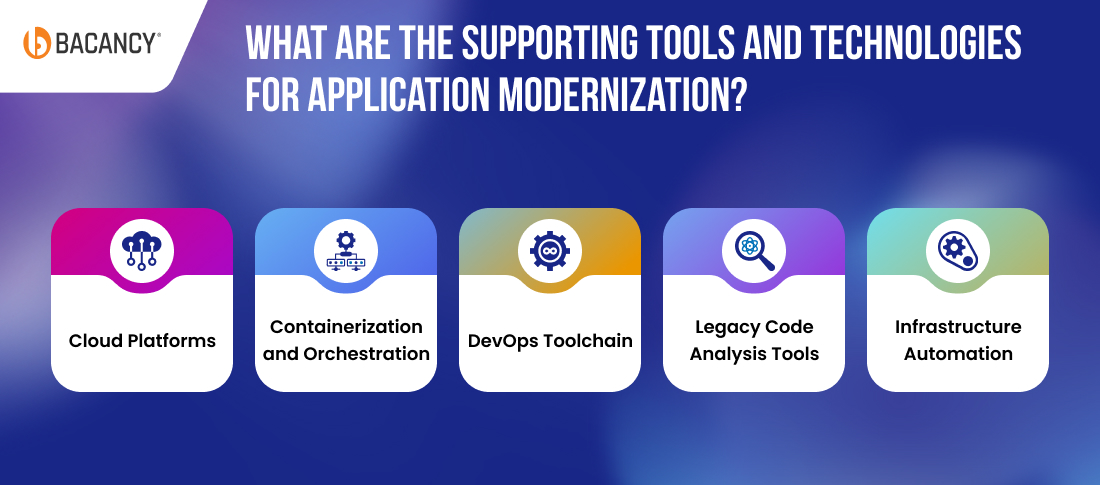
Use AWS, Azure, or Google Cloud Platform to gain scalable infrastructure, managed services, and on-demand resources.
Containerization and Orchestration
Docker simplifies packaging; Kubernetes automates deployment, scaling, and management of containerized applications.
DevOps tools like GitLab CI, Jenkins, and ArgoCD enable continuous integration and deployment for rapid delivery and better quality control.
Tools like CAST and SonarQube help identify code complexity, security flaws, and maintainability issues before migration.
Infrastructure Automation
Terraform and Ansible reduce manual configuration and ensure consistent, repeatable infrastructure deployments across environments.
How the Flywheel Approach Empowers Legacy Application Modernization Strategy
The Flywheel approach is a strategic framework that creates self-sustaining momentum by compounding the impact of small, high-value changes over time. It supports legacy application modernization through targeted and detailed steps.
It starts with focused actions, like a cloud migration or deployment automation, that improve performance and cut costs. Each win feeds the next move, such as service refactoring, API adoption, or cloud-native scaling. This builds speed, reduces tech debt, and improves digital experience.
Over time, the approach creates a self-fueling cycle. Legacy modernization becomes faster, more cost-efficient, and tightly aligned with outcomes like faster delivery, lower overhead, and stronger innovation.
Use Cases of Application Modernization Strategy
Here are use cases of how enterprises have successfully applied application modernization strategies:
1. Legacy ERP to Microservices in Manufacturing
A manufacturing firm re-architected its ERP system into microservices, enabling real-time inventory tracking and seamless third-party integrations across global plants.
2. Monolithic Fintech App Refactored into Cloud-Native
A fintech company refactored its core app through application migration services and APIs, reducing monthly downtime by 90% and scaling to meet surging transaction volumes.
A healthcare SaaS solutions provider re-platformed its application using Docker and Kubernetes on Azure. This resulted in HIPAA-compliant scalability, faster deployments, and simplified maintenance.
Get a Custom Application Modernization Strategy for Your Business
Every business faces unique challenges when it comes to modernizing legacy systems. A one-size-fits-all approach rarely works for companies with unique needs. Whether you aim to reduce tech debt, scale rapidly, or improve customer experience, a tailored modernization roadmap is essential.
At Bacancy, we offer end-to-end application development services, from auditing your current systems to implementing cloud-native architectures and microservices. Our experts work closely with your team to design a strategy that aligns with your goals, timelines, and compliance requirements.
Frequently Asked Questions (FAQs)
Application modernization is the process of updating or transforming legacy applications to improve their performance, scalability, security, and maintainability using modern technologies and practices. This may involve migrating to the cloud, adopting microservices, refactoring code, or integrating new features.
Technologies supporting application modernization include cloud platforms, containers, microservices, APIs, CI/CD automation, DevOps practices, modern databases, and AI/ML integration.
Assess your application portfolio by evaluating business value, technical debt, performance issues, scalability needs, and alignment with business objectives. Prioritize applications that will deliver the most significant impact and value when modernized.
To choose an application modernization strategy, assess your business goals, current tech stack, and legacy system challenges. Align the chosen approach, such as rehosting, refactoring, or rebuilding, with desired outcomes, such as scalability, cost-efficiency, or faster delivery.