Last Updated on February 19, 2026
Last Updated on February 19, 2026
Quick Summary
Artificial Intelligence (AI) is indeed a phrase and technology that has been used by every SME and enterprise today, in their routine operations and activities. As businesses are making efforts to achieve greater speed, precision, and scalability, AI is no longer just a competitive advantage; it’s a strategic necessity. With traditional methods and tools proven to be ineffective, businesses are turning towards AI business process automation that is driving a new era of intelligent, self-improving systems. This blog dives into real-world AI business process automation use cases and how AI is being adopted by SMEs across different industries.
Table of Contents
AI is proven to be an increasingly powerful technology that can transform the way small and medium enterprises (SMEs) operate and improve their business processes. Today, businesses across the globe are under mounting pressure to operate faster, reduce costs, and drive innovation.
Artificial Intelligence Business Process Automation (AI BPA) is a transformative solution that can empower businesses to eliminate time-consuming processes and make data-driven decisions.
As per research, the global BPA market size is expected to reach a value of USD 33.4 billion by 2032 from USD 15.3 billion in 2025, which is predicted to rise at a CAGR of 11.7% throughout the assessment period. With the BPA market size expected to double the value nearly, SMEs can no longer afford to delay the adaption of AI for business process automation.
Whether you are a small business looking to automate manual workflows or an enterprise aiming to enhance customer experience, AI business process automation offers a notable foundation to automate every operation.
AI business process automation is the use of cognitive Artificial Intelligence technologies to automate, optimize, and improve routine business operations without minimal human intervention.
For SMEs, this means transforming how they manage workflows, make decisions, and serve customers with intelligent automation. Here’s why businesses should invest in AI for business process automation.
With the use of AI to automate business processes, organizations can not only process and analyze data faster but also perform rule-based tasks with precision. This means all the critical tasks are completed efficiently with AI-powered tools, which further saves your employees’ time and allows them to focus on more strategic work.
Automation driven by AI technologies can reduce costs by saving time, which would otherwise be spent on repetitive, time-consuming tasks. Tasks such as invoice processing, inventory checks, or workflow management can be efficiently automated and streamlined. This reduces errors as well as operational costs while allowing SMEs to allocate resources more effectively.
AI empowers business professionals to analyze large amounts of data faster, within minutes. Actionable insights that AI technologies, such as Big Data Analytics, Natural Language Processing (NLP), and Machine Learning (ML), provide can lead to more informed and strategic decision-making.
AI enables SMEs to scale operations efficiently by automating repetitive tasks, reducing the need for proportional workforce expansion. Businesses can handle increasing workloads, customer demands, and market changes without incurring significant additional costs, leading to sustainable and resource-efficient growth.
With the implementation of AI in business process automation, it would be feasible to enhance customer interactions through personalized recommendations, 24/7 chatbot support, and real-time query resolution. Natural Language Processing and predictive analytics capabilities of AI help businesses understand and respond to customer needs proactively across every stage.
AI-powered systems help SMEs stay compliant with evolving regulations by continuously monitoring operations, flagging potential risks, and automating documentation. Whether it’s data privacy, financial reporting, or industry-specific standards, AI assists businesses in ensuring regulatory accuracy and accountability.
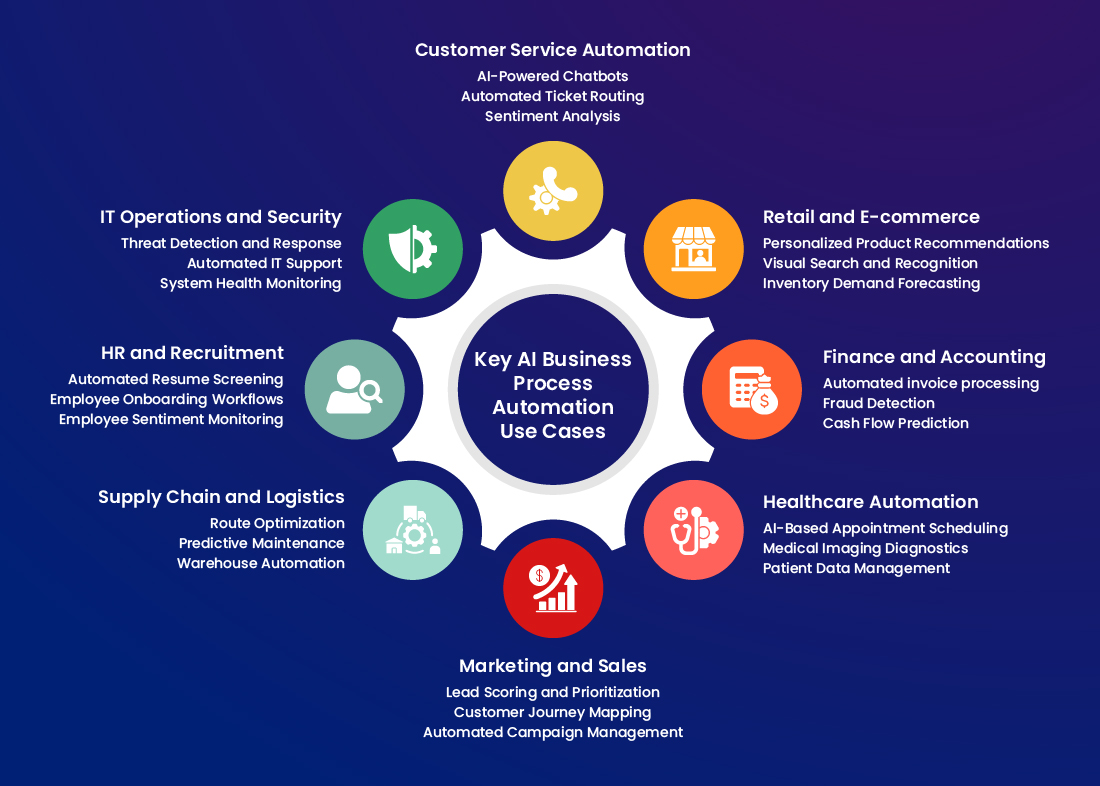
The applications of AI for business process automation have been making a significant impact across industries. Here are some practical AI BPA use cases to look for in 2026 and beyond.
Hire AI developers who can implement AI-powered solutions into your business processes to automate operations, boost efficiency, and drive intelligent automation.
These AI business process automation use cases show how intelligent automation is transforming modern enterprises. Organizations that hire automation developers with the right expertise can better design, integrate, and scale AI-driven workflows. This ensures long-term efficiency, accuracy, and measurable business impact without disrupting existing operations.
AI business process automation is a proven strategy that can leave a lasting impact on businesses by allowing them to automate and streamline thousands of repetitive tasks. Here are some real-world examples of companies that have been using AI for business process automation to improve workflows, reduce costs, and drive better results.
Telefonica, a leading Spanish multinational telecommunications company, deployed Amelia (by IPsoft), an AI-powered virtual agent. The telecom company used a generative AI platform to automate customer service tasks across multiple channels. The AI assistant handles routine queries like billing and technical support using natural language processing, significantly reducing the need for human intervention.
Coca‑Cola, a globally renowned soft drink manufacturer, incorporates AI capabilities across its value chain. They have been using AI for various aspects, from analyzing customer preferences via vending-machine data to optimizing supply chains and targeted marketing. The brand uses AI-backed data to personalize marketing, launch new products faster, reduce stock-outs, and improve ROI.
DHL focuses on an AI-powered initiative to automate packaging, sourcing, and inventory workflows within its 549 distribution centers. They embraced AI process automation to enhance sustainability, reduce transportation costs, and ensure tailored packaging solutions, all while optimizing operational efficiency at scale.
Mayo Clinic, a top American medical center, is pioneering the use of AI to optimize healthcare workflows and improve patient outcomes. They are using Ophthalmology Parametric Universal Search (OPUS), an AI-driven tool developed within the Mayo Clinic Ophthalmology. The AI-powered tool can access data from over 25 medical databases to match patients for clinical trials, enhance research accuracy, and reduce manual efforts, helping medical professionals make informed decisions.
Successfully implementing AI in business processes does not require a massive overhaul. With careful planning, you can start small and scale smart to implement and get the maximum benefit of AI business process automation. Here’s how to begin your AI automation journey:
Look at your day-to-day operations. Are your team members spending too much time on repetitive tasks like data entry, customer queries, or inventory checks? These are prime candidates where AI-powered automation can make a considerable impact and deliver measurable benefits.
What do you want AI to do for you? Whether your business focuses on reducing costs, improving customer response times, or boosting productivity. Defining your goals upfront will guide the successful implementation.
There are so many AI-powered tools available in the market, which makes it difficult to select the right platform for your needs. Pick tools that align with your business size, industry, and existing systems. Research and assess AI platforms that are user-friendly and offer room to scale.
Implementing AI automation all at once can feel like an impossible task to complete. The best approach is to begin with a single use case or department to test the technology or platform. This allows you to assess AI in action, adjust based on results, and expand confidently across your business.
Your team plays a crucial role in making the implementation of AI in business process automation a success. Invest in training so they feel empowered using AI. Track performance on a regular basis and keep refining processes to ensure continued success.
Work with an experienced AI automation agency to implement AI-powered automation that drives measurable results across your business operations.
Going through the blog post, you would have now understood how AI is already redefining business efficiency across industries. AI business process automation is indeed a true game-changer for businesses that want to automate complex workflows, reduce manual efforts, and make data-driven, smarter decisions. From customer service to supply chain, the use cases of AI BPA described above display its transformative impact.
Embracing AI is more than just a distant concept; it’s more like a strategic move for SMEs aiming to stay competitive and agile in a fast-changing market. If implementing AI in your business systems and processes seems overwhelming, partnering with the right AI development company can be the solution. Let AI experts help you tap into the maximum potential and incorporate AI-powered solutions based on your unique business needs and goals.
Traditional automation follows fixed rules and requires manual updates. AI BPA learns over time, handles complex or unstructured data, and improves on its own. It brings intelligence and adaptability to automated processes. This helps businesses respond faster to changes and challenges.
AI has the capabilities to use human-like intelligence and decisive capabilities that can be leveraged to automate tedious, repetitive tasks, reduce errors, speed up operations, and lower costs. It supports better decision-making by analyzing real-time data. AI business process automation leads to higher productivity and smarter workflows.
Industries like finance, healthcare, retail, logistics, and others benefit greatly due to high-volume tasks. Embracing AI business process automation improves accuracy, speed, and service in these sectors. It helps organizations across different sectors scale efficiently without losing quality.
When using AI for business process automation, it includes an amalgamation of numerous technologies like machine learning (ML), natural language processing (NLP), computer vision, and more. These technologies help AI-powered systems understand data, predict outcomes, and perform actions.

Tech Geek at Bacancy
Tech-Maverick expert in AI, ML, Data Science, LLM, and Automation.
MORE POSTS BY THE AUTHOR
Your Success Is Guaranteed !
We accelerate the release of digital product and guaranteed their success
We Use Slack, Jira & GitHub for Accurate Deployment and Effective Communication.