Finance runs on data. But the real problem isn’t collecting data anymore. It’s understanding it fast enough to act. Fintech companies process millions of transactions, documents, risk signals, and customer interactions every single day.
Yet, analysts spend hours summarizing reports, compliance teams sift through thousands of regulatory pages, and customer support handles endless routine queries. Most of this work is repetitive, manual, and expensive.
Traditional analytics helps detect patterns, but it rarely explains them or turns them into something useful for people. Teams still have to read reports, interpret data, and write their own insights.
As financial systems become more digital and complex, the gap between data and decision-making continues to grow.
This is where generative AI in fintech is changing the game. Instead of just analyzing numbers, generative AI can write reports, summarize regulations, generate financial insights, and assist customers in real time.
Powered by technologies like large language models (LLMs) and retrieval-augmented generation (RAG), these systems turn massive financial datasets into clear, actionable intelligence.
The shift is already underway. The global market for generative AI in financial services is expected to grow from about $2.17 billion in 2026 to nearly $9.8 billion by 2030, as banks and fintech platforms invest heavily in AI-driven automation and decision support. (Source)
In this guide, we’ll explore how generative AI in fintech works, the most impactful real-world use cases, and how major firms are already using it.
You’ll also learn how fintech companies calculate ROI from AI investments, the biggest implementation challenges, and the trends shaping the future of AI-driven financial systems. Let’s understand the basics first!
Generative AI in fintech is an AI approach that creates new outputs from financial data, such as AI-powered reports, meeting summaries, insights, and personalized financial recommendations.
These capabilities power many generative AI applications in fintech, including automated financial reporting, AI-driven customer support, and regulatory analysis.
There are many technologies that power Gen AI in fintech; here are a few important ones:
- Large Language Models (LLMs): Generate human-like text, summarize financial data, and draft insights.
- Retrieval-Augmented Generation (RAG): Combines AI with external data sources to produce accurate, up-to-date outputs, ideal for regulatory analysis, reporting, and market insights.
- Fine-Tuned Models: LLMs trained on specific financial datasets for tasks like credit risk analysis or portfolio summaries.
- Natural Language Processing (NLP): NLP in fintech can help you quickly understand unstructured financial documents, detect sentiment, and extract key entities.
- Speech-to-Text & Voice AI: Converts advisor-client meetings or call recordings into text for summaries and actionable insights.
In addition to generating actionable insights, these technologies support Generative AI for app modernization, helping banks modernize legacy systems, adopt microservices, and deliver seamless digital experiences.
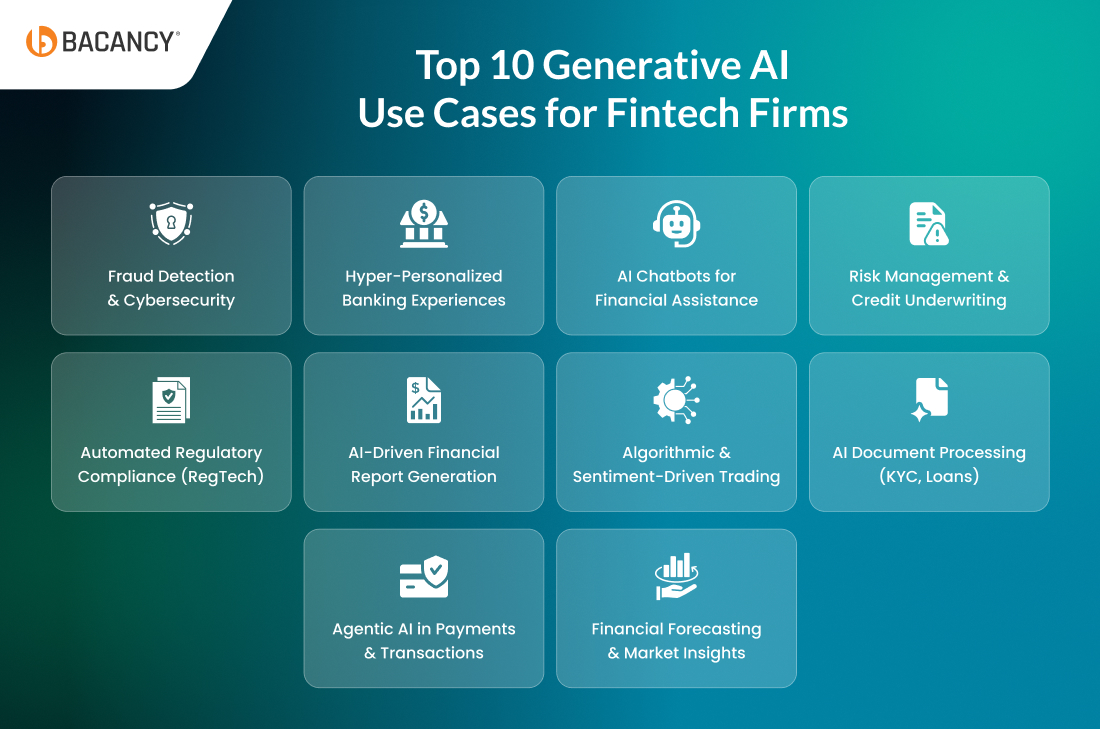
Top 10 Generative AI Use Cases for Fintech Firms
Below are 10 key generative AI use cases in fintech transforming how modern financial platforms operate.
1. Fraud Detection & Cybersecurity
Fraud detection is one of the most valuable use cases of generative AI in fintech. As digital transactions grow, financial institutions face rising threats such as payment fraud, identity theft, and account takeovers. Traditional monitoring systems often struggle to detect complex or evolving fraud patterns in real time, leaving banks and fintech platforms vulnerable.
How Generative AI helps:
- Analyze transaction patterns in real time to detect suspicious behavior
- Generate fraud alerts and risk explanations for security teams
- Simulate new fraud scenarios to improve detection models
- Identify anomalies in login behavior, device usage, and payment activity
- Support faster investigation with automated summaries of fraud cases
2. Hyper-Personalized Banking Experiences
Today’s banking customers expect experiences as personalized and intuitive as eCommerce platforms. Generic recommendations and one-size-fits-all advice fall short, leaving customers disengaged and reducing opportunities for cross-selling and loyalty.
How Generative AI helps:
- Generate personalized savings and investment recommendations
- Create tailored financial insights based on spending habits
- Provide customized credit card or loan offers
- Generate automated financial advice for different customer segments
- Personalize notifications and financial education content
3. AI Chatbots for Financial Assistance
Customer support is a major cost center for banks and fintech platforms. Traditional support teams struggle to handle high volumes of queries efficiently, resulting in long wait times, inconsistent responses, and lower customer satisfaction.
How Generative AI helps:
- Answer customer questions about transactions, balances, or payments
- Provide instant assistance for account issues or card problems
- Generate personalized financial guidance during conversations
- Handle multilingual support for global banking users
- Reduce support workload by resolving common queries automatically
4. Risk Management & Credit Underwriting
Assessing credit risk is traditionally slow and resource-intensive, requiring the analysis of vast financial datasets, credit histories, and market trends. Manual processes can lead to delayed decisions, missed opportunities, and higher chances of lending errors.
How Generative AI helps:
- Generate credit risk summaries for loan applications
- Analyze financial documents, income records, and credit histories
- Identify patterns that indicate potential default risk
- Support faster loan approvals with automated underwriting insights
- Help lenders evaluate new customer segments with limited credit history
5. Automated Regulatory Compliance (RegTech)
Financial institutions face complex, constantly changing regulations across multiple jurisdictions. Manual compliance processes are time-consuming, error-prone, and can expose banks to fines, audits, and reputational risk.
How Generative AI helps:
- Generate compliance reports based on transaction data
- Summarize regulatory updates and policy changes
- Assist compliance teams in reviewing financial documentation
- Automate suspicious activity reporting
- Reduce manual effort in regulatory monitoring and auditing
6. AI-Driven Financial Report Generation
Financial reporting requires processing vast amounts of structured and unstructured data, which is time-consuming and prone to errors. Traditional methods often delay insights, making it harder for executives and stakeholders to make timely, informed decisions.
How Generative AI helps:
- Generate financial summaries from large datasets
- Create automated quarterly or monthly reports
- Convert complex analytics into easy-to-understand insights
- Assist finance teams with narrative explanations of financial performance
- Reduce manual reporting effort for analysts
7. Algorithmic & Sentiment-Driven Trading
Financial markets are influenced not only by numbers but also by news, social media sentiment, and global events. Traders often struggle to process this vast, unstructured information quickly, leading to missed opportunities and suboptimal trading decisions.
How Generative AI helps:
- Analyze news articles and social media sentiment about stocks
- Generate trading insights from large market datasets
- Identify patterns and trends in financial markets
- Summarize market movements for traders and analysts
- Support algorithmic trading strategies with predictive insights
8. AI Document Processing (KYC, Loans)
Banks and fintech companies process thousands of documents daily for KYC and loan approvals. You might use AI in fintech to automate data extraction, summarize information, flag errors, and speed up approvals. While it reduces manual work and errors, AI may still need human oversight for unclear or unusual documents, but here’s how generative AI can make the process smoother and more efficient.
How Generative AI helps:
- Extract information from KYC documents like passports and IDs
- Analyze loan documents and financial statements
- Generate summaries of customer verification data
- Detect inconsistencies or missing information in documents
- Speed up onboarding and loan approval processes
9. Agentic AI in Payments & Transactions
Financial platforms face challenges in efficiently managing payments, subscriptions, and transaction monitoring. Manual processes are slow, prone to errors, and struggle to keep up with growing volumes of digital transactions.
How Generative AI helps:
- Generative AI in payments and transactions can automatically schedule & execute payments based on user rules
- Monitor transactions and prevent suspicious activities
- Optimize payment routing to reduce transaction costs
- Automate subscription management and recurring payments
- Assist users in managing bills and financial obligations
10. Financial Forecasting & Market Insights
Predicting market trends and financial outcomes is complex and time-sensitive for investors and financial institutions. Traditional forecasting methods struggle to process vast historical data and adapt to rapid market changes. Without advanced tools, decision-making can be slow, inaccurate, and risky.
How Generative AI helps:
- Generate financial forecasts based on historical data
- Analyze economic trends and market indicators
- Provide investment insights for portfolio management
- Identify emerging market opportunities
- Help fintech companies plan long-term financial strategies
Top 3 Gen AI in Fintech Case Studies
Here are three real-world generative AI in fintech case studies that show how leading financial institutions are using AI to improve customer experience, automate processes, and enhance financial decisions.
1. Morgan Stanley – AI Assistant for Financial Advisor Meetings
Morgan Stanley is a global investment bank and wealth management firm, one of the top generative AI examples in finance, managing trillions in client assets. It supports thousands of financial advisors handling complex portfolios and providing personalized financial guidance.
Problem
- Financial advisors spend significant time documenting client meetings, drafting summaries, and preparing follow-up emails.
- Key insights often remain unstructured and scattered across notes, emails, and CRM systems.
- Manual documentation reduces advisor efficiency and limits focus on high-value client engagement.
Solution
Morgan Stanley launched AI @ Morgan Stanley Debrief, a generative AI tool that:
- Listens to meetings (with consent)
- Generates structured notes, discussion points, and follow-up emails
- Extracts action items and saves them in CRM systems like Salesforce
Functions as a meeting intelligence layer, turning conversations into searchable, actionable financial records
Tech Stack Used
- OpenAI LLMs for text summarization and email generation
- Speech-to-text transcription for accurate meeting transcripts
- AI summarization models for extracting insights and tasks
- CRM integration (Salesforce) for automatic record-keeping
- Enterprise-grade infrastructure ensuring security and compliance
Result and impact
- With generative AI for financial advisors can save 30 minutes per meeting, boosting productivity
- Faster, more accurate follow-up communication with clients
- Improved documentation and record-keeping for advisory decisions
- 98% of advisor teams have adopted AI @ Morgan Stanley Assistant
“AI @ Morgan Stanley Debrief drives immense efficiency in an advisor’s day-to-day, allowing more time to spend on meaningful engagement with their clients.” — Vince Lumia, Managing Director and Head of Wealth Management.
2. Bank of America – AI Financial Assistant (Erica)
Bank of America is a leading global financial institution serving millions of retail and business customers. It has been at the forefront of AI adoption to improve customer experience and operational efficiency.
Problem
- Customers frequently need quick answers to routine banking questions (balances, transactions, bill payments).
- Manual customer support handling increases operational costs and wait times.
- Advisors and employees also needed internal assistance on HR, IT, and process queries.
Solution
Erica, an AI-powered virtual assistant, launched in 2018:
- Uses generative AI + NLP to interpret queries and provide personalized, real-time guidance
- Expanded to Erica for Employees, helping staff with internal workflows
- Powers tools like ask Merrill® and ask Private Bank®, generating custom recommendations and actionable outputs
Tech Stack Used
- NLP and conversational AI engines for understanding and generating responses
- Predictive analytics for personalized financial suggestions
- Mobile & web app integration for seamless user experience
- Continuous learning models updating from user interactions
Result and impact
- 2.5+ billion customer interactions handled since launch
- 20+ million active users for personalized financial support
- 90%+ employee adoption of internal AI tools, reducing service desk calls by 50%+
- Handles routine tasks like checking orders, dispute processing, and balance inquiries, freeing human staff for higher-value work
3. Citigroup – Generative AI for Regulatory Compliance
Citigroup is a major global bank with a strong focus on using AI to enhance operational efficiency and compliance. As part of the broader adoption of gen AI in fintech, the bank is exploring how advanced AI models can transform the way complex regulatory documentation is processed and understood.
Problem
- Compliance teams must review thousands of pages of regulations across jurisdictions.
- Manual analysis is slow, costly, and error-prone, especially for capital requirements or regulatory updates.
Solution
- Citigroup piloted generative AI systems that can read and interpret large regulatory texts, such as over 1,089 pages of new US capital rules.
- The AI analyzes regulatory language, breaks it into manageable components, and generates key takeaways and summaries for compliance teams.
- The bank has also initiated programs to scale access to generative AI across its wider workforce, enabling more use cases.
Tech Stack Used
- Large language models (LLMs) trained for document understanding
- Advanced NLP for summarization and information extraction
- Secure enterprise deployments to protect sensitive regulatory data
- Integration with internal compliance workflows and review systems
Result and impact
- Generative AI reduced weeks of manual review time to hours or days, accelerating compliance assessments.
- Compliance teams can quickly interpret implications of regulatory changes, helping the bank adjust capital planning and reporting processes faster.
- The bank has encouraged widespread experimentation, with employees proposing hundreds of AI use cases across operations, signaling broad organizational adoption.
Despite the potential benefits of generative AI in fintech, financial institutions face several technical and regulatory hurdles when deploying generative AI.
A Deloitte report found that over 60% of financial institutions cite data governance and regulatory compliance as their biggest barriers to AI adoption. But let’s see how we tackle these challenges at Bacancy.
Challenges of Implementing Generative AI in Fintech And How Bacancy Solves Them
Even though Gen AI in fintech offers significant benefits, implementing it poses several technical and regulatory challenges. Understanding these challenges helps organizations adopt AI safely and effectively while building fintech AI solutions with generative AI.
1. Regulatory Compliance Complexity
Financial institutions must comply with strict regulations such as those from the SEC, FINRA, GDPR, and CCPA. AI systems that process financial data must remain transparent, auditable, and compliant with evolving financial laws.
How Bacancy experts help:
- Design compliance-ready AI architectures aligned with fintech regulations
- Implement audit trails and governance frameworks for AI outputs
- Build systems that generate transparent and traceable financial insights
2. Data Privacy and Security Risks
Generative AI models require access to sensitive financial information like transaction records, KYC documents, and customer profiles. Poor data handling can expose organizations to security and privacy risks.
How Bacancy experts help:
- Implement secure data pipelines and encryption protocols
- Deploy AI in private and enterprise-grade environments
- Establish strict access controls and data governance policies
Overcome generative AI implementation challenges in fintech with expert guidance, secure architectures, and compliant AI solutions.
Hire Generative AI Engineers at Bacancy to build scalable and reliable generative AI systems for your fintech platform.
3. AI Bias and Inaccurate Financial Decisions
If AI models are trained on incomplete or biased datasets, they may generate inaccurate recommendations or unfair credit decisions.
How Bacancy experts help:
- Train models using high-quality, diverse financial datasets
- Apply bias detection and monitoring frameworks
- Continuously test AI outputs to ensure fair and reliable decision-making
4. Lack of Explainability in AI Systems
Financial decisions must often be explained to regulators, auditors, and internal teams. However, some AI models act as black boxes, making it difficult to understand how decisions are generated.
How Bacancy experts help:
- Implement explainable AI (XAI) techniques for transparent outputs
- Use RAG-based architectures that reference trusted financial data
- Generate clear reasoning and documentation for AI-generated insights
5. Integration with Legacy Financial Infrastructure
Many banks and financial institutions rely on legacy systems that are difficult to integrate with modern AI technologies. Legacy database systems limit the potential of Generative AI for databases, making it hard to modernize workflows, access real-time insights, or automate critical processes. This creates bottlenecks in data-driven decision-making and slows overall AI adoption.
How Bacancy experts help:
- Build API-driven AI integrations with existing fintech platforms
- Develop scalable AI microservices compatible with legacy systems
- Implement phased AI deployment strategies to minimize operational disruption
Read more on: Best Ways to Use Gen AI for Database Management
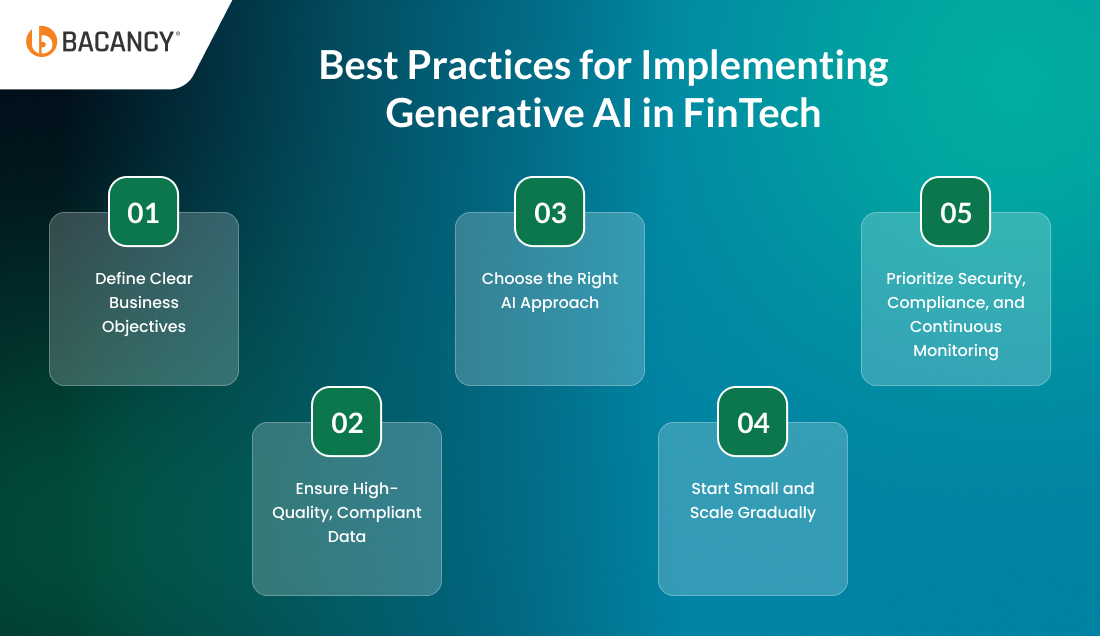
Best Practices for Implementing Generative AI in FinTech
Implementing generative AI in fintech in the USA requires clear planning, strong security frameworks, and measurable business outcomes. These five best practices help ensure your AI adoption is effective, compliant, and capable of delivering real impact across financial operations.
1. Define Clear Business Objectives
Know exactly what problem AI will solve, whether it’s automating KYC, improving fraud detection, or generating financial insights.
- Set measurable KPIs such as time saved, error reduction, and customer satisfaction.
- Focus on high-impact areas first to demonstrate quick ROI.
2. Ensure High-Quality, Compliant Data
Generative AI relies on accurate, clean data. Data must also meet U.S. regulatory standards such as SEC, FINRA, GDPR, and CCPA.
- Validate and structure financial records, transaction histories, and credit data.
- Use secure pipelines to protect sensitive customer information.
3. Choose the Right AI Approach
Select RAG vs Fine-tuning depending on the task.
- RAG for AI referencing external documents, market data, or regulations.
- Fine-tuning for custom internal datasets like risk models or financial reports.
4. Start Small and Scale Gradually
Pilot AI on one high-value workflow before enterprise-wide deployment.
- Test accuracy, adoption, and impact on operations.
- Scale progressively once ROI is proven.
5. Prioritize Security, Compliance, and Continuous Monitoring
Protect sensitive data, comply with U.S. fintech regulations, and maintain accurate AI outputs.
- Encrypt data and maintain audit trails.
- Train staff on AI-assisted workflows.
- Monitor AI performance and update models as regulations and datasets change.
Note: As generative AI becomes more embedded in financial decision-making, organizations must adopt responsible AI frameworks that ensure transparency and accountability. The World Economic Forum Report emphasizes that strong governance models will be essential for building trust in AI-driven financial systems.
How to Calculate ROI Before Building Generative AI?
Before implementing generative AI, fintech companies must evaluate ROI (Return on Investment) to ensure resources align with business goals and operational efficiency. Here’s a structured approach to calculate it effectively:
1. Infrastructure Cost
Hardware and software resources, often cloud-based, are required to run AI models.
Why it matters:
- Generative AI models, especially LLMs, require significant computing power.
- Understanding infrastructure costs upfront prevents budget overruns.
- Cloud scaling ensures AI can handle growing transactions or real-time analysis without slowing operations.
Example: Using AWS or Azure for model deployment might cost $10k–$50k per month, depending on size, so including this in ROI calculations ensures realistic financial planning.
2. Model Cost
Expenses for building, training, fine-tuning, or licensing AI models.
Why it matters:
- Some models are pre-trained (like GPT APIs) but still have usage fees.
- Custom models require specialized training, which can be costly in compute and expert time.
- Overlooking model costs can make AI projects appear cheaper than they are, leading to wasted investment.
Example: Training a model to generate personalized financial reports might cost $20k–$100k, depending on complexity.
3. Data Preparation
Cleaning, formatting, and structuring financial data for AI use.
Why it matters:
- Poor-quality data leads to inaccurate AI outputs, eroding trust.
- Regulatory compliance is critical in the U.S., so data must meet SEC and privacy standards.
- This step ensures AI produces actionable, reliable results rather than false insights.
Example: Structuring historical loan, KYC, and transaction data can take weeks of engineering and analyst effort.
4. Engineering Time
The hours spent by AI engineers and domain experts on fintech software development to build, integrate, and maintain the AI system. However, you can always choose to partner with a specialized fintech software development company to streamline implementation and leverage proven expertise.
Why it matters:
- AI is not plug-and-play; successful implementation requires integration with CRMs, banking systems, and dashboards.
- Accounting for engineering time ensures the ROI reflects both development effort and operational sustainability.
Example: Connecting a generative AI model to a core banking system and automating fraud reports might take a small team 2–3 months.
5. ROI Estimation
Calculating the expected financial benefits relative to total costs.
Why it matters:
- Shows whether the AI investment is justified.
- Links AI outputs to real business metrics: cost savings, efficiency gains, fraud reduction, and revenue growth.
- Provides a formula to quantify impact:
ROI (%) = (Financial Benefits – Total Costs) ÷ Total Costs × 100
Example:
Costs: $200k (infrastructure + model + data + engineering)
Benefits: $400k (time saved + reduced fraud + improved customer engagement)
ROI = (400k – 200k) ÷ 200k × 100 = 100% ROI
How to Choose the Right Generative AI Development Partner
Choosing the right generative AI development partner is critical for building secure, scalable, and reliable AI solutions in fintech. The right partner brings technical expertise, regulatory understanding, and the ability to deliver real business value.
- Evaluate the partner’s experience in building generative AI and LLM-based solutions.
- Ensure the team understands fintech regulations and compliance requirements.
- Look for expertise in RAG architectures, NLP, and enterprise AI integration.
- Check their ability to build secure and scalable AI infrastructure.
- Review case studies, client success stories, and proven AI implementations.
Top 5 Future Trends of Generative AI in Fintech
Here are the top trends shaping the future of generative AI in fintech. These developments are set to transform how financial institutions operate, make decisions, and engage customers.
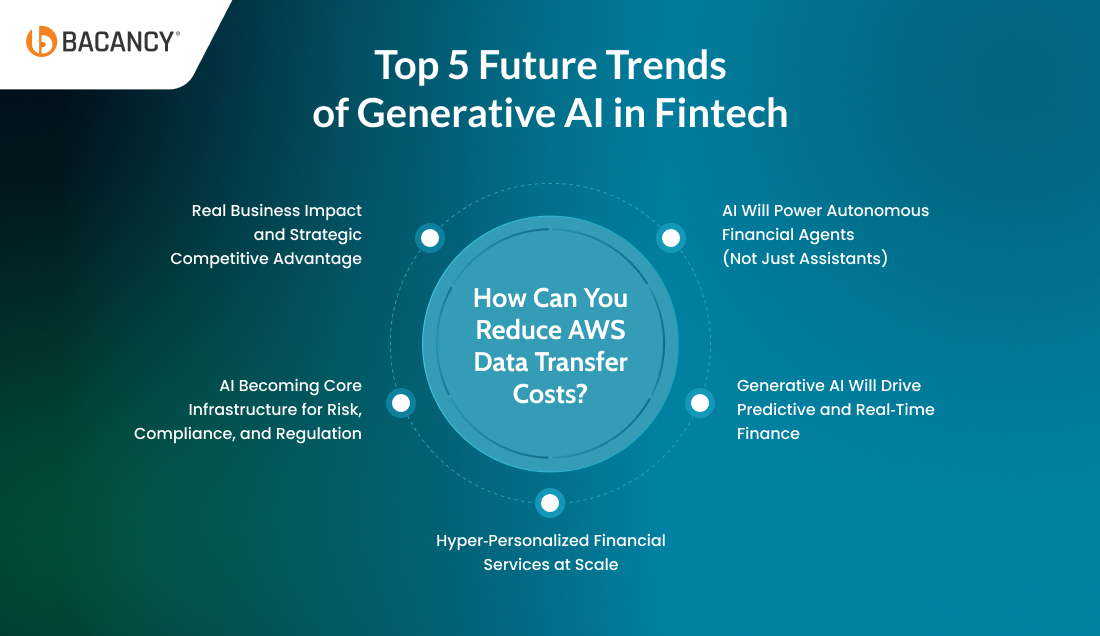
1. AI Will Power Autonomous Financial Agents
Generative AI is shifting from simple chatbots to autonomous AI agents that can make real decisions, perform multi‑step financial tasks, and complete workflows with minimal human help.
For example, instead of just answering a question, future AI could auto‑approve loans, manage compliance reporting, initiate payments, and revise risk rules in real time. This moves fintech toward self‑operating systems, not just support tools. (Source)
2. Generative AI Will Drive Predictive and Real‑Time Finance
AI won’t wait for problems; it will anticipate them. By combining generative models with live financial data, fintech platforms will forecast market movements, credit risks, and liquidity stress before they become issues.
This proactive intelligence enhances lending decisions, pricing models, and investment strategies, making Gen AI in finance faster and more resilient. (Source)
3. Hyper‑Personalized Financial Services at Scale
Future AI models will go beyond templated advice to deliver highly personalized money guidance for millions of users in real time.
This means apps will generate tailored investing tips, customized budgeting plans, and personal risk alerts, based on individual goals, behaviors, and life events. This trend will deepen user trust and engagement with digital financial platforms. (Source)
4. AI Becoming Core Infrastructure for Risk, Compliance, and Regulation
Regulators and banks are already wrestling with how AI changes financial risk profiles; executives at major firms like Goldman Sachs acknowledge AI’s growing impact on credit and underwriting.
In the near future, generative AI will automate regulatory compliance, create audit‑ready reasoning trails, and simulate regulatory changes before they hit the market, reducing human workload and enhancing oversight. (Source)
5. Real Business Impact and Strategic Competitive Advantage
Adoption of Gen AI in the finance industry is increasing rapidly; projects range from internal productivity tools to customer‑facing automation, and firms that adopt these technologies early are gaining measurable advantages.
At JPMorgan Chase, leaders recently identified hundreds of active AI use cases across risk, fraud, and operations, suggesting how deeply AI is already embedded in financial workflows.
Gen AI in fintech won’t just be a tech trend; it will become a strategic differentiator, reshaping business models, costs, and growth for banks and fintechs alike. (Source)
How Can Bacancy Help You Integrate Generative AI in Your FinTech Business?
Generative AI is transforming the fintech landscape, but implementing it effectively requires deep technical expertise, regulatory understanding, and scalable infrastructure. Bacancy’s Generative AI development services help fintech companies integrate AI solutions that drive measurable impact and business growth.
What We Offer:
Custom AI Solutions: We design generative AI tools tailored to your business needs, whether it’s automating KYC, generating financial reports, or providing AI-driven customer insights.
RAG and LLM Expertise: We build solutions using Large Language Models (LLMs) and Retrieval-Augmented Generation (RAG) to deliver real-time, accurate insights from structured and unstructured financial data.
Compliance-Ready Architecture: Our AI solutions meet U.S. financial regulations, ensuring data privacy, secure handling of customer information, and audit-ready reporting.
Fraud & Risk Mitigation: From fraud detection to credit underwriting, we implement AI models that identify anomalies, reduce false positives, and optimize risk decision-making.
Effortless Integration: We connect AI systems with your existing fintech stack, CRMs, core banking systems, and payment platforms, so teams can adopt AI without disrupting operations.
AI-Driven Insights for Growth: Our AI tools help financial advisors, analysts, and operations teams make faster, data-backed decisions, improving efficiency and customer satisfaction.
We combine deep technical expertise with fintech domain knowledge to deliver solutions that are scalable, compliant, and impactful. Instead of generic AI tools, we focus on real business outcomes, helping fintech firms innovate faster while staying secure and customer-focused.
Bacancy ensures that your Gen AI in fintech integration is practical, measurable, and future-proof, empowering your business to compete with leaders like JPMorgan, PayPal, and Goldman Sachs in the AI-driven financial services market.
Frequently Asked Questions (FAQs)
Gen AI in Finance: Basics
Generative AI in fintech refers to AI systems that can create new outputs such as financial insights, reports, summaries, and recommendations from large financial datasets. Unlike traditional analytics tools that only analyze data, generative AI can produce human-readable explanations, automate documentation, and assist decision-making in real time.
Traditional AI models typically classify or predict outcomes, such as detecting fraud or assessing credit risk. Generative AI goes a step further by generating new content and insights. For example, it can summarize financial reports, generate regulatory analysis, or create personalized financial recommendations for customers.
Generative AI in Finance: Use Cases
Financial institutions use generative AI for multiple tasks, including fraud detection, automated financial reporting, regulatory compliance analysis, document processing, and AI-powered customer support. These applications help banks and fintech platforms automate complex workflows and improve operational efficiency.
Banks use LLMs to analyze financial documents, summarize market research, generate compliance reports, and power AI assistants for financial advisors. These models help convert complex financial information into clear insights that teams can act on quickly.
Yes. Generative AI allows banks to provide personalized financial insights, automated support through AI chatbots, and proactive financial recommendations. Customers can receive tailored advice about spending, investments, or savings without waiting for manual assistance.
GenAI for Finance: Security and Compliance
Generative AI can be secure when implemented with proper governance frameworks. Financial institutions must use encrypted data pipelines, secure cloud environments, and strong access controls to protect sensitive financial information while maintaining regulatory compliance.
Banks typically deploy AI systems within private or enterprise cloud environments. Data is encrypted, access is restricted through role-based controls, and AI outputs are monitored to ensure that sensitive financial information is handled securely.
AI systems used in financial services must comply with regulations such as the SEC, FINRA, GDPR, and CCPA. These regulations require financial institutions to protect customer data, maintain transparency in decision-making, and ensure that AI-generated insights can be audited if necessary.
Generative AI in Fintech Implementation
Successful implementation begins by identifying high-impact use cases such as fraud detection, regulatory reporting, or customer support automation. Organizations typically start with a pilot project, measure performance and accuracy, and then scale the AI solution across additional workflows.
Some organizations build custom AI models when they need specialized capabilities or proprietary data integration. Others adopt pre-built AI platforms to accelerate deployment. The best approach often combines existing AI models with custom development tailored to specific financial workflows.
Most fintech platforms integrate AI using APIs and microservices. This approach allows AI systems to connect with existing infrastructure such as core banking platforms, CRMs, payment systems, and analytics dashboards, without replacing legacy systems.