Quick Summary
This blog covers the core differences between RAG vs fine tuning, when to use each, production architecture, cost vs. accuracy trade-offs, real-world enterprise examples, and a practical checklist to choose the right AI approach for your business.
Table of Contents
Introduction
You have built Proof of Concept. The demo has worked wonders and impressed leadership, but the real question is: “ Are we using RAG or fine-tuning?”
This is the point where many enterprise AI projects slow down. Because what worked in a controlled demo does not always survive production.
- What happens when your internal documents change next month?
- What if the model gives a confident but wrong answer to a customer?
- What if you need every response to follow a strict format?
- What happens to the cost when usage grows?
That is when the RAG vs fine-tuning decision stops being technical and starts becoming strategic! It’s not about which method is more advanced. It is about what problem you are trying to solve.
- Accuracy with changing data?
- Strict structure and tone?
- Lower long-term operational cost?
- Reduced hallucination risk?
This guide will help you think through when to compare Retrieval Augmented Generation vs fine-tuning in practical terms. Not theory. Just real trade-offs that matter in enterprise AI. Let’s break it down clearly!
RAG vs Fine Tuning: What's The Core Difference?
RAG is a retrieval-based AI approach in which, when a customer asks a question, the system searches your internal documents or database for relevant information and passes it to the model to generate an answer. The model itself is not retrained or modified; thus, the knowledge remains outside the model and is supplied at the time a question is asked.
Fine-tuning is different because you train the model itself using your own data. During this training, the model’s internal weights are updated. That means new patterns or knowledge become part of the model. After fine tuning, when someone asks a question, the model answers based on what it has learned internally, without needing to look up external documents.
Insight: When comparing RAG vs fine tuning, RAG optimizes for dynamic knowledge. Fine-tuning optimizes for behavioral control.
Fine Tuning vs RAG: Advanced Enterprise Comparison Table
Compare fine tuning vs RAG with a quick tabular comparison to understand how these two approaches differ across various key factors.
| Factor
| Fine-Tuning
| RAG (Retrieval-Augmented Generation)
|
|---|
| Purpose
| Improves the model’s behavior using your data
| Fetches and generates answers from live or external data |
| How It Works
| Updates the model’s parameters by feeding it labeled data
| Keeps knowledge outside the model; searches the database/docs when a question is asked
|
| Data Storage | Internal (model weights are updated)
| External (documents, databases, knowledge bases) |
| Knowledge Updates
| Requires retraining or additional training cycles | Easy and instant; you need to update the database only
|
| Scalability | Training cost increases as data grows | Handles large and expanding knowledge bases efficiently
|
| Version Control
| Difficult to control specific document versions once trained
| Can retrieve information based on metadata like date, region, or version |
| Transparency
| Cannot directly show where the answer came from
| Can show source documents for traceability
|
| Hallucination Risk
| Higher if the model relies only on learned patterns
| Lower, because responses are grounded in retrieved documents
|
| Infrastructure Complexity
| Requires a training pipeline and model management
| Requires a retrieval system + database setup
|
| Latency Impact
| Faster response generation
| Slightly slower due to retrieval step
|
| Data Isolation Control
| More difficult to separate data once trained
| Easier to isolate data using separate indexes or filters |
| Behavioral Drift Risk
| Model behavior may diverge as business logic evolves | Behavior remains stable; only knowledge layer changes
|
| Security Exposure
| Sensitive during training data processing
| Requires securing both the model and document systems
|
| Compliance Readiness
| Challenging for regulated industries due to limited traceability
| Better suited for compliance, as responses can be traced back to source documents
|
| GPU Dependency
| Requires significant GPU resources during training
| Minimal GPU usage; mostly required only for inference
|
| Multi-Tenant Suitability
| Harder to maintain separate knowledge per client without separate models
| Easier to isolate tenant data using separate indexes or filters
|
| Vendor Lock-In Risk
| Higher dependency on specific model providers and training infrastructure
| Lower vendor dependency; easier to switch models
|
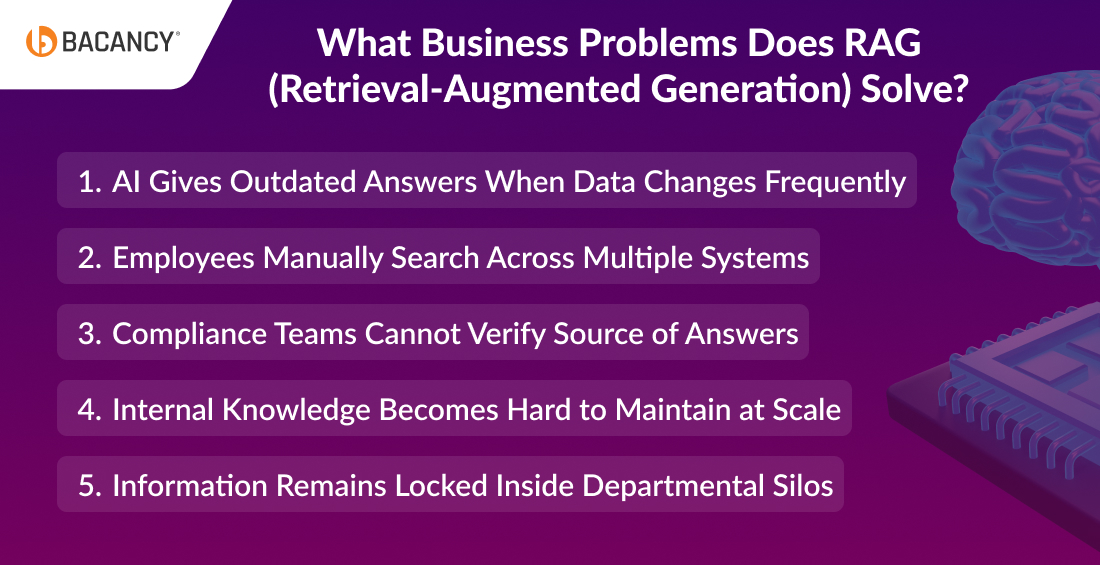
What Business Problems Does RAG (Retrieval-Augmented Generation) Solve?
RAG is designed to solve real-world problems that traditional AI models struggle with. Here are the major issues it solves with real examples.
AI Gives Outdated Answers When Data Changes Frequently
Many businesses operate in fast moving environments. Product features, internal policies, or regulatory rules might change weekly or even daily. A standard AI model trained just once might quickly become outdated, giving wrong answers that affect decisions and trust.
For example, if a fintech company updates its credit scoring logic in response to a new regulatory guidance, a static model may still refer to the old criteria. However, RAG will pull out the latest scoring criteria from your internal documents and provide the correct answer using current information.
Employees Manually Search Across Multiple Systems
Organizations may hold thousands of manuals, contracts, research papers, and reports in various tools. Employees may take a considerable amount of time to access various systems to get one answer to their question.
For example, a customer service representative handling a refund query may need to check the conditions of the refund policy on one system and the customer information on another. However, RAG enables the AI to search various systems and give all the information required in one answer.
Compliance Teams Cannot Verify Source of Answers
When talking about industries such as finance, healthcare, and law, answers cannot be vague or made up. Regular AI model often takes quick guesses or even hallucinate information, which can lead to compliance issues or legal problems.
For example, think of it as if a financial AI assistant needs to answer a question about a specific tax deduction. Instead of random guesses, RAG pulls out relevant sections directly from the official tax code documents and cites the source, too. This way, the answer is accurate and auditable.
Internal Knowledge Becomes Hard to Maintain at Scale
As organizations scale, the amount of documentation also scales. New product updates, process changes, and regulatory guidelines are constantly being added. At some point, it becomes expensive and inefficient to maintain and update training data for a static AI model.
For instance, if a company is adding new product features every quarter, it would be slow and expensive to retrain the model. With RAG, you don’t have to retrain the model every time the knowledge changes. You just have to update the documents, and the AI will automatically pull the latest information at query time.
Information Remains Locked Inside Departmental Silos
In most organizations, critical information is distributed in various departments. The legal, product, and operation departments also have their own documents. Since the systems are independent, the only way to get answers is through internal experts.
For example, if a sales executive needs information about a policy before closing a sale, they would have to wait for a response from another department. But with RAG, the information is obtained from different systems instantly.
RAG Architecture: How It Works in Production
Let’s understand this with a real example.
A bank is building an AI assistant that answers customer questions about home loans, foreclosure penalties, compliance rules, and interest rate policies.
The real challenge is not language. It is knowledge freshness. Bank policies change. Interest rates get revised. Regulatory circulars are issued. Internal SOPs are updated. If the AI gives an answer based on outdated information, it becomes a compliance risk.
That is the core problem RAG architecture is designed to solve.
Now let’s walk through how it works in production.
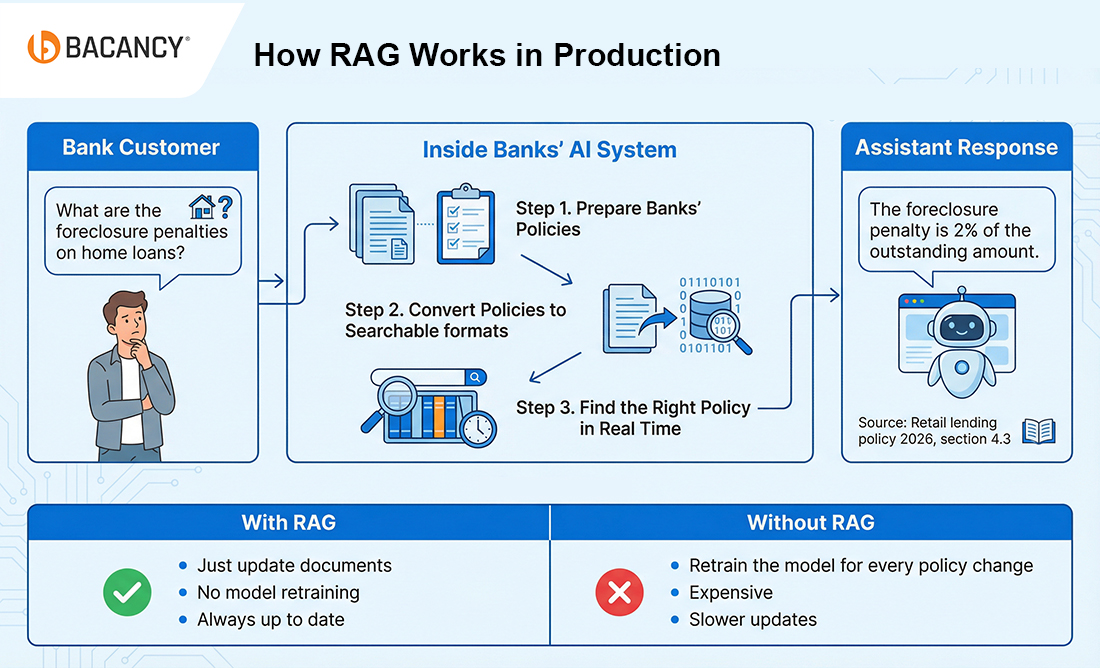
Step 1: Prepare Documents
The bank first gathers all relevant documents, loan policy PDFs, compliance manuals, interest rate circulars, and internal SOP documents.
But simply uploading them is not enough.
These files are cleaned to remove duplicate headers and irrelevant text. Then they are split into smaller logical sections instead of keeping them as one long document.
Each section is tagged with metadata, including loan type, year, department, and regulation ID.
Now, why does this matter?
Because if a foreclosure rule changes in 2026, the system should fetch the updated section, not an old 2023 version from another file. Proper document organization helps the system find the correct and latest information.
In RAG systems, document preparation directly affects answer quality.
Step 2: Convert Text Into Meaning (Embeddings)
Once documents are prepared, each section is converted into embeddings.
In simple terms, the system converts policy text into numerical representations that represent its meaning. This allows the system to understand similarity, not just exact words.
For example, if a customer asks:
“What penalty applies if I close my home loan early?”
The system does not just search for the word “penalty.”
It understands related phrases such as:
- Foreclosure charge
- Prepayment fee
- Early repayment cost
Better embedding models improve matching accuracy, but they also increase infrastructure cost. So there is always a trade-off between precision and expense.
Step 3: Store and Retrieve from Vector Database
All embeddings are stored in a vector database optimized for semantic search.
When a question comes in, the system
- Converts the question into an embedding
- Searches across thousands of policy sections
- Fetches only the most relevant matches
- Applies metadata filters (for example, only “Home Loan” documents)
- Optionally re-ranks results for better accuracy
This is where real trade-offs begin:
- If too much context is retrieved, the cost of token usage increases.
- If too little context is retrieved, the answer becomes incomplete.
Please note that choosing the right amount of information to retrieve is an important engineering decision in enterprise RAG systems.
Step 4: Generate Final Answer
Only after retrieving relevant sections does the LLM generate a response.
The model receives:
- The customer’s question
- The retrieved policy excerpts
It does not rely only on its internal memory. It answers using the provided context.
Example output:
“The foreclosure penalty for home loans issued before 2023 is 2% of the outstanding principal. (Source: Retail Lending Policy 2026, Section 4.3)”
This approach allows:
- Clear source attribution
- Easier compliance checks
- Reduced hallucination risk
In short, RAG architecture adds a retrieval layer before generation. It keeps information fresh without changing or retraining the model itself.
Now, why didn’t we just fine-tune the model?
If the bank fine-tuned the model instead, it would need to be retrained every time policies changed. That is expensive, slow, and risky in regulated environments.
When Is RAG Absolutely The Right Choice?
RAG is the right choice when the real problem is not “how the model writes”, but “how reliably it accesses the right information at the right time.” Below, we have mentioned core scenarios where RAG is the smarter choice for businesses.
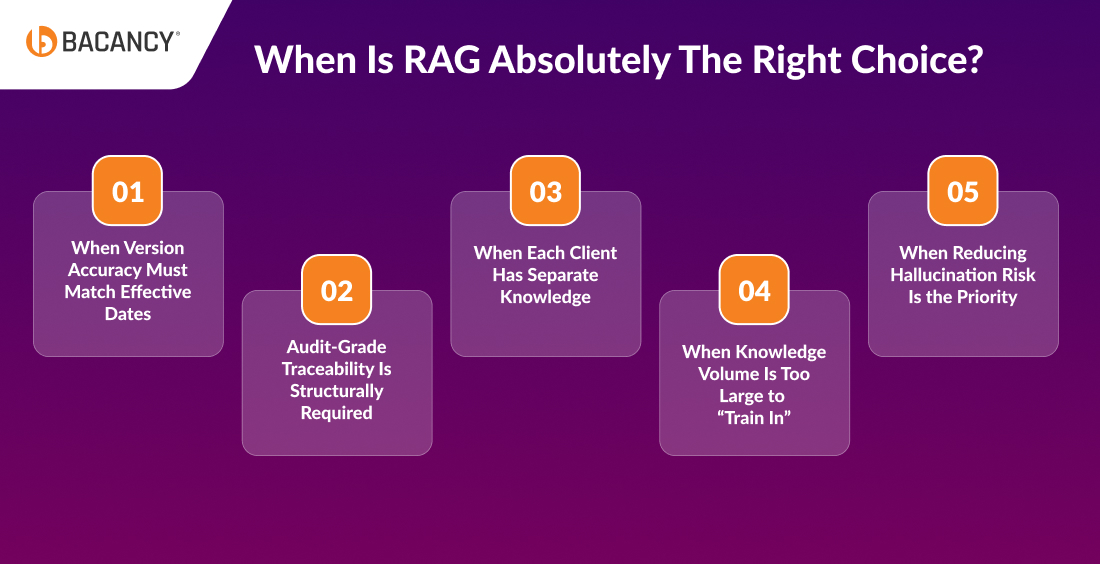
1. When Version Accuracy Must Match Effective Dates
If your organization maintains multiple policy versions across years, regions, or product lines, answers must reflect the correct version every time.
In regulated banking, insurance underwriting, or securities trading, even a small mismatch in policy year or jurisdiction can create unnecessary audit exposure.
RAG allows you to fetch information by metadata such as:
- Effective date
- Geography
- Product category
- Policy version
This ensures the response reflects the correct document version without retraining the model whenever rules change.
2. Audit-Grade Traceability Is Structurally Required
Sometimes environments require every AI response to be explainable and auditable.
If a compliance officer asks, “Where did this answer come from?”, the system must show the exact document excerpt.
RAG supports grounded responses with traceable references, making it suitable for audit-heavy industries like:
- Banking and capital markets
- Healthcare compliance
- Government advisory systems
- Enterprise procurement platforms
But if you compare it with fine tuning, alone it can never provide this amount of document level traceability without additional systems layers.
3. When Each Client Has Separate Knowledge
At Bacancy, we have worked with multi-tenant SaaS platforms, where every customer can have their own:
- Internal workflows
- Configuration rules
- Custom policy documents
- Industry-specific terminology
Instead of training a specific model for each tenant, RAG delivers client specific retrieval at the time of the query. The same base model can serve multiple customers while dynamically accessing isolated knowledge stores.
This keeps infrastructure manageable while maintaining clear data boundaries between clients.
4. When Knowledge Volume Is Too Large to “Train In”
Some enterprises don’t just have “a lot” of data; they have massive, continuously growing knowledge bases. Think millions of pages of product documentation, compliance archives, research papers, technical runbooks, customer contracts, and internal wiki content.
Training a model on all that data isn’t realistic. Models can only handle so much, and retraining them every time new documents are added takes time and costs a lot. Even small changes would mean training the model again.
RAG solves this differently. Instead of storing all knowledge inside the model, it keeps documents in an external database. As new content is added, you simply update the database. The model stays the same.
5. When Reducing Hallucination Risk Is the Priority
If your primary concern is reducing hallucination risk rather than controlling tone or writing format, RAG provides stronger safeguards.
With RAG, the model first pulls information from trusted documents and then creates the answer. It does not depend only on its memory.
Because responses are grounded in actual documents, the likelihood of incorrect or unsupported details is significantly lower.
What Business Problems Does Fine-Tuning Solve?
Fine-tuning becomes more valuable when the business problem is not missing information but unstable behavior, inconsistent judgment, or brand risk. Here are real business problems it solves in production environments.
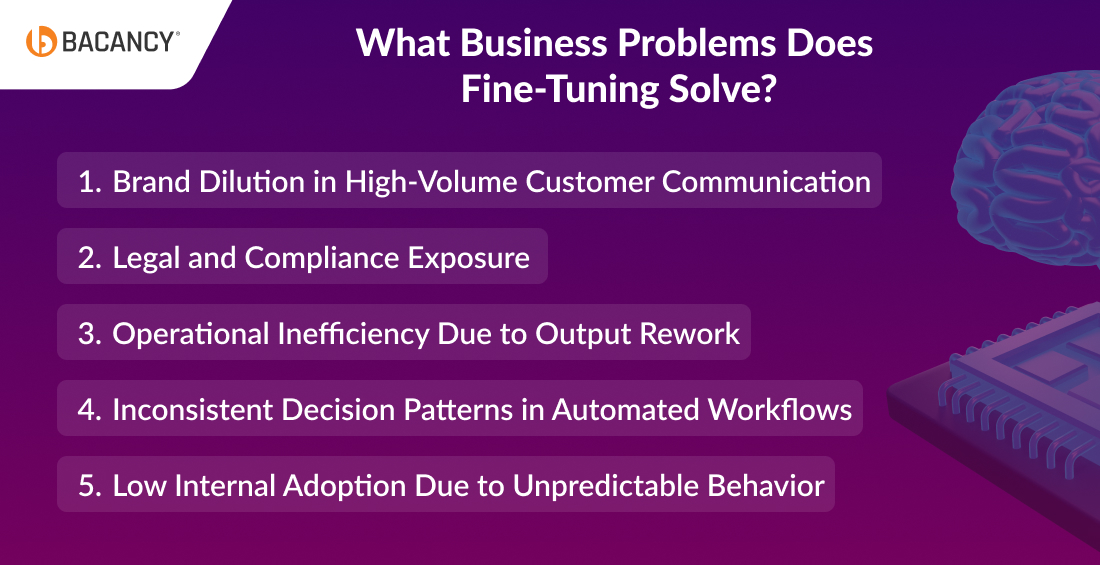
1. Brand Dilution in High-Volume Customer Communication
When AI handles thousands of interactions daily, small tone inconsistencies start adding up.
For example:
- One customer gets a cautious, policy-heavy explanation.
- Another gets a friendly, conversational answer.
- A third gets something that sounds overly robotic.
Individually, this feels minor. At scale, it creates brand confusion.
For example, a private banking firm using a tool for client communication cannot afford mixed tones. If one message sounds stiff and robotic and the next sounds overly casual, clients start to question credibility.
Fine-tuning fixes that by using approved communication examples from the firm. The system learns the right tone, structure, and choice of words. It starts to reflect how the organization actually speaks, not just the information it shares.
2. Legal and Compliance Exposure
General-purpose models often try to be helpful. It can sometimes become risky.
For example, imagine an insurance assistant responding to a claim inquiry. If it says, “You qualify for this coverage” before proper verification, that statement can create legal complications. In regulated industries, wording matters. A single overly confident sentence can create legal exposure.
Similarly:
- Suggesting refunds before eligibility checks
- Giving advisory-style answers in financial services
- Using absolute language where conditional wording is required
Fine-tuning allows you to train the model using compliance-approved examples that include:
- Required disclaimers
- Conditional phrasing
- Approved communication boundaries
Instead of improvising, the model stays within defined limits. This reduces regulatory and reputational risk.
3. Operational Inefficiency Due to Output Rework
Many companies deploy AI and then quietly assign teams to fix its outputs. Common problems include:
- Missing required data fields
- Summaries that ignore key details
- Reports that vary in structure
- Inconsistent categorization
If a significant percentage of outputs require human correction, the promised efficiency gains disappear.
For example, a company might use a tool to draft customer case summaries. But agents still end up fixing the structure, rewriting sections, or adding missing details. Instead of saving time, it becomes another editing task.
Fine-tuning helps by training the system on real, properly written summaries from the team. It learns what a “correct” output actually looks like in that company. Over time, the summaries come out closer to the expected format. Less rewriting. Less back and forth. Less manual review.
4. Inconsistent Decision Patterns in Automated Workflows
When AI is used for operational decisions, such as:
- Lead qualification
- Risk tagging
- Ticket prioritization
- Claims pre-screening
Inconsistency becomes a business problem. If two similar cases produce different classifications, teams lose confidence in the system.
For example, if one high-risk claim is flagged correctly but another similar claim is labeled low risk, internal teams begin double-checking everything. That defeats automation.
Fine-tuning with labeled examples helps the model learn your internal decision boundaries. It reduces randomness and improves alignment with business logic. This strengthens trust and stabilizes workflows.
5. Low Internal Adoption Due to Unpredictable Behavior
Internal AI tools often fail not because they are inaccurate, but because they are unpredictable.
Employees may experience:
- Different response styles each time
- Occasional irrelevant explanations
- Outputs that vary in format
When behavior feels inconsistent, teams simply stop using the tool.
For example, think about a sales team drafting emails. One draft sounds very formal. The next sounds too casual. The structure changes for no clear reason. After a few rounds of fixing tone and formatting, frustration builds. Instead of saving time, it creates extra work.
Fine-tuning fixes that. It makes the responses steady and predictable. The tone stays aligned. The structure stays consistent. People know what they’re going to get. And when people know what to expect, they actually use it.
How Fine-Tuning Works in Production?
Now, let’s take the same bank example we took for RAG, but consider a different requirement inside the same bank.
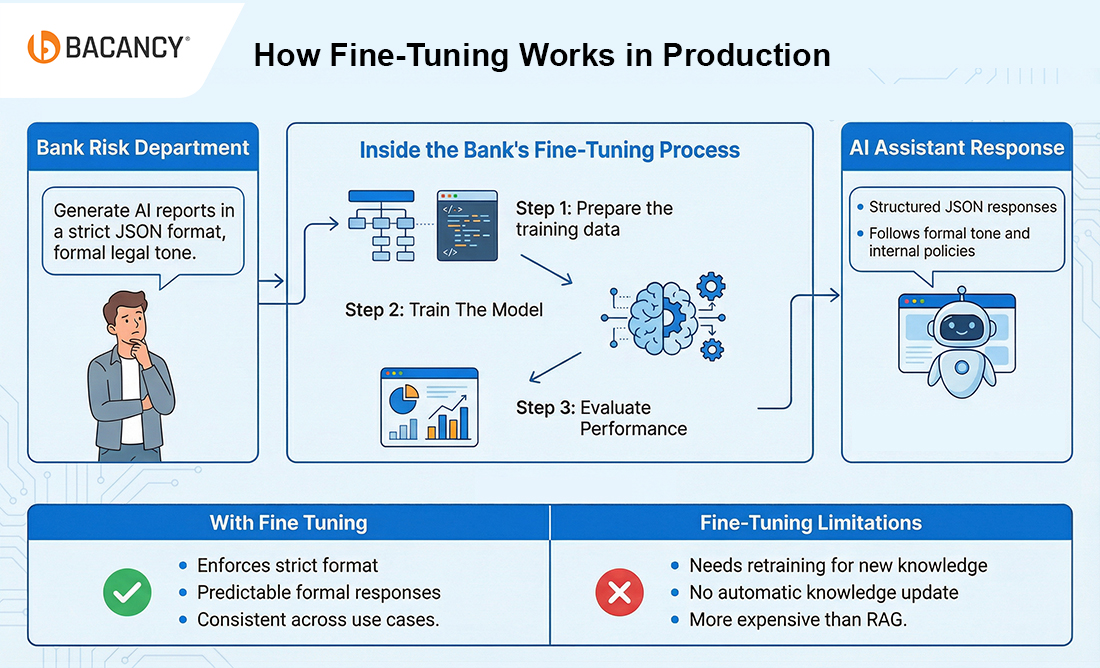
The internal risk department wants AI-generated reports that:
- Always follow a strict JSON structure
- Use formal legal language
- Avoid a casual or conversational tone
- Follow the standardized internal reporting format
This is not a knowledge freshness issue. This is a behavior control issue. RAG alone cannot guarantee formatting discipline. Even with retrieved context, the model may still respond conversationally or inconsistently.
This is where fine-tuning architecture is used.
Step 1: Prepare Training Data
The bank collects thousands of high-quality examples:
Structured loan summaries, compliance-approved responses, risk assessment templates, and official communication samples.
Poor examples are removed because the model will learn patterns directly from this data.
In fine-tuning large language models, training data quality determines output behavior quality.
Step 2: Train the Model
During fine-tuning, the model’s internal weights are adjusted. It learns to consistently produce outputs in the required format.
For example, instead of answering conversationally, it now responds like this:
{
“loan_type”: “Home Loan”,
“risk_score”: “Low”,
“compliance_status”: “Approved”,
“decision_note”: “All underwriting checks passed.”
}
The important distinction: Fine-tuning changes how the model responds. It does not connect the model to new or live documents. If the foreclosure policy changes tomorrow, the fine-tuned model will not automatically know. It must be retrained.
After training, the bank does not deploy the model immediately.
They first validate whether the model behaves exactly as required.
They measure:
- Format accuracy – Does it always return valid JSON without breaking structure?
- Output consistency – Does it generate similar structured responses for similar inputs?
- Tone alignment – Is the language always formal and compliance-safe?
- Hallucination rate – Does it invent unsupported financial details?
This stage is critical because fine-tuning modifies internal weights.
If the training data had inconsistencies, the model would amplify them.
If the model fails structure or tone checks, retraining is required.
Step 4: Deploy and Monitor
Once validated, the model is deployed into production systems.
But fine-tuned systems require lifecycle management.
The bank maintains:
- Version control of trained models
- Performance monitoring dashboards
- Scheduled reviews for drift in tone or structure
If regulations change or reporting formats evolve, the model must be retrained. Unlike RAG, there is no automatic knowledge refresh.
When Fine-Tuning Is Absolutely the Right Choice?
Fine-tuning is the best option when the actual problem is not “what information the model accesses,” but “how consistently and safely it behaves.” The following are the essential scenarios where fine-tuning is the better option for companies.
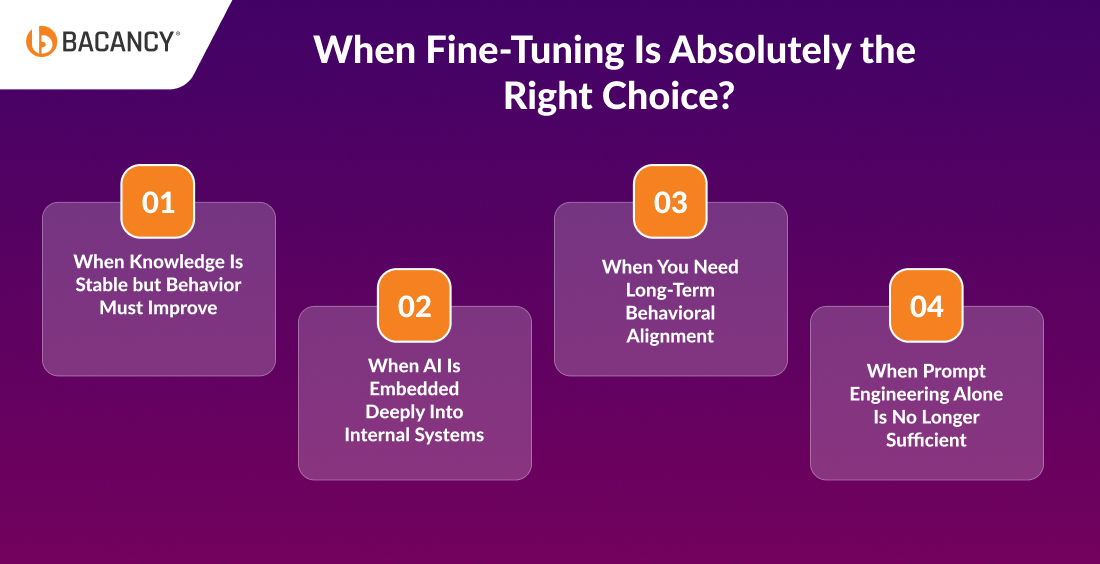
When Knowledge Is Stable but Behavior Must Improve
If your policies and information do not change frequently, but response quality and consistency need improvement, fine-tuning is appropriate. The focus here is not on updating knowledge. It is refining how the model communicates and makes judgments.
When AI Is Embedded Deeply Into Internal Systems
If the model is embedded into core reporting tools, CRM systems, underwriting platforms, or workflow engines, predictable behavior becomes more important than flexibility. Fine-tuning improves predictable behavioral performance in deeply embedded environments.
When You Need Long-Term Behavioral Alignment
If the organization expects the AI to permanently reflect internal communication standards and decision patterns, fine-tuning embeds that alignment into the model itself. This reduces dependence on constant prompt engineering adjustments.
When Prompt Engineering Alone Is No Longer Sufficient
In early stages, prompts may control tone and structure. But as usage scales, prompt-only control often leads to variation. Fine-tuning provides deeper behavioral correction when prompt adjustments stop delivering stable results.
When You Can Invest in Ongoing Model Governance
Fine-tuning involves periodic retraining and evaluation of performance. If the organization has the maturity level to handle model versions and retraining cycles, fine-tuning is a long-term solution.
How Do Fine Tuning vs RAG Compare in Cost?
When comparing RAG vs fine tuning, cost isn’t just about money; it’s about where effort and resources go.
- RAG saves upfront model training costs but shifts costs to document storage, embeddings, and token usage during queries. At scale, this can become significant, especially with millions of documents or frequent queries.
- Fine-Tuning has a high cost of training and use of GPUs, but once trained, it is less expensive to maintain and quicker to respond to consistent and regulated knowledge.
Cost Comparison Table: RAG vs Fine Tuning
| Factor
| RAG (Retrieval-Augmented Generation)
| Fine-Tuning
|
|---|
| Token Cost
| Paid per query + embeddings; scales with usage
| Paid mostly during training; inference cost stable
|
| Embedding Cost
| Required for all documents; grows with dataset size
| Minimal or none
|
| Storage Cost
| Stores embeddings & metadata; grows with document volume
| Stores trained model checkpoints; mostly fixed
|
| Training Cost
| Near zero; no model retraining needed
| High upfront cost for GPU/cloud resources
|
| Engineering Effort
| Ongoing: retrieval, indexing, updates
| Moderate: data prep, fine-tuning, version management
|
Fine Tuning vs RAG: Which One Reduces Hallucination & Accuracy Risk?
Comparing RAG vs fine tuning, with RAG, hallucination mostly comes from gaps in your documents or messy indexing, not the model itself. So even though it’s pulling real-time info, if your sources aren’t spot-on, it can still make mistakes.
The upside? You can update the knowledge instantly without retraining, which is huge for fast-changing fields like finance, product catalogs, or regulatory content.
With Fine-Tuning, the issue of hallucination will hardly arise for your trained knowledge, but any modification of rules or updates will not be reflected automatically.
The model will remain loyal to what it has learned, and you will receive consistent and reliable answers, but you will have to undergo a retraining process to keep it up-to-date.
Key takeaway: Think of RAG as “flexible and live” but dependent on quality sources, and Fine-Tuning as “locked-in accuracy” but slower to adapt.
RAG vs Fine Tuning Real-World Enterprise Case Studies
Have a look at how enterprises are using fine tuning vs RAG, as well as hybrid approaches, to solve real-world AI challenges effectively.
1. Bloomberg: BloombergGPT – Fine-Tuned Model for Financial Intelligence
Bloomberg developed BloombergGPT, a large language model trained and adapted specifically for financial tasks using a combination of public data and proprietary Bloomberg datasets.
The model was designed to improve performance in financial document classification, sentiment analysis, market reporting, and question answering within the finance domain. Instead of relying on external retrieval systems, Bloomberg focused on domain specialization through large-scale training and fine-tuning on financial language and structured market data.
BloombergGPT demonstrates how fine-tuning can enhance domain precision and task performance when behavioral control and financial accuracy matter more than real-time knowledge retrieval. (source)
2. Salesforce: Einstein GPT – RAG-Based Enterprise Search
Salesforce developed Einstein GPT, a platform that combines retrieval-based architecture to ensure AI responses are grounded in enterprise data from Sales Cloud, Service Cloud, and the company’s Knowledge Base.
Instead of relying solely on the model’s pre-trained knowledge, Einstein GPT searches across connected enterprise systems in real time and uses the retrieved data to generate accurate, context-aware, and tailored answers.
In enterprise CRM environments, where precision and relevance are critical, this retrieval-based approach ensures responses remain up to date, reduces reliance on static model memory, and maintains strong data grounding. (source)
The Hybrid Approach (RAG + Fine-Tuning)
The hybrid approach is nothing but combining the strength of RAG and fine-tuning. Fine-tuning ensures that AI gives precise, consistent answers with a good tone, and RAG ensures the data is up to date and correct. Fine tuning and RAG make a deadly combination.
Let’s take the same bank example. This time, the bank wants an AI system that:
Answers customer questions about loans, foreclosure penalties, and interest rates
Always uses the latest policies and regulatory updates
Generates internal risk reports in strict JSON format with formal, compliance-safe language
Using RAG alone would give the AI access to fresh policies and citations. Using fine-tuning alone would make sure the reports and messages follow the right format and tone. But to meet all requirements, the bank chooses a hybrid approach.
What happens here is :
- Step 1:
The bank uses structured reports and approved templates to fine-tune the AI so that it is always answering in the correct tone and style.
- Step 2: Meanwhile, all the changing policies, circulars, and SOPs are prepared, cleaned, and loaded into a RAG database.
- Step 3: When a customer or employee asks a question, RAG accesses the latest information while the fine-tuned model produces the answer in the correct style.
- Step 4: The AI produces answers that are accurate, up-to-date, and consistent, providing the bank with reliable information and controlled behavior.
RAG vs Fine Tuning Decision Checklist
Here is an expert-curated, proven checklist to make sure you make an informed decision when you choose between fine tuning vs RAG. Answer all the questions to be sure you pick the best option for your business.
☐ Does your knowledge base change weekly or daily?
☐ Do you need real-time access to updated documents?
☐ Do responses require strict formatting or structured JSON output?
☐ Must the model follow a specific brand tone or domain language?
☐ Do you need source citation or document-level traceability?
☐ Is hallucination risk business-critical?
☐ Will system usage scale significantly in the next 6–12 months?
☐ Is low latency a hard requirement?
☐ Do you have a budget and infrastructure for model retraining?
☐ Are you operating in a regulated or audit-sensitive industry?
RAG or Fine-Tuning for Enterprise AI: What We Recommend?
When comparing RAG vs fine tuning side by side, at Bacancy, we believe it is a strategic architecture choice rather than a purely technical one.
- If your priority is fresh, up-to-date information with clear source tracking, RAG is the way to go. Our RAG development services can help you implement it effectively.
- Make a choice of Fine-Tuning if predictable behavior, well-structured output, and brand-friendly responses are more important to you than up-to-date knowledge.
- Choose a Hybrid Approach if your business requires both real-time knowledge access and predictable output behavior.
Frequently Asked Questions (FAQs)
Cost & Infrastructure
It depends on your usage. RAG has low upfront costs because it avoids retraining the model, but ongoing costs accrue from embedding storage, document management, and query token usage. Fine-tuning requires significant initial GPU and training resources, but after deployment, inference is stable and often cheaper to maintain.
RAG requires a retrieval infrastructure with vector databases, indexing pipelines, and document monitoring. Fine-tuning requires training pipelines, model versioning, and GPU resources for retraining. The choice depends on whether your priority is knowledge flexibility (RAG) or controlled, predictable behavior (fine-tuning).
Yes, GPUs are needed during the training phase for efficiency and scalability. However, once the model is trained, inference can often run on the CPU or on smaller-scale GPU resources, depending on the system requirements. This makes fine-tuning heavier upfront but lighter in day-to-day operations.
Accuracy, Hallucination & Compliance
RAG reduces hallucinations when it retrieves high-quality, up-to-date documents because the answers are grounded in external sources. Fine-tuning reduces random or inconsistent responses for known data but may produce outdated information if rules or knowledge change. Choosing between the two depends on whether knowledge freshness or behavioral consistency matters more.
Yes. RAG provides document-level traceability and source citations, making auditing and compliance easier. It is especially useful in finance, healthcare, and law, where every answer must be explainable and verifiable against official documents.
Fine-tuning can enforce tone, disclaimers, and structured outputs, reducing legal and reputational risk. However, it does not inherently provide source citations or document traceability, so additional systems or hybrid approaches may be needed for full compliance in highly regulated environments.
Performance & Scalability
Architecture & Deployment
It requires ongoing management of embeddings, vector databases, and document updates. However, you avoid retraining cycles, making it simpler for rapidly changing knowledge environments. The engineering focus shifts from model updates to knowledge maintenance.
Yes, because you must version models, monitor for behavioral drift, and retrain when internal rules or policies change. Without proper governance, output consistency may degrade over time.