Quick Summary
This Bacancy’s guide explains how founders, businesses, and product engineers use Vibe coding to develop MVPs in as little as 21 days. It breaks down the complete roadmap, workflow from planning and AI-assisted development for security hardening and deployment, along with real-world examples, tooling costs, and practical strategies.
Table of Contents
Introduction
Are you still thinking that building an MVP requires a team of 10 developers, or a $50,000 agency contract? You might be wrong. In 2026, founders are trusting Vibe coding for MVP development and shipping fully functional products in 21 days or less.
According to Second Talent’s 2026 report, 92% of developers rely on AI coding tools daily, and 41% of global code is generated using AI. Teams that use Vibe coding for MVPs complete their task 51% faster, and for routine tasks, such as scaffolding, CRUD operations, and API integrations, can take that speed advantage up to 81%.
This shift has happened because Vibe coding has matured. Between 2024 and 2026, AI coding agents have developed a full codebase context instead of just file-level suggestions. As a result, several MVPs have been shipped using Vibe coding; some for experimentation, and others for execution, helping redefine how quickly products can be developed and shaping new expectations for MVP timelines.
Why Vibe Coding Is the Single Best Fit For MVP Development
Many startups fail with their MVP development, not because of bad code, but because they build something that nobody wants. At the stage of MVP, the goal is not about perfection, but rather it is about validation that what you are building is not the wrong product. Isn’t it?
Using Vibe code for MVP is not just to optimize for scalability, maintainability, or perfect architecture, but for speed of validation. By using AI to generate large parts of the codebase, founders can move from idea to testable product in days instead of weeks. And Vibe coding is the fastest way to get that answer.
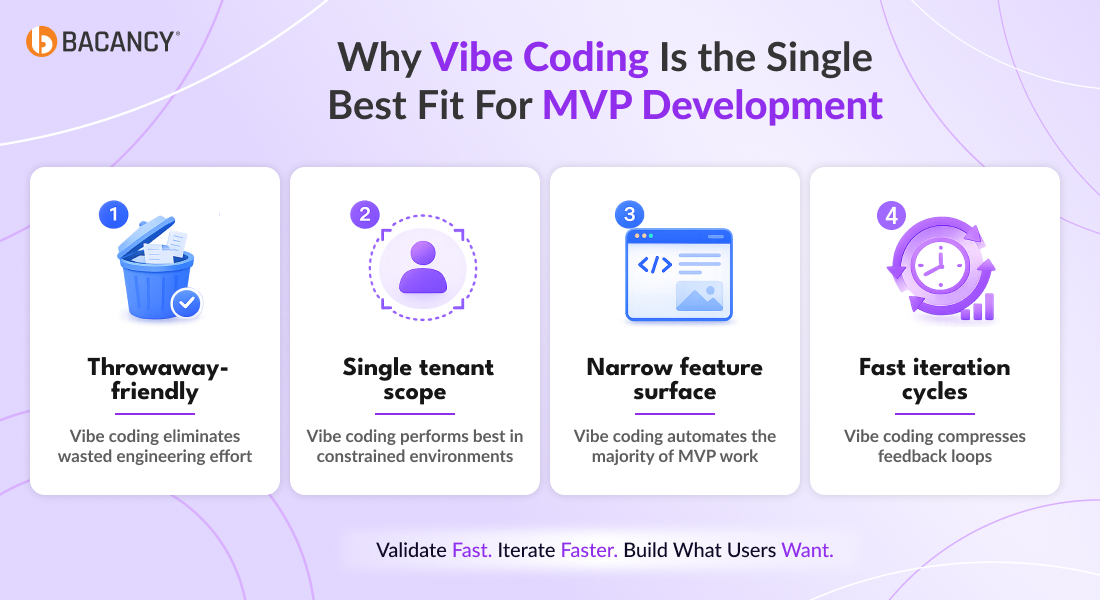
The Four MVP Characteristics That Make Vibe Coding An Ideal Approach
These characteristics don’t fall under regular traits of MVPs; they are the reason Vibe coding works so well for MVP development.
1: Throwaway-friendly: Vibe coding eliminates wasted engineering effort
The majority of MVPs need to be rebuilt after validation. That makes early code quality a low-leverage investment. Vibe coding manages it by generating functional code without spending time on long-term architecture that may never be used.
2: Single tenant scope: Vibe coding performs best in constrained environments
The early phase of MVPs focuses on one user type and one core workflow. This limited scope aligns well with AI code generation excelling at well-defined problems and patterns. Vibe coding turns this constraint into speedy development.
3: Narrow feature surface: Vibe coding automates the majority of MVP work
Several functionalities of MVPs, like CRUD, forms, authentication, and API integration, are repetitive and standardized. These are exactly those areas where AI delivers the biggest speed gains. Vibe coding doesn’t just assist here but also replaces hours of manual work.
4: Fast iteration cycles: Vibe coding compresses feedback loops
MVPs’ success depends on how quickly founders or teams can adapt. Vibe coding reduces its build time so drastically that founders can ship, test, and iterate within the same day, and that kind of deployment speed was impossible with traditional development.
Build and Launch Your MVP Using Vibe Coding in Weeks, Not Months
Hire Vibe Coding Developers from Bacancy to build scalable MVPs with the speed of AI and the reliability of expert engineering.
How Vibe Coding Compresses the Traditional MVP Build Timeline
Considering the traditional MVP development cycle, the team often spends weeks before writing any real product logic. Weeks pass due to environment setup, authentication plumbing, database configuration, CRUD boilerplate, and basic UI scaffolding. And these setups for heavy tasks can consume 20-40% of the 12-week MVP timeline. But Vibe coding removes all such bottlenecks.
12-Week Traditional MVP vs 3 Week Vibe Code MVP Development Timeline
| Phase | Traditional MVP (12 weeks) | Vibe Coding MVP (3 weeks)
|
|---|
| Environment and architecture | Weeks 1–2
| Day 0 - 60-minute scaffold session
|
| Auth and database setup | Weeks 3–4
| Hours 2–8 via Supabase + Clerk
|
| Core feature development | Weeks 5–9
| Days 1– 14 - 2-hour vertical slices |
| QA and edge case hardening | Weeks 10–11
| Days 15–18 |
| Deployment and live testing | Week 12
| Days 19–21
|
You can leverage AI coding tools and manage backend services that help founders automate, streamline API integration, and bypass repetitive setup work. What used to take weeks can now easily be done in hours. The core advantage of Vibe coding MVP development is that it enables faster product validation and iteration cycles. Also shifts focus from infrastructure to user feedback and product-market fit.
Real Cost & Timeline of an MVP Development Using Vibe Coding in 2026
Even across several breakdowns, MVP costs miss the complete picture. MVP built with vibe coding has four distinct cost components, and understanding all of them is important for core planning.
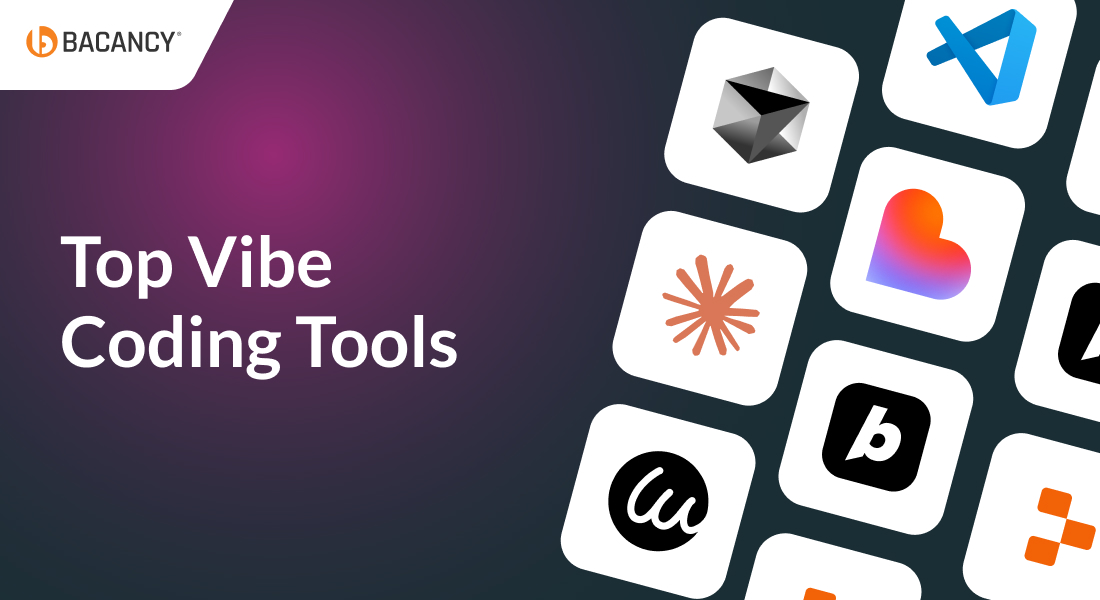
A modern vibe coding tools typically include Claude Code, Cursor, Lovable, Supabase, and Vercel. Combined, these cost around $100–$120/month for a fully functional MVP development environment.
2: AI usage and overages
Heavy AI coding sessions often exceed base plan limits. You can expect an additional $50–$150/month in usage costs. For a focused 21-day MVP sprint, this typically totals $200–$400.
3: Infrastructure and managed services
Backend service tools for database, auth, payments, and email keep infrastructure lean. During MVP’s scalability scale, services like Supabase, Clerk, Stripe, and Resend usually stay under $100/month.
Even with AI, human oversight is critical. A typical sprint requires:
- 8–15 hours of design
- 6–10 hours of QA and testing
Considering market rates, this adds up to $1,500–$3,000.
Total MVP Development Cost (21-Day Sprint)
- Vibe-code using MVP: $2,000–$5,000
- Traditional agency MVP: $30,000–$80,000
The difference is not just improved, it is dramatically bigger and significant on a completely different scale. You can go through our real-world case study below for better cost understanding, process, challenges, and overall breakdown.
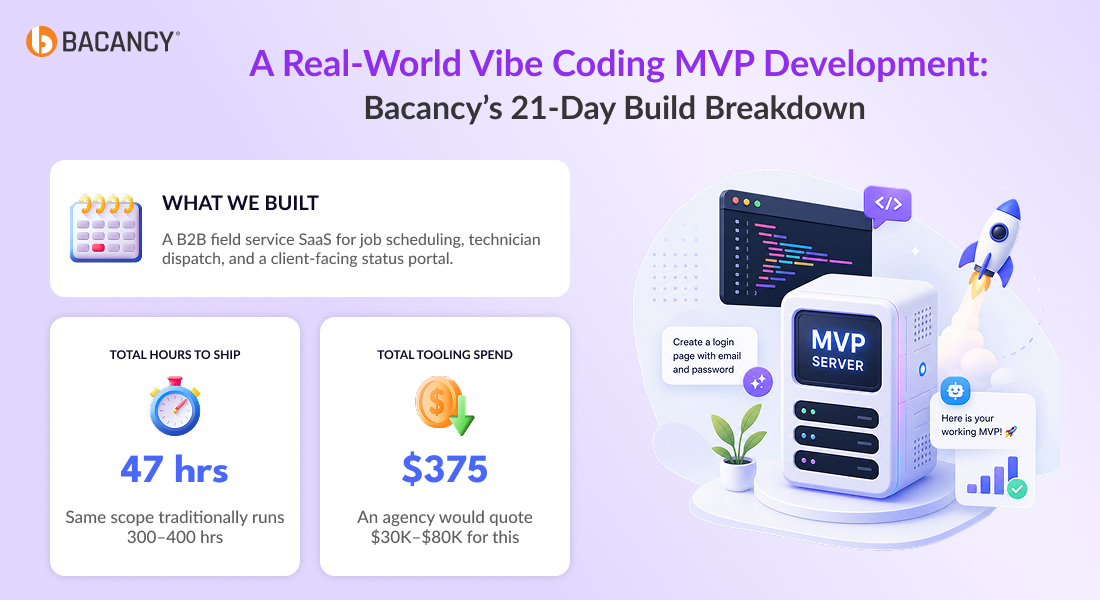
A Real-World Vibe Coding MVP Development: Bacancy’s 21-Day Build Breakdown
What We Built: A B2B field service SaaS for job scheduling, technician dispatch, and a client-facing status portal.
AI vs Bacancy’s Expert Managed Task
| AI handles (speed layer)
| Humans handle (decision layer)
|
|---|
| Scaffolding and boilerplate code
| Data modeling and entity relationships
|
| CRUD operations across entities
| Feature prioritization and build sequencing
|
| UI components, forms, and navigation
| Security reviews and edge-case validation
|
| API integrations (Stripe, database, email)
| QA sign-off on user-facing flows
|
| Authentication flows using managed primitives
| Architecture consistency and system coherence
|
Where Our Engineers Lost Time During the MVP Build
Even with AI speed, mistakes happen, and they’re instructive:
Day 3: The dependency gap arose (~2 hours of rework added)
A feature was built before its underlying data model was fully defined due to incomplete planning during the initial scaffold phase.
Day 11: Security gap (~90 minutes of manual review)
There were missing Row Level Security (RLS) policies in the database. AI-generated functional queries were present, but not secure ones. A 90-minute manual review caught the issue before production. This can also happen on your build. Plan for the review before release.
The Rewrite Tax: When a Vibe coding for MVP development works and needs to scale, a proper production rebuild typically costs $5,000–$30,000, depending on scope. That’s not a failure; that’s the model working as intended. Budget for it from the start.
Advanced Tech Stacks to Build MVP Using Vibe Coding
By 2026, the Vibe coding for MVP development has matured into two different and clear categories of tools.
- Agentic builders that generate full applications from prompts (Lovable, Bolt.new, Base44)
- AI-first coding environments that accelerate developers inside an IDE (Cursor, Claude Code, Windsurf)
The highest leverage workflow combines both. Founders use an agentic builder to proceed from an idea to a working prototype, then shift into AI-assisted code editors once the product needs deeper logic, customization, and long-term structure. The modern MVP stack now looks like this:
AI builder (UI) → AI coding agent (logic) → Managed primitives (auth, database, payments) → Deployment
Practical MVP Development With Vibe Coding Stacks for Founders
| Stage | Monthly Budget
| Recommended Stack
|
|---|
| Solo founder validating a consumer app
| ~$50/month
| Lovable + Supabase (free tier) + Vercel (free tier)
|
| Solo founder building an internal tool
| ~$20/month
| Base44 + Vercel
|
| Seed-stage startup shipping to first users
| ~$300/month
| Cursor + Claude Code + Supabase + Clerk + Stripe + Vercel
|
| Small team building a multi-feature MVP
| ~$1,500/month
| Cursor + Claude Code + Managed Postgres + Sentry + Resend + Vercel
|
Best AI Coding Stacks for Building MVPs Faster
| Tool
| Best For
| Starting Price
|
|---|
| Lovable
| Non-technical founders building consumer MVPs with React, Supabase, and built-in deployment
| ~$25/month
|
| Bolt.new
| Rapid prototypes, demos, and hackathon-style MVPs
| ~$20–29/month
|
| Base44
| Internal tools and dashboards with built-in auth, APIs, and integrations
| ~$20/month
|
| Cursor
| Developers working on production MVPs, refactors, and larger codebases
| ~$20/month
|
| Claude Code
| Backend logic, architecture decisions, and production-grade code generation
| Usage-based
|
| Replit | Browser-based development with zero setup for solo builders and fast experiments
| Free + paid plans
|
The 21 Day MVP Build Using Vibe Coding Framework: Scaffold, Slice & Ship
This is the exact framework that Bacancy’s expert uses for its Vibe coding sprints. Despite the strength of your team or whether you are working solo, the flow stays the same: scaffold fast, build in slices, harden aggressively, then ship before overthinking.
Day 0: Scaffold the MVP (The 60-Minute Planning Session)
Most Vibe-code MVPs fail before their first prompt. The problem isn’t AI; it is the missing structure. Before touching the codebase, define five things.
- Feature spec: List every feature, then cut 40% of it
- Data model: Define entities and relationships clearly
- API contract: Map every frontend/backend interaction
- File structure: Lock the folder architecture early
- Build order: Sequence foundational systems before UI layers
A planning session is what separates founders who ship in 21 days from founders who spend Week 4 refactoring broken scaffolding decisions. The fastest MVPs are actually made following efficient structuring.
Days 1–14: Build in Vertical Slices
The biggest mistake founders make is to build layers rather than features. They spend days generating APIs before any UIs exist. Instead, build the product in a systematic way. The complete and testable features include the database schema, backend logic, and Frontend UI. Having one working feature every two hours is a realistic pace for a productive Vibe coding sprint.
To keep your codebase coherent, try starting from prompts with the current feature spec and data model. Ask AI to perform a single task at a time. After every fifth commit, you need to conduct a manual review, flag consistency and security gaps. For solo founders, aim for one completed slice per day. With two people, parallelize non-dependent features and merge daily.
Vibe coding for MVP development only performs well when features are shipped continuously, not when the architecture grows.
Days 15–18: Harden the MVP Before Anyone Sees It
This phase most AI-built MVPs skip, and that’s where problems start. AI agents optimize for functionality, not production-based readiness. Without hardening, security gaps accelerate quickly. Keep your checklist ready before the launch:
- Enable Row Level Security (RLS) on every database table
- Audit authentication and protected routes
- Add fallback states and error handling
- Remove hardcoded credentials
- Configure security headers
- Add monitoring tools like Sentry
- Run one complete end-to-end user flow manually
The goal here isn’t perfection. It’s preventing avoidable failures before real users arrive. Safe MVP is preferable to just having a working MVP.
Days 19–21: Ship Before You Start Overbuilding
The final three days are allocated for deployment, smoke testing, analytics setup, and feedback collection. Avoid adding any new features here at this stage. Ship the MVP. Send it to the first users. Get feedback. The product starts becoming valuable the moment real usage data replaces assumptions.
Why Do MVPs Using Vibe Code Fail & How Bacancy Prevents Each Risk
Founders who succeed with Vibe coding for MVP development clearly understand that AI accelerates execution, but it can’t fully replace engineering judgment. Explore the biggest risks linked to Vibe-code MVPs and how Bacancy’s engineering process addresses each failure point before it becomes a problem.
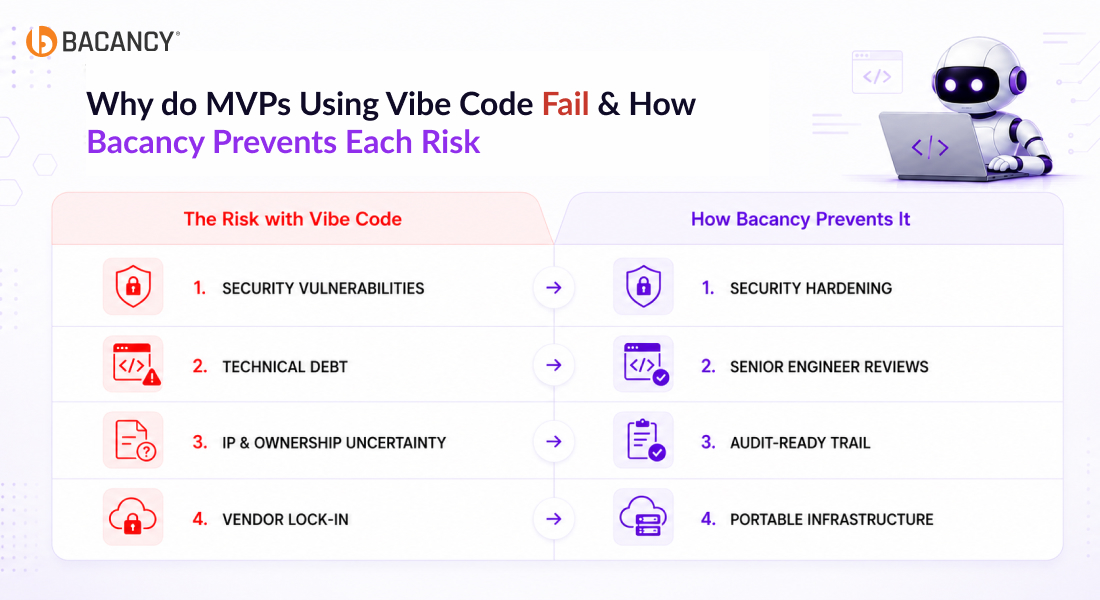
Risk 1: Security Vulnerabilities That Break User Trust
Understand, AI coding agents optimize just for the functionality, not for the security. Working codes can still contain serious vulnerabilities, missing Row Level Security (RLS) policies, exposed APIs, and weak authentication. And that’s exactly what caused 2026’s Moltbook breach, where AI-generated code exposed authentication tokens and user data because database security policies were never enabled.
How Bacancy Prevents it
Every Bacancy MVP development using Vibe coding goes through a mandatory security hardening phase before deployment. We conduct several security checks before release.
- RLS verification on every database table
- Authentication and permission audits
- Security header configuration (CSP, HSTS, X-Frame-Options)
- Hardcoded credential scans
- End-to-end protected route testing
Risk 2: Technical Debt That Slows Growth
It is true that AI generates code more quickly, but speed without proper structuring leads to several issues. Those AI-generated codebases left unreviewed often cause difficulty to maintain, onboard, or scale.
How Bacancy Prevents it
Our senior engineers review the codebase continuously throughout the sprint, not just at the end. We ensure naming conventions, architecture readability, business logic, and maintainable file structure.
Risk 3: IP and Ownership Uncertainty
The use of AI-generated code raises multiple valid questions around ownership, review history, and code provenance. Without documentation of what was AI-generated versus human-reviewed, acquisition and investment diligence can become messy.
How Bacancy Prevents it
We maintain every sprint under an audit-ready trail, followed by human engineering decisions, security reviews, architectural changes, and AI-assisted modifications. That creates a clear ownership history and reduces legal ambiguity later.
Risk 4: Vendor Lock-In
Some AI development platforms tightly couple your app to proprietary infrastructure. Migrating later can require rebuilding large parts of the system from scratch.
How Bacancy Prevents it
Bacancy’s default MVP stack prioritizes portable infrastructure. We use Supabase, Vercel, and the Clerk codebase that remains fully transferable and infrastructure independent after handoff.
Why Every Vibe Code Used MVP Still Needs Human Engineering
Even in the modern Vibe coding for MVP development, some systems never rely thoroughly on AI-generated defaults. A well-structured, operational Vibe coding for MVP development also requires engineering judgment in areas such as security, compliance, and data integration. These are certain parts of a Vibe Coding MVP build that Bacancy’s expert developers always review, architect, and validate manually.
| Area | Why Human Engineering Is Required
|
|---|
| Payment processing
| Vibe coding MVPs should use trusted Stripe primitives, not AI-generated payment logic.
|
| HIPAA/PHI workflows
| Healthcare MVPs require manual compliance, audit, and data protection architecture.
|
| Multi-tenant isolation
| |
| Cryptography & encryption
| Secure tenant separation and RLS policies need explicit engineering decisions.
|
| Financial calculations
| AI-generated calculation logic can create accounting and compliance risks.
|
Bacancy’s Engineering Standard Behind Every Vibe Coding MVP Development
Unlike other Vibe coding MVP services, we at Bacancy follow engineering principles and standards. Our process focuses on shipping it quickly, and standards ensure MVPs survive investor diligence, security production usage, and future scaling. Every Vibe Coding used MVP development at Bacancy follows five non-negotiable standards.
1: Architecture Before Prompts
We don’t proceed without any defined architecture or any AI-generated code before it. We first analyze data models, entity relationships, API contracts, folder structure, and feature build sequence. This prevents the biggest MVP Vibe coding failure, rebuilding features because of a weak foundation.
2: Expert Oversight at Every Critical Decision
AI accelerates execution. Engineers control architecture, security, and scalability. We employ AI to handle boilerplate, CRUD, UI scaffolding, and API integrations. Bacancy engineers manage data modeling, authentication, edge cases, production logic, infrastructure, and security configuration.
3: Security is Release Gate
Our Vibe code MVP does not ship until it passes Row Level Security (RLS) verification, credential and environment audits, authentication testing, security header configuration, and dependency vulnerability checks.
4: The Codebase Is Built for the Next Engineer
Every MVP at Bacancy ships with clean architecture, consistent naming conventions, documented logic, and handoff technical documentation. Our goal is to ensure your next engineer can easily build your codebase, not spend weeks decoding it.
5: The MVP Is Designed to Scale Beyond Validation
A successful build MVP using Vibe Coding engagement should not force a complete rebuild after traction. Bacancy structures every MVP so future scaling, feature expansion, and production hardening start from a stable foundation, not from scratch.
Conclusion
Vibe coding for MVP development in 2026 isn’t a shortcut. It is just a different way of employing engineering efforts. It is changing how startups build products in 2026. The advantage is not about having faster code generation, but rather it’s about faster validation. Founders can easily move their idea to a working product in weeks instead of months, test real demand, and avoid spending months building features nobody wants. But speed alone is not enough.
A fully operational yet successful MVP using Vibe coding still needs structure, security reviews, and engineering oversight. The teams that fail are usually the ones who skip planning, ignore hardening, and mistake an AI-generated codebase for immediate production readiness.
To have an expert approach, you need proficient Vibe coding services that combine the speed of AI-assisted development with senior engineering discipline at every stage of the build. From architecture planning to security reviews, working beside trusted Vibe coding engineers brings faster, safer, and more scalable results than expected.
Frequently Asked Questions (FAQs)
Yes, non-technical founders can also build a fully operational MVP using Vibe coding tools like Lovable, Base44, Bolt.new, and managed services such as Supabase and Vercel. However, for production readiness, security hardening, scalability, and architecture decisions, expert engineering oversight is still highly recommended.
Vibe coding MVP can generally be developed within 3-4 weeks, depending on the features, scope, and complexity. The simple internal tools or validation stage products can launch even faster if AI coding agents, managed infrastructure, and structured development workflows work together for a combined result.
The cost to develop Vibe coding MVP in 2026 ranges between $2,000 and $5,000 for a focused 21-day sprint. This includes AI tooling subscriptions, managed infrastructure, AI usage costs, basic design, QA, and deployment. For more advanced MVPs with multiple workflows, integrations, or production-grade requirements, the budget can scale, especially when security hardening, compliance, and scalability planning are involved.
Vibe coding works best for the validation-centric products with a limited feature set, such as SaaS dashboards, marketplaces, internal tools, booking systems, CRMs, customer portals, workflow automation apps, and early-stage B2B or consumer platforms.
Yes, but regulated products require additional engineering oversight. Healthcare and fintech MVPs often involve compliance requirements, sensitive user data, payment workflows, and security controls that should never rely entirely on AI-generated code. For these MVPs, build, human review, compliance architecture, and secure infrastructure remain essential.