Quick Summary
Based on Bacancy’s expertise, the cost of developing the MCP server in 2026 ranges between $25K for a basic MVP to $400K+ for enterprise builds, with most production deployments falling between $40K and $120K. The final costing of the MCP build depends on integration scope, security needs, tech stack, and team composition.
To provide you with better clarity, we have provided a complete MCP development cost breakdown to help you stay informed, plan accurately, and budget with confidence.
Table of Contents
Introduction
In 2026, when considering the biggest challenges related to the Model Context Protocol (MCP), the question is no longer whether to build infrastructure using it. Rather, the concern is understanding how much MCP server development costs and how enterprises should allocate their budgets accordingly.
Teams generally underestimate the pricing by focusing only on development hours, where they overlook integration complexities, compliance overhead, and long-term operational costs that can push the overall budget 2-3 times higher.
As AI agents move into production, the demand for MCP servers has accelerated, making pricing and architecture decisions a strategic concern for engineering leaders.
According to Anthropic, MCP SDK downloads have crossed 97 million per month, while more than 10,000 MCP servers are already live. Gartner also predicts 40% of enterprise applications will include task-specific AI agents by the end of 2026.
With the rising adoption, security compliance, orchestration, and scalability are becoming major drivers of MCP implementation cost. Let’s cover all of them in depth.
MCP Server Development Cost in 2026
Every MCP server development budget in 2026 depends on several variables, such as its integration scope, security requirements, infrastructure choices, team model, and long-term maintenance. Before jumping straight to estimates, it is important to understand what actually drives the MCP build budget because the gap between basic minimum viable product (MVP) and an enterprise-grade build can easily be 10x. In 2026, the MCP server build cost falls into three pricing categories:
| Project Tier | Industry Average | Bacancy's Estimate | Best Suited For |
| Basic MVP MCP Server | $25,000 – $50,000 | $15,000 – $35,000 | MVPs, internal copilots, proof of concepts |
| Mid-Tier Multi-Agent MCP Server | $60,000 – $120,000 | $40,000 – $90,000 | SaaS products, customer facing AI agents |
| Enterprise MCP Server | $150,000 – $400,000+ | $120,000 – $250,000+ | Regulated industries, multi-tenant platforms |
Pro Tip: Analyze in which category your project fits, and this would be your first step toward building an accurate MCP server development budget in 2026.
What Drives MCP Server Development Cost?
MCP server development cost depends on several factors, but seven variables consistently showcase their biggest impact on pricing, timelines, and long-term ownership costs
1. Cost Impact Per Integration
Integration scope is one of the biggest drivers in the MCP server cost breakdown. Each tool, API, or system your MCP server needs reflects engineering effort, testing requirements, and maintenance overhead.
| Integration Type | Estimated Industry Cost |
| Simple REST APIs | $500 – $2,000 |
| SaaS tools (Slack, Notion, Stripe, HubSpot) | $2,000 – $5,000 |
| Enterprise systems (Salesforce, SAP, NetSuite) | $5,000 – $15,000+ |
| Legacy or custom internal systems | $7,000 – $20,000+ |
Note: Per-integration costs reflect engineering hours plus testing, schema mapping, and OAuth setup.
2. Authentication and Compliance Scope
The security and compliance requirements significantly raise the MCP development cost, especially if the niche belongs to regulated environments. For regulated developments, compliance alone may account for 30-40% of the total MCP server development pricing.
| Compliance Layer | Cost Add-On (One-Time Build) | Annual Maintenance |
|---|
| SOC 2 Type II | $15,000–$35,000 | $8,000–$15,000/year |
| HIPAA | $20,000–$50,000 | $10,000–$25,000/year |
| PCI-DSS Level 1 | $25,000–$60,000 | $12,000–$30,000/year |
| GDPR readiness | $8,000–$20,000 | $5,000–$10,000/year |
3. Tech Stack Selection
Your selection of technologies can shift upfront build cost by 15–30% and long-term hosting cost by 25–40%. Choose a stack based on its performance and long-term project ownership.
| Tech Stack | Build Cost Impact (vs Mid-Tier baseline of $60K–$120K) | 3-Year Hosting Impact |
|---|
| Node.js / TypeScript | Baseline (fastest delivery) | Moderate |
| FastAPI (Python) | +0–10% (slightly slower for high-throughput work) | Moderate |
| Go | +15–25% (smaller talent pool, longer build) | -25 to -40% (lowest runtime cost) |
| Java | +25–40% (longer build cycles, larger team) | Variable (depends on JVM tuning) |
4. Hosting & Infrastructure Model
The hosting and deployment architecture impacts both the implementation budget and ongoing costs. The common hosting model includes:
- Self-managed Kubernetes or AWS Fargate for control and scalability
- Serverless or edge deployments for lower infrastructure overhead
- Managed MCP platforms for faster deployment with recurring platform fees
| Hosting Model | Monthly Cost (MVP → Enterprise) |
|---|
| Self-managed Kubernetes / AWS Fargate | $300 – $4,500/month |
| Serverless / edge deployments | $80 – $1,500/month |
| Managed MCP platforms | $200 – $2,500/month + license |
Note: Infrastructure decisions often shape both the performance and the MCP server development cost, even more than you notice.
5. Team Structure
Who develops your MCP server has the most impact on your pricing as much as the technical scope. The same multi-agent system builds an MCP server at very different cost points depending on team seniority, agency model, and how the work is structured. MCP engineering rates fall into three broad categories:
| Engineering Tier | Senior Engineer Hourly Rate | Typical Build Cost (Mid-Tier MCP) |
|---|
| Premium agencies | $80 – $250/hr | $120K – $250K+ |
| Mid-market agencies | $40 – $80/hr | $70K – $140K |
| Cost-efficient agencies | $20 – $50/hr | $40K – $90K |
6. Engagement Models
Once the team is decided, the step goes on the engagement model. The variety of MCP server development projects, such as MVPs, production builds, and scaling, all require different contract structures. If you fail to select the ideal one, your MCP budgets will inflate by 20-40% without anyone noticing for months.
| Engagement Model | Best For | Pricing | Cost Profile |
|---|
| Solo Architect | MVPs and prototypes | $3,200 – $4,500/month | Lowest, fastest model for lightweight builds |
| Dedicated Team | Production MCP platforms | $9,600 – $32,000/month (3–10 engineers) | Moderate-high, best for scale and continuity |
| Staff Augmentation | Scaling internal teams | $20 – $32/hour per resource | Flexible, adds specialized expertise on demand |
| Bacancy Outsourced Developers | End-to-end MCP development | $22–$32/hour | Cost-efficient, scalable, and managed with built-in expertise and oversight |
7. Post Launch Maintenance & Governance
Industry standards for ongoing maintenance typically cost 20-30% of the original build cost annually. While well-scoped retainers can keep this at 15-20% by bundling protocol updates, monitoring, security patching, and feature iteration.
Build Your MCP Server with Expert Talent
Hire MCP developers from Bacancy to build scalable, production-ready MCP servers with the right architecture, speed, and cost efficiency.
MCP Server Development Cost Breakdown by Complexity Tier
A realistic MCP server cost breakdown in 2026 falls into three complexity tiers, such as pricing shaped by integration scope, security requirements, scalability, and compliance needs.
| Project Tier | Industry Average (2026) | Bacancy Estimate | Timeline | Team Size | Best Suited For |
|---|
| Basic MVP MCP Server | $25K–$50K | $18K–$35K | 4–6 weeks | 1–2 engineers | MVPs, internal copilots, proof of concepts (2–3 integrations) |
| Mid-Tier Multi-Agent MCP Server | $60K–$120K | $42K–$85K | 8–12 weeks | 3–5 engineers | SaaS products, customer-facing AI agents (5–10 integrations) |
| Enterprise MCP Server | $150K–$400K+ | $110K–$250K+ | 14–24 weeks | 6–10 engineers | Regulated industries, multi-tenant platforms (10+ integrations, full compliance) |
MCP Server Tech Stack Cost Comparison: Node.js vs FastAPI vs Go vs Java
The selection you make on the technology stack has a direct impact on MCP server development cost, delivery, speed, scalability, and long-term operating expenses.
It might happen that your stack choice might not affect the project building cost, but it is surely going to influence three-year ownership costs. Selecting the right stack is one of the biggest levers for controlling the MCP server build cost in 2026.
| Tech Stack | Best For | Industry Mid-Tier Cost | Runtime Efficiency | Scalability |
|---|
| Node.js / TypeScript | Fast MVPs, API-heavy MCP servers | $50K–$80K | Moderate | High |
| FastAPI (Python) | AI-native workflows, agent tooling | $55K–$90K | Moderate | High |
| Go | High-throughput production MCP servers | $70K–$110K | Excellent | Very High |
| Java | Enterprise systems, regulated environments | $90K–$140K | High | Very High |
Pro Tip: Use Node.js or FastAPI for MVPs, and SaaS first builds, and Go or Java for enterprise systems where runtime efficiency and long-term cost-per-request matter more than launch speed.
MCP Server Development Cost & Team Composition
The team you choose can influence the whole development cost of the MCP server. In 2026, many MCP projects stalled not because the protocol is difficult but because they relied on an inappropriate team model based on project scope. MCP projects in 2026 fall into three team models based on scope and complexity.
| Project Tier | Team Composition | Timeline | Build Cost (Global Delivery) |
|---|
| Basic MCP Server | 1 Senior Backend Engineer + Part-time DevOps | 4–6 weeks | $15K–$35K |
| Mid-Tier MCP Server | Tech Lead, 2 Backend Engineers, DevOps, QA Engineer | 8–12 weeks | $40K–$90K |
| Enterprise MCP Server | Solution Architect, 3–4 Backend Engineers, SRE, Security/OAuth Engineer, QA Lead, PM | 14–24 weeks | $120K–$250K+ |
When the project’s complexity increases, the specialized roles around security, infrastructure, and protocol governance raise both the scope and the MCP server development budget.
Build vs Buy vs Hybrid: Which MCP Development Strategy is The Best
The biggest decision affecting MCP development cost is whether to build a custom server, adopt managed MCP infrastructure, or take a hybrid approach. Each model changes upfront investment, time to market, and three-year ownership costs.
| Strategy | Best For | 1 Year Cost (Industry) | Time to Production |
|---|
| Build (Custom) | Regulated industries, multi-tenant platforms, MCP-as-product | $80K–$400K+ for 5–10 integrations | 8–24 weeks |
| Buy (Managed) | Standard SaaS connectivity (Slack, Salesforce, HubSpot, Jira, Notion) | $9,200–$37,500 integration + $200–$3,000/month platform fee | 1–3 weeks |
| Hybrid (Recommended Default) | Production SaaS with proprietary core + standard auxiliary tools | $30K–$100K + $200–$3,000/month managed layer | 4–10 weeks |
Pro Tip: Most of Bacancy’s SaaS clients land on the hybrid model, managed infrastructure for OAuth, logging, and hosting with custom MCP logic and tools defined in-house. This generally eliminates 30-40% off the upfront build cost without giving up control of the core architecture.
Industry-Specific MCP Server Cost Drivers
MCP server development costs shift significantly depending on industrial requirements, especially when the core technical scope is similar. Let’s explore the MCP server build cost in 2026 based on different industries and their architectural complexities.
Healthcare MCP Cost (HIPAA Compliance)
Healthcare MCP server development cost goes to the most expensive side as they build on strict regulatory and data protection requirements. It generally ranges between $80K and $250K+, with HIPAA compliance alone adding 30–40% to the base cost. The key cost drivers include:
- HIPAA compliance and PHI handling
- End-to-end encryption and secure data access
- Detailed audit logs and traceability
- Strict role-based access controls (RBAC)
- Secure integration with EHR/EMR systems
FinTech MCP Pricing (PCI-DSS & Security Overheads)
FinTech MCP systems need a high-trust architecture because of financial data sensitivity and transaction workflows. The cost usually starts at $100K and can exceed $300K for trading or payment-heavy platforms. Here, the primary cost drivers are:
- PCI-DSS compliance requirements
- Advanced encryption and key management
- Fraud detection and monitoring integration
- Identity verification and secure authentication flows
- Real-time transaction data handling
Because of these layers, the MCP server build cost in FinTech is often driven more by security engineering than by integration complexity
SaaS MCP Cost (Multi Tenancy & Scaling Complexity)
For SaaS companies, MCP costs between $60K–$150K, with multi-tenancy and rate-limiting layers adding 20–25% on top of the base build. The major cost drivers here are:
- Multi-tenant architecture and isolation
- API rate limiting and usage controls
- High-volume tool integrations
- Performance optimization at scale
- Observability and monitoring systems
As the user base grows, the MCP server development budget increases due to infrastructure scaling and operational reliability requirements.
Retail & Manufacturing MCP Cost Considerations
Retail and manufacturing MCP systems usually fall between $70K and $180K, with ERP and legacy system integrations driving 50–60% of the total cost. The other cost drivers include:
- ERP and supply chain system integrations
- Inventory and logistics data workflows
- Legacy system connectivity
- Real-time operational data processing
- Event-driven automation systems
The MCP server build cost in 2026 in retail is largely influenced by system complexity and integration depth rather than regulatory overhead.
7 Hidden Costs in MCP Server Development You Must Budget For
The hidden operational cost generally adds 30-50% on top of the initial MCP server development budget for mid-tier deployments in the first 12 months. For enterprise deployments with high-volume tool catalogs, recurring costs can match or exceed the original build cost annually.
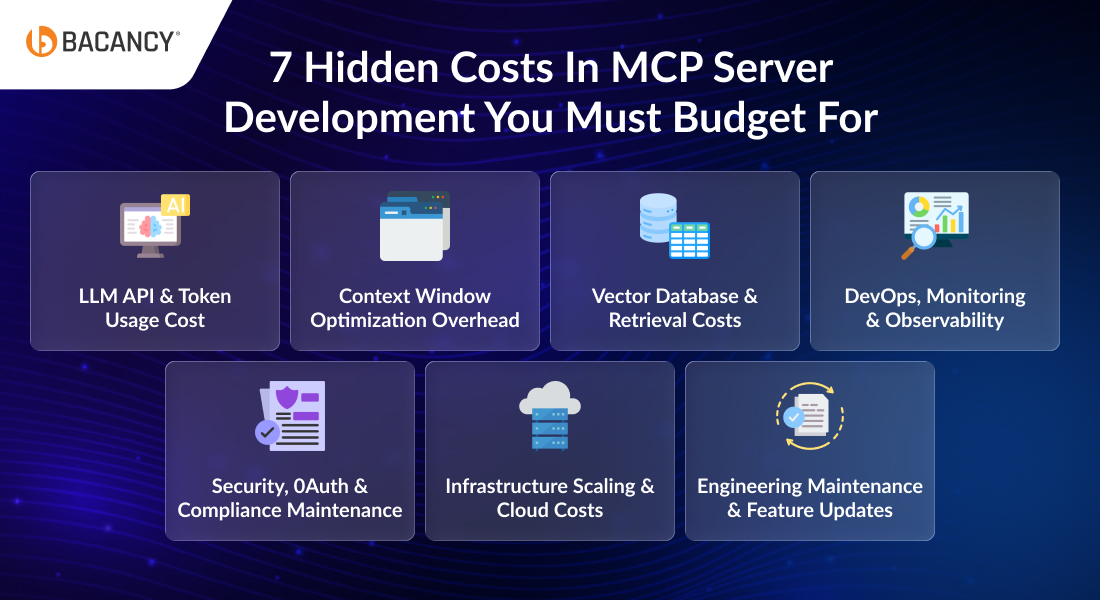
1. LLM API & Token Usage Cost
The token spend usually runs $500-$25,000/month, depending on the traffic with enterprise MCP deployments. It can also cross $21,000+/month once tool catalogs and conversation volume increase.
2. Context Window Optimization Overhead
The poor context design can increase token cost by 2-4x, adding $2,000-$8,000/month in avoidable spend across the lifetime of the deployment.
3. Vector Database & Retrieval Costs
Managed vector databases add recurring costs for storage and retrieval. For SMB workloads, it goes $70–$500/month, and for Enterprise scale, it can fall between $2,000–$10,000/month.
4. DevOps, Monitoring & Observability
Production MCP servers need monitoring, logging, and alerting beyond initial deployment, which might cost around $300–$2,500/month, depending on scale and tooling.
5. Security, OAuth & Compliance Maintenance
Security and compliance create ongoing costs beyond the initial build. $8,000–$25,000/year can go for audits, patching, and upkeep of compliance.
6. Infrastructure Scaling & Cloud Costs
As the usage increases, compute, storage, and network costs also get higher. MCP workloads can run 30–50% higher than traditional AI hosting due to context and memory demands.
7. Engineering Maintenance & Feature Updates
The need for continuous engineering efforts and feature updates becomes a recurring cost center for the development. And it can exceed roughly 20-30% of the original build cost annually for Mid Tier deployments and 30-45% for Enterprise-grade.
How to Reduce MCP Server Development Cost Without Cutting Corners
If you aim to reduce MCP server development cost in 2026, it is less about cutting features and more about making a smarter architectural plan. With a well-planned strategy, the MCP server development cost can be reduced by 30-50%.
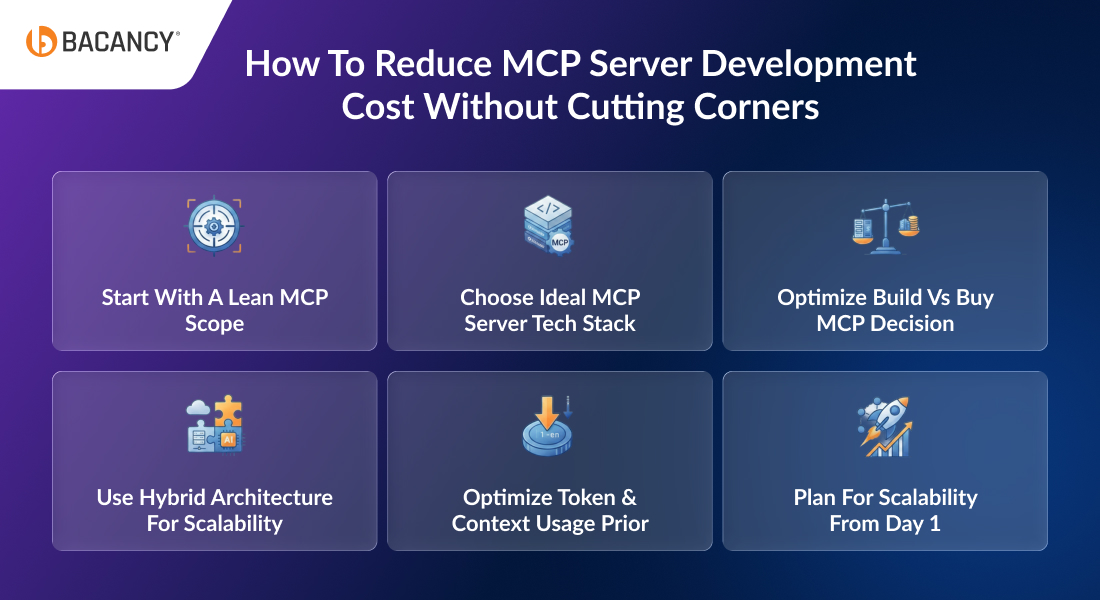
1. Start with a Lean MCP Scope
Don’t focus on overbuilding from the start. Begin with only critical integration and later expand based on validated usage. A lean 3-5 integration MVP can save 20-25% of initial build cost.
2. Choose Ideal MCP Server Tech Stack
Your selection of the MCP server tech stack can shift upfront build cost by 15-30% and long-term hosting by 25-40%. You can employ lightweight stacks like Node.js or FastAPI that reduce upfront effort, and Go lowers infrastructure costs during scalability.
3. Optimize Build vs Buy MCP Decision
Not everything in the development needs to be custom-built; your decision between build and buy can help you eliminate up to 40% of upfront cost, avoiding custom authorisation, logging, and hosting.
4. Use Hybrid Architecture for Scalability
The deployment of a hybrid model balances both cost and flexibility up to 70%. It also helps teams to reduce the MCP server development budget while maintaining control over core logic and integrations.
5. Optimize Token Usage to Lower Ongoing Costs
With efficient prompt design, caching, and retrieval optimization, the recurring LLM-related costs can be reduced between $5,000 to $21,000/month at the enterprise level, especially when the tool catalogs cross the 50+ mark.
6. Plan for Scalability From Day 1
Consider scalability from Day 1; it would save you further expensive 2-3x refactoring costs, especially in an enterprise MCP server that can translate to $50K-$200K in avoidable costs and rework
Why Choose Bacancy for MCP Server Development
We at Bacancy do not rely on inflated claims in a protocol that is still evolving. We bring practical MCP implementation experience, transparent development pricing, and proven architectural expertise to help you build scalable MCP solutions while avoiding unnecessary cost and complexity.
Pratik Panchal
Senior AI Solutions Architect at Bacancy
Here are the top reasons why we bring years of expertise to deliver practical, scalable solutions that grow with your business.
AI Engineering Expertise Built Before MCP
While MCP is a newer protocol, the engineering behind it is not. At Bacancy, our team of expert AI agent developers has spent years building agent workflows, retrieval systems, and production AI infrastructure, and we bring that depth into every MCP project.
Architecture Designed to Evolve With MCP
As MCP continues to mature and enables long-term flexibility as much as initial implementation. We design a modular MCP architecture that can adapt easily to protocol updates without expensive rebuilds.
Transparent Pricing with Predictable Delivery Costs
Having clear insight into pricing is crucial for planning MCP initiatives. We provide estimate-driven pricing based on expertise, project complexity, and from MVP builds to enterprise-level deployment, accounting for integrations, compliance, and hidden cost factors.
Compliance Ready Architecture From Start
For a regulated or security-sensitive MCP project, compliance needs to be designed into the architecture from the beginning. We help you incorporate requirements such as HIPAA, SOC 2, PCI-DSS, or GDPR early to help avoid expensive rework in the future.
Flexible Engagement Models Aligned to Project Scope
Different MCP projects need different delivery models. We offer trusted architectural consulting, a dedicated team for development, staff augmentation, and engagement models that can be aligned to project complexity, timelines, and budget requirements.
Conclusion
MCP server development cost in 2026 reflects a significant shift from experimental AI tooling to production-grade infrastructure. The discussion is no longer about whether to build, but how efficiently you can build with the right balance of security, scalability, and integration depth.
The majority of MCP server development costs fall between $25K and $120K, with payback achieved within 4-9 months when the scope stays defined. If the project is not engineered by experts or poorly scopes it can quickly exceed the budget by 2-3x without delivering any proportional business value.
The cost gap between a successful MCP build and a failed one rarely comes down to hourly rates. It reflects on the architectural decision made in the first two weeks of the project. Choosing a trusted AI development partner can determine how effectively you can deploy your project with minimal to zero cost overruns.
Frequently Asked Questions (FAQs)
In many cases, your existing team can take charge of building the MCP server, especially for basic or mid-tier implementations. However, hiring a dedicated AI/LLM engineer becomes more important when you are designing a multi-agent workflow, as you need prompt orchestration, token efficiency management, and an enterprise-ready server.
The cost depends on the complexity of the system being integrated.
Simple REST APIs: $500 – $2,000 per integration
SaaS tools (like Slack, Notion, Stripe): $2,000 – $5,000
Enterprise systems (like Salesforce, SAP, NetSuite): $5,000 – $15,000+
The cost increases when the integration requires more complex data mapping, rate limitations, and compliance logging.
You don’t need to build anything from scratch; most MCP server architectures are designed to wrap existing REST APIs, not replace them. You can follow three common migration approaches, such as wrapper, hybrid, and full rebuild (rare). For most enterprises, migration is incremental, which helps control the cost to build MCP servers while preserving the existing infrastructure.
Like any other evolving protocol, MCP will continue to update over time. However, well-architected systems can absorb such changes with minimal disruption. The major updates happen at the core protocol, needing SDK or adapter upgrades, tool schemas may need minor adjustments, and authentication or transport layers may evolve.
Both are closely aligned but fundamentally different in terms of layering. MCP server’s infrastructure layer connects AI models to tools, APIs, and data systems. The AI agent’s application layer decides what action to take using reasoning or LLM logic.