Summary
This guide will help you explain how Golang Cloud Native development shapes modern infrastructure in 2026 by improving high performance, lowering infrastructure costs, and simplifying compliance. It also highlights how organizations are building scalable systems using Go language microservices and achieving better Go container efficiency. It provides Kubernetes performance through lightweight and dependency-free deployments.
Table of Contents
Introduction
Cloud-native development in 2026 is no longer experimental; it is the standard way to build modern systems. According to the CNCF Q1 2026 report, 20 million developers have started working in cloud-native environments, and much of that ecosystem is powered by Golang. This is not the early adoption of technology; it is an infrastructure reality.
With the release of Go 1.26, the language has evolved beyond developers’ productivity. It directly impacts cost models, compliance posture, platform engineering, and even cryptographic future proofing. That is the reason why Golang Cloud Native development is considered ideal for building modern Cloud Native Systems in 2026.
Why Golang Cloud Native Development Matters in 2026?
Golang Cloud Native development is gaining widespread attention and adoption because it addresses the core challenges of modern infrastructure. It improves cost, performance, scalability, and compliance-based issues. Instead of adding complexity, it simplifies how applications are built, deployed, and managed in a cloud-native environment.
Organizations are relying more on Go as it enables efficient Go language microservices, allowing teams to build lightweight, scalable services with minimal runtime overhead. Its ability to compile into small static binaries results in faster deployment and better resource utilization.
In 2026, the reason why Golang Cloud Native development matters is that it aligns tech capabilities with business outcomes. It reduces the cost, improves performance, and simplifies compliance.
Go vs Other Cloud Native Technologies: A Realistic Comparison
The effectiveness of Go does not win every category, but it wins where enterprise systems need balance. Go delivers a strong balance of performance, cost efficiency, Kubernetes alignment, and compliance readiness, making it a reliable choice for modern cloud-native systems.
| Dimension | Go | Java (JVM)
| Node.js
| Rust
|
|---|
| Cold-start latency
| ~100–150 ms
| 500 ms–2.5 s
| 200–400 ms
| 16–100 ms
|
| Binary / image size
| 5–15 MB (static)
| 100–250 MB+ (JVM)
| 30–200 MB
| 2–10 MB
|
| Memory usage (idle)
| 10–50 MB
| 100–250 MB+
| 30–100 MB
| 5–20 MB
|
| Concurrency model
| Goroutines (~2 KB each)
| OS threads (~1 MB each)
| Event loop | Zero-cost abstractions
|
| Runtime overhead
| Low, minimal tuning
| High, requires tuning
| Moderate
| Very low
|
| Garbage collection
| Optimized (Green Tea GC)
| Tunable but heavy
| Can introduce jitter
| No GC
|
| Kubernetes ecosystem
| Native (client-go, operators)
| Limited | Minimal | Minimal |
| SBOM & compliance
| Simple, deterministic
| Complex dependency trees
| Complex npm chains
| Moderate |
| Post-quantum crypto
| Built-in (Go 1.26)
| External libraries
| External libraries
| External crates
|
| Operational complexity
| Low
| High
| Medium | High |
What are the Key Benefits of Golang Cloud Native Development in 2026?
Golang Cloud Native development not just stands out because of its technical capabilities, but also for the measurable business values it delivers. From cost optimization to scalable performance, it is compliance-ready, enabling organizations to build efficient, reliable, and future-ready cloud-native systems.
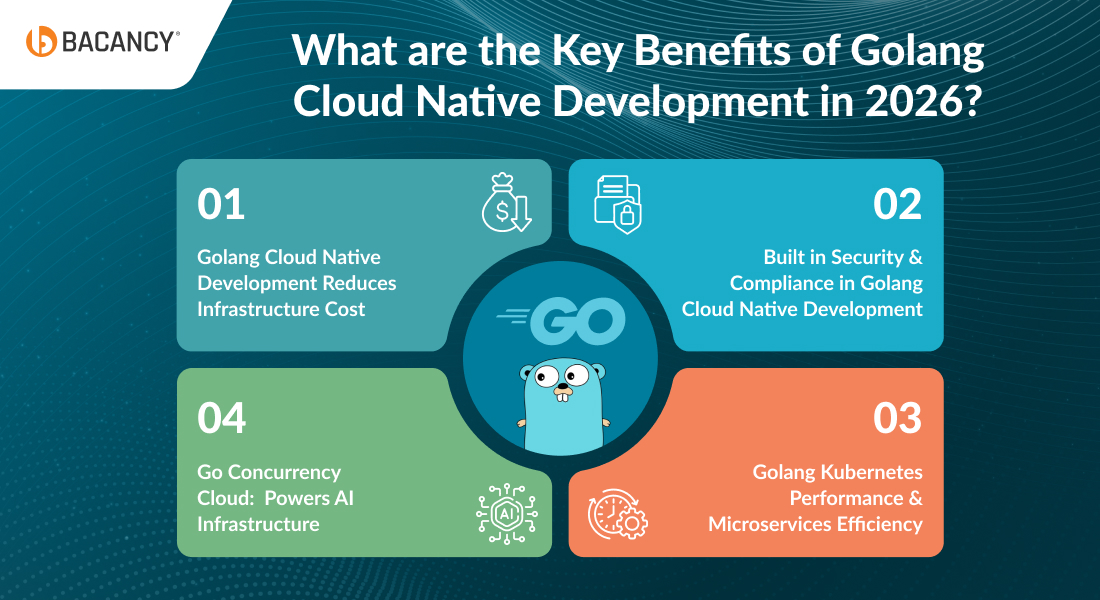
1. Golang Cloud Native Development Reduces Infrastructure Cost
The biggest reason why Golang Cloud Native development is widely adopted is its ability to minimize infrastructure cost. It fundamentally changes how applications are built and deployed.
Go applications compile into a small, single binary (typically 5–15 MB), eliminating the need for external runtimes and reducing operational complexity.
Under a moderate production load (~500 requests per second) on Kubernetes:
- Go service: ~68 MB RSS memory
- Java service: ~412–438 MB RSS
Teams can run approximately 4X more Go services on the same infrastructure compared to JVM-based services.
Go 1.26 memory also reduces unnecessary CPU usage and makes applications more efficient without extra configuration. Choosing Go for microservices is not just a technical preference, but it is a long term cost strategy.
2. Built in Security & Compliance in Golang Cloud Native Development
While cost efficiency is a major advantage, enterprises today also need strong compliance and security guarantees. In cloud-native systems, security is not just about protecting applications. It is also about knowing exactly what is inside your software and proving it to auditors and customers.
Modern compliance standards need teams to generate Software Bills of Materials (SBOMs) and verify secure developments. Golang helps applications to develop into single static binaries. It resolves dependencies and cuts down on hidden runtime. It makes SBOM generation more efficient and easier to audit compared to an ecosystem with complex dependency chains.
Modern systems need constant performance, and Golang Cloud Native development delivers it through tight Kubernetes integration and efficient runtime behaviour.
Golang Kubernetes performance is strong because most cloud native tools like Kubernetes, Prometheus, and Argo CD are built in Go. It aids developers to carry predictable performance across environments like AWS, Azure, and GKE.
At the application layer, Go language microservices improve efficiency, enable faster deployment, and higher service density per node. Golang Cloud Native development combines strong Kubernetes alignment with efficient microservices, delivering scalable performance, faster response times, and optimized infrastructure usage.
Running Go workloads on Kubernetes but not getting the performance you expected?
Our Kubernetes consulting services help teams fix cluster inefficiencies and tune runtime behaviour so your microservices deliver the maximum throughput.
4. Go Concurrency Cloud: Powers AI Infrastructure
AI is no longer just about the models; it is more about infrastructure at scale. And that infrastructure layer is increasingly built using Go (Golang). The CNCF tools managing this AI infrastructure layer are already Go native.
- Kubernetes: orchestrates GPU node pools and inference pod scheduling
- Knative Serving: routes traffic to inference pods based on queue depth
- OpenTelemetry Go SDK: traces inference requests from the gateway to the model to the response
- Prometheus: monitors inference latency, throughput, and error rates
Golang Cloud-Native Development Across Regulated Industries
In 2026, Golang Cloud-Native development is not theoretical; it delivers measurable outcomes across sectors. Across industries, Go provides a lightweight Go concurrency cloud via goroutines, stable performance under high load, and minimal runtime overhead. To understand where Go stands, here is a direct comparison across key sectors:
| Industry | Core Challenge
| Traditional Limitation
| Go Advantage
| Business Outcome
|
|---|
| Financial Services
| High concurrency + evolving security
| Thread overhead, external crypto dependencies
| Goroutines + built-in post-quantum crypto
| Faster APIs, future-ready security
|
| Healthcare
| Compliance + auditability
| Complex dependency chains, difficult SBOMs
| Deterministic builds + minimal dependencies
| Faster audits, lower compliance risk
|
| Retail & eCommerce
| Peak traffic scaling
| High memory usage, slow scaling
| Lightweight services + fast startup
| Lower cost, better peak performance
|
Golang Cloud-Native development turns technical decisions into real business outcomes. Financial institutions witness faster APIs, stronger security, and lower memory usage. Healthcare platforms gain easy audits and deterministic builds. Retail systems stay stable under peak loads.
To have a deeper look at how banks and payment platforms use the Golang language, check our guide on “Golang for fintech applications.”
Common Mistakes in Golang Cloud-Native Development (2026)
Undoubtedly, Golang Cloud Native development is robust, but teams still make unavoidable mistakes that impact cost, performance, and delivery timelines. Learn exactly where they are going wrong:
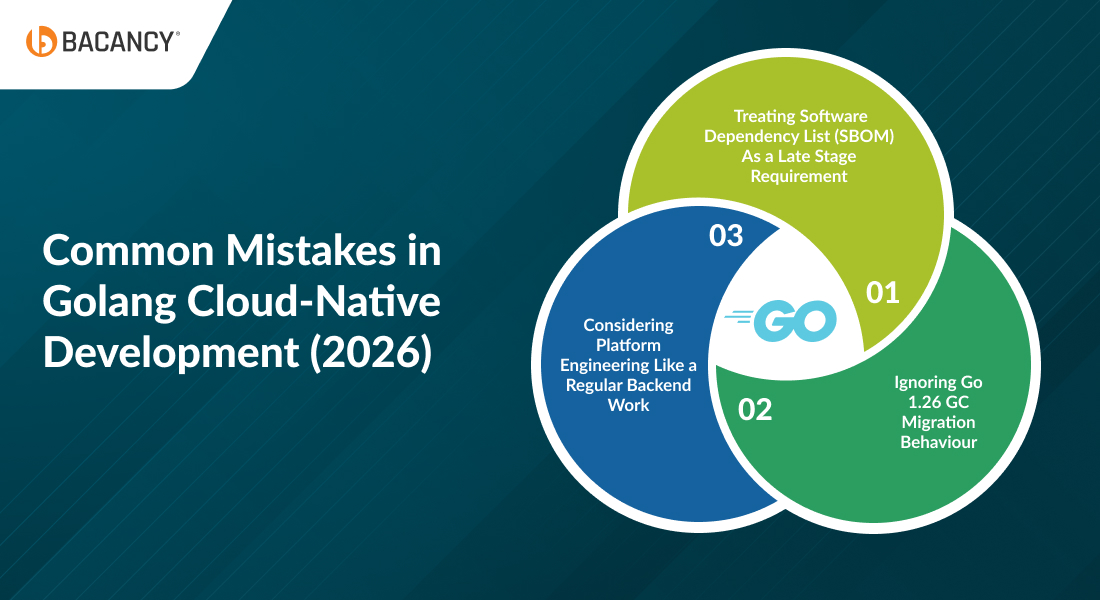
1. Treating Software Dependency List (SBOM) As a Late Stage Requirement
There are teams that delay the SBOM generation until the contract or audit needs it. This is a mistake. Tools like Syft and cosign should be integrated into the CI/CD pipeline from day one. Adding SLSA in the level 2 later, which is relatively easy, but if failed to produce a signed SBOM during procurement, it delays deals by weeks or months.
2. Ignoring Go 1.26 GC Migration Behaviour
G 1.26 introduces the Green Tea garbage collector as a default. For most of the systems, it improves the performance immediately, but for some workloads, it requires different allocation patterns.
The team here needs to run load tests before production rollout. They should monitor latency and memory behaviour using fallback if needed as a temporary option.
This is one of the most critical mistakes that happens when writing Kubernetes operators, GitOps controllers, and infrastructure APIs. It is not as similar as writing the backend services. It needs an understanding of Kubernetes controller patterns, reconciliation loops, event-driven architecture, and client-go internals.
If this is done incorrectly, controllers can overload the Kubernetes API server. Systems start becoming unstable under scale, whereas platform engineering in Go is a specialized skill, not just Go syntax.
Late compliance delays the project revenue, and skipped testing leads to production risk. Doing all such practices is mandated for the business to avoid wrong team structure and for slower delivery. The biggest risk is not choosing Go; it is using it without the right approach.
Want mistake-free Golang cloud-native development from day one?
Hire Golang developers from Bacancy who bring SBOM, GC tuning, and Kubernetes operator expertise built into their delivery process.
Why is Golang Cloud Native Development the Enterprise Standard in 2026?
Golang Cloud Native development in 2026 is no longer about tech choice. It is a result of multiple enterprise realities that align in one ecosystem. The changes are quantifiable, such as:

1. Cost (FinOps)
Go’s binary model and Green Tea GC have reduced the infrastructure cost as per the request and the scalability it brings to notice.
2. Compliance
Go provides built-in support for FIPS-ready cryptography, post-quantum encryption, deterministic SBOM generation, and SLSA-compatible builds.
Modern Infrastructure is built on Kubernetes, GitOps systems, and cloud control planes. And these are largely based on a Go-driven ecosystem.
Conclusion
Golang Cloud Native development is not a part of the trend; it is more of an infrastructural standard. Organizations that succeed with Go in 2026 are choosing the language and are designing and considering cost efficiency, building compliance from day 1. They are consistently investing in platform-based engineering skills and preparing for AI-escalated systems.
If you are planning to build a Go tech based cloud native platform, migrate to Kubernetes, and scale AI infrastructure, then the difference is not just tools; it is execution capability. And right execution always comes from an experienced Golang development company. Teams that get this development right not only build faster but also deliver systems that are more efficient, scalable, and future-ready.
Frequently Asked Questions (FAQs)
In the comparison of Go vs Java cloud native, Go has a clear advantage for modern systems, which offers faster startup time, lower memory usage, simpler deployment, and easier dependency management. Java also offers a strong ecosystem and enterprise tooling, but Go presents a better choice for Kubernetes-based Go language microservices and cloud native architectures.
Yes, it works best for a Go language microservices architecture. It provides lightweight services, efficient Go concurrency cloud using goroutines, stable performance, and faster scaling in a container environment. Even using Go 1.26 improvements, microservices have become more efficient and predictable. It enables microservices that are fast, scalable, and easy to operate.
Golang Kubernetes performance is strong because Go is deeply integrated with the Kubernetes ecosystem. It is thoroughly written in Go, using tools like Helm, Prometheus, and Argo CD. It allows the team to build operators, controllers, and platform tools.
Go container efficiency comes from its minimal runtime. Single static binary, small image size, and low memory footprint. In comparison with Java or Node.js. Go enables faster container setup, higher pod density per node, and lower infrastructure cost.
Go uses goroutines, which are quite lightweight threads managed by the runtime. Each goroutine uses very little memory, and thousands run concurrently in a single process, which is ideal for APIs, microservices, and real-time systems.