Quick Summary
This blog covers the top 7 NLP use cases in healthcare. We have explained common challenges in everyday healthcare workflows, such as hidden information in clinical notes, slow analysis of research and patient data, and how NLP can address these problems. We’ve also included real-life case studies to help you understand how organizations using NLP have gained real benefits in improving patient care, research efficiency, and decision-making.
Table of Contents
Introduction
Natural Language Processing, or NLP, is a technology that helps computers understand the way people naturally write and speak. In healthcare, a lot of important information is written in simple text, like doctor’s notes, discharge summaries, pathology reports, and patient feedback.
Most healthcare organizations are interested in organized data, such as lab results or diagnosis codes. However, actual clinical information is usually embedded in comments. Thus, the most valuable information goes unnoticed.
At Bacancy, we have worked for years on healthcare data and research projects. We understand how difficult it is for organizations to manage large amounts of clinical text. We also know how valuable that information becomes when it is properly analyzed and organized.
But here’s the solution: NLP turns everyday clinical writing into clear, usable insights that support better decisions, improved efficiency, and better patient care.
In this blog, we explore the top 7 NLP use cases in healthcare, based on key insights provided by our AI/ML expert Rajiv Mehta, showing real examples of how these solutions help patients and doctors.
Top 7 NLP Use Cases in Healthcare
Here is how Natural Language Processing in healthcare is actually deployed, what breaks, what works, and what enterprises must consider. Here are the best examples of NLP use cases in healthcare
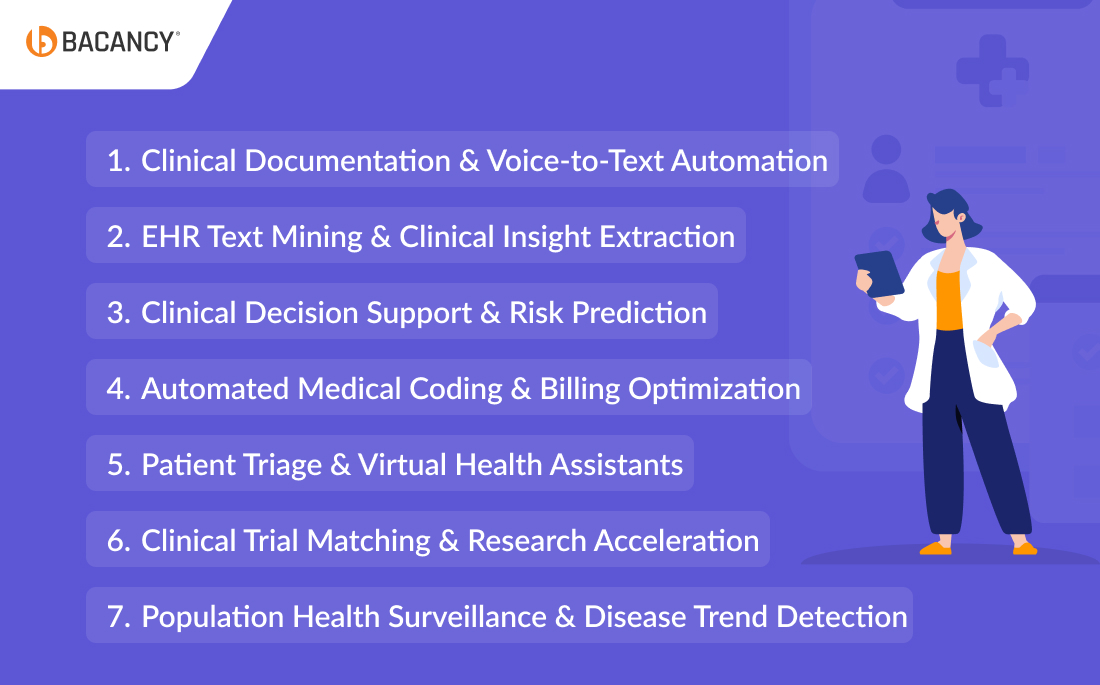
1. Clinical Documentation & Voice‑to‑Text Automation
Clinical documentation can take up to 35-50% of a physician’s day. And it’s not just about typing notes. It involves structured data entry, ICD mapping, and compliance validation inside EHR systems.
Doctors are always moving between different screens, typing in codes by hand, and tweaking their notes to meet billing and compliance requirements. It’s repetitive work, and it takes up a lot of time.
After a while, all that back and forth adds up. Charts get closed late, small details slip through, and documentation can start to feel inconsistent.
How Does NLP Improve This?
Modern NLP in healthcare solves these challenges by automatically turning doctor notes into structured data. This is one of the most practical NLP in healthcare use cases, where free-text notes are transformed into actionable clinical information.
- Speech Recognition
- Named Entity Recognition(NER)
- Contextual entity linking
- ICD-10 auto-mapping
- Real-time structured summarization
Instead of generating raw transcripts, these systems fetch structured clinical concepts that are directly integrated into EHR workflows.
For example:
- “Type 2 diabetes” is automatically mapped to the correct ICD code
- Medications are captured with dosage and frequency
- Symptoms are placed into structured EHR fields
- Missing documentation elements are flagged instantly
Real-Life Case Study
A good example is Dragon Medical One by Nuance Communications (now part of Microsoft). It’s widely used across hospitals in the U.S.It was adopted by Piedmont Healthcare to improve clinical documentation workflows. (source)
The problem:
Physicians at Piedmont were spending too much time finishing charts after clinic hours. Documentation was spilling into evenings, reducing personal time and increasing fatigue.
Solution:
They integrated Dragon Medical One directly into their EHR. The platform used speech recognition and medical NLP to:
- Convert spoken notes into structured documentation
- Automatically detect diagnoses and apply ICD-10 codes
- Capture medications with the right details
- Standardize how clinical notes are formatted
The result:
- 45–60 minutes saved per clinician each day
- More complete and consistent notes
- Less after-hours charting
- More time focused on patients instead of paperwork
Electronic Health Records store huge amounts of patient information. But a larger part of that information lives inside free text notes.
Physicians document detailed narratives during every encounter. Progress notes, discharge summaries, specialists’ consults, and follow-ups often contain critical clinical insights.
The issue is not missing data. But the issue is that most analytics systems only read structured fields. So, while sections capture diagnosis and lab values. Many important details remain buried inside paragraphs.
This creates several operational problems:
- Risk factors are mentioned but not coded
- Comorbidities are documented but not captured for risk adjustment
- Symptoms showing progression may not trigger alerts
- Social determinants of health stay invisible in reporting
- Quality reporting misses relevant clinical nuance
To extract this information manually, organizations rely on chart review teams. That process is slow, expensive, and not scalable.
How Does NLP Improve This?
NLP based EHR text mining systems are designed to read clinical language the way humans do.
They combine multiple capabilities:
- Named Entity Recognition to identify diagnoses, symptoms, medications, and procedures
- Clinical vocabulary mapping to standard codes such as ICD 10 or SNOMED
- Negation detection to understand phrases like “no signs of infection”
- Temporal analysis to identify whether a condition is current or historical
- Context understanding to assess severity and progression
Instead of generating a transcript, the system extracts structured clinical concepts.
If a physician writes, “Patient reports increasing fatigue and shortness of breath. History of congestive heart failure. No chest pain.”
The NLP engine can:
- Detect fatigue and shortness of breath as active symptoms
- Identify congestive heart failure as a chronic condition
- Recognize that chest pain is negated
- Map relevant diagnoses to standardized coding systems
All of this happens in the background. The physician documents as usual. The system converts narrative text into structured, analyzable data.
Real-Life Case Study
A strong example comes from Mayo Clinic, which applied clinical NLP systems to extract cardiovascular risk factors from unstructured EHR notes. (Source)
The problem:
Many important risk indicators, such as smoking status, hypertension, and hyperlipidemia, were documented in physician notes but were not consistently captured in structured EHR fields. This created gaps in research datasets and risk assessment models. Structured data alone did not provide a complete patient profile.
Solution:
Mayo Clinic researchers developed NLP algorithms to analyze free-text clinical notes. The system was designed to:
- Identify cardiovascular risk factors in narrative documentation
- Distinguish between active and historical conditions
- Detect negated statements
- Map extracted findings to standardized clinical concepts
The models processed large volumes of notes and converted unstructured text into structured data for analysis. Physicians did not need to change how they documented.
The result:
- Improved detection of cardiovascular risk factors
- More complete patient records
- Better identification of high-risk patients
- Reduced need for manual chart review
3. Clinical Decision Support & Risk Flagging
Hospitals generate huge amounts of clinical data every single day, but spotting high risk patients in real time is still tough.
Conditions like sepsis, risk of readmission, or sudden health deterioration develop after a certain period of time. Often, early warning signs may show up in a doctor’s notes before they show up clearly in lab results or any other structured data.
The problem is that traditional clinical decision support systems mainly depend on structured inputs such as vitals, lab values, and coded diagnoses.
They do not pick up on early warning signs that are documented in narrative form.
This creates several operational risks:
- Delayed detection of sepsis
- Missed early deterioration signals
- Higher readmission rates
- Increased ICU transfers
- Greater mortality risk
How Does NLP Improve This?
One of the most valuable NLP in healthcare use cases is analyzing both structured and unstructured data to help clinicians detect early warning signs and make faster, informed decisions.
These systems combine:
- Named Entity Recognition to detect symptoms, diagnoses, and clinical findings
- Negation detection to distinguish “no infection” from “possible infection”
- Temporal modeling to track symptom progression over time
- Risk scoring algorithms trained on historical patient outcomes
- Real time alert generation integrated into EHR workflows
Instead of waiting for lab thresholds to be crossed, NLP systems identify patterns in clinical language that indicate risk escalation.
For example, if a physician documents: “Patient increasingly lethargic. Rising respiratory rate. Concern for possible infection.”
An NLP-enabled system can:
- Detect worsening symptoms
- Recognize infection-related terminology
- Compare findings against sepsis risk models
- Trigger early alerts before full clinical deterioration occurs
The clinician continues documenting normally. The system continuously evaluates risk in the background.
Real-Life Case Study
A well-documented example comes from Mayo Clinic researchers who developed and validated NLP-based algorithms to improve early detection of sepsis using unstructured EHR notes.
The problem:
Traditional sepsis checks usually focus on things you can measure easily, like lab results or vital signs, to see if someone might have sepsis. However, early warning signs were often documented in clinical notes before meeting structured alert criteria. This was a delayed intervention.
Solution:
Mayo Clinic investigators developed NLP algorithms capable of:
- Extracting infection related symptoms from free-text clinical notes
- Identifying clinician concern phrases
- Detecting early documentation of organ dysfunction
- Combining extracted signals with structured EHR data
The models were evaluated using large retrospective patient datasets and compared against standard rule based sepsis detection systems.
The result:
- Earlier identification of patients at risk of sepsis
- Improved sensitivity compared to structured-only detection systems
- Potential reduction in delayed treatment
- Demonstrated feasibility of integrating NLP into clinical decision support
4. Automated Medical Coding & Billing Accuracy
Every time a patient is diagnosed or treated, all those details, the condition, the procedure, the services provided, have to be converted into standard codes like ICD-10 and CPT before the hospital can send the bill to the insurance company.
The challenge is that most of the clinical details required for accurate coding are in physician notes. Coders must manually read charts, interpret documentation, and assign the right codes.
This creates several operational issues, like :
- High coding turnaround time
- Risk of undercoding or overcoding
- Denied or delayed claims
- Compliance exposure
- Heavy dependence on manual review
Even small documentation gaps can affect reimbursement and audit outcomes. As patient volumes increase, maintaining coding accuracy becomes more complex.
How Does NLP Improve This?
Modern Computer-Assisted Coding (CAC) systems use clinical NLP to analyze documentation automatically.
These systems combine:
- Named Entity Recognition (NER) to detect diagnoses, procedures, and clinical findings
- Clinical terminology mapping to ICD-10-CM, CPT, and HCPCS codes
- Context detection to differentiate active vs historical conditions
- Negation detection to avoid coding ruled-out diagnoses
- Documentation gap identification to flag missing specificity
Instead of replacing human coders, NLP assists them.
For example, if a physician documents: “Acute on chronic systolic heart failure with pulmonary edema.”
An NLP-powered CAC system can:
- Identify “acute on chronic” as having higher specificity
- Recognize systolic heart failure subtype
- Map to the correct ICD-10-CM code
- Flag if the severity documentation is incomplete
- Suggest appropriate related procedure codes if applicable
The coder reviews suggested codes instead of starting from scratch. The result is faster coding workflows, improved accuracy, lower denial rates, and better compliance alignment.
Real-Life Case Study
A documented example comes from 3M Health Information Systems and its implementation of the 3M 360 Encompass™ System at a U.S.-based pediatric health system. (source)
The problem:
- The pediatric health system was facing:
- Manual, spreadsheet-based coding workflows
- Increasing coding complexity due to regulatory changes
- High administrative burden on coders
- Delays in coding turnaround
- Limited scalability as the documentation volume increased
Coders were spending significant time manually reviewing charts and navigating multiple systems to assign accurate codes.
Solution:
The organization deployed the 3M 360 Encompass™ Computer-Assisted Coding (CAC) platform, which uses Natural Language Processing (NLP) to:
- Analyze unstructured physician documentation
- Extract clinical concepts automatically
- Suggest ICD-10-CM and procedure codes
- Prioritize coding queues
- Integrate directly into existing EHR workflows
The NLP engine assisted coders by pre-identifying relevant diagnoses and procedures rather than requiring a full manual chart review.
The Result:
According to the official 3M case study, the implementation led to:
- Improved coder productivity
- Reduced manual steps in coding workflows
- More streamlined coding processes
- Better scalability for increasing documentation volume
- Enhanced coding consistency
The system allowed coders to focus on validation rather than full chart abstraction, improving operational efficiency.
Leverage advanced NLP use cases in healthcare to unlock insights and improve patient care.
Hire NLP developers from Bacancy to build smart solutions that streamline workflows and reduce risks.
5. Patient Triage & Virtual Health Assistants
Hospitals receive thousands of patient inquiries every day. Appointment requests. Symptom questions. Medication clarifications. Insurance queries. Pre-visit instructions. Post-discharge concerns.
Most of these interactions do not require a physician. But they still consume call center time, nursing bandwidth, and administrative resources.
The problem is not just volume. It is response speed, consistency, and triage accuracy.
When inquiries are handled manually:
- Call wait times increase
- Staff burnout rises
- Non-urgent cases compete with urgent ones
- Patients receive delayed guidance
- Escalations are sometimes missed
In high-volume pediatric or specialty hospitals, this becomes operationally unsustainable.
How Does NLP Improve This?
Modern virtual health assistants use advanced NLP to understand patient language in real time.
These systems combine:
- Intent detection to understand what the patient is asking
- Named Entity Recognition (NER) to extract symptoms, medications, or appointment details
- Context tracking to maintain multi-turn conversations
- Clinical knowledge integration to guide symptom triage
- Escalation logic to transfer complex cases to human staff
- Sentiment analysis to detect urgency or distress
Instead of relying on keyword matching, NLP systems interpret meaning.
For example, if a parent types: “My child has had a fever since last night and is now vomiting. Should I bring her in?”
An NLP-enabled triage assistant can:
- Identify fever and vomiting as active symptoms
- Detect duration from “since last night”
- Assess urgency based on pediatric triage rules
- Provide immediate guidance
- Escalate to a nurse if red-flag symptoms appear
The patient receives guidance within seconds. Staff are only involved when medically necessary.
The system operates continuously 24/7 without increasing administrative headcount.
Real-Life Case Study
A documented example comes from Boston Children’s Hospital, which implemented an AI-powered chatbot solution (reported by Aloa). (Source)
The problem:
Boston Children’s Hospital receives a very high volume of patient and parent inquiries across departments.
Common issues included:
- Overloaded call centers
- Long response times
- Repetitive administrative questions
- High operational cost for routine support
Many of these inquiries were informational rather than clinical emergencies.
Solution:
The hospital deployed an AI-driven virtual assistant powered by Natural Language Processing.
The system was designed to:
- Answer frequently asked medical and administrative questions
- Guide parents through symptom triage flows
- Assist with appointment scheduling
- Route complex cases to appropriate departments
- Operate across web and digital channels
The chatbot was trained on clinical knowledge bases and institutional workflows, allowing it to respond accurately while maintaining patient safety boundaries.
The Result:
According to the study:
- Inquiries were resolved automatically without human intervention
- The call center workload was significantly reduced
- Patient response time improved
- Staff were freed to handle higher-complexity cases
The deployment demonstrated that NLP-based virtual assistants can handle a majority of routine patient communication safely and efficiently, while improving access to care.
6. Clinical Trial Matching
Clinical trials help improve medical care. But finding the right patients for these trials is still difficult.
Hospitals treat many patients every day who could qualify. The challenge is that trial eligibility rules are often detailed and complicated. They include specific inclusion and exclusion criteria such as:
- Exact stage of the disease
- Presence of certain biomarkers
- Specific lab result limits
- Previous treatments received
- Other existing health conditions
- Age and basic demographic details
Most of this information lives inside unstructured physician notes, pathology reports, radiology summaries, and discharge documentation.
This creates several operational challenges:
- Low trial enrollment rates
- Missed eligible patients
- Delayed recruitment timelines
- High research coordination cost
- Underrepresentation of diverse populations
Many trials fail to meet enrollment targets on time. Some are extended. Others are terminated early.
As trial complexity increases, manual screening becomes unsustainable.
How Does NLP Improve This?
Clinical NLP systems help match patients to trials automatically by reviewing both eligibility rules and patient records at scale.
These systems combine:
- Named Entity Recognition (NER) to pull out key details like diagnoses, biomarkers, treatments, and lab results
- Ontology mapping to connect medical terms with standard clinical vocabularies
- Negation detection to avoid false positives (e.g., “no prior chemotherapy”)
- Temporal modeling to evaluate treatment timelines
- Eligibility rule parsing to convert trial criteria into machine-readable logic
Instead of manually reading charts, NLP engines continuously scan EHR data.
For example, if a trial requires:
- Stage II or III non-small cell lung cancer
- EGFR mutation positive
- No prior immunotherapy
An NLP-enabled system can:
- Detect cancer staging from pathology notes
- Identify EGFR mutation status from molecular reports
- Confirm absence of prior immunotherapy
- Automatically flag eligible patients
- Notify research coordinators
Real-Life Case Study
A well-known example comes from Flatiron Health, a company that focuses on cancer data and analytics. (Source)
The Problem
Oncology trials often face delays because the eligibility rules are very detailed and often change.
At cancer centers, coordinators usually review patient records manually. This takes a lot of time. Many eligible patients are missed because important details are hidden inside doctors’ notes or pathology reports.
These delays slow down research and increase overall costs.
Solution:
- Flatiron Health developed NLP-based systems that can:
- Pull out tumor stage details from doctors’ oncology notes
- Find genomic biomarkers in pathology reports
- Match patient history with trial eligibility rules
- Continuously scan EHR data to spot possible trial candidates
The system transformed unstructured oncology documentation into structured, research-ready data.
The Result:
According to published case materials and industry reporting:
- Oncology trial enrollment improved by approximately 20%
- Screening time per patient decreased significantly
- Research coordinators focused on validation instead of full manual chart abstraction
- Recruitment timelines became more predictable
The deployment demonstrated how NLP can operationalize real-world data for precision medicine and accelerate clinical research.
7. Population Health Surveillance & Trend Detection
Hospitals, health systems, and public health agencies continuously monitor population level data to detect emerging health threats, track disease progression, and identify abnormal patterns.
Traditional surveillance systems rely heavily on:
- International Classification of Diseases (ICD) coded diagnoses
- Laboratory test confirmations
- Insurance and claims data
- Public health reporting systems
But here’s the challenge. Early disease signals often appear first in unstructured physician notes, not in structured fields.
A clinician may document: “Patient reports new onset dry cough and loss of smell.”
But until a lab result confirms infection or a diagnosis code is assigned, structured dashboards may not reflect this case.
This creates several operational challenges, such as:
- Delayed outbreak detection
- Underreported symptom prevalence
- Incomplete epidemiological datasets
- Slower response to emerging diseases
- Missed early-warning clusters
- Limited visibility into real world symptom patterns
In fast-moving health situations, waiting for official coded data can be too slow. Manually reviewing hundreds of thousands of patient charts just isn’t practical.
How Does NLP Improve This?
Clinical NLP enhances surveillance by extracting symptom and condition signals directly from free-text clinical documentation at scale, demonstrating one of the most practical NLP use cases in healthcare.
These systems combine:
- Named Entity Recognition (NER) to detect symptoms and diagnoses
- Negation detection to differentiate “no fever” from “has fever”
- Temporal modeling to determine symptom onset timing
- Map terms to standard medical codes like ICD and SNOMED
- Combine data across the population to spot unusual trends
Instead of looking only at coded diagnoses, NLP systems can read notes and stories written by clinicians across the health system.
For example, if several doctors start writing: “Increasing shortness of breath and persistent cough over the past 48 hours”, an NLP-based monitoring system can:
- Detect respiratory symptoms
- Identify symptom onset timeline
- Aggregate cases across facilities
- Compare symptom frequency against historical baselines
- Flag abnormal increases in real time
The clinician documents normally. The surveillance engine works in the background.
Real-Life Case Study
A documented example comes from researchers at Kaiser Permanente Southern California, who applied NLP to improve COVID-19 symptom surveillance using electronic health records.
The study is publicly available via PubMed Central and analyzed large-scale EHR data during the COVID-19 pandemic. (Source)
The Problem
During COVID-19, many patients were classified as “asymptomatic” based only on structured diagnosis codes and test results.
However, clinicians frequently documented symptoms in narrative notes that were not reflected in structured fields.
This resulted in:
- Underestimation of symptomatic cases
- Inaccurate symptom prevalence reporting
- Delayed understanding of symptom onset timing
- Incomplete population-level tracking
Solution:
Researchers developed and validated an NLP algorithm capable of:
- Extracting 12 established COVID-19 symptoms from free-text clinical notes
- Detecting negated symptom mentions
- Identifying symptom onset dates
- Processing records from more than 350,000 tested patients
- Comparing NLP-derived findings with structured EHR data
The algorithm analyzed documentation within 30 days before and after SARS-CoV-2 testing.
Physicians did not modify documentation behavior. The NLP model operated retrospectively and at scale.
The Result:
The study demonstrated:
- NLP identified approximately 15% additional symptomatic cases that structured data alone had labeled as asymptomatic
- Symptom onset was detected earlier compared to structured records only
- High agreement with manual chart review validation
- Improved completeness of epidemiological datasets
The findings showed that NLP-enhanced surveillance provides earlier and more accurate disease tracking during large-scale public health events.
How Can We Help You At Bacancy?
Bacancy assists healthcare institutions in using real-world NLP use cases in healthcare to extract valuable information from unstructured data. We offer NLP development services where we help you:
– Extract structured clinical information from EHR notes to make it more usable.
– Optimize clinical documentation with automated speech-to-text and entity recognition for faster and accurate documentation.
– Assist in drug safety surveillance by identifying side effects and improving post-market surveillance.
– Speed up research by finding new drug targets, connections, and trends.
Learn more about how we can help you unlock the full potential of your healthcare data today.
Frequently Asked Questions (FAQs)
Clinical Documentation & EHR Accuracy
Yes! One of the key NLP in healthcare use cases is reading doctors’ notes and other free-text records, then converting them into structured data automatically. It helps catch details that might be missed, like symptoms, medications, or comorbidities. This reduces errors, makes records more complete, and saves time for healthcare staff.
NLP-powered systems can turn spoken notes into structured text, automatically map ICD-10 codes, flag missing information, and summarize key details. This means doctors spend less time typing and more time with patients.
Not really. NLP systems work in the background and understand natural language. Doctors can continue documenting as usual, and the system structures the information automatically.
Clinical Decision Support & Risk Detection
Absolutely. NLP can read unstructured notes and spot early warning signs that might not appear in lab results or vital signs. For example, it can alert clinicians to potential sepsis, deterioration, or readmission risk before it becomes critical.
NLP combines symptom detection, temporal analysis, and risk scoring. It continuously analyzes patient notes and data, providing real-time alerts so clinicians can act faster and make better-informed decisions.
Medical Coding & Billing
Yes! One important NLP in healthcare use cases is automatically detecting diagnoses, procedures, and medications from free-text notes and suggesting the correct ICD-10 or CPT codes. This reduces manual errors, speeds up billing, and minimizes claim denials.
No. NLP assists coders by pre-identifying relevant codes. Coders review and validate suggestions, so they can work faster and focus on complex cases rather than reading every chart manually.
Patient Interaction & Virtual Assistants
Definitely. NLP-powered chatbots and virtual assistants can answer routine questions, guide symptom triage, schedule appointments, and escalate urgent issues. This reduces call center workload and speeds up response times.
Yes, when properly trained. NLP systems are designed to understand patient language, recognize symptoms, and follow clinical guidelines. They escalate complex cases to human staff when needed.
Patient Feedback & Sentiment Analysis
One of the key NLP use cases in healthcare is analyzing patient feedback. NLP can read thousands of comments from surveys, social media, or call logs. It detects positive or negative sentiment, identifies recurring issues, and flags urgent complaints so hospitals can respond faster.
Yes. By quickly identifying problems like long wait times, poor communication, or billing issues, hospitals can fix issues sooner and improve overall patient experience.
Research & Clinical Trials
Absolutely. NLP can scan unstructured medical records, detect eligibility criteria like disease stage or biomarkers, and automatically identify patients who qualify for trials. This improves enrollment and saves time for research teams.
Yes. NLP can process millions of research articles, extract genes, diseases, and drug relationships, and organize them into structured knowledge. Researchers get insights faster without reading every paper manually.