Quick Summary
This blog uncovers how cloud security audits help your businesses to detect vulnerabilities, empower defenses, and ensure compliance with regulations like GDPR, HIPAA, and PCI-DSS. Discover steps, cloud audit checklists, insights, tools, and frameworks to secure your cloud environment.
Table of Contents
Introduction
In 2025, Allianz Life, a well-known insurance company, revealed that its cloud-based CRM system was compromised in a cyberattack, exposing 1.4 million records of its US customer data.
This is massive and alarming because sensitive customer data, financial records, and critical business information were at risk, and such vulnerabilities are only increasing.
As more businesses migrate workloads to cloud platforms like Amazon Web Services (AWS), Microsoft Azure, and Google Cloud Platform (GCP), the cloud attack surface continues to expand, making proactive security measures essential.
This is where a cloud security audit becomes critical. By providing a structured and proactive assessment, a cloud security audit helps identify vulnerabilities, validate configurations, and ensure compliance with industry regulations. It strengthens your security posture before attackers can exploit any gaps.
In this blog, we will talk about cloud security audits, tools and frameworks used, industry-wise compliance, and its step-by-step process.
What is Cloud Security Audit?
A cloud security audit is an evaluation and review of how secure an organization’s cloud environment is and its setup to identify risks, vulnerabilities, and misconfigurations. It also includes access controls, policies, and processes, usually against recognized compliance standards and security.
Cloud computing security audits systematically test your cloud for SaaS, PaaS, and IaaS and are designed, implemented, and operated effectively to secure your data and services, meeting contractual and regulatory requirements. It assists you in preventing unauthorized access, data breaches, and service interruptions while keeping your environment and following standards like HIPAA, ISO 27001, and PCI-DSS.
Types of Cloud Security Audits
Not just that, there are two ways of cloud security audits: Internal and external cloud security audits.
1. Internal Cloud Security Audit
An internal cloud security audit is performed by your organization’s own IT or security team. It emphasizes evaluating the internal process, policies, and configurations to detect potential weaknesses caused by employee errors, misconfigured settings, or insufficient access controls.
Primary activities in an internal audit include:
- Review user roles, permissions, and access levels.
- Check configurations of cloud services and applications.
- Assess compliance with internal security policies.
Internal audits help your organization understand its cloud security posture from the inside and fix issues before they become serious risks.
2. External Cloud Security Audit
An external cloud security audit is conducted by independent third-party experts. This cloud security audit provides an unbiased assessment of your cloud environment and detects risks that internal teams may overlook.
External audits are especially useful for:
- Evaluate vulnerabilities from external threats and attacks.
- Verify compliance with regulatory standards and industry best practices.
- Provide assurance to stakeholders, customers, and regulators.
Bonus – You can perform an external security audit of your cloud infrastructure efficiently with our free cloud assessment.
Cloud Security Audit Process: Step-by-Step Guide
A cloud security audit is a technical scan. It is a structured review of your entire cloud ecosystem, from architecture and access controls to compliance alignment and recovery readiness. Below is a phase-based breakdown of how organizations typically conduct a cloud security audit.
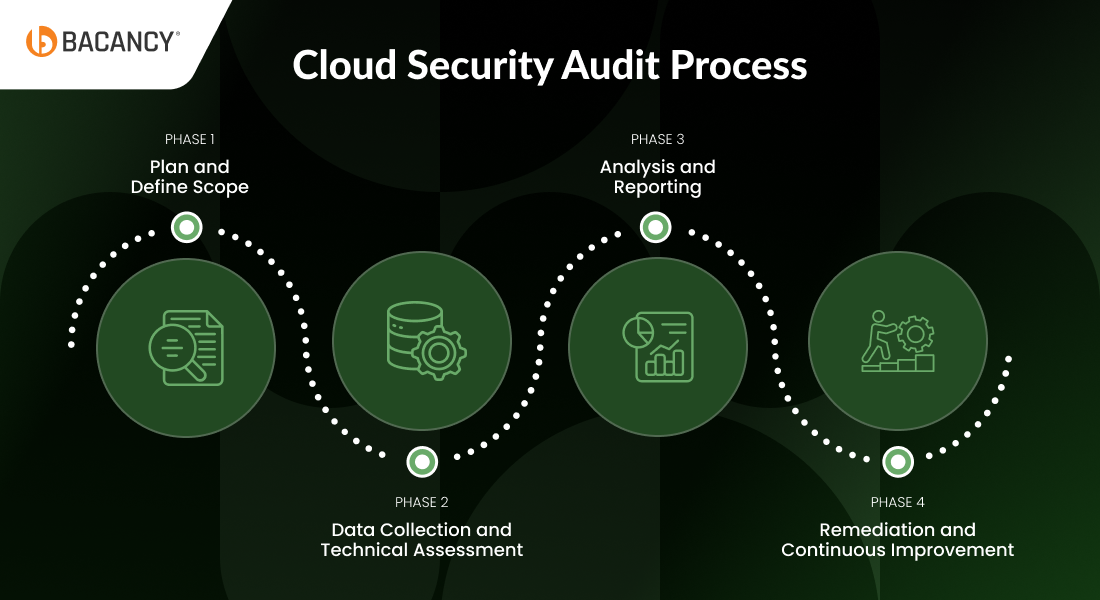
Phase 1: Plan and Define Scope
The first step of the process of cloud security audit is to plan and determine the scope. Organizations often operate complex cloud ecosystems. Therefore, the audit scope should clearly define all infrastructure components, applications, data storage systems, user access controls, network configurations, integrations, and security policies that will be reviewed.
You will also need to determine how compliance requirements will fit into your audit. At this stage, decide which compliance standards apply to your organization and what level of cloud security is necessary, whether it is conducted internally or by a third-party external security team.
Set guidelines for who will perform the audit, and how it will be structured and measured. Various companies prefer internal audits for routine checks, while external auditors provide independent validation for compliance or stakeholder assurance.
Phase 2: Data Collection and Technical Assessment
Once the scope is defined, the next step is to gather and evaluate the technical data across various environments. This stage provides visibility into your cloud security posture. You can review the following areas:
- Audit user roles, permissions, and enforce Multi-Factor Authentication (MFA).
- Verify data encryption, backups, and disaster recovery readiness.
- Check firewalls, VPNs, and network security controls.
- Ensure logging, monitoring, and alerting are in place.
- Assess application security, APIs, and deployment pipelines.
- Confirm provider-level security controls through provider certifications.
- Enforce Cloud Security Posture Management (CSPM) to detect vulnerabilities.
Phase 3: Analysis and Reporting
After collecting your technical data, the focus shifts to analysis. You need to start comparing your current security posture against internal policies and external compliance standards. Then identify what is missing, insufficient, or misconfigured.
Each vulnerability should be categorized based on risk level:
1. Critical
2. High
3. Medium
4. Low
A well-prepared audit report must have:
- Clear description of findings
- Business impact analysis
- Compliance gaps
- Practical remediation recommendations
- A prioritized action plan
The last step in the process to conduct a cloud security audit does not end with reporting, but it focuses on corrective action.
The Remediation actions may include:
- Reconfiguring cloud services
- Tightening access controls
- Enforcing stronger encryption standards
- Enhancing monitoring and alert systems
- Updating backup and recovery procedures
After implementing fixes, validation is essential. So you need to perform follow-up assessments to confirm that vulnerabilities have been resolved properly.
Ensure Every Step of the Cloud Security Audit is Executed Flawlessly
Hire cloud developers to fix vulnerabilities, optimize settings, and keep your cloud secure and compliant.
Cloud Security Audit Checklist to Follow for Security and Compliance
Once the process for cloud security audit is completed, this checklist helps confirm that no critical security or compliance area is overlooked.
1. Proactive Risk Detection
- Identify shadow IT or unauthorized cloud services not in the official inventory
- Check for unused service accounts or idle resources that could be exploited
- Flag overly permissive roles that aren’t obvious in normal audits
2. Configuration Drift & Change Management
- Track configuration changes over time to detect drift from secure baselines
- Ensure automated alerts for critical misconfigurations
- Confirm that emergency changes follow formal approval procedures
3. Multi-Cloud & Hybrid Visibility
- Consolidate security visibility across all cloud platforms (AWS, Azure, GCP, SaaS apps)
- Validate consistent policies across all clouds to prevent gaps
- Check integration points between on-prem and cloud systems
4. Automation & Continuous Auditing
- Implement CSPM or cloud-native automated checks for continuous compliance
- Ensure scheduled scans and alerts don’t miss critical updates
- Use cloud automation tools to generate audit evidence for regulators
5. Incident Preparedness & Testing
- Review insights for cloud security incidents
- Conduct simulated breach or disaster recovery tests
- Ensure logs are actionable for investigations, not just stored
6. Third-Party Risk Management
- Validate the security obligations of cloud vendors and SaaS providers
- Check for hidden data flows or API vulnerabilities
- Require regular security attestations from partners
7. Governance & Documentation
- Maintain up-to-date policies for cloud usage
- Document all audit findings and remediation actions
- Confirm periodic review cycles for policies, controls, and compliance evidence
Cloud Security Audits for Industry-Wise Compliance
Every industry functions under different regulatory pressures. As cloud infrastructure offers flexibility and scalability, it introduces compliance complexity. The cloud security audit helps you ensure your cloud environment meets the specific regulatory expectations that apply to your industry.
Below are the key compliance standards across major industries.
1. GDPR Compliance
For companies that handle personal data of EU residents, General Data Protection Regulation (GDPR) compliance is non-negotiable. In cloud environments, it indicates strong controls around data protection, access management, encryption, and breach notification processes.
A cloud security audit supports GDPR compliance by reviewing:
- Where personal data is stored and processed
- Whether encryption is enforced for sensitive data
- How access to personal information is restricted
- Whether logging and monitoring support breach detection
Cloud security audits also help confirm that data residency requirements and third-party processor agreements are aligned with GDPR standards. Without regular reviews, it becomes difficult to demonstrate accountability, a core GDPR principle.
2. HIPAA Compliance
Healthcare organizations and their partners must protect sensitive patient information under the Health Insurance Portability and Accountability Act (HIPAA) regulations. When protected health information (PHI) is stored or processed in the cloud, strict safeguards must be in place.
Cloud security auditing benefits healthcare organizations by ensuring:
- Access to PHI is tightly controlled and monitored
- Data is encrypted both at rest and in transit
- Audit logs are properly maintained
- Backup and disaster recovery plans protect patient data
Security audits verify that Business Associate Agreements (BAAs) with cloud providers are in place and that the security controls align with HIPAA’s administrative, physical, and technical safeguards.
3. PCI-DSS Compliance
You can process or store payment card information that must comply with PCI-DSS standards. In cloud environments, responsibility is shared between the organization and the cloud provider, which can sometimes create confusion.
A cloud security audit clarifies this shared responsibility model and evaluates:
- Network segmentation to isolate cardholder data
- Strong access controls and authentication mechanisms
- Secure configuration of payment processing systems
- Continuous monitoring and vulnerability management
By regularly auditing cloud infrastructure, your organization reduces the risk of payment data exposure and maintains readiness for formal PCI assessments.
Keep Your Cloud Infrastructure Compliant Across Every Industry
Rely on our cloud managed services to implement audit recommendations, maintain secure access controls, and stay compliant in every industry.
Cloud Security Audit Tools and Frameworks to Use
A cloud security audit is not required to be conducted manually from start to finish. While human expertise is critical for analysis and interpretation, specialized tools and established frameworks help structure the process, automate detection, and ensure alignment with industry standards.
Below are the most commonly used tools and compliance frameworks in modern cloud security audits.
Here are the key types of tools you can use for cloud security auditing.
1. Security Information and Event Management (SIEM) Tools
SIEM tools like Splunk, Microsoft Sentinel, and IBM QRadar play an important role in cloud audits because they centralize logs and security events from across your infrastructure.
During an audit, SIEM platforms help you:
- Aggregate logs from cloud services, applications, and endpoints
- Detect suspicious activity patterns
- Identify unauthorized access attempts
- Analyze incident response effectiveness
Auditors review SIEM configurations to confirm logs are properly collected, retained, and monitored. If logging gaps exist, incident detection may be delayed, increasing compliance and security risks.
2. Vulnerability Scanners
Vulnerability scanning tools like Rapid7 InsightVM, Prisma Cloud, and container-focused scanners such as Trivy automate the detection of known weaknesses in cloud workloads, virtual machines, containers, and applications.
In a cloud security audit, these tools help identify:
- Unpatched operating systems
- Outdated software versions
- Misconfigured services
- Exposed ports and endpoints
Regular scanning is especially important for compliance standards that require documented vulnerability management processes. However, automated scans must be reviewed carefully, as false positives are common.
3. Cloud-Native Security Solutions
Cloud providers offer built-in security tools designed specifically for their platforms. These tools improve visibility and streamline audits.
For instance, AWS Security Hub consolidates security findings across AWS accounts and highlights compliance gaps.
Microsoft Defender for Cloud (formerly Azure Security Center) provides security posture management and threat protection for Azure environments.
These solutions monitor configuration drift, enforce security baselines, and flag non-compliant resources in real time. During an audit, they provide a snapshot of the current security posture and historical risk trends.
Frameworks That Guide Cloud Security Audits
Here are the major frameworks that you can follow for cloud security audit.
1. NIST Cybersecurity Framework
The National Institute of Standards and Technology developed the NIST Cybersecurity Framework as a structured approach to managing cybersecurity risk. It organizes security activities into five core functions: Identify, Protect, Detect, Respond, and Recover.
In practice, auditors often map cloud controls to these categories to assess overall maturity. For instance, weak identity controls affect the Protect function, while insufficient monitoring impacts detection. This structure helps leadership understand gaps beyond isolated technical findings.
2. ISO/IEC 27001
ISO/IEC 27001 focuses on building and maintaining an Information Security Management System.
When applied to cloud audits, ISO 27001 shifts attention from individual vulnerabilities to cloud governance. It evaluates whether risk assessments are conducted regularly, whether access reviews are documented, and whether incident response procedures are tested.
Organizations seeking certification often conduct internal cloud security audits to ensure controls are consistently applied before formal external assessments.
3. SOC 2
SOC 2 is widely used among SaaS and cloud service providers. It evaluates controls across five trust service criteria: security, availability, processing integrity, confidentiality, and privacy.
Cloud security audits frequently serve as preparation for SOC 2 examinations. Rather than scrambling before an official review, organizations use internal audits to identify gaps early and strengthen documentation.
Real-World Case Study: Cloud Security Audit in Action
Over the years at Bacancy, we have conducted cloud security audits for startups, enterprises, and regulated organizations. One pattern we consistently see is this: the cloud environment appears stable on the surface, but governance gaps quietly grow beneath the surface.
One of our recent engagements involved a rapidly scaling eCommerce technology company operating across Microsoft Azure with several customer-facing services integrated through third-party APIs. The company was preparing to expand into enterprise markets, where compliance and security assurance were mandatory.
They needed to know whether their cloud environment could withstand scrutiny from regulators, enterprise clients, and security auditors.
The Initial Assessment
When our cloud security services team began the cloud security audit, we focused on understanding how their environment had evolved.
What we found was common in high-growth organizations:
- Access permissions granted during early development were never re-evaluated
- Production and staging environments were not fully segmented
- Encryption policies were defined, but inconsistently enforced
- Monitoring tools existed, but were not centrally managed
- No documented process for periodic access review
Technically, the cloud environment functioned. Strategically, it carried an avoidable security risk.
Our Strategy
Based on our experience, an effective cloud security audit must go beyond mere vulnerability identification. It must strengthen operational discipline. We structured our engagement around three objectives:
1. Reduce Exposure
We tightened role-based access controls, removed unnecessary administrative privileges, and enforced least-privilege policies across all critical workloads.
We also eliminated open network rules that had been temporarily enabled for testing but never disabled.
2. Standardize Controls
Our team unified encryption standards across storage services and enforced consistent key management practices. Logging and monitoring were centralized to ensure suspicious activity could be detected quickly.
We implemented automated alerts tied to high-risk actions such as privilege escalation or public resource exposure.
3. Align with Compliance Expectations
Because the company intended to work with enterprise clients, we mapped their security controls against SOC 2 trust service criteria.
Instead of treating compliance as a future event, we embedded governance mechanisms into daily operations. Access reviews, incident response testing, and change tracking became structured processes rather than informal practices.
The Results
By the end of the engagement, the organization had:
- Reduced privileged accounts by nearly 50 percent
- Segmented production workloads effectively
- Enforced encryption across all sensitive storage services
- Centralized logging and improved alert responsiveness
- Established documented security governance processes
Our CTO’s Take
From our perspective at Bacancy, cloud security audits are not about proving something is broken. They are about validating that controls scale as fast as innovation does.
Secure Cloud Security Audit With Bacancy
Cloud security audits require more than a one-time effort. As your infrastructure, users, and business goals evolve, your security strategy must evolve with them. A well-executed cloud security audit gives you the visibility needed to stay ahead of threats and regulatory requirements while maintaining operational stability.
With Bacancy as your technology partner, you gain more than just an assessment report. You gain clear insights and practical direction. Through our cloud consulting services, we focus on remediation, stronger governance, and continuous improvement. We help you turn audit findings into measurable security enhancements that protect your data and build long-term trust with your customers.
Frequently Asked Questions (FAQs)
Fundamentals
A cloud security audit is a structured assessment of your cloud infrastructure, policies, and controls to identify security risks, compliance gaps, and misconfigurations. It evaluates how well your cloud environment protects data, applications, and user access.
A cloud security audit helps prevent data breaches, regulatory penalties, and downtime. It ensures your cloud setup follows security best practices and compliance standards such as ISO, SOC 2, HIPAA, or GDPR.
Organizations should conduct a cloud security audit at least once a year. However, high-risk industries or rapidly scaling businesses may require quarterly or continuous security assessments.
A cloud security audit is typically conducted by internal security teams, third-party cybersecurity firms, or certified cloud security professionals with expertise in compliance and risk management.
Process and Execution
A cloud security audit typically includes:
Scope definition,
Risk assessment, Access control review, Configuration analysis, Vulnerability scanning, Compliance verification, and Reporting & remediation planning.
The duration depends on the size and complexity of the cloud environment. Small environments may take 1-2 weeks, while enterprise-scale audits can take several weeks.
Common tools include vulnerability scanners, configuration management tools, SIEM systems, and cloud-native tools such as AWS Security Hub, Azure Security Center, or Google Cloud Security Command Center.
After the audit, organizations receive a detailed report outlining risks, compliance gaps, and recommended remediation steps. The next phase focuses on fixing vulnerabilities and strengthening security controls.
Security and Compliance
Yes. A cloud security audit ensures your infrastructure aligns with regulatory requirements such as HIPAA, GDPR, PCI-DSS, SOC 2, and ISO 27001.
A cloud security audit identifies risks such as misconfigured storage, weak access controls, exposed APIs, unencrypted data, insecure IAM policies, and outdated security patches.
Cost and Benefits
The cost depends on the cloud provider, infrastructure size, regulatory requirements, and audit depth. Basic audits may cost a few thousand dollars, while enterprise-level audits can be significantly higher.
The key benefits of a cloud security audit include improved risk visibility, stronger compliance posture, reduced chances of data breaches, better access control management, and enhanced incident response readiness.