Quick Summary
Monolithic and microservices architectures are two popular approaches to building modern software applications. Both approaches offer distinct ways to design, scale, and maintain software systems. This blog is your guide to compare Monolithic vs Microservices architecture, their use cases, pros and cons, and best practices. We will also explore when to choose microservices and when to select monolithic architecture based on your organizational needs and goals.
Table of Contents
Introduction
When you want to develop powerful, scalable software, one of the very first and most critical decisions you will have to make is to choose the right development architecture. Every software product starts with a vision, but it’s the architecture that determines how fast you can get a product to the market, how securely it can scale, and how sustainably it can operate within your budget over time.
The ultimate strategic choice between a Monolithic vs Microservices architecture isn’t about which one is greater and adopted more among enterprises. But, it’s more like a strategic bet on which approach best aligns with your organization’s business goals, growth trajectory, and team capabilities.
Take Netflix, for example: after a crippling database failure in 2008, the company re-architected its platform into a microservices-based system to get extensive reliability and scalability that powered its global dominance. The contrary example is Amazon Prime Video which shifted parts of its monitoring system from microservices to monolithic back, only after finding that distributed services became unnecessarily complex and costly at scale.
All in all, selecting between microservices architecture and monolithic architecture is not a matter of trend but a tactical choice based on your growth trajectory, technical capabilities, and long-term objectives. That said, let’s begin this decision framework guide to help you choose the right architecture to grow, scale, and future-proof your software systems.
Monolithic Architecture vs Microservices Architecture - At a Glance Comparison
| Aspect | Monolithic Architecture
| Microservices Architecture
|
|---|
| Structure
| Single codebase with all components tightly integrated
| Distributed services, each running independently
|
| Development Speed
| Faster initial development, ideal for MVPs and small teams
| Slower setup but faster iterative updates for individual services
|
| Scalability
| Scaling requires duplicating the entire application
| Scale individual services independently based on demand
|
| Maintenance
| Easier for small apps, harder as the system grows
| Easier to maintain and deploy small updates without impacting the full system
|
| Deployment
| Single deployment pipeline, simple to manage
| Multiple deployments and orchestration tools like Kubernetes are required
|
| Team Requirements
| Best for smaller, lean teams to manage effectively
| Requires specialized skills in distributed systems, but can be aligned with cross-functional teams
|
| Fault Isolation
| Failures can affect the entire application
| Failures are contained to individual services, reducing system-wide risk
|
| Cost Considerations
| Lower initial cost, higher long-term cost with growth
| Higher initial cost, but cost-efficient for scaling and resource allocation
|
| Ideal For
| Small apps, MVPs, and companies with limited resources
| Large-scale apps, high-growth startups, and systems requiring frequent updates
|
What is Monolithic Architecture?
Monolith or monolithic architecture is not something you can consider “outdated” or “simpler by default”. Rather, consider it as a software development approach where all features are tightly integrated into a unified codebase and deployed as a single unit.
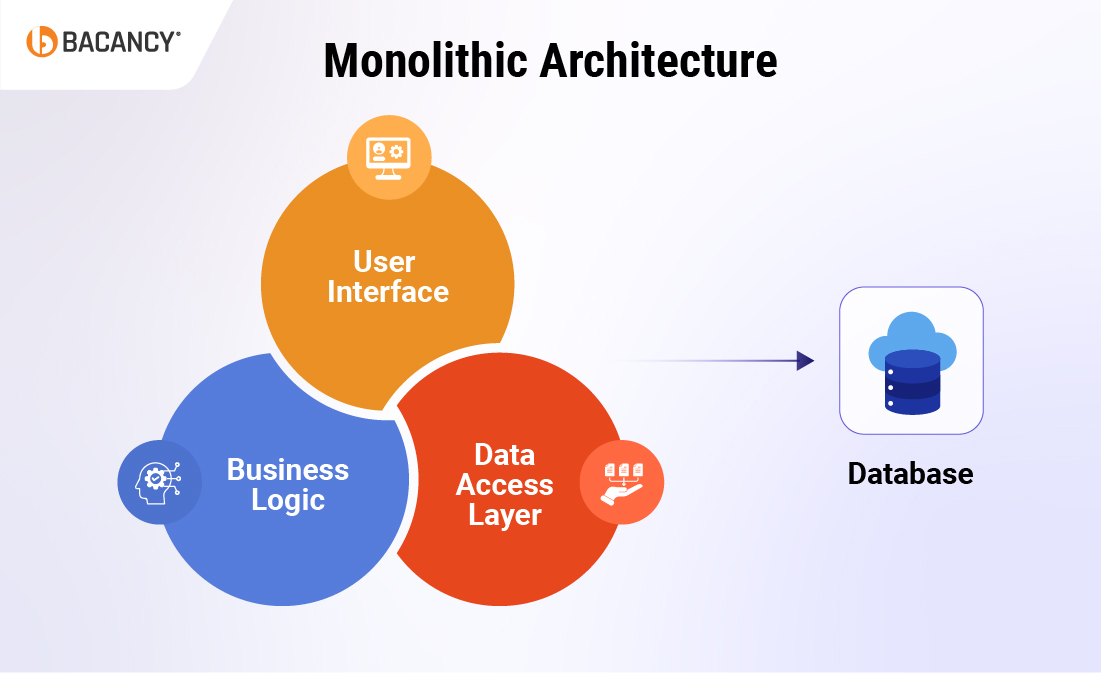
The strength of the monolith lies in its speed to market, lower operational overhead, and tighter governance. When all modules live in one deployable artifact, your development teams can move quickly, release new features without coordinating across multiple services, and avoid the operational overhead that microservices demand.
Monolithic systems are particularly powerful for organizations that value rapid delivery, predictability, and resource efficiency over extreme scaling flexibility. Many successful digital products still run on monoliths today, not because they have failed to modernize, but because the model perfectly matches their growth curve and organizational dynamics.
Selecting a monolith application over a microservices architecture makes sense when,
- Delivering features quickly is more important than optimizing for independent scaling.
- Operational simplicity is a priority, and your team doesn’t want to manage the overhead of service orchestration, observability, and distributed systems.
- Budgets are constrained, and you want to minimize infrastructure and DevOps costs until scale justifies the investment.
- Strong transactional consistency and synchronous workflows matter more than distributed resilience.
- Your engineering team size is small or centralized, which makes a unified codebase more effective than service ownership models.
Top Use Cases of Monolithic Architecture - When Speed Matters
Monolithic systems thrive when speed, cohesion, and cost-efficiency outweigh extreme scalability and distributed complexity. Common use cases of monolith architecture include:
Small to Medium-Sized Applications
Monolithic architecture is better suited when you want to build smaller apps with a clear scope. It provides faster development and easier maintenance due to a single codebase, making it ideal for startups and SMEs.
Internal Tools and Dashboards
For internal admin interfaces and dashboards, monolithic architecture simplifies development due to its extensive focus on offering straightforward functionalities and features with minimal complexity.
Legacy System Migration
When migrating legacy systems, opting for a monolithic structure simplifies modernization. It allows gradual updates without overhauling the entire infrastructure, ensuring stability during transitions.
Short Lifecycle Applications
Monolithic design is perfect when it comes to developing prototypes or MVPs, where it requires rapid development and quick feedback collection before committing to a complex microservices architecture.
Compliance-Heavy Applications
Monolithic architecture is ideal for compliance-heavy apps, where regulatory requirements benefit from centralized control and strict transactional consistency. The unified structure simplifies audit trails and reporting, ensuring adherence to regulatory standards.
Monolithic Architecture Best Practices To Avoid Technical Debt
If you choose a monolith, the challenge is not about how to build faster, but rather, it’s how to develop a future-proof app. Forward-thinking leaders must ensure their teams adopt these best practices to avoid technical debt and manage complexity while keeping their application efficient and adaptable as their business grows.
- Modularize Your Codebase:
Organize your application into smaller, well-defined modules to avoid the infamous “big ball of mud” and make your code easier to maintain and scale.
- Use Dependency Injection: Prioritize loose coupling in your system by using dependency injection. This makes testing easier and allows for greater flexibility when upgrading or swapping components.
- Implement Centralized Logging and Monitoring: Keep your system healthy by using centralized logging and monitoring tools. This best practice helps you quickly detect issues and simplifies debugging.
- Adopt CI/CD Pipelines: Streamline your deployment and testing processes with continuous integration and continuous delivery (CI/CD) pipelines, ensuring faster and error-free releases.
- Optimize Your Database Design: Make sure to focus on database performance by utilizing best practices like indexing, query optimization, and sharding to maintain efficiency as your application scales.
What is Microservices Architecture?
Microservices architecture is not just a trend; it’s a deliberate approach where your application is split into diverse, independently deployable services, each responsible for a specific business capability. These loosely coupled services use independent databases and coding for a particular business goal.
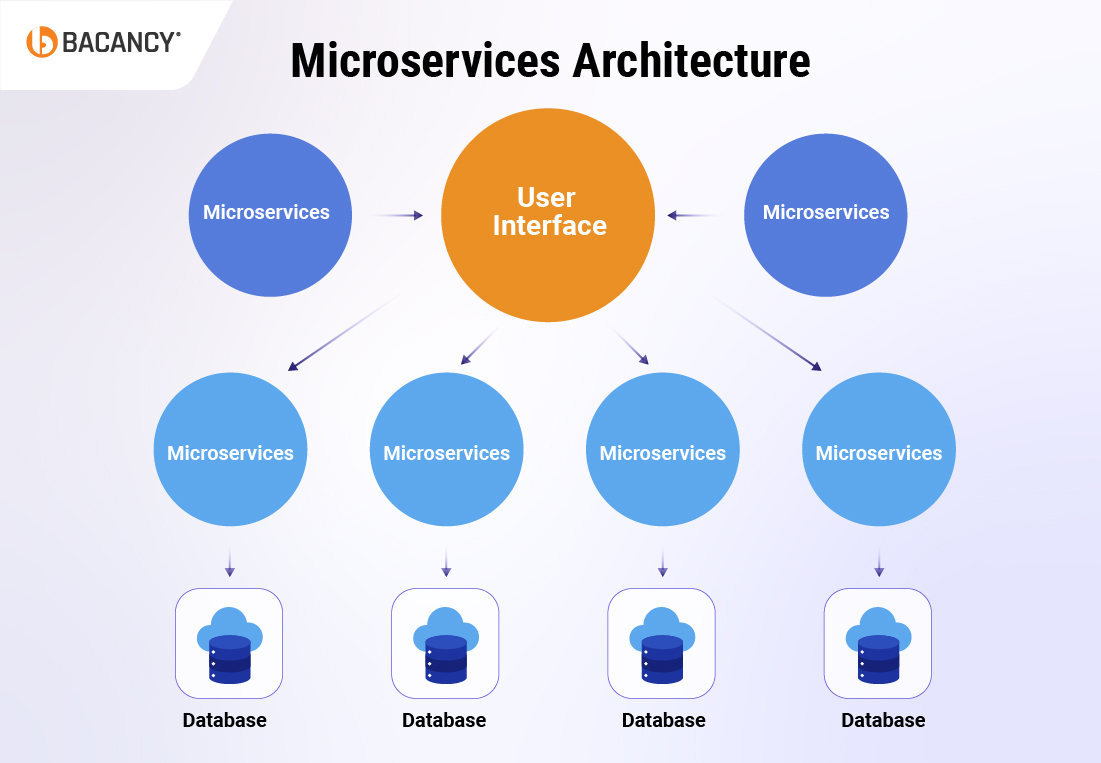
Unlike monolith applications, the focus of microservices is on emphasizing decentralization, autonomy, and scalability, which allows businesses and their teams to innovate faster without being constrained by a single codebase.
The real strength of microservices lies in their flexibility. Organizations can choose to go with the microservices architecture to scale critical services independently, experiment with different technologies for different components, and isolate failures to prevent system-wide downtime.
For leaders who want to tackle complex, rapidly evolving applications, microservices offer architectural resilience and operational agility that monoliths often struggle to provide.
Selecting microservices over monolithic makes sense when:
- You expect high growth or uneven usage across different modules and want to scale selectively.
- Your team is large, distributed, or structured around autonomous service ownership.
- Rapid innovation and adoption of new technologies are more important than minimizing operational overhead.
- Your application requires high availability and fault isolation, as well as the ability to update services independently.
Top Use Cases of Microservices Architecture - When Scale is Key
Microservices are the go-to choice for scenarios where flexibility, scalability, and independent evolution of components are paramount. Here are some common use cases of microservices architecture:
Large-scale digital platforms
E-commerce, SaaS, or streaming services with diverse features benefit from the ability to scale each service independently. Best examples are companies like Amazon or eBay who utilize microservices architecture to handle high-volume transactions and enable independent scaling.
High-traffic applications
For businesses with fluctuating or high traffic volumes, such as e-commerce sites or social media platforms, microservices offer the advantage of scaling specific parts of the app based on demand. Systems, where some modules experience spikes more than others, can be scaled horizontally without overprovisioning the entire system.
Continuous Delivery and DevOps Environments
Microservices are a perfect approach for organizations that prioritize continuous integration and continuous delivery (CI/CD). Their modular structure allows for frequent, smaller releases without impacting the entire application, facilitating faster development cycles.
Complex, distributed systems
Applications with multiple business domains or microservices-aligned teams can reduce interdependencies and accelerate feature delivery. With decentralized management, microservices ensure each part of the system can be localized and optimized based on unique needs.
Maintenance and Legacy System Modernization
Microservices allow for incremental modernization of legacy systems. Instead of a complete system rewrite, organizations can migrate parts of their legacy systems to microservices over time. This helps mitigate risks and ensure that critical services remain functional while new capabilities are developed and integrated.
Microservices Architecture Best Practices To Reduce Complexity
Adopting microservices is not just about splitting your app into independent deployable services. But it is more about designing your software product for resilience, scalability, and maintainability. Below are some success-driven best practices to implement the microservices architecture:
- Define Clear Service Boundaries:
Focus each service on a single business capability to avoid overlap, reduce dependencies, and simplify governance.
- Decentralized Data Management: Each microservice should own its data, preventing direct database sharing between services. This avoids bottlenecks and ensures that each service can evolve independently with minimal dependencies.
- API-First Approach: Define clear, versioned APIs for each of your services from the start. This helps organizations establish clear boundaries between services, supports independent development, and reduces the risk of breaking changes.
- Centralize Logging, Monitoring, and Tracing: Observability is critical when it comes to microservices-based applications. Make sure to continuously track service health, performance, and interactions to quickly identify issues and resolve them.
- Automate CI/CD Pipelines for Each Service: Implement powerful automated testing and CI/CD pipelines to ensure each microservice is thoroughly tested, which makes deployments seamless and reduces the risk of defects during production.
- Infrastructure as Code (IaC): Use IaC to automate infrastructure provisioning, configuration, and scaling so as to ensure consistency and repeatability across development, testing, and production environments.
Need Expert Guidance To Make the Right Tech Decisions?
Our software consulting services help CTOs and tech leaders select the best approach between monolithic and microservices to optimize performance and scalability.
Monolithic vs Microservices Architecture: In-depth Comparison
The decision between monolithic and microservices architecture can significantly impact your business’s scalability, development speed, and operational efficiency. That’s why understanding the strengths and trade-offs of each approach is crucial for making an informed choice that aligns with your specific needs and growth strategy. Here’s a breakdown of how both architectures compare across several key factors:
1. Development and Speed of Delivery
Talking about the monolithic systems first, it allows faster initial development due to a single, unified codebase. It would be better to select the monolithic approach for small teams who are looking to get products to market quickly. However, as the application grows, adding new features or updates becomes slower due to the tight interdependencies between components.
On the contrary, microservices allow teams to work independently on different services, which certainly accelerates the development process for complex applications. Each service can be deployed and updated individually. So it’s perfect for organizations to go with microservices architecture to release new features and updates more frequently and without major disruptions.
2. Scalability
Scaling a monolithic application can be a bit challenging as it involves duplicating the entire system, which can lead to inefficiencies. This becomes complex, especially if only one part of the application needs additional resources. Hence, such scaling is typically vertical and can quickly become costly and difficult to manage as traffic increases.
Microservices, on the other hand, allow for independent scaling of individual services. This means that only those specific parts of the application that need more resources are scaled. With this horizontal scaling approach, you can efficiently use resources, particularly for applications that experience fluctuating traffic or high demands during peak periods.
3. Maintenance and Flexibility
While easier to maintain initially, monolithic systems have a single codebase, which makes debugging and testing straightforward. However, as the application grows, maintaining a large and complex monolith application becomes difficult, with updates often impacting multiple parts of the system.
When comparing monolithic vs microservices architecture, organizations that choose microservices get greater flexibility, as it allows individual services to evolve independently. This modular approach makes maintenance easier in the long run, as updates, fixes, and new features can be added to individual services without affecting the entire system.
4. Operational Complexity
Monolithic systems are simple to deploy and monitor due to their unified nature. But you may have to think about the time when your system grows. As the system scales, deployment becomes slower, and the challenge of managing a large, complex codebase increases. All in all, it becomes harder to keep up with frequent updates and system-wide changes.
While microservices increase operational complexity due to the need for independent deployments, they offer the advantage of isolating failures to individual services, which reduces the risk of widespread system outages. Furthermore, you will need to consider using containerization and orchestration tools like Docker and Kubernetes for effective deployment, monitoring, and troubleshooting.
5. Fault Tolerance and Resilience
With monolithic architectures, a failure in any single component can affect the system and bring down the entire application. This interdependence creates a risk of system-wide downtime and makes it harder to ensure fault tolerance, especially in high-traffic environments or mission-critical environments where resilience is crucial.
In comparison to the monolith architecture, microservices offer better fault tolerance by isolating failures within individual services. In case one service fails, others can continue operating, which prevents complete system outages. The decentralized approach of microservices makes it a more resilient and suitable option for high-availability applications.
6. Cost Considerations
Comparing microservices vs monolithic architecture, the latter one offers a more cost-effective solution for smaller projects due to its simpler infrastructure and development process. With a single codebase, initial costs are lower. So, startups and organizations with smaller teams can maintain and manage the application with fewer resources and performance bottlenecks.
While microservices require a higher initial investment in terms of infrastructure, tooling, and expertise, they can be a more cost-effective option in the long run. For large-scale applications that require frequent updates and independent scaling of services for better resource utilization, selecting microservices can result in significant cost savings as the application scales.
Microservices vs Monolithic Pros and Cons
Let’s compare the advantages and drawbacks of both microservices and monolithic architectures to understand which model better fits your software goals.
Pros and Cons of Monolithic Architecture - Picking What Fits Growth
| Advantages | Drawbacks
|
|---|
| Easier to develop and deploy with all components in one place, helping startups and SMEs deliver products quickly.
| Scaling a monolithic application can be challenging and expensive as traffic grows, often requiring vertical scaling rather than horizontal scaling.
|
| A unified codebase and single deployment pipeline reduce complexity, especially for smaller teams with limited resources.
| If one component fails, it can bring down the entire application, potentially impacting service availability.
|
| With a single codebase, there is less overhead in terms of managing microservices, enabling lean teams to stay focused.
| As the codebase grows, the monolith can become harder to maintain, leading to technical debt and slower development cycles.
|
| Development and infrastructure costs are lower compared to managing multiple microservices, which is ideal for smaller teams or budget-conscious organizations.
| Making changes in one part of the system can impact the entire application, leading to potential delays or bugs in other areas.
|
| Easier to enforce strict governance and regulatory requirements, making it ideal for compliance-heavy industries.
| Frequent changes across the codebase can make testing and continuous delivery more difficult without proper tooling.
|
| With all components in a single codebase, debugging is simpler, and monitoring is centralized, reducing the complexity for teams.
| Difficulty scaling parts of the system independently, reducing agility.
|
Pros and Cons of Microservices Architecture - Before Complexity Hits
| Advantages
| Drawbacks |
|---|
| Independent deployment of services allows faster iterations and minimizes the risk of affecting the entire system.
| Higher operational complexity due to service orchestration, distributed monitoring, and network dependencies. |
| Each service can use the best-fit technology, framework, or database for its functionality, which facilitates innovation and efficiency.
| Increased infrastructure and DevOps requirements often need container orchestration tools, CI/CD pipelines, and specialized skill sets.
|
| Easier horizontal scaling of critical modules, reducing costs compared to scaling an entire monolith.
| Inter-service communication adds latency and complexity, requiring careful design of APIs and data consistency strategies.
|
| Fault isolation prevents failures in one service from bringing down the entire application.
| Testing and debugging can be more challenging due to distributed dependencies and asynchronous workflows.
|
| Supports large, distributed teams effectively, allowing autonomous service ownership and parallel development.
| Operational overhead increases with the number of services, including logging, monitoring, versioning, and deployment management.
|
Microservices vs Monolithic: When To Choose Which Architecture?
After comparing monolithic vs microservices architecture on different parameters, you should know that selecting the best-suited architecture actually depends on your business’s scalability, complexity, and future growth needs. Here’s when to pick which architecture.
Choose Monolithic Architecture for:
- Smaller, simpler applications that require fast, straightforward development.
- Limited resources or a small team, where managing a single codebase is more efficient.
- Prioritizing quick time-to-market, and when there is no immediate need for scaling or frequent updates.
- Testing a business idea with an MVP or early-stage product without heavy technical overhead.
Choose Microservices Architecture for:
- Large-scale or complex systems that require frequent updates and independent scaling of components.
- Autonomy and flexibility, which is required when multiple teams work on different parts of the application.
- High traffic or dynamic workloads, where parts of the application need to scale independently.
- When continuous delivery is a priority, you need it with smaller, independent service deployments without affecting the entire system.
Choose a Hybrid Approach for:
- Starting small with a monolithic system but planning for significant future growth and scalability.
- Balancing cost and flexibility, beginning with a monolith for efficiency and migrating to microservices for agility as the system expands.
- Prioritizing minimal complexity initially, but anticipating scalability demands as the business evolves.
- Limited initial resources, but with a long-term strategy to adopt microservices for better performance and flexibility.
- Faster time-to-market without the need for microservices at first, but planning for transition as the system scales.

Bacancy’s Expert Insight on What To Choose - Microservices, Monolithic, or Both?
Being a leading software development company in the USA, Bacancy understands that it’s a pivotal decision for organizations at various growth phases to compare microservices vs monolithic architectures and select the best approach. As an expert consultant, we often recommend starting with monolithic architecture for early-stage companies that need simple applications.
However, in many cases, we suggest a hybrid approach, starting with a monolithic setup and gradually migrating to microservices, to achieve the best balance of cost efficiency and scalability. Here’s an example of how we helped a client achieve this through a hybrid approach.
Real-life Case Study
One of our clients approached us seeking a solution to optimize their application architecture and reduce operational costs. Initially, they relied on a monolithic system that worked well for a smaller user base, but as their organization grew, the system became inefficient and difficult to scale, which led to rising operational costs.
Challenge:
The monolithic architecture could not scale efficiently with growing demands, causing higher operational costs and slower release cycles.
Solution:
We recommended and implemented a hybrid approach, helping them migrate from the monolithic system architecture to microservices. This allowed us to migrate critical parts of the system to microservices while maintaining the existing monolithic structure for other components. This gradual shift minimized disruption while ensuring scalability and flexibility for future growth.
Results:
- Reduced operational costs by 70%
- Improved scalability for faster growth
- Accelerated development cycles
- Enhanced system performance and resource allocation
Choose an Architecture that Supports Scale, Speed, and Cost Efficiency.
Hire software developers to plan, build, and evolve your monolithic or microservices journey.
Key Considerations When Migrating From Monolithic to Microservices Architecture
If your team is thinking about shifting from a monolithic app to microservices, a few things overlooked can make or break the process. Here are the key factors you need to consider to ensure a smooth and successful transition:
Take a hard look at your current system. Where does it lag? What’s slowing growth? Pinpoint pain points before planning any migration.
- Think twice about complexity. Microservices aren’t always necessary; sometimes a monolith can still serve well if scaling needs are modest.
- Check your existing system infrastructure. By using tools like Kubernetes or Docker, you can ensure to keeping everything running smoothly.
- Skill up your team as microservices demand experience with distributed systems; without the needed expertise, even a solid plan can hit roadblocks.
- Climb step by step at your own pace. Adopt the incremental migration strategy and start with the services that matter most. Migrating everything at once usually leads to chaos.
- Data management is tricky. Each service needs its own storage and strategy for successful migration because shared databases can quickly become a nightmare without appropriate management.
- Standardize service communication with APIs, protocols, and version control to maintain consistency and avoid integration issues.
- Test constantly and continuously to ensure each service functions as intended. Even small tweaks in one service can ripple across the system if you are not careful.
Conclusion
Every business has unique needs, and there’s no one-size-fits-all solution when it comes to choosing between monolithic, microservices, or a hybrid setup. The key to success is to assess and understand your existing system, define your goals, anticipate future growth, and select the best-suited architecture that balances efficiency, scalability, and cost. If you are planning to migrate from a monolithic system to microservices or need guidance on which approach fits your organization best, connect with a leading custom software development company like Bacancy that can help design and implement the right solution for your business.
Frequently Asked Questions (FAQs)
Think of monolithic as a single, big app where everything is tightly packed together, easy to build at first, but hard to scale later. Microservices break your app into smaller, independent services that can run and scale on their own. This means updates, scaling, or fixing one part won’t bring the whole system down.
Yes, but it’s not a switch you flip overnight. Most companies start with the most critical parts, move them to microservices, and slowly shift the rest. This hybrid approach keeps your app running smoothly while preparing it for future growth.
To answer it truly, it depends on your app’s size, team skills, and growth plans. Small, straightforward projects often do fine with monolithic architecture, while bigger, fast-growing systems benefit from microservices or a hybrid model. The goal is to pick an approach that supports scaling, speed, and reliability without overcomplicating things.