Quick Summary
This guide covers everything about low-code development, including what it is, its benefits, differences with traditional development and no-code, top low code development platforms, real-world low-code development examples, and the future of low code development. Learn how low-code can help your business innovate faster, scale efficiently, and empower teams.
Table of Contents
Introduction
What if building an app felt as simple as posting on social media?
That’s the game-changing capabilities of low-code development, and it’s a promise that CTOs, startup founders, and tech leaders from companies like Reddit, Netflix, and Airbnb are already talking about on public platforms.
Their posts show a clear trend: Startups and CEO communities now see low-code as a dynamic way to adapt to and scale software.
Low-code and no-code platforms offer your teams speed and flexibility. Instead of waiting months for traditional development, businesses can use drag-and-drop tools and ready modules to launch apps quickly, modernize old systems, and let non-technical teams create apps easily.

The buzz is real: from Fortune 500 companies to startups racing against time, low-code development has become a strategic choice to accelerate digital transformation, cut down time-to-market, and scale innovation beyond the limits of traditional coding.
What is Low-Code Development?
Low-code development is a smart alternative to custom code with pre-built UI components, integration, visual tools, and scripts. It replaces traditional software development and creates custom applications with a Graphical User Interface (GUI) and drag-and-drop tools.
Low-code development platforms include no-code features like reusable components and models that accelerate the development process. Furthermore, they automate every step of the application development lifecycle, making development easier, faster, and accessible to people without technical expertise; ultimately, they eliminate code writing from scratch.
Advanced tools like drag-and-drop modelers, pre-built templates, and intuitive UI make creating more accessible for developers. They also allow them to design and deploy apps much faster, allowing organizations to scale, be more profitable, and achieve above-average returns.
According to a BusinessWire report, the global market for low-code development platforms is valued at nearly US $15 billion and is expected to quadruple in the next five years.
How is it Different from Standard Development?
Let’s compare it with the traditional way of building software. In standard development, everything is written in code. Developers write every function, every button, and every integration line by line. This approach gives full control and endless customization, but it also requires more time, effort, and expertise.
Low-code changes this model. Instead of writing code for each feature, developers assemble applications with visual tools and pre-built modules. Need a login screen? It is already available. Want to connect to a database? Just add the integration. The goal is to reinvent the wheel and put the pieces together faster.
The key difference looks like this:
- Standard development – full control and customization, but slower and resource-heavy.
- Low-code development – speed, accessibility, and collaboration that allow developers and business teams to create apps together.
Experience the Boundless Power of Low Code and Evolve Your Project Now!
Hire full stack developer to embrace future development with mission-critical functionalities and seamless integration for your project.
Low-Code vs No-Code Development: A Quick Overview
No code is designed for citizen developers, and low-code development is for developers and non-professional developers. However, if minimal low code is good, no code must be great, right? Not really, as the development process is different for every organization.
| Factor | Low Code is Best for | No Code is Best For |
|---|
| Applications | Enterprise and small applications
| Small applications
|
| Functionality | Advance functionality | Limited functionality |
| Coding | Some basic coding is required | No coding is required |
| Target User
| Developers and IT professionals | Citizen developers and business owners
|
| Scalability | Scales well for both small and enterprise-level apps; can extend with custom code
| Limited scalability; struggles with complex integrations or large user bases
|
| Debugging Challenges
| Easier debugging with access to the underlying code; fixes can be applied directly
| Debugging is difficult because logic is hidden; there is a heavy reliance on vendor support
|
| Vendor Lock in
| Lower risk, as apps can often be extended with standard coding
| Higher risk, as apps are tightly tied to the provider’s ecosystem, migration is difficult
|
| Real-life examples
| Mendix, OutSystems, Power Apps
| Wix, Squarespace, Zapier, Airtable
|
When to Choose Low-Code Development?
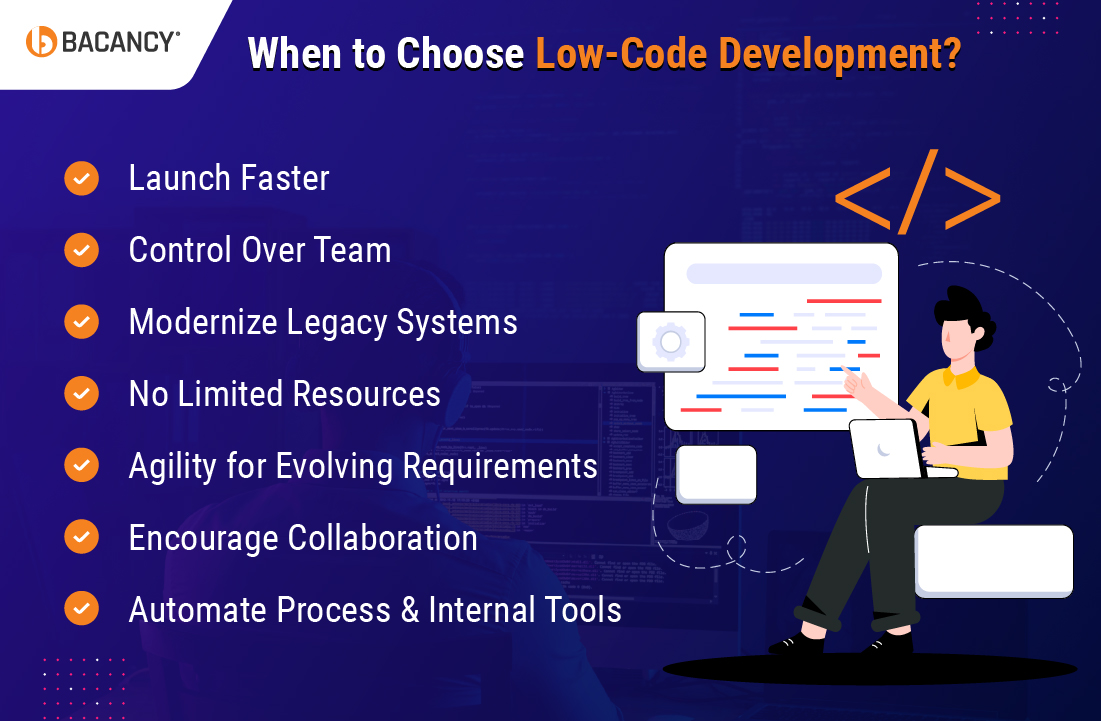
Low-code development is helpful, but that does not mean it is meant for every project. It fits perfectly in scenarios where speed, agility, and collaboration matter most. You should consider low-code when:
1. You Need to Launch Fast
A project with a tight deadline will require launching a minimum viable product (MVP) faster. They want to market it rapidly and test new ideas in the market. In such a scenario, low-code development helps your team deliver functional applications quickly.
It also provides you with pre-built components, templates, and visual tools to reduce time-to-market without reducing quality.
Example: A startup wants to test a food delivery idea. Rather than spending 6 months to build that full app, they utilize a low-code platform to create a basic app within 3 weeks and test it with customers.
Why it fits: Low-code enables your project through MVP in less time.
2. Your Business Teams Want More Control
When non-technical users, or citizen developers, need to create applications or automate workflows, low-code gives them independence. It avoids delays caused by IT dependencies and allows business teams to address immediate needs while IT focuses on complex tasks.
Example: A marketing team needs to automate campaign tracking across multiple channels. Instead of waiting months for IT, they use a low-code tool to build a dashboard that pulls data in real time from social media and email platforms.
Why it fits: Business users solve immediate needs without IT dependency.
3. You Want to Modernize Legacy Systems
If your existing software feels outdated but a complete redevelopment is not possible, low-code offers a practical solution. It allows your team to extend or rebuild legacy systems, integrate with modern technologies, and roll out updates faster while causing minimal disruption.
Example: A bank that runs on an old system, partners with a low code developer to build customer-facing apps that connect with its legacy backend. This gives customers mobile banking access without replacing the entire system.
Why it fits: Low-code connects old and new systems while saving time and cost.
4. You Face Limited Resources
Organizations with small development teams often find it difficult to manage multiple projects. Low-code reduces manual coding and reuses components, allowing your team to achieve more with fewer resources. This works well for companies with tight budgets or limited staff.
Example: A small logistics company with only two developers creates a shipment tracking system on a low-code platform. Instead of writing custom code for everything, they use pre-built modules and go live in a month.
Why it fits: Low-code increases output with a small team.
5. You Need Agility for Evolving Requirements
When business priorities change rapidly, low-code allows quick adjustments, iterative improvements, and real-time updates. This ensures your software adapts to new needs without major redevelopment.
Example: A retail chain creates a store inventory app on a low-code platform. When supply chain issues appear, they add features for alternate supplier management without stopping the
app.
Why it fits: Low-code supports fast changes without heavy redevelopment.
6. You Want to Encourage Collaboration
Low-code suits projects that demand close coordination between business and technical teams. The visual, shared workspace lets stakeholders contribute ideas, share feedback, and track progress, which improves communication and ensures solutions match business needs.
Example: An insurance company develops a claims management app on a low-code platform. Business analysts define workflows visually while developers handle complex logic. Both teams work together on the same platform, avoiding miscommunication.
Why it fits: Low-code creates stronger collaboration across teams.
For internal dashboards, employee-facing apps, or workflow automation tools, low-code reduces development time and makes maintenance simple. These tools usually do not require heavy custom code, making low-code the right choice to build, roll out, and update them.
Example: An HR department creates an employee leave management system on a low-code platform. It replaces manual spreadsheets with an automated portal in 2 weeks.
Why it fits: Internal tools do not require complex code, and low-code delivers faster results.
Top 6 Platforms for Low Code Development That You Must Opt For
Choosing the right low-code platform can make all the difference in how fast and efficiently you build applications. With a variety of options available, it is important to pick a platform that aligns with your project needs, team skills, and business goals. Here are the top six platforms for low-code development that you should consider.
| Platform | Key Features | Best For | User Rating |
|---|
| OutSystems | Full-stack support, scalability, integration options
| Enterprise apps, complex solutions
| 4.5/5 |
| Mendix | Multi-cloud support, AI-assisted developer, and collaboration | Large-scale business applications | 4.4/5 |
| Microsoft Power Apps
| Seamless with Office 365, Dynamics, and Azure | Businesses using the Microsoft ecosystem
| 4.5/5
|
| Appian | Strong BPM integration, robust process automation functions, built-in low-code plus BPM capabilities
| Workflow-heavy enterprise automation
| 4.5/5
|
| Salesforce Lightning
| Deep Salesforce integration, declarative UI, mobile-ready development
| CRM-centric custom applications
| 4.4/5
|
| Zoho Creator
| Easy drag-and-drop builder, prebuilt templates, affordable pricing, mobile-ready apps
| Small & medium businesses and quick lightweight apps
| 4.7/5
|
What is the Future of Low Code Development?
The low-code development future holds great promise, with innovations making these platforms essential for modern businesses. Key trends include:
- Low-code platforms use artificial intelligence to automate complex workflows, which helps teams to make innovative decisions with less manual work.
- Tools like n8n allow businesses to create intelligent workflows that perform tasks on their own, boosting efficiency and responsiveness.
- Robotic process automation (RPA) in low-code platforms helps automate repetitive tasks across applications, which improves speed and consistency.
- Predictive analytics in low-code platforms can forecast business needs and trigger actions automatically that support proactive decisions.
- Low-code platforms support easy integration with AI, IoT, blockchain, and cloud services, which helps businesses quickly adapt to new tech.
- Automated compliance checks and security measures in low-code platforms protect data and keep businesses aligned with regulations.
What are the Next Steps to Start Low-code Development for Your Product?
Low-code development can transform how your product comes to life, speed delivery, reduce costs, and enable quick innovation without compromising quality. Begin by assessing business needs, identifying key workflows for automation, and choosing a low-code platform that fits your objectives. Start with a pilot project, collect feedback, and expand applications gradually.
Partnering with a full stack development company can make this process smooth. Bacancy helps businesses implement low-code solutions tailored to their requirements, ensures seamless integration, delivers robust performance, and accelerates time-to-market. With Bacancy’s expertise, your product gains faster growth and stronger market presence.
Frequently Asked Questions (FAQs)
Low code development is a software development approach that enables users to build applications with minimal coding through visual tools and pre-built templates.
Low-code platforms can be used by professional developers, IT teams, and business users with minimal technical knowledge.
Low-code platforms require minimal coding and offer more flexibility, while no-code platforms are completely code-free but have limited customization.
Low-code development offers faster application delivery, cost savings, improved productivity, and enhanced collaboration.
Industries such as finance, healthcare, retail, manufacturing, and IT can leverage low-code platforms for process automation and application development.
Many low-code platforms offer robust security features, but to ensure data protection, it is essential to choose trusted providers.
The future of low-code lies in AI integration, enhanced automation, and increased adoption across industries, making it a key driver of digital transformation.